Genus
Syncrossus
- Species
- 4
- Photographed
- 4 of 4
- Difficulty rated
- 4 of 4
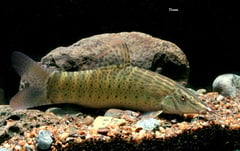
Syncrossus beaufortiChameleon Loach
Smith, 1931
The chameleon loach, Syncrossus beauforti, is a botiid loach from Thailand and southern Myanmar, including the Chao Phraya and the Ataran River. It has been widely mislabelled as S. berdmorei in older aquarium literature, but has 9-10 branched dorsal-fin rays and rows of small dark markings across the body and head even when young. Adults reach 160-180 mm, and wild populations appear to have declined by at least 20-29% since 1997.
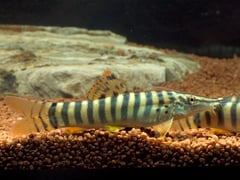
Syncrossus berdmoreiRedfin Tiger Loach
Blyth, 1860
The redfin tiger loach, Syncrossus berdmorei, is a botiid loach from the Irrawaddy, Sittaung and Salween systems in Myanmar and Manipur, India. It looks very similar to S. beauforti but has 11-14 branched dorsal-fin rays, and in young fish its larger dark markings appear first behind the opercle. Colour and pattern vary with locality and age, and some of these forms may turn out to be separate species.
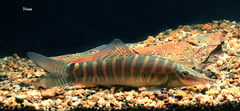
Syncrossus helodesBanded Tiger Loach
Sauvage, 1876
The banded tiger loach, Syncrossus helodes, is a botiid loach from the Mekong in Laos, Cambodia, Vietnam and Thailand, and the Chao Phraya. Reaching 250-300 mm, it lives in flowing waters from headwater streams to main channels and migrates into flooded areas in the wet season to feed and spawn. It is sometimes confused with S. hymenophysa but has small dark markings on the lower body, no dark spot in the dorsal fin and 10-12 bars without bluish borders.
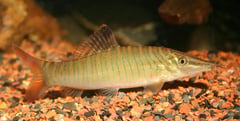
Syncrossus hymenophysaGreen Tiger Loach
Bleeker, 1852
The green tiger loach, Syncrossus hymenophysa, is a botiid loach from Sumatra and Borneo, and the Pahang and Perak systems of Peninsular Malaysia. It may already have disappeared from Peninsular Malaysia, where only one confirmed specimen has been documented since 1955. Often associated with submerged branches, roots and logs, it is sometimes confused with S. helodes but has a dark spot in the dorsal fin and 12-15 body bars with bluish borders.