Genus
Yasuhikotakia
- Species
- 6
- Photographed
- 6 of 6
- Difficulty rated
- 6 of 6
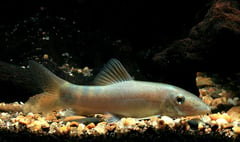
Yasuhikotakia caudipunctataSpeckle-tailed Loach
(Taki & Doi, 1995)
The speckle-tailed loach, Yasuhikotakia caudipunctata, is a botiid loach described from the Mekong drainage in Laos, near Pakse and Vientiane. Relatively rare in the aquarium trade and much sought after, it looks similar to Y. splendida but has numerous small blackish spots in the dorsal and caudal fins. SF members report it milder in temperament than some congeners, and it needs an aquarium with a base of at least 120 ∗ 30 cm.
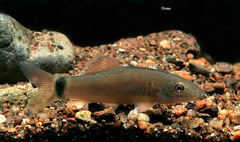
Yasuhikotakia eosSun Loach
(Taki, 1972)
The sun loach, Yasuhikotakia eos, is a botiid loach from the middle and lower Mekong in Laos, Cambodia and Thailand, and the Dong Nai in Vietnam. Its yellow to reddish brown body with a metallic sheen and a large dark marking on each side of the caudal peduncle make it difficult to confuse with any congener. It has a reputation for aggression and can be fiercely territorial where space or shelter is limited, so it suits only larger, well-structured aquaria with other sturdy fishes.
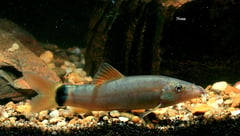
Yasuhikotakia leconteiSilver Loach
(Fowler, 1937)
The silver loach, Yasuhikotakia lecontei, is a botiid loach from the middle and lower Mekong and the Chao Phraya and Mae Klong drainages of Thailand. Sometimes confused with Y. modesta, it is a slimmer, more elongate fish, usually brownish with a gold/green sheen, and its roundish caudal peduncle markings do not meet on the ventral surface. It forages under cover of dusk and darkness, and SF members report it milder in temperament than Y. eos and Y. morleti.
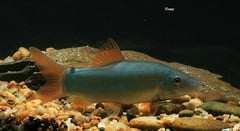
Yasuhikotakia modestaRedtail Loach
(Bleeker, 1864)
The redtail loach, Yasuhikotakia modesta, is a botiid loach from the middle and lower Mekong and the Chao Phraya and Mae Klong drainages of Thailand. One of the more commonly encountered botiids in the hobby, it is also sold as 'blue', 'orange-finned' or 'red-finned' botia. Some fish are dyed and sold as 'blueberry' or 'raspberry' loach, and their health is normally compromised by the process. Deeper-bodied than the similar Y. lecontei, it grows to 250 mm and needs an aquarium with a base of at least 150 ∗ 45 cm.
Yasuhikotakia morletiSkunk Loach
Tirant, 1855
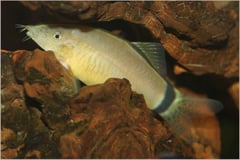
The skunk loach, Yasuhikotakia morleti, is a botiid loach from the middle and lower Mekong and the Chao Phraya and Mae Klong drainages of Thailand. Common in the hobby, where most fish are farmed commercially, it is also sold as 'skunk botia' or 'Hora's loach'. The dark stripe over its dorsal surface separates it from the similar Y. longidorsalis. It can be combative, nipping fins and harassing tankmates, especially when kept in smaller groups.
Yasuhikotakia splendida
(Roberts, 1995)
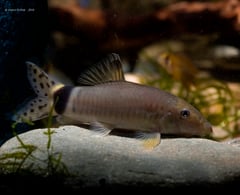
Sold as the 'jaguar loach' among other names, Yasuhikotakia splendida is a botiid loach from the Xe Pian river system in southern Laos. It is known from small, swiftly-running headwater streams draining the Bolaven Plateau, with clear water over rocks and cobbles. An unbroken dark ring around the caudal peduncle and large dark spots in the yellow caudal-fin separate it from the similar Y. caudipunctata, Y. longidorsalis and Y. morleti. SF members report it milder in temperament than some congeners.