Hobbyist group · Other groups
Atheriniformes
Atheriniformes spans 5 families.
- Species
- 26
- Families
- 5
- Genera
- 7
- Photographed
- 24 of 26
- Difficulty rated
- 26 of 26
Families
Where they come fromnative records only
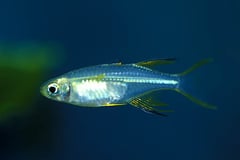
Marosatherina ladigesiCelebes Rainbowfish
Telmatherinidae · authority not recorded
The Celebes rainbowfish, Marosatherina ladigesi, is a rainbowfish from the island of Sulawesi (formerly Celebes) in Indonesia. For many years it was included in Telmatherina, and it is the only species in Marosatherina. Overfishing for the aquarium trade has left it listed as vulnerable by the IUCN, but it is now mass-produced on farms in the Far East and Eastern Europe. It needs pristine, medium to hard alkaline water and is very sensitive to rapidly changing conditions.
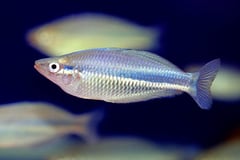
Melanotaenia affinisNew Guinea Rainbowfish
Melanotaeniidae · authority not recorded
The New Guinea rainbowfish, Melanotaenia affinis, is a rainbowfish from Papua New Guinea. It was one of the first rainbowfish species to be imported for the hobby in any numbers. Three geographical variants are found in the hobby: the widespread 'standard' form, the 'Pagwi' form from a tributary of the Sepik River, and the 'Bluewater Creek' form known from a single location near Madang. They look superficially similar and differ only in small details of colour and patterning.
Melanotaenia australisWestern rainbowfish
Melanotaeniidae · authority not recorded
The western rainbowfish, Melanotaenia australis, is a rainbowfish from Australia and probably the commonest rainbowfish species there. Once classified in the M. splendida complex, it has since proved genetically distinct from that group, with two clear lineages within it. Colour and patterning vary widely by locality, and the different morphs should not be mixed in the aquarium because they hybridise freely. Juveniles are much drabber than adults, and full colour can take over 12 months to develop.
Melanotaenia fluviatilisAustralian Rainbowfish
Melanotaeniidae · authority not recorded
The Australian rainbowfish, Melanotaenia fluviatilis, is a rainbowfish from Queensland and New South Wales, Australia. Also known as the Murray River or crimson-spotted rainbowfish, it is easily confused with the very similar M. duboulayi, with which it was once grouped as a single species. Its range extends further south than any other rainbowfish, and it can withstand relatively cool temperatures, though it becomes less active and loses colour if kept that cold.
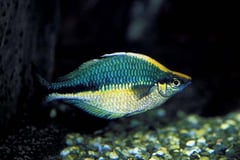
Melanotaenia lacustrisLake Kutubu Rainbowfish
Melanotaeniidae · authority not recorded
The Lake Kutubu rainbowfish, Melanotaenia lacustris, is a rainbowfish endemic to Lake Kutubu and the River Soro in Papua New Guinea. The lake is threatened by overfishing, much of it for the aquarium trade, and by oil development, and the species has 'vulnerable' status on the IUCN red list. Juveniles are much drabber than the blue adults and are usually sold as 'blue' rainbowfish or similar. Full colour can take over 12 months to develop.
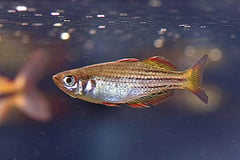
Melanotaenia maccullochiDwarf Rainbowfish
Melanotaeniidae · authority not recorded
The dwarf rainbowfish, Melanotaenia maccullochi, is a small rainbowfish from Papua New Guinea and Australia. Several geographical variants are available, differing in colour, patterning and sometimes size, and they should not be mixed in aquaria because they may hybridise. Some are so distinct that they may turn out to be different species. It is found in a wide range of habitats, from clear streams to turbid, tannin-stained ponds.
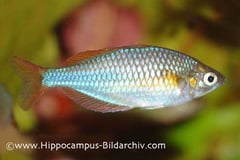
Melanotaenia praecoxNeon Dwarf Rainbowfish
Melanotaeniidae · authority not recorded
The neon dwarf rainbowfish, Melanotaenia praecox, is a small rainbowfish endemic to the Mamberamo river system in New Guinea, Indonesia. It inhabits swiftly flowing tributaries of the main river and the surrounding swamps and marshes. Peaceful and small enough for many community aquaria, it shows its best colours in a heavily planted tank with floating plants to diffuse the light.
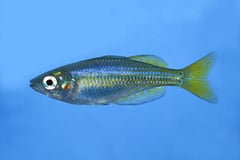
Melanotaenia splendida inornataCheckered Rainbowfish
Melanotaeniidae · authority not recorded
The checkered rainbowfish, Melanotaenia splendida inornata, is one of four described subspecies of M. splendida and comes from Australia. The subspecies differ mainly in colour, pattern and fin counts, though these also vary by locality, and the different forms should not be mixed in the aquarium because they may hybridise. Juveniles are much drabber than adults, and full colour can take over 12 months to develop.
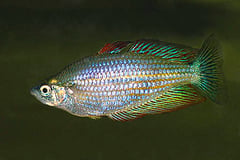
Melanotaenia splendida splendidaEastern Rainbowfish
Melanotaeniidae · authority not recorded
The eastern rainbowfish, Melanotaenia splendida splendida, is one of four described subspecies of M. splendida and comes from Australia. It varies widely in colour and patterning by locality, and fish are often sold with a place name added to the species name. The different forms and subspecies should not be mixed in the aquarium because they may hybridise. Full colour can take over 12 months to develop.
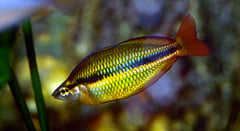
Melanotaenia trifasciataBanded Rainbowfish
Melanotaeniidae · authority not recorded
The banded rainbowfish, Melanotaenia trifasciata, is a rainbowfish from Australia, most commonly seen in flowing streams and tributaries. Colour and patterning vary widely by locality, and the morphs are often sold with the collection locality added to the scientific name. They should never be mixed in the aquarium because they hybridise freely. Several species are thought to be involved, and a reclassification will probably follow.
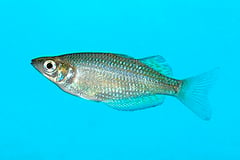
Melanotaenia splendida rubrostriataRed-striped Rainbowfish
Melanotaeniidae · authority not recorded
The red-striped rainbowfish, Melanotaenia splendida rubrostriata, is a rainbowfish from Indonesia and Papua New Guinea. One of the most colourful of the four described subspecies of M. splendida, it lives among vegetation and debris in the tributaries and swamps of coastal plain rivers. The forms and subspecies should not be mixed in the aquarium because they may hybridise, and the drab juveniles can take over 12 months to colour up.
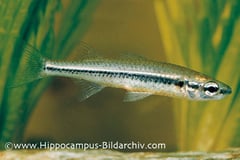
Craterocephalus stercusmuscarum stercusmuscarumFly-specked Hardyhead
Atherinidae · authority not recorded
The fly-specked hardyhead, Craterocephalus stercusmuscarum stercusmuscarum, is an atherinid endemic to Australia. It ranges from the Northern Territory to southern Queensland and forms large shoals over barren sand, mud or clay in streams, rivers, lakes and ponds. Skittish and rarely seen in the trade outside Australia, it does far better in a shoal of at least 8-10. Genetic differences between neighbouring populations are in some cases large enough to suggest several distinct species.
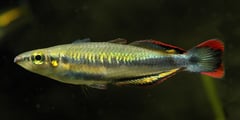
Bedotia madagascariensisMadagascan Rainbow Fish
Bedotiidae · Regan, 1903
The Madagascan rainbow fish, Bedotia madagascarensis, comes from small streams and the lower reaches of rivers in eastern Madagascar. First imported in the 1950s, it continues to be misidentified and traded as Bedotia geayi, a congener from the Mananjary River system further south. Males are told apart by the caudal fin, where the midlateral stripe extends into black central rays, and B. geayi males also have a red spot on the lower jaw.
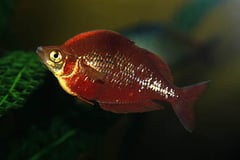
Glossolepis incisusRed Rainbowfish
Melanotaeniidae · authority not recorded
The red rainbowfish, Glossolepis incisus, is a rainbowfish from the Lake Sentani region of northern New Guinea, Indonesia. Also known as the salmon-red or New Guinea rainbowfish, it is usually found in shoals around heavily vegetated areas. Mass-bred fish have far less colour than wild ones. It is quite skittish and does far better in a shoal of at least 6-8.
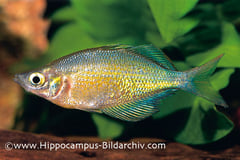
Glossolepis wanamensisLake Wanam Rainbowfish
Melanotaeniidae · authority not recorded
The Lake Wanam rainbowfish, Glossolepis wanamensis, is a rainbowfish endemic to Lake Wanam in Papua New Guinea. It is now considered critically endangered, a decline thought to result from introduced tilapia, Gambusia and carp and a big rise in the number of people living around the lake. A captive breeding programme has been set up, but it has been argued that most fish in the hobby are contaminated by cross-breeding with G. multisquamata.
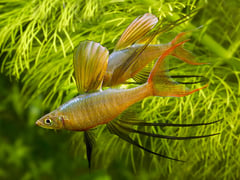
Iriatherina werneriThreadfin Rainbowfish
Melanotaeniidae · Meinken, 1974
The threadfin rainbowfish, Iriatherina werneri, is a small rainbowfish from southern New Guinea, Cape York in Queensland and the Northern Territory. Although widely traded and produced on a commercial scale, it is quite delicate with rather specific care requirements and is not a recommended beginner's fish. Easily outcompeted for food, and with long-finned males that some common species nip, it is best kept alone or with fishes of comparable size and disposition.
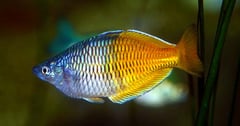
Melanotaenia boesemaniBoeseman's rainbowfish
Melanotaeniidae · authority not recorded
Boeseman's rainbowfish, Melanotaenia boesemani, is a rainbowfish from Indonesia, known only from the Ajamaru lakes and nearby Lakes Hain and Aitinjo. One of the most popular rainbowfish in the hobby, it is almost always sold as farmed stock from the Far East and Eastern Europe. The species is rare in nature and on the IUCN red list, and collection of breeding stock for the trade has had a massively detrimental effect on it. The drab juveniles usually offered for sale can take over 12 months to colour up.
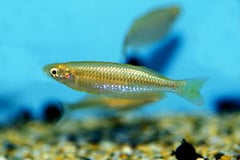
Melanotaenia gracilisSlender Rainbowfish
Melanotaeniidae · authority not recorded
The slender rainbowfish, Melanotaenia gracilis, is a small rainbowfish from the Drysdale and Carson Rivers in the Kimberley, north-western Australia. It is uncommonly seen in the hobby because it comes from such a remote area, and the IUCN lists it as at risk. Unlike many members of the genus, it lives in sparse, rocky, slow-moving stretches of river and in isolated pools during the dry season.
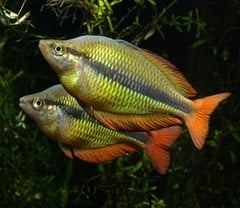
Melanotaenia herbertaxelrodiLake Tebera Rainbowfish
Melanotaeniidae · authority not recorded
The Lake Tebera rainbowfish, Melanotaenia herbertaxelrodi, is a rainbowfish endemic to the Lake Tebera basin in the Central Highlands of New Guinea. It inhabits clear, heavily vegetated water in the lake and its surrounding streams, and is probably at risk from overfishing. Mature fish are among the more colourful rainbowfish, and they show their best colours in a heavily planted tank with high water quality.
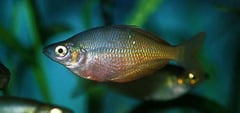
Melanotaenia irianjayaIrian Jaya Rainbowfish
Melanotaeniidae · authority not recorded
The Irian Jaya rainbowfish, Melanotaenia irianjaya, is a rainbowfish from Indonesia, recorded only around Bintuni Bay in Irian Jaya. It can be identified by the longer middle rays in the dorsal and anal fins, a feature usually associated with the closely related genus Glossolepis. It is not often seen in the hobby. In nature it lives in slow and fast-flowing rainforest streams with little aquatic vegetation, using submerged logs and branches for cover.
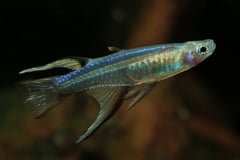
Pseudomugil cyanodorsalisNeon Blue-eye
Pseudomugilidae · Allen & Sarti, 1983
The neon blue-eye, Pseudomugil cyanodorsalis, is a euryhaline blue-eye from coastal northern Australia and possibly southern New Guinea. Males are told apart from the rest of the genus by the bright metallic blue upper portion of the body, the source of the alternative name 'blueback blue-eye'. It has been recorded from full marine conditions to pure fresh water, and is generally considered to do better in brackish water. Timid and easily outcompeted, it is unsuitable for the general community.
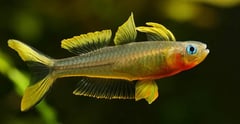
Pseudomugil furcatusForktail Blue-eye
Pseudomugilidae · Nichols, 1955
The forktail blue-eye, Pseudomugil furcatus, is a small pseudomugilid endemic to the Northern and Milne Bay provinces of eastern Papua New Guinea. Aquarium stock is bred commercially and apparently derives from a single collection in 1981, so inbreeding can bring reduced fertility and a high rate of deformity in fry. It inhabits heavily-vegetated, clear forest streams and suits a densely-planted, well-chosen community aquarium.
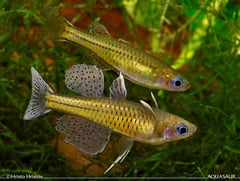
Pseudomugil gertrudaeSpotted Blue-eye
Pseudomugilidae · Weber, 1911
The spotted blue-eye, Pseudomugil gertrudae, is a pseudomugilid from northern Australia, Papua New Guinea and the Aru Islands, eastern Indonesia. Wild populations are isolated from one another and differ in colour pattern, body size and fin morphology, but the fish on sale are of a single, commercially produced ornamental strain. Dark spots in the dorsal, anal and caudal fins separate it from other members of the genus except P. paskai and Pseudomugil sp. 'red neon'.
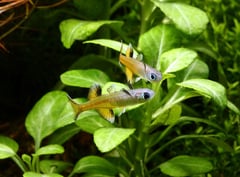
Pseudomugil signiferPacific Blue-eye
Pseudomugilidae · Kner, 1866
The Pacific blue-eye, Pseudomugil signifer, is the most widely-distributed blue-eye in Australia, found along most of the eastern coastline. Its habitats range from full marine conditions to pure fresh water, and northern populations often grow considerably larger than southern ones. Recent unpublished analyses apparently suggest it may comprise two or more distinct taxa, and wild fish from the northern and southern ends of its range would not hybridise in captive experiments.
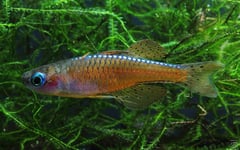
Pseudomugil sp. 'red neon'
Pseudomugilidae · authority not recorded
Pseudomugil sp. 'red neon' is an undescribed blue-eye, possibly collected near Timika in Papua province, Indonesia. It first appeared in the hobby in 2011 under names including P. sp. cf. paskai and P. 'iriani'. Initially suspected to be a hybrid or selectively-bred form of P. paskai, it has been shown by DNA sequencing to be an undescribed species close to P. gertrudae and P. paskai. Peaceful but easily outcompeted, it suits a densely-planted aquarium.
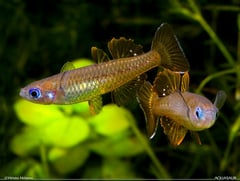
Pseudomugil tenellusDelicate Blue-eye
Pseudomugilidae · Taylor, 1964
The delicate blue-eye, Pseudomugil tenellus, is a euryhaline blue-eye with a patchy but wide range in coastal northern Australia. Sometimes called the 'Arnhem Land blue-eye', it is most easily identified by the midlateral scale row, a series of pale spots with darker spaces between that become more conspicuous with age. It is particularly common in densely-vegetated swamps, billabongs and slow-moving streams, and also occurs on the Aru Islands and in southern Papua New Guinea.