Country · Oceania
Papua New Guinea
Only species with a profile on Seriously Fish are counted, whether native or introduced.
- Species
- 17
- Families
- 8
- Genera
- 9
- Found only here
- 3
- Photographed
- 16 of 17
Regions here
Shares its fishes withspecies recorded in both
Found only here3
3 of the species on this page are recorded in Papua New Guinea and in no other country. This is not the same as being endemic.

Butis amboinensisOlive Flathead Gudgeon
Butidae · (Bleeker, 1853)
The olive flathead gudgeon, Butis amboinensis, is a nocturnal ambush predator from the eastern Indian Ocean to the West Central Pacific. It inhabits brackish estuaries, lagoons and mangroves, entering tidal freshwater rivers to an extent, and often aligns itself with solid surfaces or swims upside-down. It is occasionally exported as bycatch and differs from congeners in lacking enlarged outer teeth and scales on the cheek. It is territorial and should probably be kept singly.

Butis butisCrazy Fish
Butidae · (Hamilton, 1822)
The crazy fish, Butis butis, is a flathead gudgeon of coastal and brackish waters across the Indo-Pacific, from eastern Africa to Fiji. The most commonly traded member of the genus, it has many other names, including crocodile fish, duckbill sleeper and upside-down sleeper. A nocturnal ambush predator, it often swims upside-down, and it is territorial and not sociable with conspecifics, so is best kept singly.
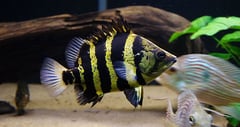
Datnioides campbelliNew Guinea Tiger Perch
Datnioididae · Whitley, 1939
The New Guinea tiger perch, Datnioides campbelli, is a large tiger perch from southern New Guinea, recorded mostly from the lower Fly River basin. A golden yellow base colour with 4 to 6 wide, diffuse dark bars separates it from its congeners. The species is euryhaline, found in brackish tidal creeks as well as in tributaries and swamps at least 900 km from the sea, and it grows to 350 mm SL.
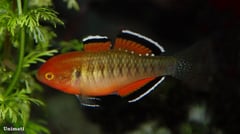
Hypseleotris compressaEmpire Gudgeon
Eleotridae · (Krefft, 1864)
The empire gudgeon, Hypseleotris compressa, is an eleotrid from northern and eastern Australia and southern New Guinea. Breeding is rarely achieved in aquaria because of its complex amphidromous strategy: adults spawn in freshwater streams, but the larvae are washed downstream to the sea and develop there. Plenty of cover and broken lines of sight let weaker individuals escape the attention of dominant fish.
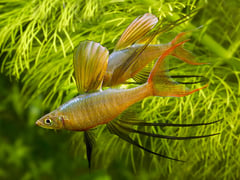
Iriatherina werneriThreadfin Rainbowfish
Melanotaeniidae · Meinken, 1974
The threadfin rainbowfish, Iriatherina werneri, is a small rainbowfish from southern New Guinea, Cape York in Queensland and the Northern Territory. Although widely traded and produced on a commercial scale, it is quite delicate with rather specific care requirements and is not a recommended beginner's fish. Easily outcompeted for food, and with long-finned males that some common species nip, it is best kept alone or with fishes of comparable size and disposition.
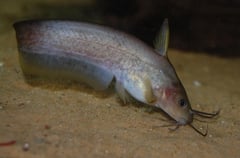
Neosilurus brevidorsalisShortfin Tandan
Plotosidae · (Günther, 1867)
The shortfin tandan, Neosilurus brevidorsalis, is a plotosid catfish restricted to the tips of northern Australia and southern Papua New Guinea. In Australia it is recorded only from the Jardine and Jackson river systems on the Cape York Peninsula, and in Papua New Guinea from the Fly River and some other drainages.
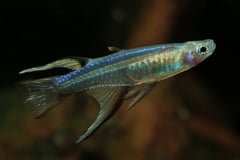
Pseudomugil cyanodorsalisNeon Blue-eye
Pseudomugilidae · Allen & Sarti, 1983
The neon blue-eye, Pseudomugil cyanodorsalis, is a euryhaline blue-eye from coastal northern Australia and possibly southern New Guinea. Males are told apart from the rest of the genus by the bright metallic blue upper portion of the body, the source of the alternative name 'blueback blue-eye'. It has been recorded from full marine conditions to pure fresh water, and is generally considered to do better in brackish water. Timid and easily outcompeted, it is unsuitable for the general community.
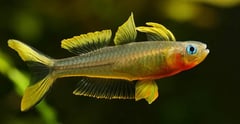
Pseudomugil furcatusForktail Blue-eye
Pseudomugilidae · Nichols, 1955
The forktail blue-eye, Pseudomugil furcatus, is a small pseudomugilid endemic to the Northern and Milne Bay provinces of eastern Papua New Guinea. Aquarium stock is bred commercially and apparently derives from a single collection in 1981, so inbreeding can bring reduced fertility and a high rate of deformity in fry. It inhabits heavily-vegetated, clear forest streams and suits a densely-planted, well-chosen community aquarium.
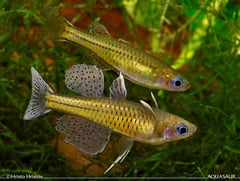
Pseudomugil gertrudaeSpotted Blue-eye
Pseudomugilidae · Weber, 1911
The spotted blue-eye, Pseudomugil gertrudae, is a pseudomugilid from northern Australia, Papua New Guinea and the Aru Islands, eastern Indonesia. Wild populations are isolated from one another and differ in colour pattern, body size and fin morphology, but the fish on sale are of a single, commercially produced ornamental strain. Dark spots in the dorsal, anal and caudal fins separate it from other members of the genus except P. paskai and Pseudomugil sp. 'red neon'.
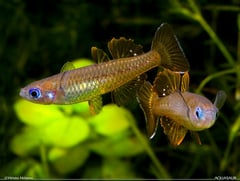
Pseudomugil tenellusDelicate Blue-eye
Pseudomugilidae · Taylor, 1964
The delicate blue-eye, Pseudomugil tenellus, is a euryhaline blue-eye with a patchy but wide range in coastal northern Australia. Sometimes called the 'Arnhem Land blue-eye', it is most easily identified by the midlateral scale row, a series of pale spots with darker spaces between that become more conspicuous with age. It is particularly common in densely-vegetated swamps, billabongs and slow-moving streams, and also occurs on the Aru Islands and in southern Papua New Guinea.
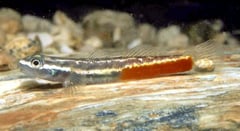
Sicyopus discordipinnis
Gobiidae · Watson, 1995
Sicyopus discordipinnis is a small stream goby from northern New Guinea and the islands of Normanby, New Hanover and Bougainville, Papua New Guinea. Members of the genus inhabit short coastal streams on tropical islands, typically above waterfalls or cataracts, and have a complex amphidromous breeding strategy.
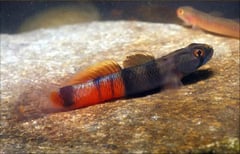
Sicyopus zosterophorus
Gobiidae · (Bleeker, 1856)
Sicyopus zosterophorus is a stream goby with a patchy but wide range from the Marquesas Islands westwards to Indonesia, Japan and southern China. It is occasionally available in the hobby as the 'flaming arrow goby', 'belted rockclimbing goby' or 'ornate goby', often under the invalid name Sicyopus zosterophorum. It inhabits short coastal streams on tropical islands, typically above waterfalls or cataracts.
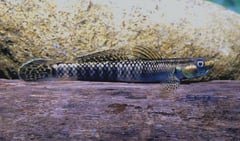
Stiphodon atratus
Gobiidae · Watson, 1996
Stiphodon atratus is a stream-dwelling goby from Indonesia, northern New Guinea and islands east to Vanuatu and New Caledonia. Males are blackish, especially on the unpaired fins, and large males appear entirely black between the second dorsal and anal fins. It has been maintained by a few private collectors. Like other Stiphodon it is a specialised algal grazer with an amphidromous life cycle.
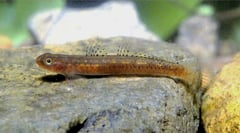
Stiphodon birdsong
Gobiidae · Watson, 1996
Stiphodon birdsong is a tiny stream-dwelling goby from Halmahera Island east along the northern coast of Papua New Guinea to Fergusson Island. The largest officially recorded specimen measured just 22.9 mm. It is most similar to S. surrufus and S. mele and differs from them only in meristics, such as tooth and scale counts. Like other Stiphodon it is a specialised algal grazer with an amphidromous life cycle.
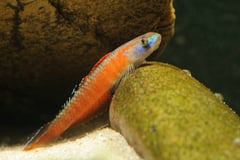
Stiphodon rutilaureus
Gobiidae · Watson, 1996
Stiphodon rutilaureus is a small rock-climbing goby from fast island streams, from northern Papua New Guinea east to Vanuatu and Fiji. Males are bright orange-red with 9 to 11 vertical bars and a blue upper lip, cheek and opercle. An algal grazer, it needs clean, well-oxygenated, flowing water.
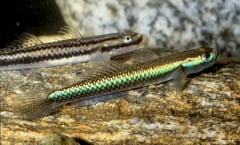
Stiphodon semoniCobalt Blue Goby
Gobiidae · Weber, 1895
The cobalt blue goby, Stiphodon semoni, is a stream-dwelling goby ranging from western Sumatra east to northern New Guinea and the Solomon Islands. It has been traded for a number of years but often under the wrong name, including S. elegans and S. atropurpureus. Males have a bright blue metallic stripe from snout to caudal peduncle and rounded, almost hyaline dorsal fins, while those of S. atropurpureus are dusky to black.
Xiphophorus helleriiGreen Swordtail
Poeciliidae · Heckel, 1848
The green swordtail, Xiphophorus hellerii, is a livebearer native to southeastern Mexico, Guatemala, Belize and Honduras. Among the world's most recognisable aquarium fishes, it is ubiquitous in the trade, where selective breeding and hybridisation with X. maculatus and X. variatus have produced a bewildering array of ornamental forms. The name is often misspelled X. helleri.