Glossolepis wanamensis
Lake Wanam Rainbowfish
Last revised 2012Edit this page
On this page11 sections
Quick factsEdit
Difficulty5 of 8 measures
- Space
- large tank
- Water
- needs a steady pH
- Temp
- flexible
- Diet
- unknown
- Temperament
- peaceful
- Social
- needs to be in a group
- Compatibility
- unknown
Other demands
Each of these can raise the rating on its own, whatever the measures above say.
- Hardiness
- unknown
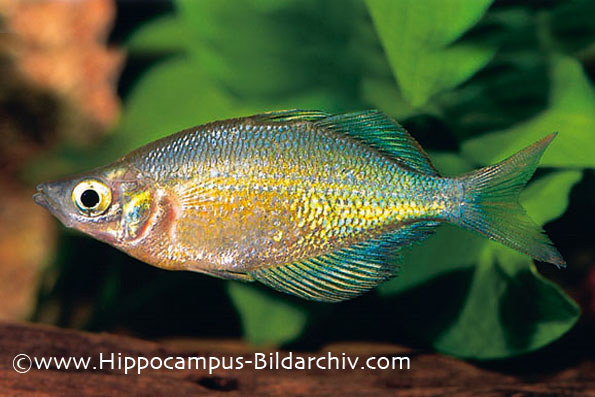
The Lake Wanam rainbowfish, Glossolepis wanamensis, is a rainbowfish endemic to Lake Wanam in Papua New Guinea. It is now considered critically endangered, a decline thought to result from introduced tilapia, Gambusia and carp and a big rise in the number of people living around the lake. A captive breeding programme has been set up, but it has been argued that most fish in the hobby are contaminated by cross-breeding with G. multisquamata.
Distribution
EditEndemic to Lake Wanam, Papua New Guinea.
Habitat
Write a noteEditThe lake is quite shallow (maximum 20 metres depth) and small. It's situated in a valley, surrounded by hills. It has many large patches of water lilies and other vegetation around its edges The rainbows tend to be found around these, in shallow, clear water.
Aquarium size
Write a noteEdit90 ∗ 30 ∗ 30 cm36 ∗ 12 ∗ 12 in - ~81 litres~21 US gal.
Maintenance
Write a noteEditLike most rainbows, this species looks most at home in a planted aquarium. Provide areas of dense vegetation, along with some open areas for swimming. Water movement should be quite gentle. High water quality is essential to the well-being of this species, so weekly partial water changes are recommended.
Water conditions
EditTemperature: 25 – 30 °C77 – 86 °F
pH: 7.0-8.0. It will not do well in soft, acidic conditions.
Hardness: 10-20°H
These recommendations come from this profile’s own figures. They contain affiliate links, so we may earn a commission.
Diet
Write a noteEditUnfussy and will accept most dried, frozen and live foods. Regular feedings of the latter will ensure the best colouration.
Behaviour and compatibility
Write a noteEditVery peaceful but can disturb smaller or slow-moving fish with its rapid movements and relatively large size. Good tankmates include other similarly-sized rainbowfish, characins, danios, barbs, and catfish such as hard water-tolerant Corydoras.
It has quite a skittish nature and does far better when kept in a shoal of at least 6-8 fish, preferably more. The males will also be encouraged to display their best colours in the company of conspecifics. Obviously a suitably-sized aquarium would be required for a very large group.
Sexual dimorphism
Write a noteEditMature males are larger and exhibit brighter colouration than females. They also develop a much deeper body than females and possess elongated first dorsal and anal fins.
Reproduction
Write a noteEditSpawns in a similar egg scattering fashion to other Glossolepis species.
The breeding tank should be at least 30" long and contain slightly hard, alkaline water with a pH of around 7.5 and a temperature of 24 – 26.5 °C75 – 80 °F. A small air-powered filter will provide sufficient oxygenation and flow. The tank should be filled with fine-leaved plants such as java moss, or nylon spawning mops. No substrate is necessary.
The adult fish are best conditioned in a group in a separate aquarium with plenty of live and frozen foods. Select the fattest pair for spawning and introduce them to the spawning tank. A small raise in temperature can usually induce courtship. The pair will spawn for a period of several weeks, laying a few eggs each day. These are attached to surfaces by a small thread. Although the adults tend not to eat the spawn, it's easier to raise the fry in a separate aquarium. We recommend checking the plants or mops daily and removing any eggs you find to a raising tank containing water from the spawning tank.
The eggs hatch in 7-12 days, depending on temperature and the tiny fry initially require infusoria-type food. After a week or so they can be moved onto microworm or brine shrimp nauplii. They're quite sensitive to unfavourable water conditions and frequent small water changes are a must.
Notes
EditLake Wanam has been the subject of a management project co-ordinated by famous aquarist Heiko Bleher, who became concerned by an apparent drop in numbers of both this species and the barred rainbowfish (Chilatherina fasciata), which is also found in the lake. The drop in numbers is thought to be a result of the introduction of non-native Tilapia, Gambusia and carp species into the lake, along with a significant increase in the number of humans living in the area. G. wanamensis is now considered to be critically endangered and a captive breeding program has been set up. It is occasionally available in the hobby, usually via breeders in Germany. It has been argued, however, that the vast majority of the fish available in the hobby have been contaminated by cross-breeding with G. multisquamata. We can only hope that this beautiful species does not become lost forever.
Species images · 2
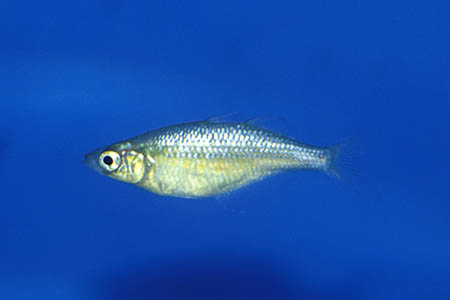
These photographs are used with each photographer's permission.
Send a photographProfile completeness19 of 24
79% complete
Also missing: a recorded distribution, taxonomic authority, etymology.
Community
Questions about Glossolepis wanamensis?
Ask on Discord