Country · Africa
Madagascar
Only species with a profile on Seriously Fish are counted, whether native or introduced.
- Species
- 6
- Families
- 5
- Genera
- 5
- Found only here
- 3
- Photographed
- 5 of 6
Shares its fishes withspecies recorded in both
Found only here3
3 of the species on this page are recorded in Madagascar and in no other country. This is not the same as being endemic.
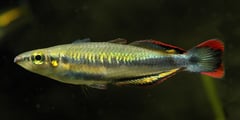
Bedotia madagascariensisMadagascan Rainbow Fish
Bedotiidae · Regan, 1903
The Madagascan rainbow fish, Bedotia madagascarensis, comes from small streams and the lower reaches of rivers in eastern Madagascar. First imported in the 1950s, it continues to be misidentified and traded as Bedotia geayi, a congener from the Mananjary River system further south. Males are told apart by the caudal fin, where the midlateral stripe extends into black central rays, and B. geayi males also have a red spot on the lower jaw.

Butis butisCrazy Fish
Butidae · Hamilton, 1822
The crazy fish, Butis butis, is a flathead gudgeon of coastal and brackish waters across the Indo-Pacific, from eastern Africa to Fiji. The most commonly traded member of the genus, it has many other names, including crocodile fish, duckbill sleeper and upside-down sleeper. A nocturnal ambush predator, it often swims upside-down, and it is territorial and not sociable with conspecifics, so is best kept singly.
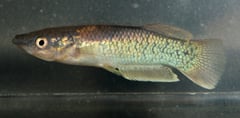
Pachypanchax arnoulti
Aplocheilidae · Loiselle, 2006
Pachypanchax arnoulti is a killifish endemic to western Madagascar, where it occurs in the Mahavavy du Sud and Betsiboka river systems. It was in the hobby for many years as the congener P. omalonotus and appears under that name in most older aquarium literature, so a degree of hybridisation has undoubtedly occurred. The absence of metallic gold spots on the flanks separates it from that species. Its populations have declined dramatically since the 1950s.
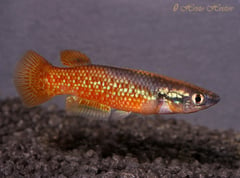
Pachypanchax sakaramyiMadagascar Panchax
Aplocheilidae · Holly, 1928
The Madagascar panchax, Pachypanchax sakaramyi, is a killifish from high-gradient forest streams around the Ambohitra Massif in northern Madagascar. The only remaining riverine populations are in a short stretch of the Sakaramy River and the upper Antongombato River, most of the original populations having been lost to invasive species, deforestation and the diversion of the Sakaramy's source. Despite its conservation status it is relatively well-established in the aquarium hobby.
Xiphophorus helleriiGreen Swordtail
Poeciliidae · Heckel, 1848
The green swordtail, Xiphophorus hellerii, is a livebearer native to southeastern Mexico, Guatemala, Belize and Honduras. Among the world's most recognisable aquarium fishes, it is ubiquitous in the trade, where selective breeding and hybridisation with X. maculatus and X. variatus have produced a bewildering array of ornamental forms. The name is often misspelled X. helleri.
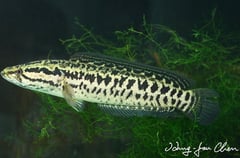
Channa maculataBlotched Snakehead
Channidae · Lacepède, 1801
The blotched snakehead, Channa maculata, is a snakehead from coastal drainages of southeastern China, including Hong Kong, and northern Vietnam. It is frequently confused with C. argus but has fewer fin rays and lateral line scales and carries 2-3 rounded blotches on the caudal peduncle. An important food fish, it has become established in Japan, Taiwan, the Philippines, Madagascar and Hawaii, and hybrids with C. argus appear to be quite common in aquaculture.