Region · Indonesia
Riau Islands
Only species with a profile on Seriously Fish are counted.
- Species
- 14
- Countries
- 1
- Photographed
- 14 of 14
- Difficulty rated
- 14 of 14
Countries here
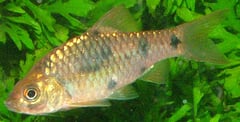
Barbodes banksi
Cyprinidae · (Herre, 1940)
Barbodes banksi is a cyprinid from Peninsular Malaysia, Singapore and western Borneo, plus the Anambas and Natuna islands of Indonesia. It is tentatively considered distinct from the closely related B. binotatus, differing in a dark, wedge-shaped marking below the dorsal fin in place of a midlateral spot, though the two may be colour forms of a single species. Occasionally exported as bycatch, it lives in habitats from fast hill streams to canals and floodplain ponds.

Barbodes binotatusSpotted Barb
Cyprinidae · (Valenciennes, 1842)
The spotted barb, Barbodes binotatus, is a cyprinid ranging from Myanmar and Thailand through the Greater Sunda Islands to the Philippines. So ubiquitous across its range that it's often called simply 'common barb', it occurs from sea level to at least 2000 m in habitats from fast-flowing hill streams to irrigation canals and floodplain ponds. The basic pattern of a dark spot at the dorsal-fin origin and another on the caudal peduncle varies with origin.

Betta edithae
Osphronemidae · Vierke, 1984
Betta edithae is a paternal mouthbrooding labyrinth fish from Indonesia, recorded across Kalimantan, southern Sumatra, Bangka, Belitung and Bintan. The only member of the B. edithae group, it is separated from all other Betta spp. by its opaque or translucent branchiostegal membrane and posterior opercle. Fish from Bintan differ from Bornean specimens in several characters, and it remains unclear whether all populations are conspecific.

Betta hipposideros
Osphronemidae · Ng & Kottelat, 1994
Betta hipposideros is a paternal mouthbrooding labyrinth fish from peat swamps in western Peninsular Malaysia and eastern Sumatra, Indonesia. A member of the B. waseri group, it is most easily told from its relatives by a black horse-shoe shaped marking on the throat. An obligate inhabitant of peat swamps and blackwater streams, where the pH can be as low as 3.0 or 4.0, it may have to survive for several weeks in moist leaf litter at certain times of year.

Betta spilotogena
Osphronemidae · Ng & Kottelat, 1994
Betta spilotogena is a mouthbrooding labyrinth fish from Bintan and Singkep islands in the Riau Islands province of Indonesia. It inhabits shaded freshwater swamps and streams with clear or lightly tannin-stained water less than a metre deep, alongside B. edithae, B. miniopinna and B. fusca. A member of the B. waseri group, it has a single dark, pear-shaped blotch on the throat that is not joined to the black lower lip.
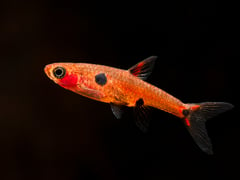
Boraras maculatusDwarf Rasbora
Cyprinidae · (Duncker, 1904)
The dwarf rasbora, Boraras maculatus, is a miniature cyprinid from Peninsular Malaysia, southern Thailand, eastern Sumatra, Singapore and Bintan. It inhabits blackwater streams and rivers associated with forest peat swamps, where the water is very soft and acidic. Colour pattern varies between populations, some forms showing more intense red than others. It is most similar to B. naevus, in which the red body colouration does not extend into the head.
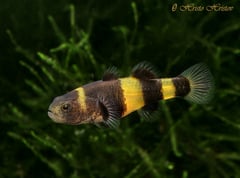
Brachygobius doriaeBumblebee Goby
Gobiidae · (Günther, 1868)
The bumblebee goby, Brachygobius doriae, is a small goby from western Borneo and the Natuna Islands, described from Sarawak. Among the more frequently traded members of the genus, it is often misidentified as B. nunus or B. xanthozonus and is most easily confused with B. sabanus. It lives in fresh and brackish water in lowland coastal habitats such as mangrove swamps, estuaries and tidal streams. It is best kept in a species-specific set-up.
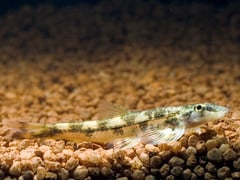
Homalopteroides nebulosus
Balitoridae · (Alfred, 1969)
Homalopteroides nebulosus is a small hillstream loach described from the Sok River in northern Peninsular Malaysia and since recorded from Borneo. Poorly known in the aquarium hobby, it may never have been exported for the ornamental trade. Its eyes sit in a comparatively raised position on the head, as in H. tweediei, but it has more lateral line scales. Little is known of its habitat, which is presumed to be swiftly-flowing streams and headwaters.
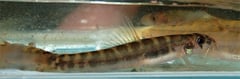
Nemacheilus spiniferus
Nemacheilidae · Kottelat, 1984
Nemacheilus spiniferus is a nemacheilid loach from Borneo, recorded from Sarawak, Brunei and Kalimantan, plus the Natuna and Anambas islands. It is most common in shallow, flowing forest streams with clear to slightly tannin-stained water. A member of the N. selangoricus group, it is rare in the aquarium hobby and differs from N. selangoricus in its 10-13 irregularly-shaped dark bars.
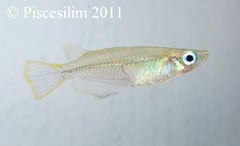
Oryzias javanicusJavanese Ricefish
Adrianichthyidae · (Bleeker, 1854)
The Javanese ricefish, Oryzias javanicus, ranges through Peninsular Thailand, Malaysia, Singapore and Indonesia as far east as Lombok and Sulawesi. Typically found in coastal, normally brackish, streams, pools and mangrove swamps, it tolerates a wide salinity range and has also been recorded in fresh water. It is exported on occasion and sometimes referred to as the 'blue-eyed ricefish'.

Parosphromenus bintan
Osphronemidae · Kottelat & Ng, 1998
Parosphromenus bintan is a liquorice gourami from Indonesia, confirmed only from Bintan Island in the Riau Archipelago and from Bangka. Similar-looking fish from Sumatra and Borneo may or may not be conspecific, and the name is sometimes misapplied to commercial shipments of other species. Males have a rounded caudal fin with concentric whitish, black, bluish and broad black or reddish-black bands.
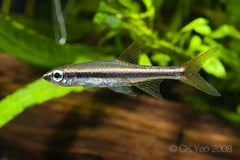
Trigonopoma gracile
Cyprinidae · (Kottelat, 1991)
Trigonopoma gracile is a small rasbora from the blackwater peat swamps of Peninsular Malaysia, Borneo and Sumatra. Its colour forms vary with collection locality. The name Rasbora agilis has been applied to it since a 1971 book pictured it under that name, but R. agilis is a junior synonym of T. pauciperforatum, the fish it is said to resemble.
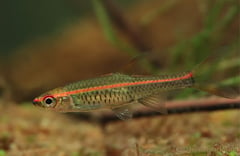
Trigonopoma pauciperforatumGlowlight Rasbora
Cyprinidae · (Weber & de Beaufort, 1916)
The glowlight rasbora, Trigonopoma pauciperforatum, is a small cyprinid from Peninsular Malaysia, Singapore, Borneo and Sumatra. Also sold as the 'redline' rasbora, its lateral stripe varies from deep orange to golden with locality, diet, condition and mood. It inhabits blackwater streams associated with peat swamps, where the pH can drop as low as 3.0 or 4.0, and the name R. agilis is a junior synonym of it.
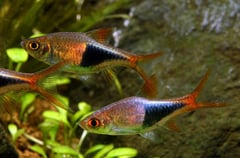
Trigonostigma heteromorphaHarlequin
Cyprinidae · (Duncker, 1904)
The harlequin, Trigonostigma heteromorpha, is a small cyprinid from southern Thailand, Peninsular Malaysia, Singapore and Sumatra. First exported for aquaria in the early 1900s, it is now mass-produced, and farmed fish lack much of the colour of wild ones. The dark triangular body marking sets it apart from T. espei and T. hengeli, and two divergent lineages found in aquarium stock suggest the species as currently recognised may contain more than one taxon.