River · also known as Nam Ma
Mã
Only species with a profile on Seriously Fish are counted.
- Species
- 5
- Families
- 4
- Photographed
- 5 of 5
- Difficulty rated
- 5 of 5
Shares fishes withspecies recorded from both

Folifer brevifilis
Cyprinidae · Peters, 1881
Folifer brevifilis is a large cyprinid from the Mekong, Salween and Ayeyarwady systems of southern China, Myanmar, Thailand, Laos and Vietnam. It has also been recorded from Hainan and Hong Kong. Growing to 300 mm SL, it is unsuitable for the majority of home aquaria and extremely rare in the ornamental trade. It inhabits flowing middle and lower sections of major rivers and may migrate seasonally to spawn.

Macropodus opercularisParadise Fish
Osphronemidae · Linnaeus, 1758
The paradise fish, Macropodus opercularis, is a labyrinth fish from China south of the Yangtze, including Taiwan and Hainan, plus Vietnam and Laos. Imported to France in 1869, it was among the very first ornamental fish brought to Europe. Wild examples are uncommon in the hobby since it is farmed extensively, and xanthic, albino, red, blue and stripeless strains exist. Males are territorially aggressive, especially when breeding, and should not be housed together unless the aquarium is very large.
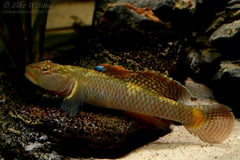
Rhinogobius leavelli
Gobiidae · (Herre, 1935)
Rhinogobius leavelli is a goby ranging from northeastern Laos through northern Vietnam to the Pearl drainage in Guangxi, southern China. It appears to exist in a number of forms that differ in colour pattern, morphology or both, although those in the aquarium trade all look similar. Fish identified as this species tend to have an orange blotch at the base of the caudal fin and a dark vertical bar at the base of the pectoral fin.
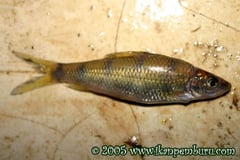
Acrossocheilus iridescens
Cyprinidae · Nichols & Pope, 1927
Acrossocheilus iridescens is a barred cyprinid known from Laos, northern Vietnam, Yunnan province in southwestern China and Hainan Island. Adults carry wide black vertical bars on the flanks, each six to eight scales across, and lack the filament on the dorsal fin seen in its closest relative, A. longipinnis. Some populations are of questionable taxonomic status, and the species sensu stricto may be restricted to Hainan, where the type locality lies.
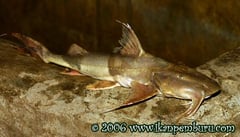
Bagarius rutilus
Sisoridae · Ng & Kottelat, 2000
Bagarius rutilus is a sisorid catfish from the Red River and other drainages of northern Vietnam and Yunnan in southern China, possibly also Laos. Reaching 700 to 1000 mm SL, it is clearly unsuitable for the home aquarium, and small numbers are only occasionally exported. It has orange fins in life. Adults live in fast, turbulent rapids in large river channels and perform spawning migrations when rivers swell between March and June.