River
Sebuku
Only species with a profile on Seriously Fish are counted.
- Species
- 5
- Families
- 3
- Photographed
- 5 of 5
- Difficulty rated
- 5 of 5
Shares fishes withspecies recorded from both
Runs through

Betta albimarginata
Osphronemidae · Kottelat & Ng, 1994
Betta albimarginata is a small mouthbrooding labyrinth fish that appears endemic to the Sebuku River drainage in East Kalimantan, Indonesian Borneo. It lives among marginal plant roots and leaf litter in forest streams only 5 to 10 cm deep. With B. channoides it forms the Betta albimarginata group, and the two look very similar: in B. albimarginata the unpaired fins have a broad white distal band and a broad dark submarginal band around a plain red inner portion.

Betta balunga
Osphronemidae · Herre, 1940
Betta balunga is a mouthbrooding labyrinth fish from Borneo, found from Tawau in Sabah, Malaysia, south to the Sebuku and Mahakam basins in Indonesia. A member of the Betta akarensis group, it has a reddish-orange iris in life. In the Sebuku it lives in very shallow forest streams among roots and leaf litter, and in the Mahakam basin in sluggish blackwater streams among submerged marginal vegetation.

Betta ocellata
Osphronemidae · de Beaufort, 1933
Betta ocellata is a large paternal mouthbrooding labyrinth fish from Sabah, northeastern Borneo, and the Sebuku River basin in East Kalimantan. A member of the B. unimaculata complex, it grows to 90 mm SL and has a pointed, slightly conical head. It has been collected from clear flowing streams, elevated headwater pools, turbid forest streams, ox-bow lakes and ponds in oil palm plantations.
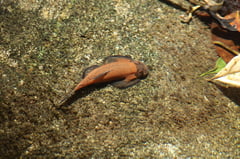
Gastromyzon lepidogaster
Gastromyzontidae · Roberts, 1982
Gastromyzon lepidogaster is a hillstream loach from northern Borneo and the most widely-distributed member of the genus. It occurs in Sabah, Brunei and East Kalimantan. Colour is variable: large adults may be bright green, orange or barred, and can apparently change from barred to plain in a few seconds. It is occasionally available in the trade, where the orange form is particularly sought after.
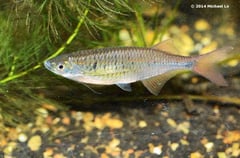
Nematabramis everetti
Cyprinidae · Boulenger, 1894
Nematabramis everetti is a cyprinid endemic to Borneo, known from Sarawak and Sabah plus East and North Kalimantan. It has a distinctive dark, vertically-elongate humeral marking, more prominent than in other Nematabramis species. Juveniles and subadults appear to favour fast-moving water, while adults are found in deeper, slower stretches of minor tributaries.