Search the catalogue
Type a name: scientific, common, or one a species used to go by. Or narrow the catalogue with the filters.
Filters
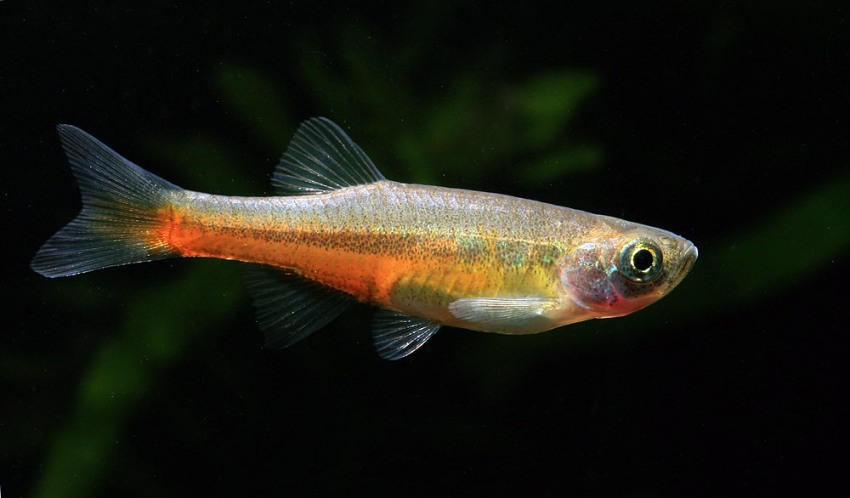
Devario acuticephalus
Hora, 1921
Max length40mm SL1.6in SLTank80 × 30cm31 × 12inTemp16–22°C61–72°FpH6.0–7.0Described from Manipur state, northeastern India and also known from neighbouring Nagaland state. In the original description Hora refers to it as 'widely-distributed' in the region but during an assessment conducted by the IUCN in 2010 it was recorded only from a handful of localities and restricted to an area of less than 15,000 square kilometres. Most habitats lie within the Manipur river basin, including the tributary Iril and Khuga drainages, and the Di...
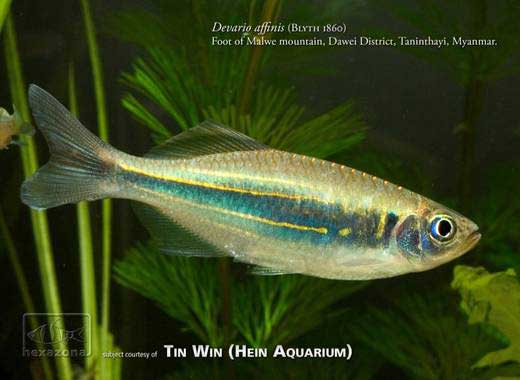
Devario affinis
Blyth, 1860
Max length80mm SL3.1in SLTank120 × 45cm48 × 18inTemp20–26°C68–79°FpHnot recordedType locality is 'Tenasserim, Myanmar' which at time of description was used to refer to the portion of Myanmar lying to the south and east of the Ayeyarwaddy/Irrawaddy river delta, including present-day Kayah, Kayin, and Mon states, Bago Division, and possibly the southern Tanintharyi Region. Blyth's description paper covered fishes collected from the Sittaung River (plus a few Gangetic species) in what is currently Bago Division, but we've been unable to locate any modern records of D. affinis fro...
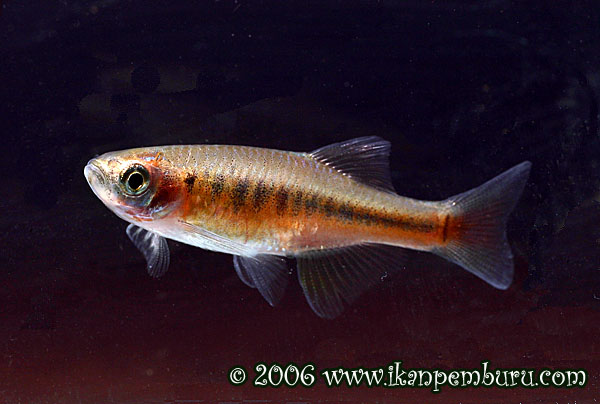
Devario apogon
Chu, 1981
Max length45mm SL1.8in SLTank80 × 30cm31 × 12inTemp15–24°C59–75°FpH6.0–7.5Type locality is given as 'Jiucheng, Yunnan Province, China' which could refer to one of several places with the same name in southwestern Yunnan. It's also been collected in Tengchong and Lianghe districts, Yingjiang county, and all known localities are within the Daying river (Dayingjiang) watershed, a major tributary of the larger Irrawaddy/Ayeyarwady river syst...
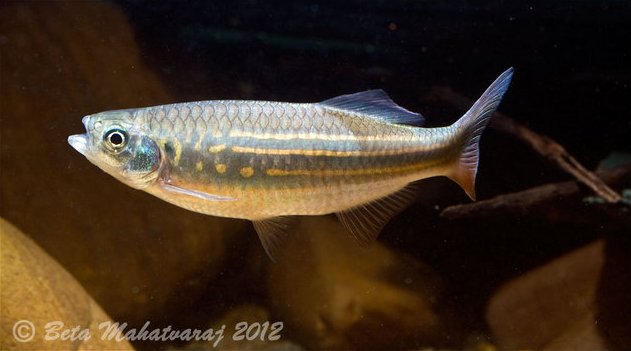
Devario assamensis
Barman, 1984
Max length90mm SL3.5in SLTank120 × 45cm48 × 18inTemp15–22°C59–72°FpH6.0–8.0Type locality is 'Streamlets near Tangla, Darrang District, Assam, India', but records also exist from the Mahananda River in West Bengal state and other tributaries of the lower Brahmaputra river system, some of which originate in Bhutan. Further upstream it's been recorded in the Kalmoni riv...
Devario chrysotaeniatus
Chu, 1981
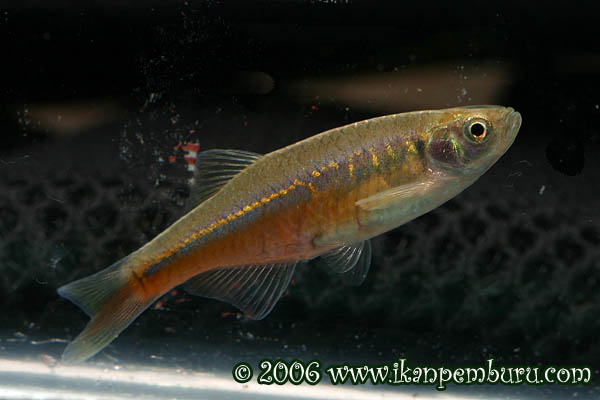
Max length75mm SL3.0in SLTank120 × 30cm48 × 12inTemp23–26°C73–79°FpH6.0–7.0This species is poorly known and first appeared in the hobby during 2005 but has rarely been seen since, probably because its natural waters lie outside the range of most commercial collectors. It can be distinguished by a combination of characters including: lateral line complete; infraorbital process absent; two pairs of short barbels; 8-9 branched dorsal fin rays; 12-13 branched anal fin rays; P stripe originating above pelvic fin and extending to en...
Devario devarioBengal Danio
Hamilton, 1822
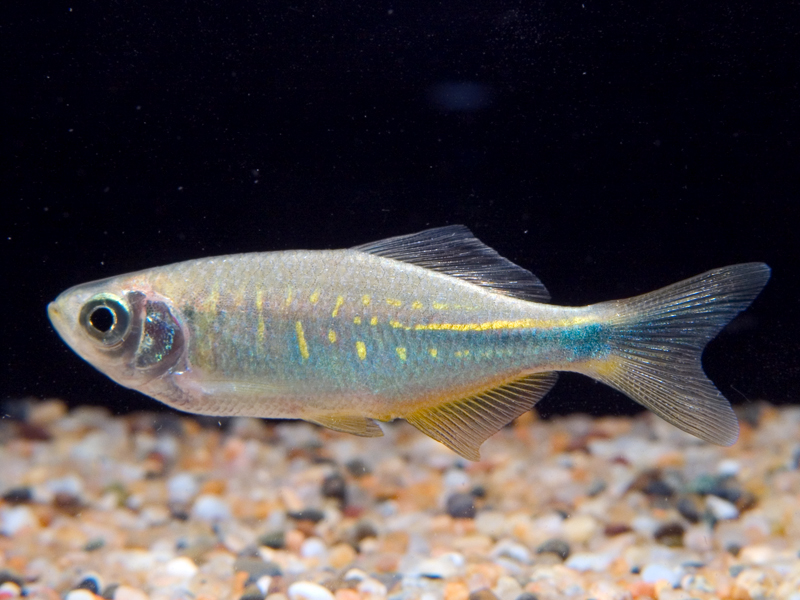
Max length80mm SL3.1in SLTank120 × 45cm48 × 18inTemp15–26°C59–79°FpH6.0–8.0Ecological studies have revealed this species to be more of a generalist than its chiefly insectivorous congeners. Aquatic and terrestrial insects form a significant proportion of the diet, but substantial amounts of filamentous algae and diatoms are consumed with water mites, fish scales, isopods, nematodes and detritus also taken occasionally. In the aquarium it's largely unfu...
Devario interruptus
Day, 1870
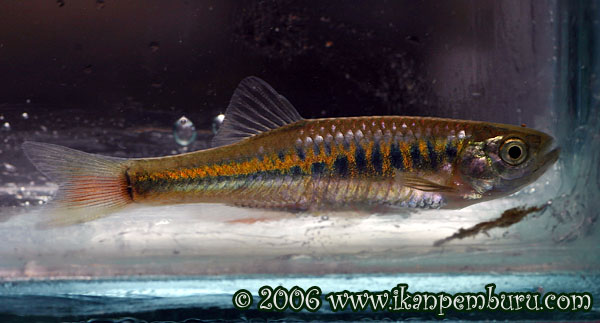
Max length60mm SL2.4in SLTank75 × 30cm30 × 12inTemp16–21°C61–70°FpH6.5–7.5This species has mostly been collected from small (1-2 metres wide, 20-40 cm deep), moderate-to-swiftly-flowing streams with clear water, substrates of sand, gravel and rocks and no aquatic vegetation. Marginal vegetation was present in some cases, offering a degree of shade, and sympatric species included an unidentified Schistura sp., S. vinciguerrae, Misgurnus anguillicaudatus, Garra qiaojiensis,...
Devario laoensis
Pellegrin & Fang, 1940
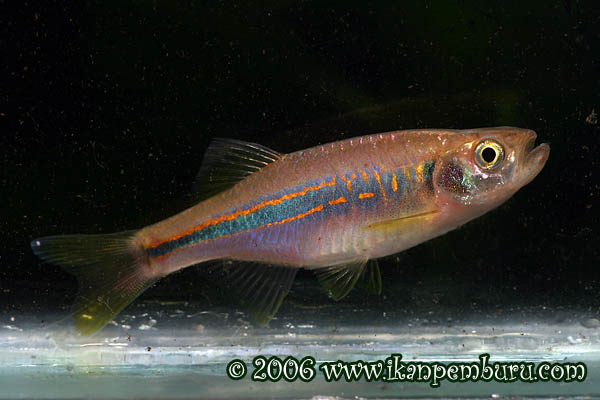
Max length65mm SL2.6in SLTank90 × 30cm36 × 12inTemp23–26°C73–79°FpH6.0–7.5It can be further distinguished from other species in the genus by colour pattern consisting of a dark, horizontal P stripe originating around mid-body, where it's relatively faint, this becoming thicker and darker in the posterior portion of the body and terminating at the base of the caudal-fin. Among congeners it's most similar to D. chrysotaeniatus but that species lacks the infraorbital process, has three rows of pharyngeal teeth and the P stripe extends to the end of the caudal-fin rays.
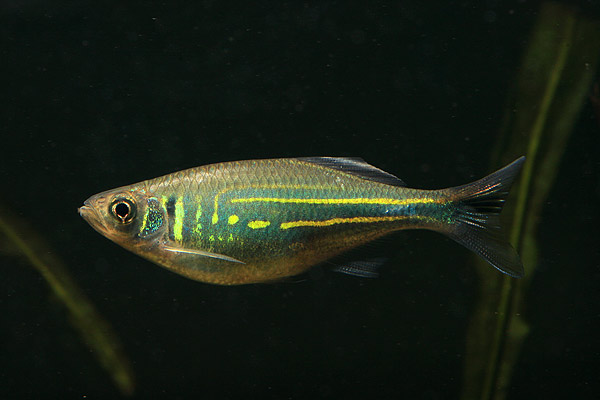
Devario malabaricusGiant 'Danio'
Jerdon, 1849
Max length80mm SL3.1in SLTank120 × 45cm48 × 18inTemp18–25°C64–77°FpH6.0–8.0This species is frequently confused with the congener D. aequipinnatus auct. but their identitities are in a state of confusion, particularly that of the latter. There are however a handful of characters which separate these two nominal species from one another. D. malabaricus possesses a moderately deep body, 35-38 scales in the lateral se...
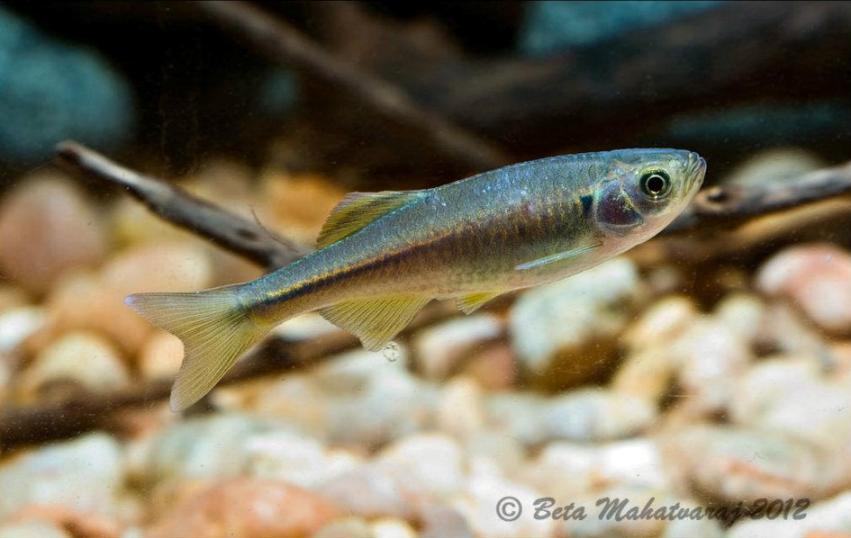
Devario neilgherriensisPeninsular 'Danio'
Day, 1867
Max length100mm SL3.9in SLTank120 × 45cm48 × 18inTemp16–24°C61–75°FpH6.0–7.5Appears endemic to tributaries of the Bhavani river system in the Nilgiri Hills of Tamil Nadu state, southern India including the Pykara, Avalanche and Kaity streams. Type locality is 'Ootacamund Lake, Pykara, Avelanche and Kaity streams, Neilgherry Hills, India', with the former now often shortened to Ooty Lake.
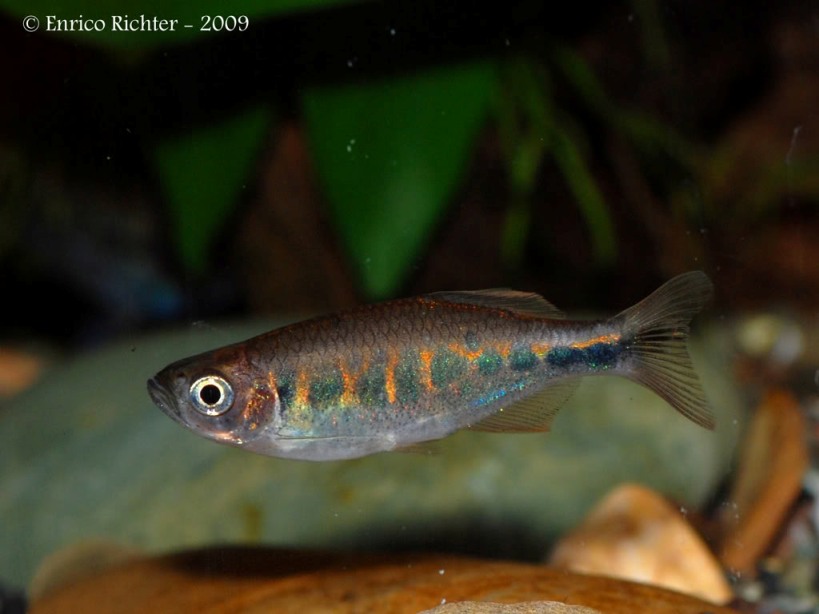
Devario pathiranaBarred 'Danio'
Kottelat & Pethiyagoda, 1990
Max length80mm SL3.1in SLTank120 × 45cm48 × 18inTemp23–26°C73–79°FpH6.0–7.5This species is diagnosable from other members of the genus primarily by its unique colour pattern which consists of 7-11 dark blue, irregularly-shaped, parallel vertical bars on the anterior portion of each flank plus a short horizontal stripe on the caudal peduncle which extends into the central caudal fin rays. Phylogenetic analyses suggest it's most closely-related to Indian Devario spp. plus D. xyrops from the western slope of the Rakhine Yoma mountains in Myanmar (Fang et al., 2009; Fang and Kullander, 2009).
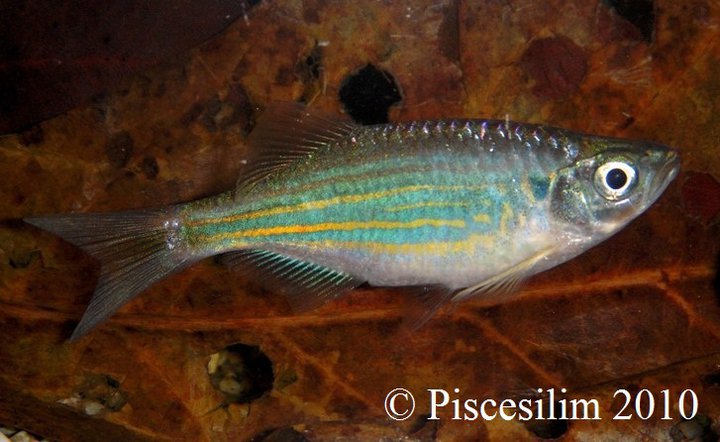
Devario reginaQueen 'Danio'
Fowler, 1934
Max length80mm SL3.1in SLTank120 × 45cm48 × 18inTemp20–26°C68–79°FpH5.5–7.5Probably restricted to western and southern Thailand and northern Peninsular Malaysia plus some small surrounding islands. In Thailand records exist from Surat Thani (Ko Samui island), Nakhon Si Thammarat, Ranong, Trang, Phuket, Ratchaburi, Kanchanaburi, and Mae Hong Son provinces while in Peninsular Malaysia it's been collected from Perak and Kedah states, including th...
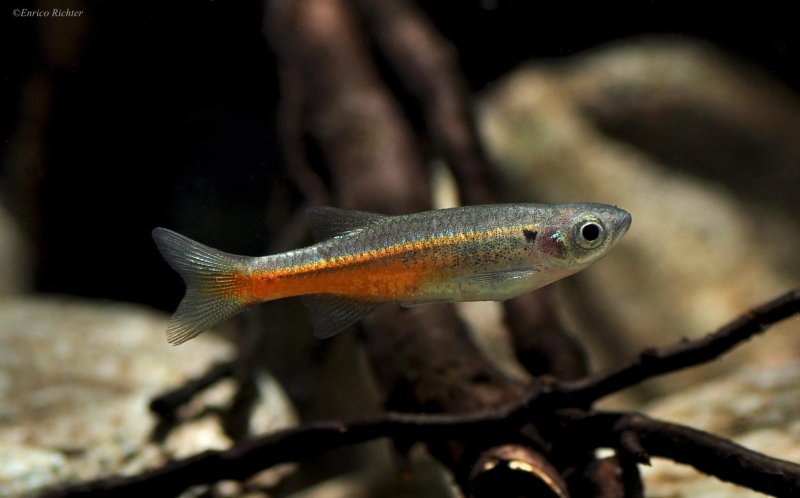
Devario sondhiiFireline Devario
Hora & Mukerji, 1934
Max length45mm SL1.8in SLTank75 × 30cm30 × 12inTemp20–26°C68–79°FpH6.5–7.5The habitat near Hopong is an area of permanently-flooded grassland formed by the damming of a spring for agricultural purposes and is around 1,040 metres AMSL. The water is only around 30cm deep, transparent and supports dense growths of aquatic plants, mostly from the family Hydrocharitaceae which includes such genera as Elodea, Egeria and Blyxa.
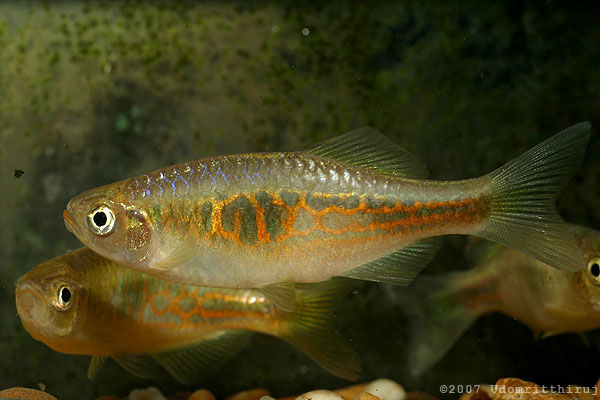
Devario sp. 'giraffe'
authority not recorded
Max length80mm SL3.1in SLTank120 × 30cm48 × 12inTemp18–26°C64–79°FpH6.0–8.0This unidentified species was first collected in 2007 but very little is known about it. The vernacular name refers to the colour pattern on the body which resembles that of a giraffe, and it's known to be collected in Myanmar although its distribution and natural habitat remain a mystery.
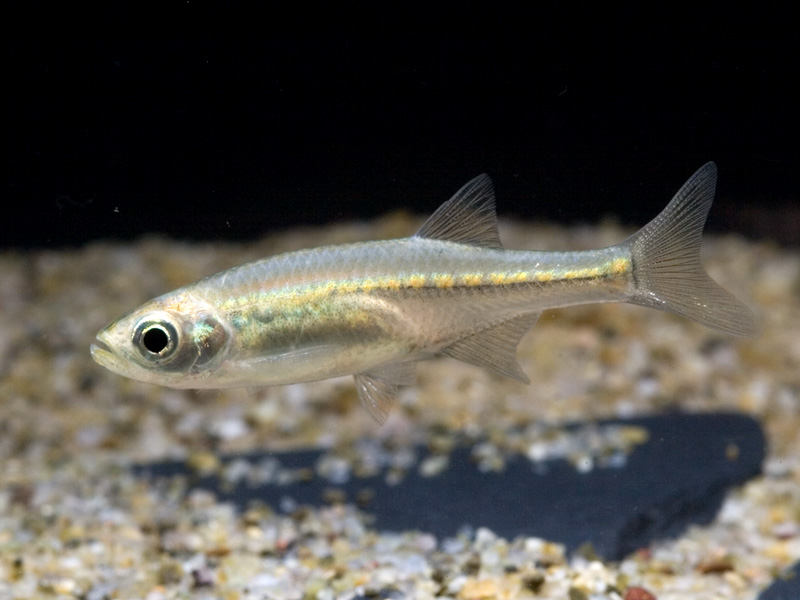
Devario sp. 'purple cypris'
authority not recorded
Max length45mm SL1.8in SLTank75 × 30cm30 × 12inTempnot recordedpHnot recordedThis unidentified species has only appeared in the aquarium trade on a handful of occasions and it has been widely misidentified as Devario jayarami (Barman, 1984). It differs from D. jayarami by possessing 9-10 lateral bars which progressively increase in size posteriorly (vs. 12-13 bars which decrease in size posteriorly), 12 anal-fin rays (vs. 15-16) and a blunter head profile with a lack of convexity behind the head (vs. head profile conical with noticeable convexity behind the head).
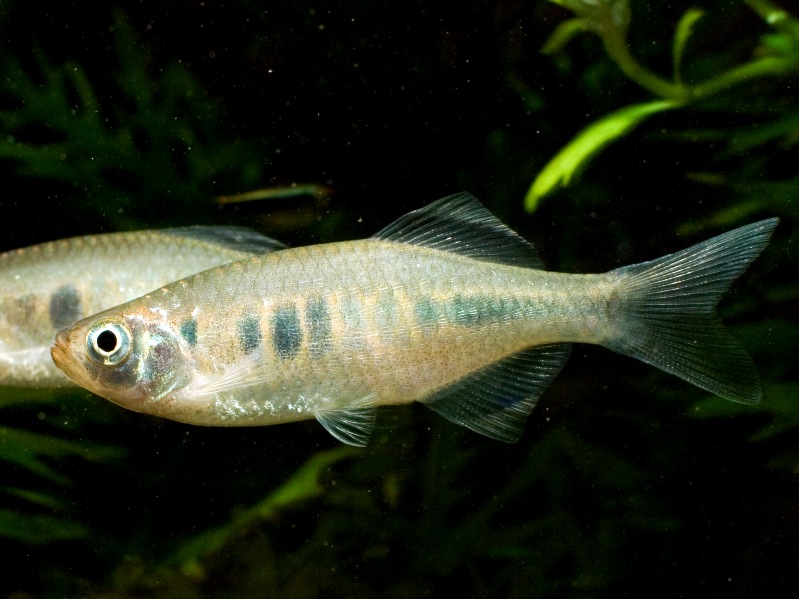
Devario xyropsBlue Moon 'Danio'
Fang & Kullander, 2009
Max length80mm SL3.1in SLTank120 × 45cm48 × 18inTemp18–26°C64–79°FpH6.0–8.0Thrives in an aquarium set up to resemble a flowing stream or river with a substrate of variably-sized, water-worn rocks, sand, fine gravel and perhaps some small boulders. This can be further furnished with driftwood roots or branches, and while the majority of aquatic plants will fail to thrive in such surroundings hardy types such as Microsorum, Bolbitis or Anubias spp. can be grown attached to the décor.
Dianema longibarbisPorthole Catfish
authority not recorded
Max length100mm SL3.9in SLTank90 × 38cm36 × 15inTemp24–28°C75–82°FpH5.5–7.5So named because of the row of spots running along the lateral line, the porthole cat is a good community species. Newly imported fish tend to be a little delicate and are susceptible to disease. This is at least in part because all specimens sold for the trade are wild caught. Once acclimatised, it usually proves very hardy and can be exceptionally long-lived for a fish of this size, having the potential to survive for over 10 years....
Dianema urostriatumFlagtail Catfish
authority not recorded
Max length125mm SL5in SLTank120 × 38cm48 × 15inTemp25–28°C77–82°FpH6.0–8.0A good choice for the larger community tank. Newly imported fish tend to be a little delicate and can be susceptible to disease. This is at least in part because all specimens sold for the trade are wild caught. Once acclimatised it usually proves very hardy and adaptable....
Dicrossus filamentosusLyretail Checkerboard Cichlid
authority not recorded
Max length102mm SL4in SLTank60 × 30cm24 × 12inTemp27–30°C81–86°FpHnot recordedDicrossus Filamentosa were once part of the Crenicara genus, but now share the Dicrossus genus with Dicrossus Maculata. The two species look similar, but the Maculata lack the lyretailed of the Filamentosa. Some say however, that the Maculata has even more striking body colouration than the already impressive Filamentosa. These fish aren't impossible to find, but aren't readily available in local fish shops either. They are seen as a challenge to breed, but plenty of breeders have h...
Dicrossus maculatusSpadetailed Checkerboard Cichlid
authority not recorded
Max length53mm SL2.1in SLTank60 × 30cm24 × 12inTemp26–30°C79–86°FpH3.4–5.4Dicrossus Maculatus are not commonly available in the trade. Sometimes they are mistaken for the more common and popular Dicrossus Filamentosa. The Spadetailed Checkerboards are an absolutely fascinating species to keep. They are a challenge to breed, requiring such acidic and soft water, but when it does happen it is a very rewarding experience. Reports maintain that the pH and temperature of the water when conceived, eggs laid, eggs hatched and in the first month of the fry's life c...