Dicrossus filamentosus
Lyretail Checkerboard Cichlid
On this page11 sections
Quick facts
Difficulty2 of 8 measures
Not enough data to rate
More bars, more demanding. Hardiness is not averaged with the rest.
- Space
- modest tank
- Water
- unknown
- Temp
- narrow band
- Diet
- unknown
- Temperament
- unknown
- Social
- unknown
- Compatibility
- unknown
Hardiness on its own can raise the rating, whatever the measures above say.
- Hardiness
- unknown
Dicrossus Filamentosa were once part of the Crenicara genus, but now share the Dicrossus genus with Dicrossus Maculata. The two species look similar, but the Maculata lack the lyretailed of the Filamentosa. Some say however, that the Maculata has even more striking body colouration than the already impressive Filamentosa. These fish aren't impossible to find, but aren't readily available in local fish shops either. They are seen as a challenge to breed, but plenty of breeders have h...
Distribution
Habitat
Ranges through Colombia and Venezuela, from the Rio Inírida to Maripa and in the Rio Orinoco. It's also found in parts of the Brazilian Rio Negro.
Aquarium size
60 ∗ 30 ∗ 38 cm24 ∗ 12 ∗ 15 in - ~68 litres~18 US gal
Maintenance
Checkerboard Cichlids are very shy fish, often "hugging" the bottom of the tank amongst plants and scattered leaves. Provide a well planted aquarium with a great number of hiding places. Floating plants are also an excellent option. Dim lighting is recommended.
Water conditions
Temperature: Higher temperatures - 81 to 86°f (27 to 30°c)
pH: Can tolerate upto 7, but much more acidic is required to breed Filamentosa - 4.5 to 5.8.
Hardness: Again, can tolerate moderately hard water but will only thrive and breed with very little hardness (1°dH or lower recommended).
These recommendations come from this profile’s own figures. They contain affiliate links, so we may earn a commission.
Diet
Checkerboards will probably accept dry foods, especially sinking cichlid pellets. If that is the case, feed a good quality sinking pellet as staple. Vary their diet with vegetarian or spirulina flakes and plenty of frozen foods. To bring Checkerboards into breeding condition, live foods are highly recommended - a daphnia culture is great for this purpose.
Behaviour and compatibility
Relatively peaceful cichlids, will struggle against more aggressive tankmates. Fine in a community with other peaceful fish.
Sexual dimorphism
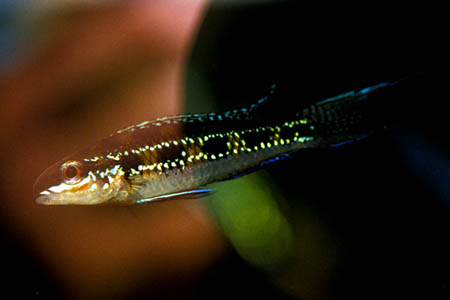
Males are slightly larger and possess a highly attractive "lyretailed" caudal fin. Females are smaller with less colour, possessing merely a rounded caudal.
Reproduction
Dicrossus Filamentosa are relatively easy to breed if you can provide them with premium water conditions. This means very acidic, soft, highly quality water. RO water is nearly mandatory for breeding these fish, unless your tap water is around pH 4.5.
Notes
Dicrossus Filamentosa were once part of the Crenicara genus, but now share the Dicrossus genus with Dicrossus Maculata. The two species look similar, but the Maculata lack the lyretailed caudal fin of the Filamentosa. Some say however, that the Maculata has even more striking body colouration than the already impressive Filamentosa.
These fish aren't impossible to find, but aren't readily available in local fish shops either. They are seen as a challenge to breed, but plenty of breeders have had success. The problem seems to lie in the eggs hatching - reports maintain that they will not hatch below pH 5.8.
Species images · 1
Used with the photographer’s permission. Not licensed for reuse.
Profile completeness15 of 24
63% complete
- Add water parameters
- Add hardness
- Add a reference
- Add temperament
- Add social needs
- Add community suitability
Also missing: a recorded distribution, taxonomic authority, etymology.
Community
Questions about Dicrossus filamentosus?
Ask on Discord