Results for “genera”
Type a name: scientific, common, or one a species used to go by. Or narrow the catalogue with the filters.
Filters
Microsynodontis polliPygmy Synodontis
authority not recorded
Max length40mm SL1.6in SLTank45 × 30cm18 × 12inTemp24–27°C75–81°FpH6.8–7.5There are a dozen described species of Microsynodontis but most are not seen in the hobby. This species is one of the commoner ones however. Microsynodontis are much smaller than Synodontis species, with M. batesii being the largest. They can be distinguished from Synos and the similar Mochokiella by the rounded or slightly forked caudal fin. The is highly forked in the other genera. Interestingly in Microsynodontis the eyeball is fixed and cannot be moved unlike in Synodontis which has a moveab...
Moenkhausia cerosCeros Tetra
authority not recorded
Max length50mm SL2.0in SLTank60 × 38cm24 × 15inTemp24–26°C75–79°FpH5.5–7.0A rather rare fish in the UK hobby. It occasionally shows up as a contaminant among imports of more popular species. The taxonomic status of all species in the genus Moenkhausia is currently Incertae Sedis, meaning uncertain. The genus is currently used as something of a catch-all for a large number of small characin species. Most experts agree that a full revision is required, with the likely outcome that many of these will be placed into new or different genera....
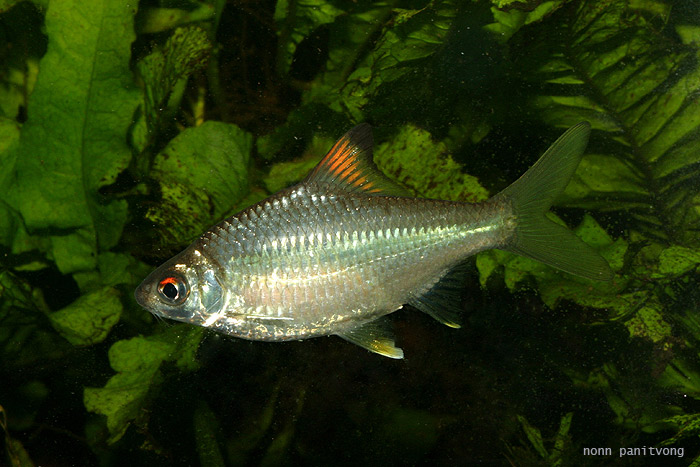
Mystacoleucus argenteus
Day, 1888
Max length140mm SL6in SLTank120 × 45cm48 × 18inTemp20–27°C68–81°FpH6.0–7.5All Mystacoleucus species possess a procumbent predorsal spine orientated towards the head, though it can be difficult to spot with the naked eye. This can become entangled in an aquarium net so care must be taken when handling the fish. The trait is shared by members of Tor, Spinibarbus and Paraspinibarbus although there exists no strong evidence to suggest that these genera form a monophyletic lineage and it is...
Nannacara anomalaGolden Dwarf Cichlid
authority not recorded
Max length76mm SL3.0in SLTank46 × 38cm18 × 15inTemp22–25°C72–77°FpHnot recordedNannacara Anomala are widely available in the trade, and are generally regarded as an excellent beginner's fish. If a beginner is interested in keeping Cichlids and learning about breeding, then these fish are absolutely ideal. Anomala are attractive, hardy and usually quite cheap to purchase. Like some species of the Apistogramma genus, the mother may use fascinating body language to communicate with her fry when she is caring for them. If there is more than one male in a tank smalle...
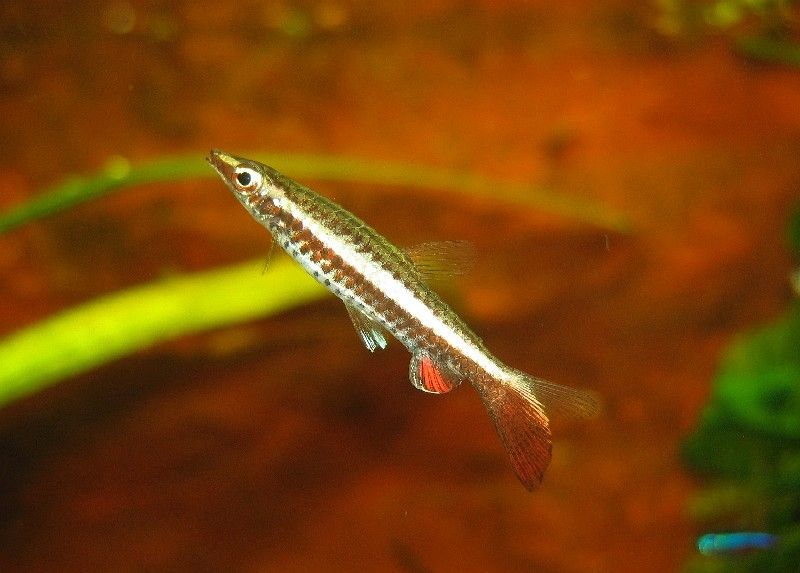
Nannostomus equesHockeystick Pencilfish
Steindachner, 1876
Max length35mm SL1.4in SLTank60 × 30cm24 × 12inTemp22–28°C72–82°FpH4.5–7.5This species has been referred to the genera Poecilobrycon and Nannobrycon in the past and in the aquarium hobby is also known as 'rocket', 'brown', 'brown-tailed', 'diptail', or 'tubemouth' pencilfish.It's a popular aquarium fish and has an interesting oblique swimming-style, a behavioural trait shared only with N. unifasciatus among congeners. In the original description the colour pattern is given by Steindachner as a brown lateral stripe exte...
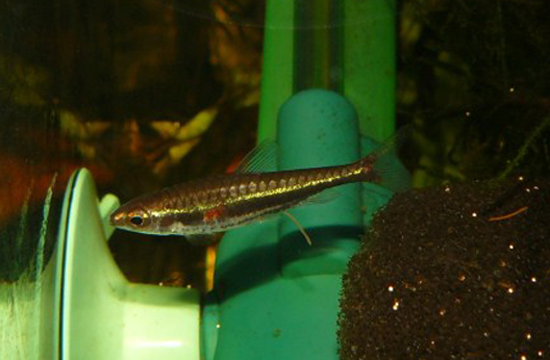
Nannostomus minimusLeast Pencilfish
Eigenmann, 1909
Max length23mm SL0.9in SLTank45 × 30cm18 × 12inTemp22–28°C72–82°FpH4.0–6.5Inhabits sluggish blackwater tributaries, small rivers and swampy areas, particularly in areas with dense growth of aquatic or overhanging riparian vegetation, submerged woody structures and leaf litter. The water is typically stained darkly with humic acids and other chemicals released by decaying organic material, the dissolved mineral content is generally negligible and pH can be as low as 4.0. N. minimus occurs sympat...
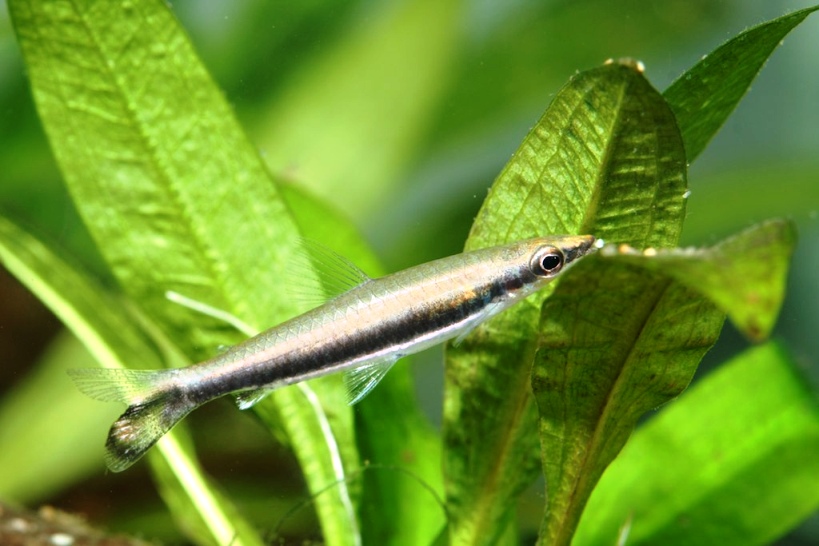
Nannostomus unifasciatusOne-lined Pencilfish
Steindachner, 1876
Max length40mm SL1.6in SLTank75 × 30cm30 × 12inTemp23–28°C73–82°FpH4.0–7.0This species has been referred to the genera Poecilobrycon and Nannobrycon in the past and in the aquarium hobby is also known as 'oneline' or 'red fin' pencilfish. It's a popular aquarium fish and has an interesting oblique swimming-style, a behavioural trait shared only with N. eques among congeners. The most recent diagnosis of the species appears to be that giv...
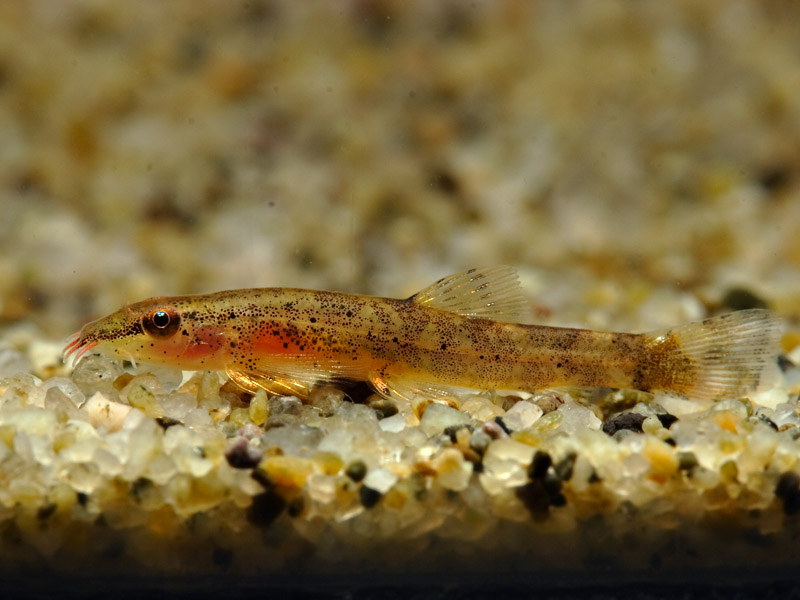
Neohomaloptera johorensis
Herre, 1944
Max length25mm SL1.0in SLTank45 × 30cm18 × 12inTemp23–26°C73–79°FpH3.5–6.5We're unsure if this species has ever been traded on a commercial basis though we know of several private collectors who've maintained it. It's difficult to confuse with any other balitorid due to the small adult size and distinctive orange to reddish-brown body colouration, and was originally described as a subgenus by Herre (1944) before Silas (1953) raised it to full genus status. It was later syonymised with Homaloptera by Alfred (1969) but has been generally accepted as a distinct, valid genus since Roberts (1989).
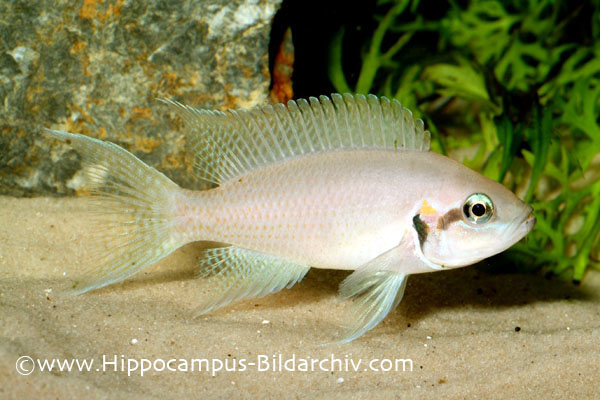
Neolamprologus pulcherBrichardi
Trewavas & Poll, 1952
Max length90mm SL3.5in SLTank120 × 30cm48 × 12inTemp23–27°C73–81°FpH8.0–9.0Deservedly one of the most popular Tanganyikan species available in the hobby, N. brichardi is ideal for newcomers to both Rift Lake cichlids and cichlids in general, being beautiful and easy to keep and breed. It is seen for sale under several common names including "Fairy Cichlid", "Lyretail Cichlid" and "Princess of Burundi". There are several colour morphs available, although these do not vary much in patterning, and an albino form is also occasionally available...
Neolamprologus sexfasciatusSix-barred Lamprologus
authority not recorded
Max length150mm SL6in SLTanknot recordedTemp23–27°C73–81°FpH7.5–9.0Several geographical morphs of this species are available, including "Sambia" and "Kipili". These vary in base colour from blue to yellow to white. It is not recommended for the general Tanganyikan community due to its aggressive and predatory nature....
Neolamprologus tretocephalusFive-barred Lamprologus
authority not recorded
Max length150mm SL6in SLTank120 × 30cm48 × 12inTemp23–27°C73–81°FpH7.5–9.0It can be distinguished from the similar N. sexfasciatus by the presence of only five, rather than six, vertical bars on it's flanks. It is not recommended for the general Tanganyikan community due to it's aggressive nature, particularly when breeding....
Nimbochromis livingstonii
authority not recorded
Max length250mm SL10in SLTank120 × 45cm48 × 18inTemp24–28°C75–82°FpH7.6–8.8Not a fish for the general Malawi cichlid community, N. livingstonii is an ambush predator in nature, often being seen hanging motionless around rocky structures, in Vallisneria thickets or on the floor of the lake. It is a sedentary species and does not move around a lot. This is a behavioural adaptation known as thanatosis, or 'playing dead'. This strategy is usually used as for defensive means in other animals but in N. livingstonii is adapted for offensive means. The fish has a mot...
Nimbochromis venustusVenustus
authority not recorded
Max length250mm SL10in SLTank120 × 45cm48 × 18inTemp24–28°C75–82°FpH7.6–8.8Not a fish for the general Malawi cichlid community, N. venustus is an ambush predator in nature. It is often found hanging motionless around rocky structures, in Vallisneria thickets or on the floor of the lake. It is a sedentary species and does not move around a lot. This is a behavioural adaptation known as thanatosis, or 'playing dead'. This strategy is usually used as for defensive means in other animals but in N. venstus is adapted for offensive means. The fish has a mottled col...
Oxyeleotris marmorataMarbled Goby
authority not recorded
Max length650mm SL26in SLTank150 × 60cm60 × 24inTemp22–28°C72–82°FpH6.5–7.5One of the largest goby species in the world, O. marmoratus is unsuitable for the vast majority of aquaria, but is an interesting oddball for the true enthusiast with the facilities to house it properly. It is a nocturnal ambush predator and generally remains motionless during daylight hours unless striking at food. It is a popular food fish in some of its native countries, where it is known as soon hock....
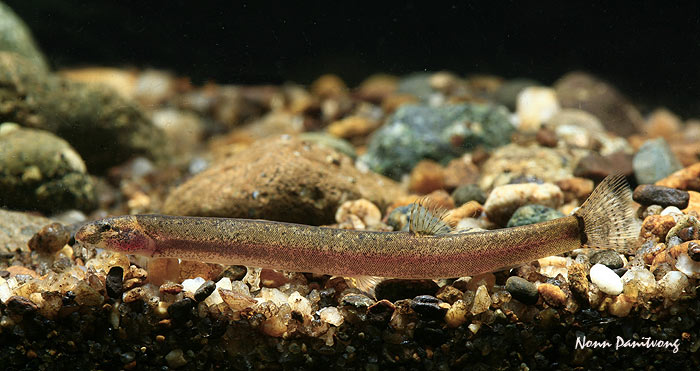
Pangio piperata
Kottelat & Lim, 1993
Max length60mm SL2.4in SLTank45 × 30cm18 × 12inTemp21–26°C70–79°FpH4.0–7.5Some Sumatran and Bornean populations of the highly variable P. shelfordii superficially resemble P. piperata which can cause issues with identification as the two often occur together. In general however the body patterning in P. piperata is than that of P. shelfordii and they differ in vertebral counts (mode 47 vs. 50, respectively).
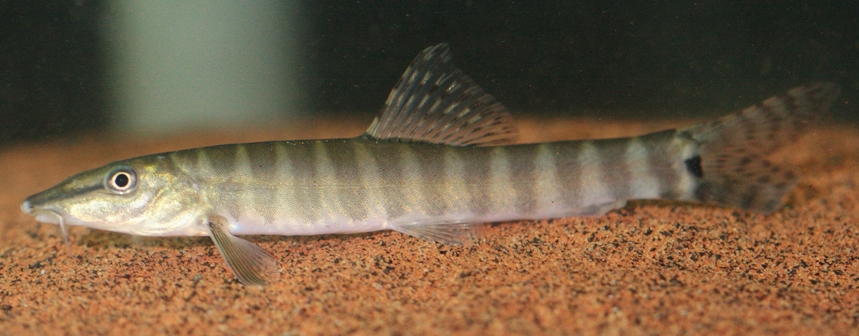
Parabotia fasciata
Dabry de Thiersant, 1872
Max length150mm SL6in SLTank120 × 45cm48 × 18inTemp20–24°C68–75°FpH6.0–7.5P. fasciata is rarely seen in the trade and is typically available only as bycatch among shipments of Sinibotia spp., particularly S. robusta. According to current classification numerous species from several genera are considered synonymous with it.
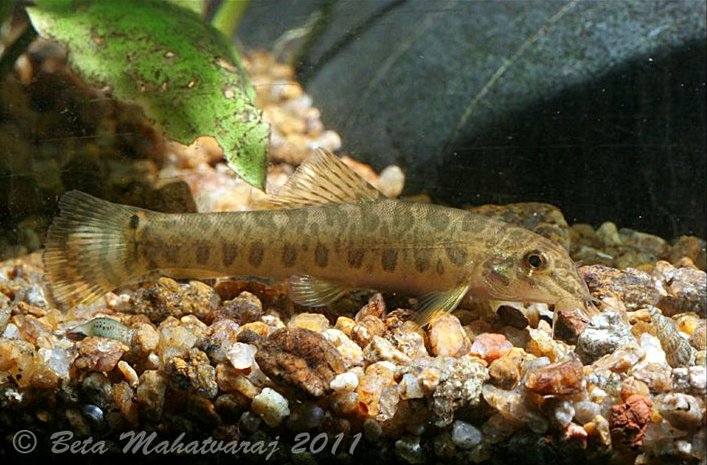
Paracanthocobitis mooreh
Sykes, 1839
Max length75mm SL3.0in SLTank75 × 30cm30 × 12inTemp20–26°C68–79°FpH6.0–7.5This species is still considered a member of the genus Nemacheilus by some sources, but it was reclassified and placed in Acanthocobitis by Grant (2008). Acanthocobitis sinuata, generally considered a junior synonym of A. mooreh (Kottelat, 2012b), also appears distinct and differs in geographical distribution plus number of dorsal-fin rays (2-3/9-10 in A. mooreh vs. 2/8-9 in A. sinuata) and some aspects of colour pattern.
Parambassis siamensis
authority not recorded
Max length60mm SL2.4in SLTank45 × 30cm18 × 12inTemp22–27°C72–81°FpH6.5–7.5This occasional import is sometimes offered for sale as P. ranga, the Indian glass fish. Unlike that species however, P. siamensis is an exclusively freshwater fish and should never be kept under brackish conditions. It can be distinguished from ranga by the lack of patterning behind the eye and it's generally more elongate body....
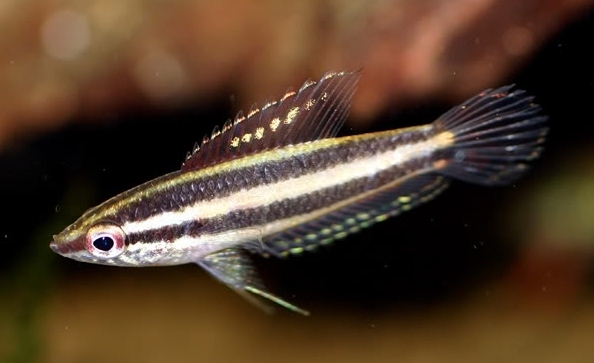
Parosphromenus bintan
Kottelat & Ng, 1998
Max length26mm SL1.0in SLTank40 × 20cm16 × 8inTemp22–28°C72–82°FpH3.0–6.5This species is not generally available in the aquarium hobby on a commercial basis but is occasionally collected and distributed by private aquarists. It's name is sometimes misapplied to commercial shipments of other species, and there also exist a number of other fish with rounded caudal-fins that may or may not be conspecific, including P. sp. 'blue line' and P. sp. 'Selatan' from Sumatra.
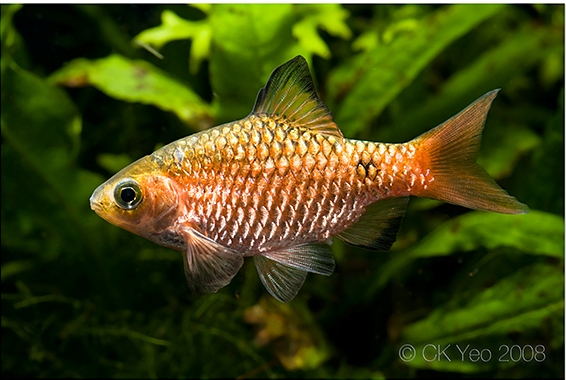
Pethia conchoniusRosy Barb
Hamilton, 1822
Max length100mm SL3.9in SLTank100 × 30cm39 × 12inTemp16–24°C61–75°FpH6.0–8.0Generally considered one of the hardiest small cyprinids available in the aquarium hobby, P. conchonius is an excellent choice for the beginner. Selective breeding has produced various ornamental strains including long-finned, 'veil-tail', 'super red', 'neon', and 'golden' forms. It's also been hybridised with some congeners although the offspring of such experiments are apparently infertile. It was formerly included in th...