Nannacara anomala
Golden Dwarf Cichlid
Last revised 2026Edit this page
On this page11 sections
Quick factsEdit
Difficulty5 of 8 measures
- Space
- medium tank
- Water
- flexible
- Temp
- flexible
- Diet
- unknown
- Temperament
- territorial
- Social
- unknown
- Compatibility
- unknown
Other demands
Each of these can raise the rating on its own, whatever the measures above say.
- Hardiness
- hardy
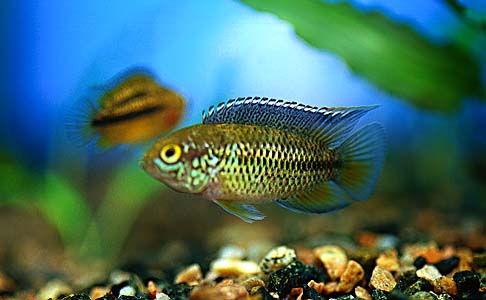
The golden dwarf cichlid, Nannacara anomala, ranges from the Rio Aruka in Guyana to the lower Rio Marowijne in Suriname. It is often found in flooded grassland in low-lying coastal areas, but most fish in the trade are mass-produced on farms in the Far East or Eastern Europe. Hardy and easy to breed, it is regarded as an excellent beginner's cichlid, though a female guarding fry can be very aggressive.
Distribution
EditHabitat
Write a noteEditOften found inhabiting areas of flooded grassland in low-lying coastal areas.
Aquarium size
Write a noteEdit46 ∗ 38 ∗ 30 cm18 ∗ 15 ∗ 12 in
Maintenance
Write a noteEditProvide a well planted setup with bits of bogwood, driftwood or mopani wood to provide cover and spawning sites for these fish.
Water conditions
EditTemperature: 22 – 27 °C72 – 81 °F
pH: Acidic, but can tolerate moderately alkaline - 6 to 7.5
Hardness: Prefer soft, but can tolerate moderately hard - from 3 to 8°dH.
These recommendations come from this profile’s own figures. They contain affiliate links, so we may earn a commission.
Diet
Write a noteEditIt's naturally a micropredator, foraging for worms, insects and other invertebrates in the wild. Anomala should take dry foods, in which case a meaty Cichlid pellet should be fed as staple food. Make sure diet is supplemented with both vegetative matter (vegetable/spirulina flakes or small pieces of cucumber) and frozen/live foods (of which the Anomala will prefer bloodworm and brineshrimp).
Behaviour and compatibility
Write a noteEditVery peaceful dwarf Cichlid. Can be kept in a community with most other peaceful fish. Female can be very aggressive indeed when protecting her fry, so if the Nannacara Anomala start breeding in a community tank you may have problems.
Sexual dimorphism
Write a noteEditMale is much bigger, generally exhibiting pale blues and reds whilst the smaller female tends to be yellow with a black lateral line on its flank. Female will present a checkerboard-esque pattern when inbreeding mood.
Reproduction
Write a noteEditVery simple. In merely adequate water conditions, a single male and female will very likely breed. Breeding is even easier in a larger tank with a number of females providing companionship to a single male. Females require "sub-territories" of at least 40cm x 40cm on the bottom of a tank, so a 30" tank would be required to house two females with a male.
Notes
EditNannacara Anomala are widely available in the trade, and are generally regarded as an excellent beginner's fish. If a beginner is interested in keeping Cichlids and learning about breeding, then these fish are absolutely ideal.
Anomala are attractive, hardy and usually quite cheap to purchase. Like some species of the Apistogramma genus, the mother may use fascinating body language to communicate with her fry when she is caring for them.
If there is more than one male in a tank smaller than 48", the subdominant male may take on the guise of a female (colouration and size) to avoid the aggression of the dominant male. If the dominant male was taken away, the subdominant male would quickly (a matter of weeks) grow into a fully functioning male and become the dominant male in the tank.
"Nannacara" simply means "Small Acara".
Species images · 2

These photographs are used with each photographer's permission.
Send a photographDistribution
Profile completeness18 of 24
75% complete
Also missing: taxonomic authority, etymology.
Contributors
Improved by
- Benthic1
The number beside each name is how many contributions that person has had accepted on Seriously Fish.
Community
Questions about Nannacara anomala?
Ask on Discord