Oxyeleotris marmorata
Marbled Goby
Last revised 2026Edit this page
On this page11 sections
Quick factsEdit
Difficulty5 of 8 measures
- Space
- very large tank
- Water
- needs a steady pH
- Temp
- flexible
- Diet
- unknown
- Temperament
- territorial
- Social
- unknown
- Compatibility
- choose tankmates carefully
Other demands
Each of these can raise the rating on its own, whatever the measures above say.
- Hardiness
- unknown
- Needs a very large tank
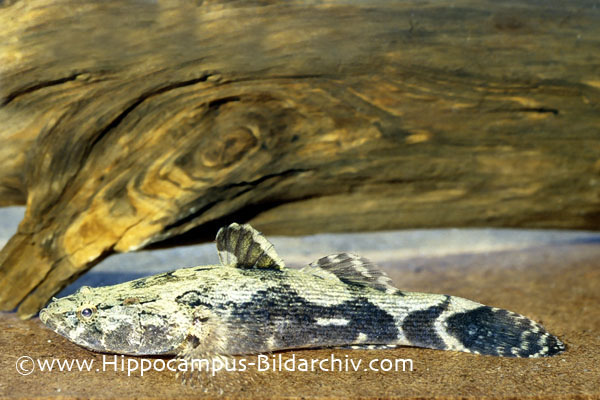
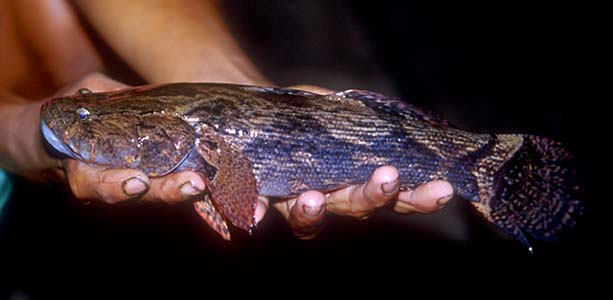
The marbled goby, Oxyeleotris marmorata, is one of the largest gobies in the world, found in Southeast Asia from Thailand to the Philippines. It lives in rivers, ponds, swamps and flooded forests, mainly in fresh water but also in brackish environments, and grows to 65 cm. A nocturnal ambush predator, it is territorial with its own kind and will eat any fish it can fit in its mouth, so it is best kept alone. It is also a popular food fish in some of its native countries.
Distribution
EditHabitat
Write a noteEditAquarium size
Write a noteEditA sedentary species, so a tank measuring 150 ∗ 60 ∗ 60 cm60 ∗ 24 ∗ 24 in - ~540 litres~143 US gal ought to be enough for all but the very largest specimens. Young fish can obviously be grown on in smaller tanks.
Maintenance
Write a noteEditThe fish like to dig, and sometimes partially bury themselves, so a soft substrate of sand, several inches in depth is recommended. Provide hiding places using large chunks of bogwood, lengths of plastic piping, or clay flowerpots. Dim lighting is also preferable, as this is essentially a nocturnal species.
Water conditions
EditTemperature: 22 – 28 °C72 – 82 °F
pH: 6.5-7.5
Hardness: 10-15°H
These recommendations come from this profile’s own figures. They contain affiliate links, so we may earn a commission.
Diet
Write a noteEditAlthough strictly carnivorous in nature, many captive specimens can be trained to take dried pellets. It should definitely be offered a meat-based diet, however. Young fish will accept bloodworm, small earthworms etc., while larger fish will take whole prawns, large earthworms, lancefish and other similar foods. Take care not to overfeed as these fish are very greedy indeed.
Behaviour and compatibility
Write a noteEditTerritorial with its own kind and will consume any fish it can fit in its capacious mouth. It is therefore best kept alone, although we have seen large specimens coexisting with other similarly-sized fish that inhabitb other parts of the aquarium, such as arowana. Obviously, a very large tank would be required if this is to be attempted.
Sexual dimorphism
Write a noteEditMale fish have a longer anal fin and more extended second dorsal fin. Apparently the genital papilla is also more pointed in the male than in the female.
Reproduction
Write a noteEditNot thought to have been bred in captivity. Any attempt would surely prove problematic, due to the adult size of the fish and their territorial, predatory nature.
Notes
EditOne of the largest goby species in the world, O. marmorata is unsuitable for the vast majority of aquaria, but is an interesting oddball for the true enthusiast with the facilities to house it properly. It is a nocturnal ambush predator and generally remains motionless during daylight hours unless striking at food. It is a popular food fish in some of its native countries, where it is known as soon hock.
Species images · 2
These photographs are used with each photographer’s permission.
Send a photographProfile completeness19 of 24
79% complete
Also missing: a recorded distribution, taxonomic authority, etymology.
Community
Questions about Oxyeleotris marmorata?
Ask on Discord