Results for “non-native”
Type a name: scientific, common, or one a species used to go by. Or narrow the catalogue with the filters.
Filters
Glossolepis wanamensisLake Wanam Rainbowfish
authority not recorded
Max length100mm SL3.9in SLTank90 × 30cm36 × 12inTemp25–30°C77–86°FpH7.0–8.0Lake Wanam has been the subject of a management project co-ordinated by famous aquarist Heiko Bleher, who became concerned by an apparent drop in numbers of both this species and the barred rainbowfish (Chilatherina fasciata), which is also found in the lake. The drop in numbers is thought to be a result of the introduction of non-native Tilapia, Gambusia and carp species into the lake, along with a significant increase in the number of humans living in the area. G. wanamensis is now considered ...
Oreochromis mossambicusMozambique Mouthbrooder
authority not recorded
Max length390mm SL15in SLTank210 × 60cm84 × 24inTemp21–27°C70–81°FpH6.2–8.5One of the most invasive fish species in the world, O. mossambicus is one of the species farmed for supermarkets and restaurants across the globe. Several colour varieties have been selectively bred from the natural green fish to make the fish more appealing to consumers and unsurprisingly, it is these more brightly coloured forms which are usually seen in aquaria. Some of these variants are cross breeds with other species of Oreochromis. The destructive effect of O. mossambicus on non-nativ...
Oreochromis niloticus niloticusNile Tilapia
authority not recorded
Max length600mm SL24in SLTank210 × 60cm84 × 24inTemp21–27°C70–81°FpH6.2–8.5One of the most invasive fish species in the world but also one of the most economically important, O. niloticus is bred in huge numbers in many countries as a food fish. It is often cross-bred with other Oreochromis species for colour in order to make the fish more appealing to consumers. The destructive effect of O. niloticus on non-native ecosystems into which it escapes or is released is mainly due to it's adaptibility. It has been recorded over a temperature range of 60-110°F an...
Pungu maclareni
authority not recorded
Max length100mm SL3.9in SLTank75 × 30cm30 × 12inTemp28–30°C82–86°FpH7.5–8.5This is currently the only described species in the genus Pungu. Because of it's its tiny natural range, habitat destruction due to excess water removal (the nearby town of Kumba relies on the lake for it's water supply), deforestation, the introduction of non-native species and overfishing, it is considered to be critically endangered and all efforts at captive breeding are to be encouraged. It is correspondingly rare in the hobby, and we suggest purchasing some only if you intend to ...
Stomatepia pindu
authority not recorded
Max length90mm SL3.5in SLTank75 × 30cm30 × 12inTemp28–30°C82–86°FpH7.5–8.5Because of it's its tiny natural range, habitat destruction due to excess water removal (the nearby town of Kumba relies on the lake for it's water supply), deforestation, the introduction of non-native species and overfishing, it is considered to be critically endangered. All efforts at captive breeding are to be encouraged. However, it is correspondingly rare in the hobby. The area around Lake Barombi Mbo has been suggested to be designated a protected area, but as yet this has not o...
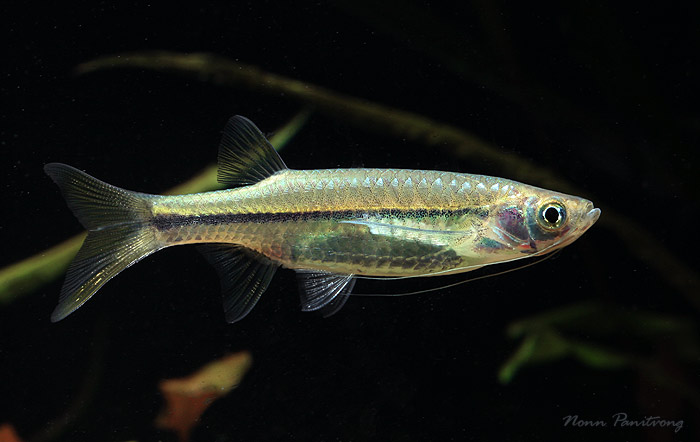
Esomus metallicusStriped Flying Barb
Ahl, 1923
Max length75mm SL3.0in SLTank120 × 30cm48 × 12inTemp20–26°C68–79°FpH6.0–7.0There currently exist a dozen described Esomus spp. alhough few are seen in the aquarium trade and none are especially popular. Most are commonplace in their native countries and also quite plainly-patterned so generally overlooked by collectors. Their most common use in some areas is actually as a feeder fish in the aquaculture of larger species. They're characterised by greatly-enlarged pectoral fins and two pairs of barbels, of which the maxillary pair are extremely long and usually reach the pectoral fins.
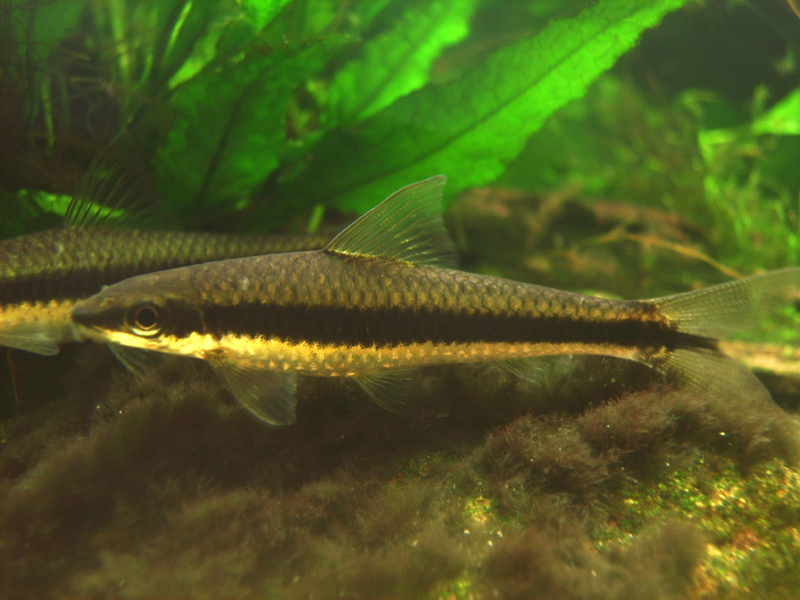
Crossocheilus langeiSiamese Algae Eater
Bleeker, 1860
Max length150mm SL6in SLTank150 × 45cm60 × 18inTemp20–26°C68–79°FpH6.0–7.5C. oblongus is another name widely misused in the trade but that species has seemingly never been exported and was described as a blueish fish with yellow fins. It's native to streams of Gunung Salak mountain in Bogor Regency, West Java, Indonesia where collecting of ornamental fishes is almost non-existent. Other species of laterally-striped Crossocheilus also exist and may be available from time-to-time but are more easily told apart from the group described above.