Pungu maclareni
On this page11 sections
Quick facts
Difficulty3 of 8 measures
More bars, more demanding. Hardiness is not averaged with the rest.
- Space
- modest tank
- Water
- mild adjustment
- Temp
- specialist range
- Diet
- unknown
- Temperament
- unknown
- Social
- unknown
- Compatibility
- unknown
Hardiness on its own can raise the rating, whatever the measures above say.
- Hardiness
- unknown
This is currently the only described species in the genus Pungu. Because of it's its tiny natural range, habitat destruction due to excess water removal (the nearby town of Kumba relies on the lake for it's water supply), deforestation, the introduction of non-native species and overfishing, it is considered to be critically endangered and all efforts at captive breeding are to be encouraged. It is correspondingly rare in the hobby, and we suggest purchasing some only if you intend to ...
Distribution
Cameroon. It is endemic to Lake Barombi Mbo, a volcanic crater lake with a diameter of just 3 miles.
Habitat
It is found in shallow water around the shores of the lake.
Aquarium size
75 ∗ 30 ∗ 30 cm30 ∗ 12 ∗ 12 in - ~68 litres~18 US gal.
Maintenance
Not much is written about the fish's natural biotope. We suggest a sandy substrate with some piles of rockwork arranged to form caves and hiding places.
Water conditions
Temperature: 28 – 30 °C82 – 86 °F
pH: 7.5-8.5
Hardness: 4-12°H
These recommendations come from this profile’s own figures. They contain affiliate links, so we may earn a commission.
Diet
The species has developed unique dentition to allow it to consume freshwater sponges that exist abundantly in the lake. In the aquarium it is reckoned that a herbivorous diet is best; apparently the fish can develop internal problems if fed with too many high-protein foods. Small meals of live and frozen foods such as bloodoworm or Daphnia can be offered, but should be considered a "treat" rather than a staple part of the diet.
Behaviour and compatibility
It is best kept in a species tank to give you the highest possible chances of a successful spawn.
Sexual dimorphism
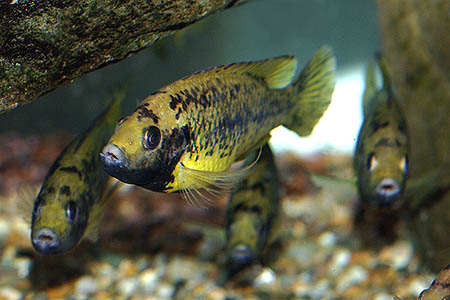
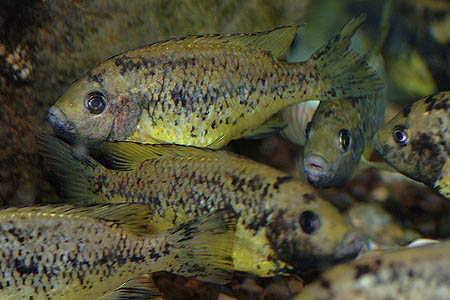
Not easily sexed. It is the only known cichlid in which both sexes exhibit a yellow and black colouration. The easiest way to sex it is by observing its behaviour, or by analysis of the vents, although this approach is for the expert fishkeeper only.
Reproduction
Has been achieved in captivity but little information is available. It's a maternal mouthbrooder.
Notes
This is currently the only described species in the genus Pungu. Because of it's its tiny natural range, habitat destruction due to excess water removal (the nearby town of Kumba relies on the lake for it's water supply), deforestation, the introduction of non-native species and overfishing, it is considered to be critically endangered and all efforts at captive breeding are to be encouraged. It is correspondingly rare in the hobby, and we suggest purchasing some only if you intend to breed the fish and distribute the offspring wisely. The area around Lake Barombi Mbo may be designated a protected area in the future, but at time of writing this had not occured.
Unusually for a fish it has been proven that it developed as a direct result of hybridisation between 2 other species. It also exhibits unique (among cichlids) adaptations to the mouthparts, having enlarged jaw muscles and small teeth which are used to tear small chunks from it's characteristic diet of freshwater sponges (another feature particular to this species).
Species images · 2
Used with the photographer’s permission. Not licensed for reuse.
Profile completeness16 of 24
67% complete
Also missing: a recorded distribution, taxonomic authority, a common name, etymology.
Community
Questions about Pungu maclareni?
Ask on Discord