Barbonymus altus
Red-tailed Tinfoil Barb
Formerly Puntius bocourti Bleeker, 1864 · Barbus altus Günther, 1868 · Barbus foxi Fowler, 1937
Last revised 2015Edit this page
On this page13 sections
Quick factsEdit
Difficulty6 of 8 measures
- Space
- very large tank
- Water
- flexible
- Temp
- flexible
- Diet
- unknown
- Temperament
- eats smaller fish
- Social
- needs to be in a group
- Compatibility
- choose tankmates carefully
Other demands
Each of these can raise the rating on its own, whatever the measures above say.
- Hardiness
- unknown
- Needs a very large tank
Before you buy
Needs a tight-fitting lid as this species is known to jump
Be sure to fit the tank with a heavy, tightly-fitting cover as it can be quite skittish at times and has a powerful leap.
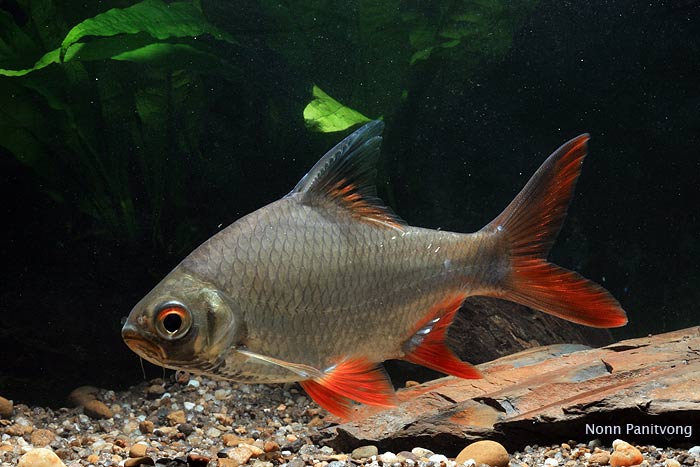
The red-tailed tinfoil barb, Barbonymus altus, is a large cyprinid from Thailand, Laos, Cambodia and Vietnam. One of two species traded as 'tinfoil barb', it is usually sold at 50 to 75 mm with little information on its eventual size, and long-term care is beyond the resources of most hobbyists. Natural fish lack the black stripe along each caudal-fin lobe seen in B. schwanefeldii, and adults have a golden or bronze hue.
Etymology
EditBarbonymus: from the generic name Barbus, to which members of this genus were previously assigned, and Ancient Greek ἀνώνυμος (anṓnumos), meaning 'anonymous', since this group of fishes had previously lacked a proper generic name.
altus: from the Latin altus, meaning 'high, deep', presumably in reference to this species' deep body shape.
Distribution
EditHabitat
Write a noteEditMostly inhabits larger river channels that are prone to flooding during the wet season as well as their surrounding floodplains. The fish move into inundated agricultural areas and forests during these wetter months to feed and spawn, returning to the rivers as the water begins to recede. It is also reported to be found in large numbers close to human towns and settlements.
Aquarium size
Write a noteEditAn aquarium with base dimensions of 150 ∗ 60 cm60 ∗ 24 in should be the minimum size considered.
Maintenance
Write a noteEditChoice of décor is not as critical as water quality and the amount of open swimming-space provided; we have seen very healthy-looking specimens being maintained in completely bare set-ups for example.
An enormous external-style filter or two are going to be needed in order to provide the desired levels of oxygen, flow and surface area for bacterial colonisation. Be sure to fit the tank with a heavy, tightly-fitting cover as it can be quite skittish at times and has a powerful leap.
Water conditions
EditThese recommendations come from this profile’s own figures. They contain affiliate links, so we may earn a commission.
Diet
Write a noteEditOmnivorous and something of an opportunist although studies suggest it is primarily a herbivore; wild Barbonymus have been observed feeding on invertebrates, algae, smaller fish, plant matter both aquatic and terrestrial and even carcasses of dead animals. In the aquarium it is just as easily-fed and will accept just about anything offered.
Ideally, offer regular meals of small live and frozen foods such as chironomid larvae (bloodworm), Daphnia and Artemia along with good quality dried flakes, granules and plenty of vegetable matter. Shelled peas, blanched courgette, spinach and chopped fruit all make good additions to the menu. Larger specimens will also take chopped earthworm, prawn, mussel etc., but take care not to overfeed.
Behaviour and compatibility
Write a noteEditNot aggressive but will eat small fishes and can upset slow-moving or more timid tankmates with its constant activity and rather vigorous feeding behaviour. It is therefore only appropriate for very large tanks containing robust, similarly-sized tankmates. There are plenty of suitable choices including many cichlids, catfish, other cyprinids and characins.
This species is found swimming in large schools in nature and some individuals can become skittish or even aggressive if kept in insufficient numbers in the aquarium, meaning a group of six or more should be the smallest considered. You will be rewarded with a much more natural-looking display plus interesting behaviour from the fish as they interact with conspecifics.
Sexual dimorphism
Write a noteEditMature females are usually deeper-bodied than males especially when in spawning condition. Otherwise there are no obvious external differences.
Reproduction
Write a noteEditNot known to have been bred in private aquaria but is used in aquaculture projects in its native countries. Like others in the genus it is an egg-scatterer that exhibits no parental care and produces large broods; a single female being capable of releasing thousands of eggs in a single event.
A serious attempt by the hobbyist would not be a tempting prospect as it would require a method of preventing the adults eating the eggs, an enormous aquarium, plus the facilities and contacts to raise and sell on hundreds of fish that are unsuitable for the vast majority of aquaria.
Notes
EditThis is one of two species traded under the vernacular name 'tinfoil barb', the other being the more well-known B. schwanefeldii. Despite this, it appears that B. altus is just as widely available as B. schwanefeldii and in many cases is seen on sale more regularly. Unfortunately both are usually offered at a small size (usually around 50 – 75 mm2.0 – 3.0 in) with little to no information regarding the eventual size of the fish.
Although B. altus is the smaller of the two its requirements still mean that long term care is beyond the resources of most hobbyists. Many shop-owners will tell you that tinfoil barbs are among the species most often returned having outgrown their aquarium, and many are reluctant to accept them as the resale value is very low.
The situation has been exacerbated by the development of ornamental colour forms including 'golden' and 'blushing' strains. These have been selectively-bred for the trade and have slightly gaudier colours than the wild fish thus increasing their sales potential. Care is identical to that described above and all are equally unsuitable for the majority of aquaria.
The easiest way to differentiate the natural forms of B. altus and B. schwanefeldii is by caudal-fin colour pattern, the latter possessing a distinct black stripe along each lobe which are absent in the former. Additionally adult specimens of B. altus tend to exhibit an overall golden/bronze hue to the body when compared with the more silvery B. schwanefeldii.
Kottelat (1998) gave the defining external characteristics of B. altus as: broad red distal margin with no black submarginal stripe along each lobe of the caudal fin; red pelvic and anal fins; a black distal blotch on the dorsal fin; the body depth 1.8-2.2 times in standard length.
The taxon Barbonymus was erected by Kottelat in 1999 and contains former members of Barbus and Barbodes from Southeast Asia. Most are rare in the ornamental trade, and all have previously been included in the genera Barbus, Puntius, and Barbodes, so you may see them listed with one or more of these names in older literature.
References
- Kottelat, M. (1998). Fishes of the Nam Theun and Xe Bangfai basins, Laos, with diagnoses of twenty-two new species (Teleostei: Cyprinidae, Balitoridae, Cobitidae, Coiidae and Odontobutidae). Ichthyological Exploration of Freshwaters 9(1), 1-128
- Rainboth, W. J. (1996). FAO species identification field guide for fishery purposes. Fishes of the Cambodian Mekong. Rome, FAO, 1-265
- Kottelat, M. (2013). The fishes of the inland waters of southeast Asia: a catalogue and core bibiography of the fishes known to occur in freshwaters, mangroves and estuaries. The Raffles Bulletin of Zoology Supplement 27, 1-663
- Günther, A. (1868). Catalogue of the Physostomi, containing the families Heteropygii, Cyprinidae, Gonorhynchidae, Hyodontidae, Osteoglossidae, Clupeidae,... [thru]... Halosauridae, in the collection of the British Museum. Catalogue of the fishes in the British Museum v. 7, i-xx + 1-512
Species images · 3
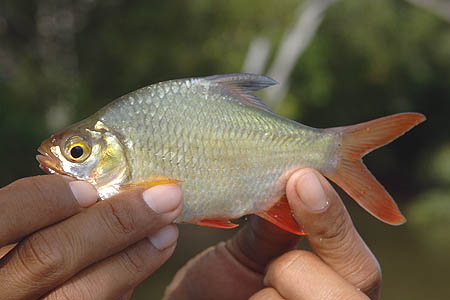
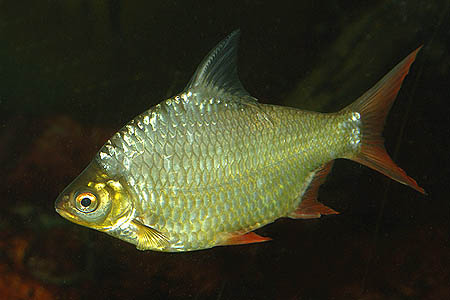
These photographs are used with each photographer's permission.
Send a photograph