Hobbyist group · Cypriniformes
Barbs & relatives
- Species
- 79
- Families
- 1
- Genera
- 15
- Photographed
- 79 of 79
- Difficulty rated
- 79 of 79
Families
Where they come fromnative records only

Barbodes aurotaeniatus
Cyprinidae · Tirant, 1885
Barbodes aurotaeniatus is a small cyprinid from the middle and lower Mekong basin in Laos, Vietnam, Cambodia and Thailand. Uncommon in the aquarium trade, it has a single pair of maxillary barbels, lacking the rostral barbels of other Barbodes, and usually four small vertical black markings on the flanks. It inhabits streams, irrigation canals and ditches, and is apparently very peaceful, best kept in a mixed-sex group of 6 to 10.
Barbodes banksi
Cyprinidae · Herre, 1940
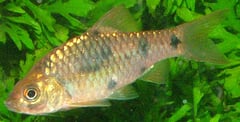
Barbodes banksi is a cyprinid from Peninsular Malaysia, Singapore and western Borneo, plus the Anambas and Natuna islands of Indonesia. It is tentatively considered distinct from the closely related B. binotatus, differing in a dark, wedge-shaped marking below the dorsal fin in place of a midlateral spot, though the two may be colour forms of a single species. Occasionally exported as bycatch, it lives in habitats from fast hill streams to canals and floodplain ponds.

Barbodes binotatusSpotted Barb
Cyprinidae · Valenciennes, 1842
The spotted barb, Barbodes binotatus, is a cyprinid ranging from Myanmar and Thailand through the Greater Sunda Islands to the Philippines. So ubiquitous across its range that it's often called simply 'common barb', it occurs from sea level to at least 2000 m in habitats from fast-flowing hill streams to irrigation canals and floodplain ponds. The basic pattern of a dark spot at the dorsal-fin origin and another on the caudal peduncle varies with origin.
Barbodes semifasciolatusGolden Barb*
Cyprinidae · Günther, 1868
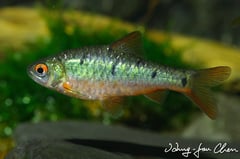
Barbodes semifasciolatus, the green or Chinese barb, is a cyprinid from Vietnam, Taiwan, southwestern China and northern Laos. The natural green form is an infrequent find in the trade, but the selectively-bred golden variant, first produced in the 1960s, is farmed in huge numbers. Commercial fish are largely inbred, with reduced fins and other deformities not uncommon. The name 'Puntius schuberti' often given to the golden form is not an official scientific name.
'Barbus' fasciolatusAfrican Banded Barb
Cyprinidae · Günther, 1868
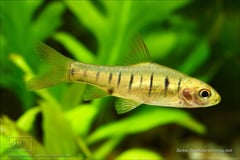
The African banded barb, 'Barbus' fasciolatus, is a small cyprinid widely distributed in Central Southern Africa, from Angola to Zimbabwe. For many years it was imported as Barbus/Barbodes barilioides, now a junior synonym, and it is also called the blue banded or Angola barb. It has 10 to 15 blue-black vertical bars and lives in slow-flowing, heavily vegetated lake shallows, floodplain lagoons and rainforest streams.

Dawkinsia rubrotinctus
Cyprinidae · Jerdon, 1849
Dawkinsia rubrotinctus is a cyprinid from southern India, considered widespread throughout the Cauvery drainage in Karnataka, Kerala and Tamil Nadu. It may have appeared in the trade under the misapplied names Puntius arulius and P. tambraparniei. Three small, well-defined dark body markings separate it from D. arulius, D. srilankensis and D. tambraparniei, in which the markings are larger and more diffuse.
Desmopuntius endecanalis
Cyprinidae · Roberts, 1989
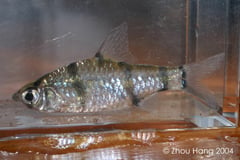
Desmopuntius endecanalis is a cyprinid apparently endemic to the Kapuas River basin in West Kalimantan, Borneo, including the Danau Sentarum lakes. A whitish base body colour and 8 (rarely 7) branched anal-fin rays distinguish it from congeners, and its placement in Desmopuntius was only tentative. Its habitat is unconfirmed, but related species are associated with peat swamps and black water streams.
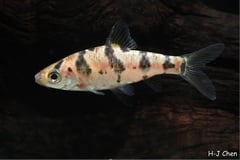
Desmopuntius foerschi
Cyprinidae · Kottelat, 1982
Sometimes traded as the 'boomerang barb' or 'Foersch's fire barb', Desmopuntius foerschi is a cyprinid from East and Central Kalimantan, Borneo. Extra dark blotches between the second, third and fourth vertical bars, and a mark at the rear of the dorsal-fin base, set it apart from other vertically-striped congeners. It probably inhabits peat swamps and associated blackwater streams, and information on its range is scarce.
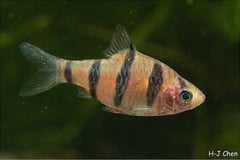
Desmopuntius hexazona'Pentazona' Barb
Cyprinidae · Weber & de Beaufort, 1912
Normally traded as the 'pentazona' barb, Desmopuntius hexazona is a cyprinid from southern Borneo, eastern Sumatra, Singapore and the Malay Peninsula. It is almost identical to D. pentazona, which has a small dark marking at the rear of the dorsal-fin base that D. hexazona lacks. Older literature may label it 'Puntius johorensis'. In Singapore it is considered highly endangered and is restricted to the Central Catchment nature reserve.
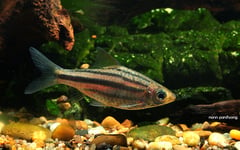
Desmopuntius johorensisStriped Barb
Cyprinidae · Duncker, 1904
The striped barb, Desmopuntius johorensis, is a cyprinid from southern Thailand, Peninsular Malaysia, Singapore, Sumatra and Borneo. Juveniles have 4 dark vertical bars and develop 5 or 6 broad lateral stripes as they grow, a pattern change shared with D. gemellus and D. trifasciatus. Before Kottelat (1992) it was referred to as Puntius eugrammus, while the name 'Puntius johorensis' was misapplied to D. hexazona. It lives mainly in peat swamps and black water streams.
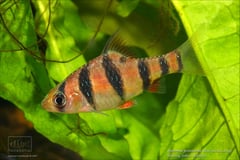
Desmopuntius pentazonaFive-banded Barb
Cyprinidae · Boulenger, 1894
The five-banded barb, Desmopuntius pentazona, is a cyprinid generally accepted to be endemic to northwestern Borneo, with a type locality in Sarawak. It is rare in the trade, and most fish sold as 'pentazona barb' are the closely-related D. hexazona. The two are almost identical, but D. pentazona has a small dark marking at the rear of the dorsal-fin base that D. hexazona lacks.
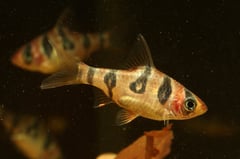
Desmopuntius rhomboocellatusSnakeskin Barb
Cyprinidae · Koumans, 1940
The snakeskin barb, Desmopuntius rhomboocellatus, is a cyprinid endemic to southern Kalimantan, the Indonesian portion of Borneo. It has been recorded from several river systems including the Kapuas, Kepayang and Barito. It most often inhabits peat swamps, black water streams and other still waters with submerged plants and dense riparian vegetation.
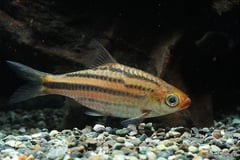
Desmopuntius trifasciatus
Cyprinidae · Kottelat, 1996
Desmopuntius trifasciatus is a cyprinid from Borneo, described from the Kapuas basin in West Kalimantan and also known from southern Sarawak. Like D. gemellus and D. johorensis, juveniles have 4 dark vertical bars, and fish over 40 mm have 3 or 4 broad lateral stripes, the central one broadest. It may also be confused with Striuntius lineatus.

Haludaria fasciataMelon Barb
Cyprinidae · Jerdon, 1849
The melon barb, Haludaria fasciata, is a small cyprinid endemic to the Western Ghats of southern India, in Goa, Karnataka, Kerala and Tamil Nadu. It exists in a number of colour forms, and it is undecided whether they are geographical variants or a complex of closely-related species. Also traded as the 'ember barb', 'banded barb' and 'black spot barb', it is relatively peaceful and hardy, but a vigorous feeder that may outcompete slower or more timid fishes.
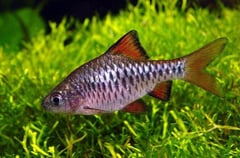
Oliotius oligolepisCheckered Barb
Cyprinidae · Bleeker, 1853
The checkered barb, Oliotius oligolepis, is a small cyprinid apparently endemic to western central Sumatra, Indonesia. Also traded as 'checker barb', 'checkerboard barb' or 'island barb', it is farmed commercially in enormous numbers and wild examples are rarely, if ever, available. Kottelat (2013) raised the genus Oliotius for it, diagnosed partly by black crescent-shaped marks on all scales.

Pethia conchoniusRosy Barb
Cyprinidae · Hamilton, 1822
The rosy barb, Pethia conchonius, is a small cyprinid found from Pakistan throughout India, Nepal and Bangladesh. Generally considered one of the hardiest small cyprinids in the hobby, it is an excellent choice for newcomers. Wild specimens are not usually available and the vast majority are commercially bred, with long-finned, 'veil-tail', 'super red', 'neon' and 'golden' strains among the forms selective breeding has produced. Feral populations exist in several countries.
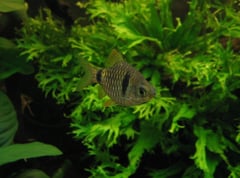
Pethia cumingiiCuming's Barb
Cyprinidae · Günther, 1868
Cuming's barb, Pethia cumingii, is a small cyprinid endemic to southwestern Sri Lanka, apparently only in the Bentara and Gin river drainages. It was long thought to occur in yellow- and red-finned forms, and the red-finned fish are now recognised as P. reval, a smaller species of sluggish lowland rivers. Reports suggest the more brightly-coloured fish are becoming scarcer, and selective collection for the aquarium trade may have altered wild populations.

Pethia didi
Cyprinidae · Kullander & Fang, 2005
Pethia didi is a small cyprinid from the Ayeyarwady drainage around Lake Indawgyi and Myitkyina, Kachin State, where it appears to be endemic. Rare in the aquarium trade though occasionally available, it has two black, vertically-orientated flank blotches, one behind the operculum and one on the caudal peduncle, a pattern shared with several congeners. The type locality is a swift, shaded stream through bamboo forest, and the species is subject to seasonal temperature fluctuations in nature.

Pethia manipurensis
Cyprinidae · Menon, Rema Devi & Vishwanath, 2000
Pethia manipurensis is a small cyprinid apparently endemic to Loktak Lake in Bishnupur District, Manipur state, northeastern India. The species is considered endangered with a declining population trend, though it is bred commercially for the aquarium hobby. Males carry orange-red pigmentation on the flanks and caudal fin, as in P. meingangbii and P. padamya, but its humeral marking is a small spot where both of those have a large, vertically-elongated one.
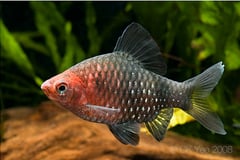
Pethia nigrofasciataBlack Ruby Barb
Cyprinidae · Günther, 1868
The black ruby barb, Pethia nigrofasciata, is a small cyprinid endemic to the Kelani and Nilwala river basins in the 'wet zone' of Sri Lanka. Sometimes traded as 'purple-headed barb' or 'ruby barb', it has three dark, vertical flank markings, and in spawning males the head and front of the body turn reddish-purple. Farm-raised fish are fairly adaptable in water chemistry, while wild stock are likely to prefer slightly acidic to neutral conditions.

Pethia padamyaOdessa Barb
Cyprinidae · Kullander & Britz, 2008
The Odessa barb, Pethia padamya, is a small cyprinid from central Myanmar, also recorded from the lower Chindwin, a tributary of the Ayeyarwady. In the trade since the early 1970s, it first appeared in Ukraine and was widely considered a hybrid until natural populations were found, with the formal description following in October 2008. Males carry a thick band of bright red-orange on the flanks, and farm-produced fish seem to hold their colour better when stressed.

Pethia phutunioDwarf Barb
Cyprinidae · Hamilton, 1822
The dwarf barb, Pethia phutunio, is a small cyprinid from the lower Ganges and Brahmaputra river basins in Bangladesh and India. Frequently misidentified and quite rare in the trade, it is sometimes called 'spotted-sail barb' or 'spotted-tail barb'. Several congeners share its two black flank blotches, but it is smaller than all of them at 25 to 30 mm. It inhabits sluggish rivers, streams, ponds and swamps, often over deep mud or silt.

Pethia pookodensisPookode Lake Barb
Cyprinidae · Mercy & Jacob, 2007
The Pookode Lake barb, Pethia pookodensis, is a small cyprinid described from Pookode Lake in Wayanad district, Kerala, and possibly endemic there. Pookode is a small forest lake and tourist destination that has suffered some degradation, and the IUCN classify the species as 'Critically Endangered'. It is most similar to P. ticto and P. punctata, with two dark flank markings, one on the front of the body and one on the caudal peduncle.

Pethia punctata
Cyprinidae · Day, 1865
Pethia punctata is a small cyprinid endemic to the Western Ghats of southwestern India, where it appears restricted to west-flowing rivers. Poorly known in the hobby, it has a confusing taxonomic history and has been treated as both a synonym and a subspecies of P. ticto. It has a complete lateral line, two dark body blotches with the front one a scale row below the lateral line, and rows of spots in the dorsal fin.
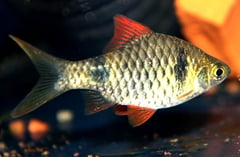
Pethia reval
Cyprinidae · Meegaskumbura, Silva, Maduwage & Pethiyagoda, 2008
Pethia reval is a small cyprinid endemic to western Sri Lanka, known from the Kelani and Maha Oya river systems and the drainages between them. Considered a red-finned colour form of P. cumingii before its description, it is a smaller fish, to 33.6 mm SL, with red dorsal, anal and pelvic fins (pale yellow in the Kalu River population). The Mahaweli River population appears to have been introduced.

Pethia setnaiNarayan Barb
Cyprinidae · Chhapgar & Sane, 1992
The Narayan barb, Pethia setnai, is a small cyprinid common in rivers draining the Western Ghats of India, described from Sanguem in Goa. It is widely traded as 'Puntius' narayani, though the trade fish all have the serrated dorsal-fin spine of P. setnai, a feature 'P.' narayani lacks. The central of its three dark flank markings, beneath the dorsal fin, is uniquely pale and diffuse. In hill streams and smaller rivers it gathers in backwater pools and deeper, slower areas.

Pethia sp. 'Myanmar'
Cyprinidae · authority not recorded
Pethia sp. 'Myanmar' appears to be an undescribed small cyprinid, supposedly collected in northern Myanmar. This fish has been widely misidentified and sold as the congener P. tiantian or 'Burmese bumble-bee barb'. Generally very peaceful, it suits the well-researched community aquarium in a mixed-sex group of at least 8-10, where rival males display their best colours.

Pethia stoliczkana
Cyprinidae · Day, 1871
Pethia stoliczkana is a small cyprinid that appears to range from Manipur state in northeastern India through Myanmar and Thailand to western Laos. Much of the literature confuses it with P. ticto, but the two do not occur in the same waters and the lateral line is complete in this species and incomplete in P. ticto. The form from Mandalay division in Myanmar is sometimes sold as Puntius sp. 'pearlscale'. It mostly inhabits shady, flowing streams and tributaries.

Pethia tiantian
Cyprinidae · Kullander & Fang, 2005
Pethia tiantian is a small cyprinid known only from the remote, mountainous area of Putao in Kachin state, northern Myanmar. Both known localities, the Nan Hto Chaung and the Mali Hka River, are part of the upper Ayeyarwady system. The species is only exported occasionally, and an undescribed fish often traded as 'Burmese bumblebee barb' is sometimes mislabelled with its name. It is subject to seasonal temperature fluctuations in nature.

Pethia tictoTicto Barb
Cyprinidae · Hamilton, 1822
The ticto barb, Pethia ticto, is a small cyprinid widely distributed through most of the Indian subcontinent, from Pakistan and Nepal to Bangladesh. Its name is frequently misapplied to P. padamya in aquarium literature, though P. ticto is much the less colourful fish and males lack reddish-orange pigmentation on the body. Morphology and colour pattern vary by population, and some populations have already been described as distinct species.
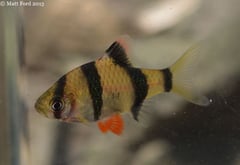
Puntigrus anchisporus
Cyprinidae · Vaillant, 1902
Puntigrus anchisporus is a small cyprinid endemic to Borneo, recorded from Kalimantan in Indonesia and much of Sarawak in Malaysia. One of the four-barred species once called the 'Puntius tetrazona group', it has a complete lateral line, a black dorsal fin with a red outer band and red pelvic fins. It occasionally appears in the hobby, but the trade relies largely on commercially-produced 'tiger barbs' of questionable origin.

Puntigrus partipentazona
Cyprinidae · Fowler, 1934
Puntigrus partipentazona is a small cyprinid recorded from numerous river basins in Vietnam, Cambodia, Laos, Thailand and Peninsular Malaysia. It is easily told from congeners because the dark blotch on its dorsal fin extends onto the body. Typically found in heavily vegetated parts of rivers and sluggish streams, it is generally peaceful, though rival males continually battle for position within the group.
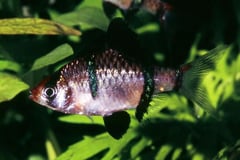
Puntigrus pulcher
Cyprinidae · Rendahl, 1922
Puntigrus pulcher is a small cyprinid endemic to the Indonesian part of eastern Borneo, with records from the Kayan and Mahakam rivers. Considered a synonym of P. anchisporus for decades following Alfred (1963), it was revalidated by Kottelat and Tan (2011). It has an incomplete lateral line, an entirely black dorsal fin and black pelvic fins, and occasionally appears in the hobby, though the trade relies largely on commercially-produced 'tiger barbs'.
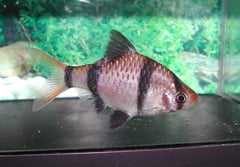
Puntigrus tetrazonaTiger Barb
Cyprinidae · Bleeker, 1855
The tiger barb, Puntigrus tetrazona, is a small cyprinid probably endemic to central and southern Sumatra, Indonesia. Among the most ubiquitous species in the aquarium trade, it is seen mostly as commercially-produced fish and ornamental strains, and wild examples are rarely traded. The identity of the 'aquarium' tiger barb is the subject of ongoing confusion, and many farmed fish are weak or deformed through inbreeding.

Puntius bimaculatusTwo-spotted Barb
Cyprinidae · Bleeker, 1863
The two-spotted barb, Puntius bimaculatus, is a small cyprinid from Sri Lanka and southern India. It lives in flowing hill streams and quieter stretches in the middle reaches of rivers, but tends to be absent from lowland environments. Also called the 'redside barb', it has 7 branched dorsal-fin rays and round dark spots at the base of the dorsal and caudal fins. Generally very peaceful, it is a schooling species and at least 6-10 should be kept.

Puntius cholaSwamp Barb
Cyprinidae · (Hamilton, 1822)
The swamp barb, Puntius chola, is a cyprinid from much of Pakistan, India, Nepal, Bhutan, Bangladesh, Sri Lanka, Myanmar and western Thailand. Sometimes called the 'chola' or 'green' barb, it has a single pair of barbels and dark blotches behind the operculum and near the caudal-fin base. It apparently prefers stiller waters over mud or silt, and makes an ideal addition to a peaceful community of riverine fishes.

'Puntius' guganioGlass Barb
Cyprinidae · Hamilton, 1822
The glass barb, Puntius guganio, is a small cyprinid widespread in the Ganges and Brahmaputra river systems of Bangladesh, Nepal and northern India. It lives in slow-moving or standing waters such as pools, ditches and minor rivers. Poorly known in the hobby, it is of uncertain taxonomic placement, and its stiff, serrated last dorsal-fin ray, incomplete lateral line and 36-39 lateral scales are shared only with 'P.' nangalensis.

'Puntius' lineatusLined Barb
Cyprinidae · Duncker, 1904
The lined barb, 'Puntius' lineatus, is a laterally-striped cyprinid from Peninsular Malaysia, Sumatra and Borneo, found mostly in peat swamps. It is most often confused with 'P.' johorensis, the two being the most common of the striped species in the trade, but it has no more than one pair of barbels, lacks vertical bars as a juvenile and grows smaller. Its habitats include black water streams stained brown with humic acids, with pH as low as 3.0 or 4.0.

Puntius mahecola
Cyprinidae · Valenciennes, 1844
Puntius mahecola is a cyprinid from rivers draining much of the Western Ghats mountains in Kerala, Karnataka and Tamil Nadu states, southern India. The name was misapplied to members of Dawkinsia for over a century, while the fish itself was widely misidentified as P. amphibius. A relatively plain fish, it has a single dark blotch on the caudal peduncle behind the anal fin. D. assimilis and other Dawkinsia species appear on trade lists as 'mahecola barb'.

'Puntius' snyderi
Cyprinidae · Oshima, 1919
'Puntius' snyderi is a cyprinid from central and northern Taiwan, found in shallow margins of slow streams, irrigation canals and ponds. Almost identical to the wild form of 'P.' semifasciolatus, the 'golden barb' of the hobby, it is reliably told apart externally only by its tiny, indistinct barbels. It is also a deeper-bodied fish with 4-5 main dark markings on the flank, and the two differ genetically.

Puntius terioOnespot Barb
Cyprinidae · Hamilton, 1822
The onespot barb, Puntius terio, is a cyprinid widely distributed from Pakistan through northern India, Nepal and Bangladesh. Its range covers parts of the Indus, Ganges and Brahmaputra drainages, where it apparently prefers stiller waters over mud or silt. Populations vary in colour pattern to an extent, but all share a diffuse yellow-golden marking on the operculum and a dark spot on the caudal peduncle.

Puntius titteyaCherry Barb
Cyprinidae · Deraniyagala, 1929
The cherry barb, Puntius titteya, is a small cyprinid endemic to the Kelani and Nilwala river basins in the southwestern 'wet zone' of Sri Lanka. Among the most ubiquitous small cyprinids in the hobby and an unreserved choice for beginners, it is sold mostly as commercially farmed stock, including albino and 'super red' strains. Generally very peaceful, it is a schooling species and at least 6-10 should be kept.

Puntius vittatusGreenstripe Barb
Cyprinidae · Day, 1865
The greenstripe barb, Puntius vittatus, is a small cyprinid widely distributed in India, with further populations in Pakistan and Sri Lanka. Sometimes called the 'kooli barb', it lacks barbels and has a vertical black streak and an orange-marked black tip on the dorsal fin. It most commonly occurs in lowland streams, pools, irrigation channels and rice paddies over mud or silt, and is not an especially popular aquarium fish despite its wide range.

Sawbwa resplendens
Cyprinidae · Annandale, 1918
Sawbwa resplendens is a small cyprinid endemic to Inlé Lake and its associated watershed in Shan State, eastern Myanmar. It is traded as 'Asian rummynose', 'rummynose rasbora' and 'naked microrasbora', and is listed as 'Endangered' on the IUCN Red List. Rival males are engaged in a continual battle for dominance, so it is not an ideal choice for the general community aquarium, and keeping more females than males helps.
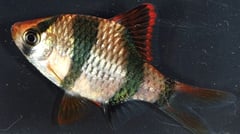
Puntigrus navjotsodhii
Cyprinidae · Tan, 2012
Puntigrus navjotsodhii is a small cyprinid known only from the upper Katingan and Barito river basins in Central Kalimantan, Indonesian Borneo. The type series came from a small clear-water hill stream of riffles and deeper pools over sand, gravel and rocks. Among the four-barred Puntigrus species it has broad black bars up to five scales wide, black lips and almost entirely red pelvic fins in life.
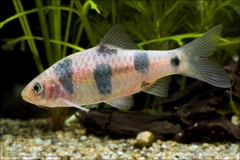
Barbodes dunckeriClown Barb
Cyprinidae · Ahl, 1929
The clown barb, Barbodes dunckeri, is a cyprinid from Peninsular Malaysia, described from Singapore, where it may now be extirpated. It has been widely misidentified as B. everetti, a distinct species from Borneo, and appears under that name in most aquarium literature. B. dunckeri has much larger dark body markings, no blotch at the rear of the dorsal-fin base and 4½ scales above the lateral line. Fish entering the ornamental trade appear to be farm-raised.
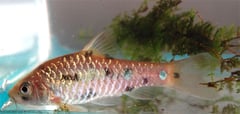
Barbodes everetti
Cyprinidae · Boulenger, 1894
Barbodes everetti is a cyprinid from Borneo, known from Sarawak and West Kalimantan, where it lives in clear forest streams in the foothills. Uncommon in the hobby, its name has been widely misapplied to the clown barb, B. dunckeri, from Peninsular Malaysia and Singapore. B. everetti is the less colourful of the two, with relatively small dark body markings, a dark blotch at the rear of the dorsal-fin base and 3½ scales above the lateral line.
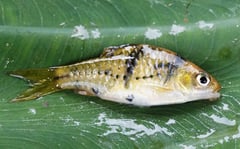
Barbodes kuchingensisFalse Spanner Barb
Cyprinidae · Herre, 1940
The false spanner barb, Barbodes kuchingensis, is a cyprinid apparently endemic to western Borneo, from Sarawak into the Kapuas system. It lives mainly in shallow, clear forest streams and is rarely exported, while subadult B. everetti and some populations of B. lateristriga are regularly traded under its name. B. kuchingensis sensu stricto has a prominent row of dark spots along the lateral line and a short streak extending from the upper part of the operculum.
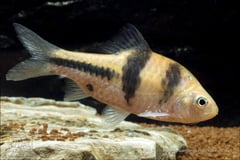
Barbodes lateristrigaSpanner Barb
Cyprinidae · Valenciennes, 1842
The spanner barb or 'T-barb', Barbodes lateristriga, is a cyprinid from peninsular Thailand, Peninsular Malaysia, Singapore, Sumatra and Java. Its colour pattern varies with locality, and the form most commonly seen in the trade corresponds most closely to fish from Johor. The species may prove to be a complex of closely-related taxa. Quite boisterous, it can intimidate more timid species with its size and activity, especially at feeding times.
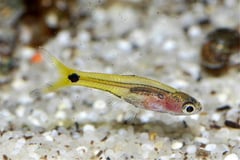
Barboides gracilis
Cyprinidae · Brüning, 1929
Barboides gracilis is a miniature cyprinid from coastal West and Central Africa, ranging from Benin through Nigeria and Cameroon to Equatorial Guinea. Adults measure less than 20 mm SL, and it inhabits slow-moving, shady rainforest streams and swamps with dense marginal vegetation. It has a following among enthusiasts of planted 'nano' aquaria and may be sold as 'dwarf amber/ember barb'. Very peaceful but timid, it is best kept alone or with other diminutive West African species.

Barbonymus altusRed-tailed Tinfoil Barb
Cyprinidae · Günther, 1868
The red-tailed tinfoil barb, Barbonymus altus, is a large cyprinid from Thailand, Laos, Cambodia and Vietnam. One of two species traded as 'tinfoil barb', it is usually sold at 50 to 75 mm with little information on its eventual size, and long-term care is beyond the resources of most hobbyists. Natural fish lack the black stripe along each caudal-fin lobe seen in B. schwanefeldii, and adults have a golden or bronze hue.
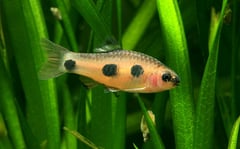
'Barbus' candens
Cyprinidae · Nichols & Griscom, 1917
'Barbus' candens is a small African barb from the Congo basin in northern and central DR Congo, mainly between Lisala and Kisangani. It lives in slow-moving, shady rainforest streams and swamps with soft, acidic, brown-stained water. Rare in the trade and sporadically collected, it can be told from the better-known 'B.' hulstaerti, which has a bluer body, larger dark markings and yellow fins in males. Its shy nature suits it to a tank of similarly small, peaceful species.
'Barbus' guiraliAfrican Blackfin Barb
Cyprinidae · Thominot, 1886
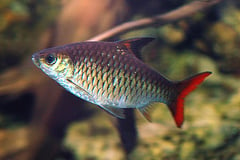
The African blackfin barb, 'Barbus' guirali, is a cyprinid recorded only from Cameroon and Gabon, including the Sanaga and Ogooué basins. Primarily a river fish, it also enters affluent streams and tributaries. It is rare in the hobby and little is known of its captive care, though one lone fish kept by a forum member behaved well, and a batch of what appeared to be a different species has been imported under the same name.
'Barbus' holotaeniaSpotscale Barb
Cyprinidae · Boulenger, 1904
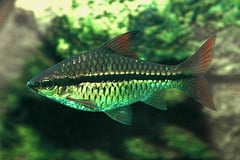
The spotscale barb, 'Barbus' holotaenia, is a cyprinid from Central West Africa, found principally in the Ogooué and Congo river systems. It has been recorded right across DR Congo and appears to be primarily riverine. Rare in the hobby, it has been suggested as the closest surface-dwelling relative of the Congo blind barb, Caecobarbus geertsii, a claim the profile considers questionable.
'Barbus' hulstaertiAfrican Butterfly Barb
Cyprinidae · Poll, 1945
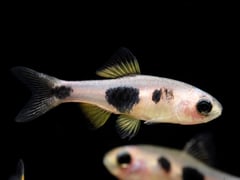
The African butterfly barb, 'Barbus' hulstaerti, is a cyprinid endemic to DR Congo, in rainforest south and east of the main Congo River channel. It reappeared in the trade in 2006 after an absence of 25 years. It lives in slow-moving, shady rainforest streams and swamps with very soft, acidic, brown-stained water, and its shy, retiring nature makes it unsuitable for most community tanks.
'Barbus' jae
Cyprinidae · Boulenger, 1903
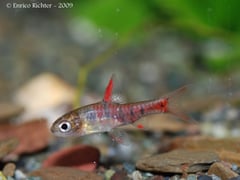
'Barbus' jae is a small, delicate African barb from Cameroon, Equatorial Guinea, Gabon and the two Congos, sometimes sold as 'jae' or 'charcoal' barb. Populations vary in colour and pattern with locality, and the forms should never be mixed in the aquarium, to avoid crossbreeding. It lives in shady rainforest streams and swamps with soft, acidic, brown-stained water, and its shy nature makes it unsuitable for most community aquaria.
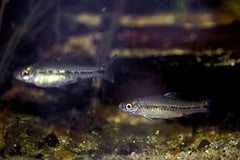
'Barbus' sublineatus
Cyprinidae · Daget, 1954
'Barbus' sublineatus is a widespread West African barb found in river basins from Senegal east to Cameroon, including the Niger and Volta. It is very variable in patterning and can be difficult to identify: Upper Niger fish show three elongate midlateral markings, Middle Niger fish a continuous band and Volta fish four spots. It may prove to be a complex of closely-related species. Little is known of its captive care.
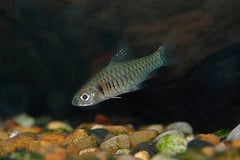
Clypeobarbus congicusCongo Barb
Cyprinidae · Boulenger, 1899
The Congo barb, Clypeobarbus congicus, is a small African cyprinid from the Congo River drainage in the Republic of Congo and DR Congo. Rare in the hobby, it often turns out to be something else when it appears on exporters' lists. Its genus is characterised by a midlateral row of greatly enlarged, shield-like scales. A shoaling species with a distinct pecking order between males, it should be kept in a group of 8 or more in a well-planted tank.

Dawkinsia arulius
Cyprinidae · Jerdon, 1849
Dawkinsia arulius is a cyprinid from Karnataka, southwestern India, apparently now restricted to the upper Cauvery and the Tungabhadra headwaters. Adults have three large, diffuse dark markings on the body. It appears extirpated at its type locality, most likely because of the Krishna Raja Sagara dam upstream, and the fish traded as 'arulius barb' is often the related D. tambraparniei, in which males have filamentous dorsal-fin rays.

Dawkinsia assimilisMascara Barb
Cyprinidae · Jerdon, 1849
The mascara barb, Dawkinsia assimilis, is a cyprinid from the Netravati, Chalakudy and Kallada basins of Karnataka and Kerala, India. The caudal-fin lobes are tipped with a black band about as wide as the eye, faint or absent in Kallada fish. Misidentified in the past as Puntius mahecola, it still appears on trade lists as 'mahecola barb', and some populations might represent distinct species.

Dawkinsia exclamatio
Cyprinidae · Pethiyagoda & Kottelat, 2005
Dawkinsia exclamatio is a cyprinid from the Kallada River in southern Kerala, India, and may be endemic to that river system. Rare in the hobby, it occasionally arrives as bycatch among similar-looking species such as D. assimilis. Two black blotches on each flank set it apart from the rest of the group, but there is a case that it is a natural hybrid between D. assimilis and a D. arulius-like fish found with it at its type locality.

Dawkinsia filamentosaFilament Barb
Cyprinidae · Valenciennes, 1844
The filament barb, Dawkinsia filamentosa, is a cyprinid endemic to the Western Ghats region of southern India, in Kerala, Tamil Nadu and Karnataka. Adult males and some females develop filament-like extensions to the branched dorsal-fin rays. Most common in lowland coastal floodplains, it occurs in fresh and brackish water, and it also appears on trade lists as 'blackspot barb' or 'mahecola barb'.

Dawkinsia rohani
Cyprinidae · Rema Devi, Indra & Knight, 2010
Dawkinsia rohani is a cyprinid known only from Kanyakumari District, Tamil Nadu state, at the southern tip of the Indian peninsula. A single black club-shaped blotch running back to the caudal-fin base, with no other body markings in front of it, separates it from congeners. Habitat data are lacking, but it is a pelagic, riverine species and apparently most common in hill streams.

Dawkinsia tambraparniei'Arulius' Barb
Cyprinidae · Silas, 1954
The 'arulius' barb, Dawkinsia tambraparniei, is a cyprinid possibly restricted to the middle Tambraparni River basin in Tamil Nadu, southern India. Described as a subspecies of D. arulius, it appears in most earlier aquarium literature as Puntius arulius or 'arulius barb' and is often still traded as such, although D. arulius is quite different-looking and rarely exported. Many fish in the trade are likely to have been bred commercially.
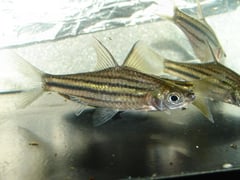
Desmopuntius gemellus
Cyprinidae · Kottelat, 1996
Desmopuntius gemellus is a rarely-traded cyprinid from eastern Sumatra and the island of Bangka, Indonesia. Like D. johorensis and D. trifasciatus, it is vertically barred as a juvenile and changes to a pattern of thin lateral stripes, a change that begins at around 20 mm SL and is normally complete by 30 to 40 mm. It inhabits peat swamp forests and associated black water streams.

Pethia aurea
Cyprinidae · Knight, 2013
Pethia aurea is a small cyprinid known from ponds in South 24 Parganas District, West Bengal, in the Ganges delta of northern India. Considered a phenotype of the similar P. gelius before its description, it has a yellowish-golden body, a broad black band around the caudal peduncle and a black blotch beneath the dorsal-fin origin. Very peaceful but timid, it does best in a group of at least 8-10 alongside other diminutive species.

Pethia canius
Cyprinidae · Hamilton, 1822
Pethia canius is a small cyprinid from West Bengal in northern India, with recent collections from Cooch Behar and Nadia districts. Long considered a synonym of the closely related P. gelius, it had its identity settled and a neotype designated by Knight (2013). It inhabits ponds and other still-to-sluggish waters, and its small size and timid nature mean it does best alone or with other diminutive species.

Pethia erythromycterLipstick Barb
Cyprinidae · Kullander, 2008
The lipstick barb, Pethia erythromycter, is a small cyprinid from the upper Ayeyarwady River basin in northern Myanmar, including Lake Indawgyi. Sometimes traded as 'Tulip barb', it first appeared in the hobby in 2006 and was described by Kullander (2008). Males have red pigmentation around the mouth and tubercules on the snout when nuptial. It may nip slow-moving or long-finned tankmates but does very well with other small, active cyprinids or nemacheilid loaches.

Pethia geliusGolden Dwarf Barb
Cyprinidae · Hamilton, 1822
The golden dwarf barb, Pethia gelius, is a small cyprinid native to the Ganges and Brahmaputra river drainages of northern India and Bangladesh. Records suggest a wider range, including Tamil Nadu and the Ayeyarwady delta in Myanmar, though the latter may warrant investigation. Knight (2013) settled its identity, revalidating P. canius and describing P. aurea, both previously treated as phenotypes of P. gelius. Very peaceful but timid, it does best alone or with other diminutive species.

Pethia nigripinnis
Cyprinidae · Knight, Rema Devi, Indra & Arunachalam, 2012
Pethia nigripinnis is a small cyprinid of cool, flowing hill streams in Kerala and Tamil Nadu, apparently endemic to the southern Western Ghats. Adult males have black dorsal, anal, pelvic and pectoral fins. Its need for cooler temperatures makes it unlikely to suit the general community aquarium, and it will probably do best alone or with comparably-sized species needing similar conditions.

Pethia shalyniusShalyni Barb
Cyprinidae · Yazdani & Talukdar, 1975
The Shalyni barb, Pethia shalynius, is a small cyprinid that appears to be endemic to Meghalaya state in northeastern India. It is known from only a handful of localities in the Khasi and Jaintia hills, mostly streams above 1200 metres with cool, clear, well-oxygenated water, and is apparently under threat from industrial activity. Very peaceful, it is still a poor choice for the general community aquarium because of its preference for cooler temperatures.

Puntius sahyadriensisMaharaja Barb
Cyprinidae · Silas, 1953
The maharaja barb, Puntius sahyadriensis, is a cyprinid endemic to the northern and central Western Ghats mountains of India. It lives in hill streams shaded by the forest canopy and dense marginal vegetation, over boulders, stones, sand or gravel. The angular body, colour pattern and enlarged male dorsal fin make it difficult to confuse with any other member of the genus, and it is occasionally traded as the 'Khavli' barb.

Puntius sharmai
Cyprinidae · Menon & Rema Devi, 1993
Puntius sharmai is a small cyprinid known only from a handful of localities around Chennai in Tamil Nadu, India. It mostly inhabits ponds and lakes, many of them in urban areas under pressure from urbanisation. Very peaceful but small and timid, it does best alone or with other diminutive species, and it is almost unheard of in the hobby outside India.

Sahyadria chalakkudiensis
Cyprinidae · Menon, Rema Devi & Thobias, 1999
Sahyadria chalakkudiensis is a cyprinid from Kerala, southern India, known from the Chalakudy, Periyar, Pamba and Achankovil rivers. It was first exported in 1996 under the name S. denisonii, from which it differs in its inferior mouth, a black marking in the dorsal fin, and a duller scarlet body stripe. It can be belligerent and is unsuitable for the general community aquarium.

Sahyadria denisoniiRed-line Torpedo Barb
Cyprinidae · Day, 1865
The red-line torpedo barb, Sahyadria denisonii, is a cyprinid endemic to Kerala and Karnataka in southern India. Extremely popular since it appeared in the trade in the late 1990s, it is listed as Endangered by the IUCN, and collection for the aquarium trade has been held largely responsible for its decline. Large numbers are produced in Southeast Asia and Eastern Europe. The similar S. chalakkudiensis is occasionally traded as this species and is more belligerent.

Puntius kamalikaKami's Barb
Cyprinidae · Silva, Maduwage & Pethiyagoda, 2008
Kami's barb, Puntius kamalika, is a cyprinid endemic to Sri Lanka, widespread in the southwestern 'wet zone' between the Kelani and Gin basins. Common throughout its range, it has been collected from rivers, streams and marshland. Before its description it was referred to as P. amphibius, a putatively valid species probably restricted to western India, and it lacks prominent markings on the body and fins.

Barbonymus gonionotus
Cyprinidae · Bleeker, 1849
Barbonymus gonionotus is a large cyprinid with an enormous distribution across Southeast Asia, from the Mekong to Java and Sumatra. It inhabits larger, slow-moving rivers and their floodplains, moving into flooded forest to feed and spawn, and is increasingly found in man-made canals and lakes. Plain grey caudal and dorsal fins and pale yellow pelvic and anal fins separate it from congeners. Populations in Peninsular Malaysia appear to be introduced.

Barbonymus schwanefeldiiTinfoil barb
Cyprinidae · Bleeker, 1854
The tinfoil barb, Barbonymus schwanefeldii, is a large cyprinid found across much of Southeast Asia, from the Mekong to Borneo and Sumatra. Usually sold at 50 to 75 mm, it grows to 355 mm SL, and tinfoil barbs are among the species most often returned to shops having outgrown their aquarium. Selectively-bred 'golden' and 'blushing' strains exist, and the species has also been subjected to artificial dyeing.

Systomus orphoides
Cyprinidae · Valenciennes, 1842
Systomus orphoides is a large cyprinid ranging from Myanmar to Vietnam and south through Peninsular Malaysia to Borneo, Sumatra and Java. It mostly inhabits flowing tributaries and large streams, moving onto inundated farmland and forest in the wet season to feed and spawn. Not often available in the trade and usually seen as bycatch, it grows to 250 mm SL, is quite boisterous, and needs more-or-less spotless water.