River
Mun
Only species with a profile on Seriously Fish are counted.
- Species
- 29
- Families
- 7
- Photographed
- 29 of 29
- Difficulty rated
- 29 of 29
Basin
Also in the Mekong basinspecies recorded from both
Shares fishes with rivers elsewherespecies recorded from both
Runs through

Akysis variusVariable Stream Catfish
Akysidae · Ng & Kottelat, 1998
The variable stream catfish, Akysis varius, is a small akysid catfish from the Mekong drainage in Laos, Thailand and Cambodia. The number of serrations on its pectoral spine varies, and in contrast to other Akysis with serrated spines, the larger specimens examined had fewer or none. Members of the genus live almost exclusively in swiftly flowing streams and rivers over sand, gravel and rocks.

Bagrichthys majusculusWhite-Whisker Lancer
Bagridae · Ng, 2002
The white-whisker lancer, Bagrichthys majusculus, is a bagrid catfish from the Mekong and Chao Phraya river systems in Thailand and Laos. Described from the Mun River in eastern Thailand, it is most similar to B. macracanthus and B. vaillantii and differs from both in its longer pectoral-fin spines. It inhabits large, turbid, slow rivers and moves into flooded riparian zones to spawn in the wet season. A shy, nocturnal fish, it is territorial towards other bottom-dwellers, especially its own kind.

Bagrichthys obscurus
Bagridae · Ng, 1999
Bagrichthys obscurus is a bagrid catfish from the Chao Phraya, Bang Pakong and Mekong watersheds in Thailand, Cambodia and Vietnam. One of the lancers, named for the extended dorsal spine in several members of the genus, it has a uniformly brown body with no pale stripe or blotches, a small mouth and a relatively short dorsal spine. It inhabits large, turbid rivers with slow flow, and is shy, nocturnal and territorial towards other bottom-dwellers.

Barbodes aurotaeniatus
Cyprinidae · Tirant, 1885
Barbodes aurotaeniatus is a small cyprinid from the middle and lower Mekong basin in Laos, Vietnam, Cambodia and Thailand. Uncommon in the aquarium trade, it has a single pair of maxillary barbels, lacking the rostral barbels of other Barbodes, and usually four small vertical black markings on the flanks. It inhabits streams, irrigation canals and ditches, and is apparently very peaceful, best kept in a mixed-sex group of 6 to 10.

Barbonymus altusRed-tailed Tinfoil Barb
Cyprinidae · Günther, 1868
The red-tailed tinfoil barb, Barbonymus altus, is a large cyprinid from Thailand, Laos, Cambodia and Vietnam. One of two species traded as 'tinfoil barb', it is usually sold at 50 to 75 mm with little information on its eventual size, and long-term care is beyond the resources of most hobbyists. Natural fish lack the black stripe along each caudal-fin lobe seen in B. schwanefeldii, and adults have a golden or bronze hue.

Betta smaragdinaEmerald Betta
Osphronemidae · Ladiges, 1972
The emerald betta, Betta smaragdina, is a bubble-nesting labyrinth fish from the Khorat Plateau in eastern Thailand and Mekong tributaries in Laos. It inhabits still and sluggish waters such as rice paddies, swamps and roadside ditches. It has been line-bred for aggression in eastern Thailand, and selectively bred and hybridised for the ornamental trade into colour forms that do not occur naturally. Wild populations vary in the extent of red or green patterning and are often labelled by locality.

Datnioides undecimradiatusMekong Tiger Perch
Datnioididae · Roberts & Kottelat, 1994
The Mekong tiger perch, Datnioides undecimradiatus, is known only from the middle and lower Mekong basin in Thailand, Laos, Cambodia and Vietnam. An efficient, largely piscivorous predator of large, deep lowland rivers, it is marked with 4 relatively thin dark bars. The names 'Siamese tiger fish' and 'gold datnoid' are sometimes applied to it, but more typically belong to D. pulcher.

Epalzeorhynchos munense
Cyprinidae · Smith, 1934
Epalzeorhynchos munense is a cyprinid from the Mun river and other tributaries of the middle Mekong in Thailand and Laos. It resembles E. bicolor and E. frenatum but has a black head, body and anal fin, red caudal and dorsal fins, and black margins on the pelvic and pectoral fins. A record from the Tonlé Sap system may refer to E. frenatum.

Hampala disparSpotted Hampala Barb
Cyprinidae · Smith, 1934
The spotted hampala barb, Hampala dispar, is a cyprinid endemic to the Mekong basin in northern Laos, Thailand and Cambodia. It needs plenty of space but, at up to 350 mm SL, makes a more suitable aquarium fish than the larger and more commonly traded H. macrolepidota. It has a single dark blotch on the body and less well-defined marginal stripes on the caudal lobes, although juveniles of the two can appear very similar.

Hypsibarbus lagleri
Cyprinidae · Rainboth, 1996
Hypsibarbus lagleri is a large cyprinid endemic to the middle Mekong basin in Laos, eastern Thailand and Cambodia. It migrates seasonally, living in larger river channels in the dry season and moving into smaller tributaries and flooded forests in the wetter months. Growing to 350 mm, it is a valued food fish, and like most of its congeners is thought to be in decline because of the damming of rivers and agriculture.
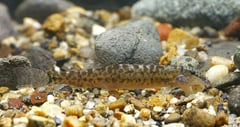
Lepidocephalichthys kranos
Cobitidae · Havird & Page, 2010
Lepidocephalichthys kranos is a cobitid loach from the Chao Phraya system in Thailand and the Mekong in Thailand, Laos and Vietnam. Some private collectors have kept it. Its colour pattern tends to form a mosaic, unlike the irregular spotting of most congeners, and the body deepens steeply behind the snout to give a 'hunched' appearance. It can often be found living with L. hasselti.
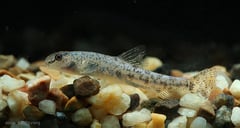
Lepidocephalichthys zeppelini
Cobitidae · Havird & Tangjitjaroen, 2010
Lepidocephalichthys zeppelini is a tiny cobitid loach from the Mekong system in Thailand and Vietnam and the Chao Phraya drainage in central Thailand. Adults reach only 25.8 mm SL, and the lamina circularis of mature males forms a large, finely serrated flange. Many adults at the type locality were collected from remnant ephemeral pools in otherwise dry agricultural land.

Luciosoma bleekeri
Cyprinidae · Steindachner, 1878
Luciosoma bleekeri is a slender, pike-like cyprinid from the Mekong in Laos, Thailand, Cambodia and Vietnam, and from central and western Thailand. Subadults are traded regularly as 'apollo shark' or 'shark minnow' and it is frequently confused with L. setigerum, which has a series of black spots on the lateral line scales that this species lacks. It needs the largest private aquaria, and feeds mainly on terrestrial insects taken at the surface.

Luciosoma setigerumApollo Shark
Cyprinidae · Valenciennes, 1842
The apollo shark, Luciosoma setigerum, is a slender cyprinid found across much of Southeast Asia, from the Mekong basin to Borneo, Sumatra and Java. Subadults are traded regularly and are frequently confused with L. bleekeri, which lacks the series of black spots on the lateral line scales. A similar fish of unknown origin with no stripe on the front of the body is also common in the trade, listed as L. cf. setigerum. It needs the largest private aquaria.

Mystacoleucus greenwayi
Cyprinidae · Pellegrin & Fang, 1940
Mystacoleucus greenwayi is a riverine cyprinid from the middle Mekong basin in Thailand and Laos and the Chao Phraya watershed. It favours clear, well-oxygenated running water over sand or gravel, often in rock and boulder-filled headwater streams. A schooling fish, it should be kept in a group of six or more alongside similarly-sized cyprinids, loaches and other riverine fishes, and like all Mystacoleucus it has a forward-pointing predorsal spine that can snag in a net.

Opsarius koratensis
Cyprinidae · Smith, 1931
Opsarius koratensis is a cyprinid of the middle and lower Mekong in Thailand, Laos and Cambodia, and the Chao Phraya, Mae Klong and Dong Nai systems. It apparently inhabits larger, deeper and more turbid rivers than many congeners. Genetic evidence from Tang et al. (2010) suggests it may represent a distinct genus, and it occasionally appears in the ornamental trade.

Trichopsis pumilaSparkling Gourami
Osphronemidae · Arnold, 1936
The sparkling gourami, Trichopsis pumila, is a small labyrinth fish from the lower Mekong basin and central and southern Thailand. Also known as the pygmy gourami, it has a solid dark midlateral stripe topped by a row of dark blotches, which with its small size separates it from T. schalleri. Both sexes produce audible 'croaking' sounds with a specialised pectoral mechanism, and most traded fish are produced commercially.

Trichopsis schalleri
Osphronemidae · Ladiges, 1962
Trichopsis schalleri is a croaking gourami from the lower Mekong basin and the Chao Phraya watershed in Thailand, Laos, Cambodia and Vietnam. Sometimes called the Mekong croaking gourami or three-stripe gourami, it is larger than the similar T. pumila, and its upper body stripe varies with mood and sometimes fades entirely. Peaceful unless breeding, it can be kept in a pair or a group.
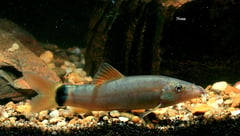
Yasuhikotakia leconteiSilver Loach
Botiidae · Fowler, 1937
The silver loach, Yasuhikotakia lecontei, is a botiid loach from the middle and lower Mekong and the Chao Phraya and Mae Klong drainages of Thailand. Sometimes confused with Y. modesta, it is a slimmer, more elongate fish, usually brownish with a gold/green sheen, and its roundish caudal peduncle markings do not meet on the ventral surface. It forages under cover of dusk and darkness, and SF members report it milder in temperament than Y. eos and Y. morleti.
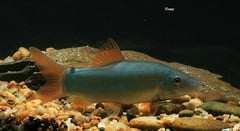
Yasuhikotakia modestaRedtail Loach
Botiidae · Bleeker, 1864
The redtail loach, Yasuhikotakia modesta, is a botiid loach from the middle and lower Mekong and the Chao Phraya and Mae Klong drainages of Thailand. One of the more commonly encountered botiids in the hobby, it is also sold as 'blue', 'orange-finned' or 'red-finned' botia. Some fish are dyed and sold as 'blueberry' or 'raspberry' loach, and their health is normally compromised by the process. Deeper-bodied than the similar Y. lecontei, it grows to 250 mm and needs an aquarium with a base of at least 150 ∗ 45 cm.
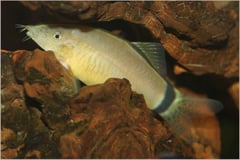
Yasuhikotakia morletiSkunk Loach
Botiidae · Tirant, 1855
The skunk loach, Yasuhikotakia morleti, is a botiid loach from the middle and lower Mekong and the Chao Phraya and Mae Klong drainages of Thailand. Common in the hobby, where most fish are farmed commercially, it is also sold as 'skunk botia' or 'Hora's loach'. The dark stripe over its dorsal surface separates it from the similar Y. longidorsalis. It can be combative, nipping fins and harassing tankmates, especially when kept in smaller groups.

Hemibagrus wyckioidesAsian Red Tailed Catfish
Bagridae · Fang & Chaux, 1949
The Asian red tailed catfish, Hemibagrus wyckioides, is a bagrid from the Mekong system in China, Laos, Vietnam, Cambodia and Thailand. It also occurs in the Chao Phraya drainage. The largest bagrid in central Indochina, it reaches at least 900–1000 mm and 70–80 kg, and the largest specimen known measured 1300 mm. Juveniles are sometimes sold, but buying them is strongly discouraged given its size, aggression and a lifespan of several decades.

Labeo chrysophekadionBlack Shark
Cyprinidae · Bleeker, 1849
The black shark, Labeo chrysophekadion, is a large cyprinid from Southeast Asia, including the Mekong, Chao Phraya and the Greater Sunda Islands. Also known as the black sharkminnow, it reaches 600 mm and is aggressively territorial towards conspecifics and similarly-shaped fishes. It continues to be sold despite its patent unsuitability for the home aquarium, and an albino form has been selectively bred for the trade.

Amblyrhynchichthys micracanthus
Cyprinidae · Ng & Kottelat, 2004
Amblyrhynchichthys micracanthus is a riverine cyprinid from the Mekong catchment in Laos, Thailand, Cambodia and Vietnam, and the Chao Phraya system. It moves into inundated forest during the wet season, and wild fish feed on periphyton, plankton and benthic algae. Older records of A. truncatus from mainland Indochina all refer to this species, which has a straighter snout profile, a shorter dorsal-fin spine and fewer gill rakers.

Gymnostomus ornatapinnis
Cyprinidae · Roberts, 1997
Gymnostomus ornatapinnis is a small cyprinid known only from the Mekong River system in Laos, Thailand and Cambodia. It appears to favour still or slow-moving, often temporarily-inundated, marginal habitats away from the major river channels. Barbels are completely absent, the caudal peduncle is very deep, and the pectoral, pelvic and anal fins are usually reddish-orange or rose-tinted.

Hypsibarbus pierreiYellow Eyed Silver Barb
Cyprinidae · Sauvage, 1880
The yellow eyed silver barb, Hypsibarbus pierrei, is a large cyprinid from the middle and lower Mekong basin in Laos, Thailand, Cambodia and Vietnam. It also occurs in the Dong Nai drainage, and migrates seasonally from larger river channels in the dry season to spawning grounds that remain unknown. Reaching at least 300 mm, it is a valued food fish, and most Hypsibarbus species are thought to be in decline because of the damming of rivers and agriculture.

Mystacoleucus atridorsalis
Cyprinidae · Fowler, 1937
Mystacoleucus atridorsalis is a pelagic cyprinid considered endemic to the lower Mekong basin in Laos, Thailand and Cambodia. It favours flowing lowland river channels and moves into flooded forest during the wet season. A triangular blotch at the tip of the dorsal fin helps separate it from congeners, and like all Mystacoleucus it has a forward-pointing predorsal spine that can become entangled in an aquarium net.

Mystacoleucus chilopterus
Cyprinidae · Fowler, 1935
Mystacoleucus chilopterus is a pelagic cyprinid from the middle Mekong, Chao Phraya and Mae Klong basins in Laos and Thailand. It favours flowing lowland rivers and swiftly-flowing forest streams with rock and gravel. The anal fin has a concave margin and the dorsal and caudal fins black margins, and like all Mystacoleucus it has a forward-pointing predorsal spine that can become entangled in an aquarium net.

Mystacoleucus ectypus
Cyprinidae · Kottelat, 2000
Mystacoleucus ectypus is a pelagic cyprinid from the middle Mekong basin in Laos and Thailand, and may be endemic to the Khorat Plateau. It inhabits flowing lowland rivers and swift tributary streams with rock and gravel. It has a triangular blotch at the tip of the dorsal fin but no black fin margins or crescent-shaped scale markings, and like all Mystacoleucus it has a forward-pointing predorsal spine that can snag in a net.