Corydoras britskii
Giant Brochis
Formerly Brochis britskii Nijssen & Isbrucker, 1983
On this page13 sections
Quick facts
Difficulty6 of 6 measures
More bars, more demanding.
- Space
- large tank
- Water
- mild adjustment
- Temp
- unfussy
- Temperament
- peaceful
- Social
- shoal
- Compatibility
- community tank
Brochis was first synonymised with Corydoras by Britto (2003), since the latter genus cannot be considered monophyletic if the former is accepted as valid. This decision has been supported in subsequent phylogenetic studies by Shimabukuro-Dias et al. (2004) and Alexandrou et al. (2011), although the name Brochis is still common in aquarium literature. It is likely that the genus will be revalidated and expanded in the future following a required taxonomic review of the subfamily Corydoradinae as suggested by Alexandrou and Taylor (2011).
Etymology
Corydoras: from the Ancient Greek κόρυς (korus), meaning ‘helmet’, and δορά (dora), meaning ‘skin, hide of an animal’, in allusion to the rows of bony plates on the flanks of genus members.
britskii: named for Brazilian ichthyologist Heraldo A. Britski.
Distribution
Habitat
This species tends to form aggregations in smaller tributaries and still bodies of water such as backwaters, oxbows and marginal lakes.
Aquarium size
Minimum base dimensions of 120 ∗ 45 cm48 ∗ 18 in or equivalent are recommended.
Maintenance
Ideally use a substrate of fine sand, although rounded gravel is an acceptable alternative provided it is kept scrupulously clean.
Other décor is largely down to personal choice, but some cover should be provided to give the fish security.
Water conditions
These boxes carry affiliate links and we may earn a commission. What they recommend comes from each profile’s own figures, never chosen by hand or paid for.
Diet
Corydoras spp. are foraging omnivores and will accept most sinking dried foods, as well as small live and frozen varieties such as chironomid larvae (bloodworm), Tubifex, etc.
Feeding a varied diet will ensure the fish are in optimum condition.
Under no circumstances should they be expected to survive on 'left-overs' from other inhabitants of the aquarium or relied on to 'clean' the aquarium.
.
Behaviour and compatibility
Peaceful and gregarious. Should be maintained in a group of at least 6-8 individuals.
Sexual dimorphism
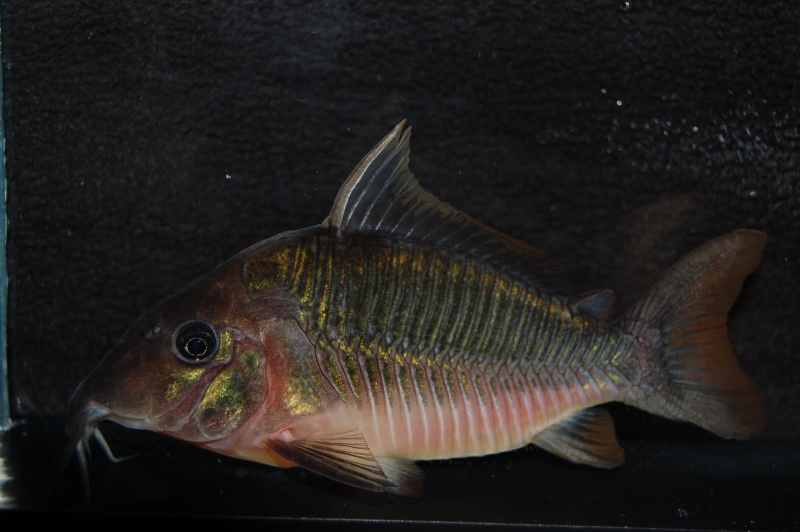
Adult females are noticeably rounder, higher-bodied, and grow slightly larger than males.
Reproduction
Unreported.
Notes
This species was formerly classified in the genus Brochis and is sometimes referred to as 'Britski's catfish'.
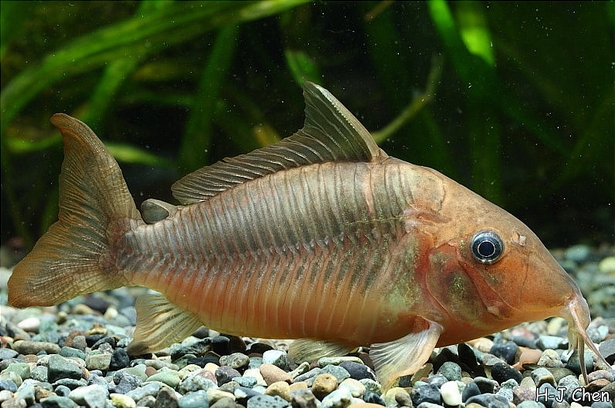
C. britskii can be told apart from other ex-Brochis species by possession of 15-18, normally 15, dorsal-fin rays (vs. 10-12 in C. splendens and normally 17-18 in C. multiradiatus). All other members of the genus Corydoras, as well as the closely-related Aspidoras and Scleromystax, possess 6-8 dorsal-fin rays.
Brochis was first synonymised with Corydoras by Britto (2003), since the latter genus cannot be considered monophyletic if the former is accepted as valid. This decision has been supported in subsequent phylogenetic studies by Shimabukuro-Dias et al. (2004) and Alexandrou et al. (2011), although the name Brochis is still common in aquarium literature. It is likely that the genus will be revalidated and expanded in the future following a required taxonomic review of the subfamily Corydoradinae as suggested by Alexandrou and Taylor (2011).
The genus Corydoras is included in the family Callichthyidae, of which members are often referred to collectively as 'armoured' or 'mailed' catfishes group due to the presence of bony plates in place of scales on the body. Their taxonomy can be confusing, and numerous undescribed species are also thought to exist. Fish of unconfirmed identification entering the aquarium hobby are therefore typically assigned a 'C' or 'CW' number for purposes of reference and organisation.
They are facultative air breathers and possess a modified, highly vascularised intestine which has evolved to facilitate uptake of atmospheric oxygen and aid survival in oxygen-deprived environments. In the aquarium you'll occasionally see them rising to the surface to take in gulps of air.
The stiffened pectoral-fin spines are capable of piercing human skin and a 'sting' can be very painful indeed, so care should be exercised when handling them. It's thought that secretions from the axillary glands at the base of each spine may even be mildly toxic or venomous.
References
- Reis, R. E., S. O. Kullander and C. J. Ferraris, Jr. (eds) (2003). Check list of the freshwater fishes of South and Central America. CLOFFSCA. EDIPUCRS, Porto Alegre, i-xi + 1-729
- Fuller, I. A. M., and H-G. Evers (2005). Identifying Corydoradinae Catfish. Verlag A.C.S. GmbH, 1-384
- Ferraris, C. J., Jr. (2007). Checklist of catfishes, recent and fossil (Osteichthyes: Siluriformes), and catalogue of siluriform primary types. Zootaxa 1418, 1-628
- Alexandrou, M. A. and M. I. Taylor (2011). Evolution, Ecology and Taxonomy of the Corydoradinae Revisited. In: Identifying Corydoradinae Catfish. Verlag A.C.S. GmbH, 101-114
- Alexandrou, M. A., C. Oliveira, M. Maillard, R. A. R. McGill, J. Newton, S. Creer, and M. I. Taylor (2011). Competition and phylogeny determine community structure in Müllerian co-mimics. Nature 469, 84-89
- Britto, M. R. (2003). Phylogeny of the subfamily Corydoradinae Hoedeman, 1952 (Siluriformes: Callichthyidae), with a definition of its genera. Proceedings of the Academy of Natural Sciences of Philadelphia, 153, 118-154
- Hoedeman, J. J. (1952). Notes on the Ichthyology of Surinam (Dutch Guiana). The Catfish genera Hoplosternum and Callichthys, with key to the genera and groups of the family Callichthyidae. Beaufortia 1(12), 1-11
- Reis, R. E. (1998). Anatomy and phylogenetic analysis of the neotropical callichthyid catfishes (Ostariophysi, Siluriformes). Zoological Journal of the Linnean Society 124(2), 105-168
- Shimabukuro-Dias, C. K., C. Oliveira, R. E. Reis and F. Foresti (2004). Molecular phylogeny of the armored catfish family Callichthyidae (Ostariophysi, Siluriformes). Molecular Phylogenetics and Evolution 32(1), 152-163
- Nijssen, H. and I. J. H. Isbrücker (1983). Brochis britskii, a new species of plated catfish from the Upper Rio Paraguai system, Brazil (Pisces, Siluriformes, Callichthyidae). Bulletin Zoölogisch Museum, Universiteit van Amsterdam 9(20), 177-186
Species images · 2
Used with the photographer’s permission. Not licensed for reuse.
Distribution
Profile completeness23 of 24
96% complete
Missing: water condition notes.