Country · South America
Brazil
Only species with a profile on Seriously Fish are counted, whether native or introduced.
- Species
- 272
- Families
- 28
- Genera
- 102
- Found only here
- 104
- Photographed
- 265 of 272
Shares its fishes withspecies recorded in both
Found only here104
104 of the species on this page are recorded in Brazil and in no other country. This is not the same as being endemic.
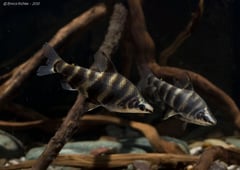
Abramites hypselonotusMarbled Headstander
Anostomidae · (Günther, 1868)
The marbled headstander, Abramites hypselonotus, is an anostomid from the Amazon, Orinoco and Paraguay-Paraná basins in South America. An ecological generalist, it occurs in turbid main river channels, minor tributaries and backwaters, and enters inundated zones during the annual floods. Best kept as a group in a large tank alongside cichlids, characins and catfishes, it may nip long or trailing fins and eat soft-leaved plants.
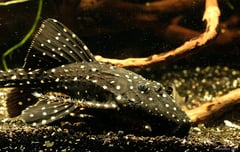
Acanthicus adonisPolka Dot Lyre Tail Pleco
Loricariidae · Isbrücker & Nijssen, 1988
The polka dot lyre tail pleco, Acanthicus adonis, is a very large loricariid catfish from the rio Tocantins in Brazil. Thought to range across much of the Amazon basin, it is traded as spotted juveniles in quite large numbers despite its patent unsuitability for aquaria. It reaches 600 mm or more, loses its spotted patterning as it matures and becomes increasingly belligerent with age, so it can only be recommended to owners of the largest private aquaria or tropical ponds.
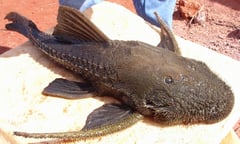
Acanthicus hystrixL155
Loricariidae · Spix & Agassiz, 1829
The lyre tail pleco, Acanthicus hystrix, is a very large loricariid catfish from the Amazon region of Brazil and Peru. A handful of records come from the Orinoco in Venezuela. Juveniles are traded in quite large numbers, but it can reach at least 1000 mm in nature and 500 to 600 mm in captivity, and becomes increasingly belligerent with age. Young fish are easily told from A. adonis by lacking its white to yellowish body spots.
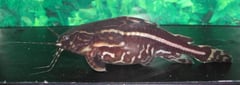
Acanthodoras cataphractusChocolate Talking Catfish
Doradidae · (Linnaeus, 1758)
The chocolate talking catfish, Acanthodoras cataphractus, is a doradid catfish from the northern Amazon basin and Atlantic drainages of the Guianas. It is most often exported as bycatch among Platydoras armatulus and is sold under the same trade names as A. spinosissimus, which has pale blotches on the back between the dorsal and caudal fins where this species has pale lines or no markings. Largely nocturnal and gregarious, it is best kept in a group of at least four.
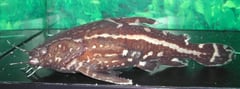
Acanthodoras spinosissimusChocolate Talking Catfish
Doradidae · (Eigenmann & Eigenmann, 1888)
The chocolate talking catfish, Acanthodoras spinosissimus, is a doradid catfish from the northern Amazon basin and the Essequibo in Guyana. Usually exported as bycatch among Platydoras armatulus, it is sold under the same trade names as A. cataphractus, and the most useful difference is the pale blotches on its back between the dorsal and caudal fins. Largely nocturnal and gregarious, it is best kept in a group of at least four.
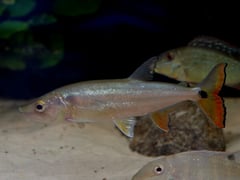
Acestrorhynchus altusRed Barracuda Tetra
Acestrorhynchidae · Menezes, 1969
The red barracuda tetra, Acestrorhynchus altus, is a predatory acestrorhynchid that may be restricted to the lower Amazon in Brazil. A member of the A. lacustris group, it has a round humeral spot and is virtually impossible to tell from its relatives in the trade unless collection data is known. An obligate piscivore of open water, it is best kept in a group of four or more of comparable size, since acestrorhynchids are cannibalistic.
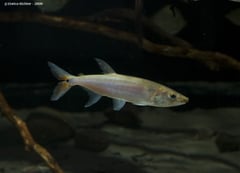
Acestrorhynchus falcatusRed-Tailed Freshwater Barracuda
Acestrorhynchidae · (Bloch, 1794)
The red-tailed freshwater barracuda, Acestrorhynchus falcatus, is a predatory acestrorhynchid from the northern Amazon and Orinoco basins. It also occurs in coastal rivers of Guyana, Suriname and French Guiana. Its large humeral spot, shaped like an inverted tear drop, separates it from other Acestrorhynchus. Reaching 250 to 275 mm, it needs plenty of open water, and a group must be of comparable size because acestrorhynchids are cannibalistic.
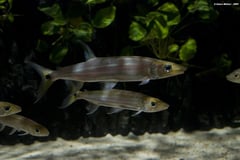
Acestrorhynchus falcirostrisBig-Eyed Cachorro
Acestrorhynchidae · (Cuvier, 1819)
The big-eyed cachorro, Acestrorhynchus falcirostris, is a large predatory acestrorhynchid from northern Amazon drainages and the Orinoco. The two dark body stripes of the A. nasutus group appear only in its juveniles, and at 320 to 350 mm SL it grows far larger than the other members. A black fringe to the rear of the operculum gives it a 'collared' look. It needs open water, and a group must be of comparable size because acestrorhynchids are cannibalistic.
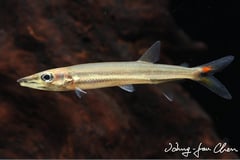
Acestrorhynchus isalineaeStriped Barracuda Tetra
Acestrorhynchidae · Menezes & Géry, 1983
The striped barracuda tetra, Acestrorhynchus isalineae, is a small predatory acestrorhynchid from the rio Madeira basin in the Brazilian Amazon. Most records come from the type locality, a tributary of the rio dos Marmelos. Like others in the A. nasutus group it keeps two dark longitudinal stripes into adulthood and stays around 100 mm. Acestrorhynchids are cannibalistic given the opportunity, so a group must be of comparable size.
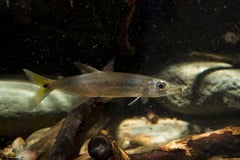
Acestrorhynchus microlepisPike Tetra
Acestrorhynchidae · (Jardine, 1841)
The pike tetra, Acestrorhynchus microlepis, is a predatory acestrorhynchid from northern Amazon drainages and the Orinoco. It also occurs in coastal rivers of Guyana, Suriname and French Guiana. A member of the A. microlepis group, it has a small blackish spot behind the gill cover and is separable from the very similar A. grandoculis only by counts. It tends to take smaller prey such as tetras, and acestrorhynchids are cannibalistic, so a group must be of comparable size.
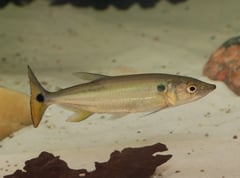
Acestrorhynchus pantaneiroPantanal Barracuda Tetra
Acestrorhynchidae · Menezes, 1992
The Pantanal barracuda tetra, Acestrorhynchus pantaneiro, is a predatory acestrorhynchid from the Paraná, Uruguay and de la Plata basins. It also occurs in the rio Mamoré in Bolivia. A member of the A. lacustris group with a round humeral spot, it is virtually impossible to tell from its relatives in the trade unless collection data is known. It lives in open water, and a group must be of comparable size because acestrorhynchids are cannibalistic.
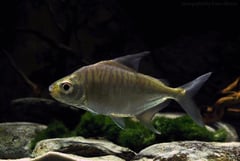
Acnodon normaniSheep Pacu
Serrasalmidae · Gosline, 1951
The sheep pacu, Acnodon normani, is a serrasalmid from Brazil, possibly restricted to the Xingu and Tocantins watersheds of the Amazon basin. Also known in the trade as 'tiger pacu', it is often said to be a frugivore or herbivore, but aquarium observations suggest it also feeds on the scales of other fishes. That makes it unsuitable for the community aquarium, although it does not seem to target much smaller species.
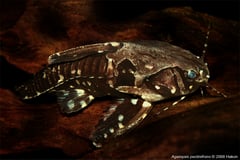
Agamyxis pectinifronsSpotted Talking Catfish
Doradidae · (Cope, 1870)
The spotted talking catfish, Agamyxis pectinifrons, is a doradid catfish from the Amazon basin in Bolivia, Brazil, Colombia and Peru. Very common in the trade, it is hardy and relatively long-lived, and recommended to beginners and experienced aquarists alike despite its adult size. It closely resembles A. albomaculatus, known only from the Río Orinoco drainage in Venezuela, and the two are probably sold under the same trade names.
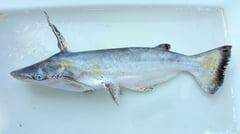
Ageneiosus inermisManduba
Auchenipteridae · (Linnaeus, 1766)
The manduba, Ageneiosus inermis, is a large auchenipterid catfish found throughout much of South America east of the Andes. At around 470 mm SL it would need an aquarium in excess of 400 x 120 cm as an adult and is largely unsuitable for private aquaria. An obligate carnivore, it can take surprisingly large prey, and the larger Ageneiosus species are often used as food fishes in their native countries.
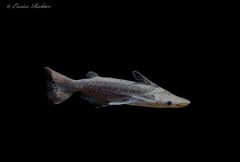
Ageneiosus marmoratusBottlenose Catfish
Auchenipteridae · Eigenmann, 1912
The bottlenose catfish, Ageneiosus marmoratus, is a predatory auchenipterid catfish from Guyana, Suriname and the upper Amazon in Peru and Ecuador. Also sold as 'Guyana slopehead', 'dolphin' or 'hammerhead' catfish, it loses much of its black-blotched juvenile patterning as it grows. Surprisingly peaceful with anything too large to swallow, it is active and sometimes skittish, and needs a tank of at least 150 x 60 cm.
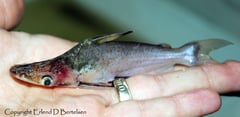
Ageneiosus ucayalensisDuck Catfish
Auchenipteridae · Castelnau, 1855
The duck catfish, Ageneiosus ucayalensis, is an auchenipterid catfish described from Peru and recorded across the Amazon, Orinoco and Guianas. Body patterning apparently varies with locality, and fish from black water habitats, particularly on the Guiana Shield, tend to be darker. Growing to around 290 mm SL and capable of taking large prey, it is safe only with similarly sized catfishes or large pelagic characins, mostly a combination for public aquaria.
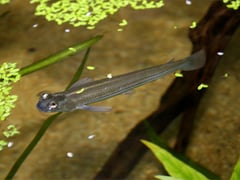
Anableps anablepsFour-Eyed Fish
Anablepidae · (Linnaeus, 1758)
The four-eyed fish, Anableps anableps, is a viviparous fish of brackish mangrove coasts in north-eastern South America, from Venezuela to Brazil. Each eye is split horizontally, with two corneas and two pupils, so it can see above and below the water at the same time. It moves in and out with the tides, and in aquaria it needs brackish water, shallow depth and a large surface area, with a group of at least six in a tank no smaller than 150 x 45 cm.
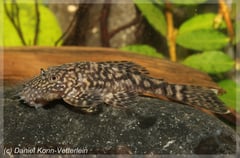
Ancistrus claroLDA 008
Loricariidae · Knaack, 1999
Ancistrus claro, the gold marble bristlenose catfish (LDA 008), is a suckermouth catfish from the rios Claro and Coxipó in Mato Grosso, Brazil. It inhabits flowing streams over boulders and bedrock. Sometimes confused with unidentified fishes such as A. sp. 'L352', it has long maxillary barbels and small spots on the head, with vermiform lines on the body in males and spots all over in females. A peaceful cave-spawner, it has been bred in aquaria on numerous occasions.
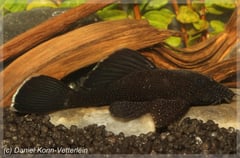
Ancistrus dolichopterusL183
Loricariidae · Kner, 1854
Ancistrus dolichopterus, the starlight ancistrus (L183), is a bristlenose catfish most likely endemic to the middle and lower rio Negro, Brazil. It inhabits blackwater streams. The name has been used for the common bristlenose and other similar species, while this fish has been called A. hoplogenys, and much of the literature confuses them. It differs from all congeners in having 9 soft dorsal-fin rays, and is territorial with conspecifics and similarly-shaped species.
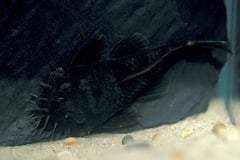
Ancistrus ranunculusL034
Loricariidae · Muller, Rapp Py-Daniel & Zuanon, 1994
Ancistrus ranunculus, the medusa pleco (L034), is a wide-headed, flattened suckermouth catfish from the rio Xingu and rio Tocantins basins in Brazil. It lives among rocks in shallow, fast-flowing water, needs well-oxygenated water with plenty of movement and a protein-rich diet, and is often in poor condition after import. Juveniles carry light spots like the similarly shaped L255, but in A. ranunculus these fade as the fish matures.
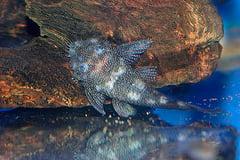
Ancistrus sp.L255
Loricariidae · authority not recorded
L255, the spotted medusa plec, is a wide-headed, flattened Ancistrus known only from the middle rio Xingu basin in Pará state, Brazil. It lives among rocks in shallow, fast-flowing water, needs well-oxygenated water with plenty of movement and a protein-rich diet, and is often in poor condition after import. It resembles A. ranunculus, but keeps its light body markings throughout life, whereas those of A. ranunculus fade as the fish matures.
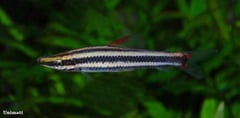
Anostomus anostomusStriped Headstander
Anostomidae · (Linnaeus, 1758)
The striped headstander, Anostomus anostomus, is an anostomid from the Amazon and Orinoco river systems in Peru, Brazil, Venezuela and Guyana. It lives along rocky shores of fast-flowing rivers, grazing algae and small invertebrates from the rocks. Although it shoals in nature, it is very quarrelsome with conspecifics when only a few are kept, so it is best kept singly or in a group of 6 or more in a larger tank.
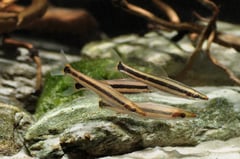
Anostomus ternetziGold-Striped Headstander
Anostomidae · Fernández-Yépez, 1949
The gold-striped headstander, Anostomus ternetzi, is an anostomid from the Río Orinoco system and coastal Guyana, Suriname and French Guiana. It lives in rocky areas at the edge of fast-flowing rivers and streams, grazing algae and small invertebrates. Like A. anostomus, it is quarrelsome with conspecifics when only a few are kept. Its distribution in Brazil is unclear, with patchy records from the Araguaia and Xingu basins.

Aphyocharax anisitsiBloodfin Tetra
Characidae · Eigenmann & Kennedy, 1903
The bloodfin tetra, Aphyocharax anisitsi, is a characid endemic to the Paraná River drainage in Brazil, Paraguay and Argentina. A hardy species that adapts to a wide range of conditions, it can even be kept unheated in a well-insulated house, though it is less colourful in cooler water. Captive specimens over ten years old are not unheard of. It may nip long-finned or slow-moving tankmates, and the tank needs a tight cover as it will jump.

Aphyocharax nattereriDawn Tetra
Characidae · (Steindachner, 1882)
The dawn tetra, Aphyocharax nattereri, is a small characid from southern Brazil, Bolivia and Paraguay. In the hobby it is usually called A. paraguayensis, a name considered a synonym of A. nattereri since 2003. Confusion remains, because the type locality of A. nattereri lies on the main Amazon channel, far from most confirmed localities. It is most often imported as a contaminant among shipments of other species.

Aphyocharax rathbuniGreen Fire Tetra
Characidae · Eigenmann, 1907
The green fire tetra, or Rathbun's bloodfin, Aphyocharax rathbuni, is a characid endemic to the Paraguay, Paraná and Uruguay river drainages. It is found in Brazil, Paraguay, Argentina and Uruguay, in streams and rivers shaded by floating or overhanging vegetation. Although suitable for a community aquarium, it has a reputation as a fin-nipper, and long-finned species such as many cichlids and anabantoids should be avoided as tankmates.

Apistogramma agassiziiAgassiz's Dwarf Cichlid
Cichlidae · (Steindachner, 1875)
Apistogramma agassizii is a dwarf cichlid found through much of the Amazon/Solimões basin, from the Río Ucayali in Peru to the Capim River in Brazil. Colour and pattern vary considerably with locality, and numerous ornamental forms have been selectively bred for the trade. It inhabits slower-moving tributaries and creeks where leaf litter collects. Captive-raised fish suit the community aquarium, while wild fish are best kept alone or with small dither fishes.

Apistogramma bitaeniataTwo-Striped Dwarf Cichlid
Cichlidae · Pellegrin, 1936
The two-striped dwarf cichlid, Apistogramma bitaeniata, ranges across the Peruvian, Colombian and Brazilian Amazon, from the Marañón to the Tapajós. Also known as the banded dwarf cichlid, it occurs in several colour forms depending on locality, loosely grouped as 'red', 'blue', 'orange' and 'yellow' in the hobby. Many locality names are in use for these forms, and several are regularly applied incorrectly.

Apistogramma borelliiBorelli's Dwarf Cichlid
Cichlidae · (Regan, 1906)
Borelli's dwarf cichlid, Apistogramma borellii, is from southern Brazil, Paraguay, Argentina and Uruguay. Also known as the umbrella or yellow dwarf cichlid, it occurs in creeks and tributaries of the rio Paraguay, lower rio Paraná and Uruguay systems. Captive-raised fish are the recommended choice for the community aquarium, while wild examples are best kept alone or with small dither fishes.
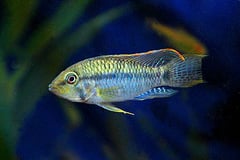
Apistogramma brevis
Cichlidae · Kullander, 1980
Apistogramma brevis is a dwarf cichlid from the Rio Uaupés basin in far northwestern Brazil and the Rio Tiquié in southern Colombia. It has also been recorded in the upper Rio Negro and Rio Orinoco, and inhabits slow-moving blackwater streams where the pH can drop as low as 4.0 or 5.0. Coded A168, it is the type species of the A. brevis group, and breeding is not too difficult if very soft, acidic water can be provided.

Apistogramma cacatuoidesCockatoo Cichlid
Cichlidae · Hoedeman, 1951
The cockatoo cichlid, Apistogramma cacatuoides, is a small cichlid from the upper Amazon basin, from the Ucayali in Peru to the Solimões in Brazil. It lives in slow tributaries, backwaters and creeks where leaf litter collects. Numerous line-bred forms such as 'double red' and 'orange flash' are traded, and captive-raised fish suit a community aquarium, while wild fish are best kept alone or with small dither fishes.

Apistogramma commbraeA93
Cichlidae · (Regan, 1906)
The Corumbá dwarf cichlid, Apistogramma commbrae, is widespread in the Paraguay River watershed of Argentina, Bolivia, Brazil and Paraguay. One of the smallest members of the genus, it is told apart with the rest of the A. commbrae complex by a conspicuous double caudal peduncle spot. Its habitats cool seasonally to as low as 16 °C, and it should be kept cooler over winter.

Apistogramma elizabethaeA208
Cichlidae · Kullander, 1980
Apistogramma elizabethae is a dwarf cichlid from the rio Uaupés and adjacent rio Içana, both tributaries of the upper rio Negro in Brazil. Coded A208, it is among the more sought-after Apistogramma in the hobby. Içana fish tend to have more blue on the head than those from the Uaupés, a reddish population is traded as A. elizabethae 'super red', and none of the forms should be mixed in aquaria.

Apistogramma eunotus
Cichlidae · Kullander, 1981
Apistogramma eunotus is a dwarf cichlid from the Río Ucayali in Peru and the Solimões/Amazon in Colombia and Brazil, as far east as the Japurá. Coded A73 under the DATZ system, it has similar-looking, possibly conspecific populations referred to as A74 to A77 depending on locality. It inhabits slow-moving streams, creeks and tributaries, and captive-raised fish are the recommended choice for the community aquarium.
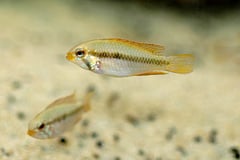
Apistogramma gibbicepsBlackline Apisto
Cichlidae · Meinken, 1969
The blackline apisto, Apistogramma gibbiceps, is a dwarf cichlid from the Rio Branco and middle Rio Negro basins in Brazil. It is identified by a row of short dark marks low on the flank below the lateral band, which show most clearly on a settled fish. Meinken's type series held three species, and A. roraimae from the Rio Branco has been treated as a synonym since 2003.

Apistogramma sp. 'breitbinden'A164
Cichlidae · authority not recorded
Apistogramma sp. 'breitbinden' is an undescribed dwarf cichlid from the upper Rio Negro in Brazil, the Venezuelan Orinoco and the Inirida in Colombia. The German name means 'broad-banded' and refers to the uniformly broad suborbital stripe of males. Known in the hobby for several decades, it is often imported as bycatch among shipments of wild-collected A. iniridae, and some populations carry the DATZ codes A164, A165 and A167.

Apistogramma trifasciataThree-striped Apisto
Cichlidae · (Eigenmann & Kennedy, 1903)
The three-striped apisto, Apistogramma trifasciata, is a dwarf cichlid from the Guaporé, Paraguay and middle Paraná basins. Found in Brazil, Paraguay and Argentina, it lives in sluggish creeks, tributaries and smaller rivers where leaf litter collects. A narrow third stripe from the pectoral-fin insertion to the anal fin helps separate it from congeners. The DATZ code is A204, with possibly conspecific forms from Argentina and the rio Guaporé coded A205 and A206.
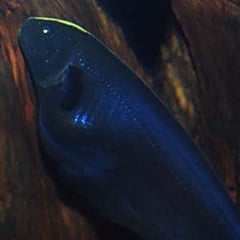
Apteronotus albifronsBlack Ghost Knifefish
Apteronotidae · (Linnaeus, 1766)
The black ghost knifefish, Apteronotus albifrons, is a weakly electric knifefish from the upper half of South America, from Colombia to Paraguay. Usually sold at around 4 inches, it grows to 50 cm and needs a long-term housing plan. Its eyesight is very poor, and it navigates, finds prey and communicates using a weak electric field. In the wild it lives in swiftly flowing streams and rivers over sand.
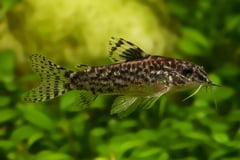
Aspidoras pauciradiatus
Callichthyidae · (Weitzman & Nijssen, 1970)
Aspidoras pauciradiatus is a small armoured catfish that appears restricted to the upper Araguaia basin in Goiás state, Brazil. Sometimes called the 'false corydoras' or 'sixray corydoras', it has 6 soft dorsal-fin rays against 7 in other Aspidoras, plus a distinctive colour pattern. Aspidoras are told from the very similar Corydoras mainly by having two cranial fontanels.
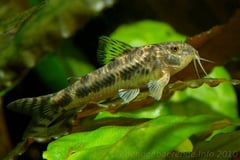
Aspidoras raimundiC125
Callichthyidae · (Steindachner, 1907)
Aspidoras raimundi (C125) is a small armoured catfish from coastal river drainages in north and northeastern Brazil. The fish sold as A. spilotus, from Ceará state, is now treated as the same species. A peaceful, schooling species, it grows to around 45 mm SL.
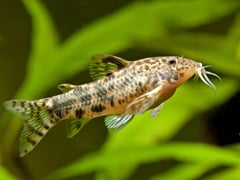
Aspidoras taurus
Callichthyidae · Lima & Britto, 2001
Aspidoras taurus is a small armoured catfish known only from the upper Itiquira and Taquari rivers, in the rio Paraguay system of Mato Grosso, Brazil. Relatively common in the aquarium trade, it is sometimes mislabelled as A. menezesi, a valid but distinct species. Thick skin covering the infraorbitals, preopercle and reduced nuchal plate separates it from congeners.
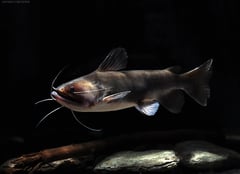
Asterophysus batrachusGulper Catfish
Auchenipteridae · Kner, 1858
The gulper catfish, Asterophysus batrachus, is a predatory auchenipterid catfish from the rio Negro in Brazil and the Orinoco in Venezuela. Also called the 'ogre catfish', it hunts in shallow blackwater tributaries, mostly at night. It can consume fishes almost twice its own size and is not recommended for the community aquarium.

Astronotus ocellatusOscar
Cichlidae · (Agassiz, 1831)
The oscar, Astronotus ocellatus, is a large cichlid widely distributed in the Amazon region, recorded from Colombia and Venezuela south to Argentina. It grows to 350 mm SL and typically lives 10 to 20 years, both of which need taking into account before purchase. Most fish on sale come from commercial breeders in Eastern Europe or the Far East, in numerous ornamental strains, and genetic analyses suggest the genus contains additional, morphologically cryptic species.

Astyanax bimaculatusTwo Spot Astyanax
Characidae · (Linnaeus, 1758)
The two spot astyanax, Astyanax bimaculatus, is a characid ranging from Panama through most of the Amazon and Orinoco basins. It lives in a wide variety of biotopes, from swiftly-flowing rivers and streams to ponds, ditches and reservoirs. The name is currently applied to what is considered a species complex of at least four taxa, and aquarium fish most often arrive as contaminants among shipments of other species.

Astyanax leopoldiLeopold's Tetra
Characidae · Géry, Planquette & Le Bail, 1988
Leopold's tetra, Astyanax leopoldi, is a characid native to the Approuague and Oyapock river basins in French Guiana and Brazil. It is most common in fast-flowing waters, where it swims in large shoals in marginal or calmer areas. Like most Astyanax, it is rarely offered for sale.
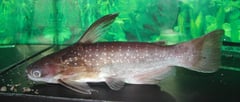
Auchenipterichthys coracoideusMidnight Catfish
Auchenipteridae · (Eigenmann & Allen, 1942)
The midnight catfish, Auchenipterichthys coracoideus, is an auchenipterid catfish from the Peruvian and Brazilian Amazon and the Essequibo drainage. Also known as the 'Zamora woodcat', it has often been misidentified as A. thoracatus, and the two differ principally in anal-fin ray count. By day it shelters among submerged roots, tree stumps or vegetation in turbid rivers and flooded areas, emerging to feed in open water at night.

Axelrodia stigmatias
Characidae · (Fowler, 1913)
Axelrodia stigmatias is a tiny characid from the western Amazon region in Brazil and Peru, sometimes traded as the 'white star' or 'pepper' tetra. It resembles A. riesei but has a more elongate body and is silvery yellow in life where that species is red. It is said to inhabit blackwater environments, and given its small size and somewhat specialised requirements it is best kept alone or with diminutive, non-aggressive characids and small catfishes.
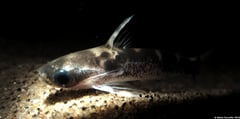
Balroglanis macracanthus
Auchenipteridae · (Soares-Porto, 2000)
Balroglanis macracanthus is a small driftwood catfish endemic to the upper rio Negro system in Brazil. Poorly known but occasionally available in the aquarium hobby, it shelters among submerged wood by day and forages at night. Like other auchenipterids it practises internal insemination, and females can carry eggs and sperm packets until conditions trigger fertilisation.
Bario oligolepisGlass Tetra
Characidae · authority not recorded
The glass tetra, Bario oligolepis, is a characin from northern South America, with populations in Venezuela, the Guianas, Peru and Brazil. One of a handful of species that closely resemble the red-eye tetra, it is seen much less often in the hobby and is also known as the glassy tetra. It inhabits slow-moving rivers, tributaries and floodplain lakes. Very peaceful, it does not compete well with boisterous or much larger tankmates.

Bario sanctaefilomenaeRed-eye Tetra
Characidae · authority not recorded
The red-eye tetra, Bario sanctaefilomenae, is a characin from Brazil, Paraguay and Argentina, living mostly in clear rivers that feed the Pantanal. All fish in the trade are captive-bred in huge numbers and are unfussy about water chemistry and diet. Somewhat boisterous, it suits a community of active tankmates such as similarly sized tetras, rainbowfish and barbs, and can intimidate sedate species such as anabantoids or dwarf cichlids.
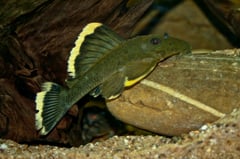
Baryancistrus chrysolomusMango Pleco
Loricariidae · Rapp Py-Daniel, Zuanon & Ribeiro de Oliveira, 2011
The mango pleco, Baryancistrus chrysolomus, traded as L047, is a loricariid endemic to the rio Xingu basin in Pará state, Brazil. A broad, usually yellowish band along the edges of the dorsal and caudal fins throughout life separates it from B. xanthellus, whose bands shrink to tips in adults. It grows to around 220 mm SL, and males in particular become highly intolerant of conspecifics as they age.
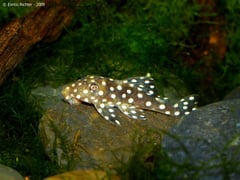
Baryancistrus sp. L142Big White Spot Pleco
Loricariidae · authority not recorded
The big white spot pleco, Baryancistrus sp. L142, is an undescribed suckermouth catfish from the rio Tapajós in Pará state, Brazil. It appears restricted to a short stretch of the river between Itaituba and Pimenta, in shallow, fast-flowing, warm water. The species is also traded as 'snowball pleco', a name first applied to Hypancistrus inspector and now used for several similar white- or yellow-spotted fishes. Males become highly intolerant of conspecifics as they age.
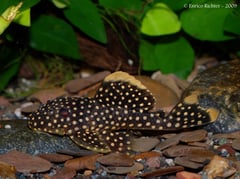
Baryancistrus xanthellusGold Nugget Pleco
Loricariidae · Rapp Py-Daniel, Zuanon & Ribeiro de Oliveira, 2011
The gold nugget pleco, Baryancistrus xanthellus, is a suckermouth catfish endemic to the rio Xingu basin in Pará state, Brazil. It lives in whitewater rapids in the Volta Grande do rio Xingu, between Belo Monte falls and the mouth of the rio Iriri. Before its description it was traded as L018, L085, L177 and LDA060, and L081 is the same fish. Males become highly intolerant of conspecifics as they age.

Biotodoma cupidoCupid Cichlid
Cichlidae · (Heckel, 1840)
The cupid cichlid, Biotodoma cupido, is a geophagine cichlid from much of the Amazon basin, north to the Essequibo in Guyana and south to Bolivia. Also traded as the 'green-streaked eartheater', it varies in colour pattern and shape by locality, and most traded fish come from around Santarém in Pará state. Unless breeding it is surprisingly peaceful. Its relatively compact body and a dark flank blotch above the upper lateral line separate it from B. wavrini.

Biotodoma wavriniOrinoco Eartheater
Cichlidae · (Gosse, 1963)
The Orinoco eartheater, Biotodoma wavrini, is a geophagine cichlid from the Orinoco and rio Negro basins of Venezuela, Colombia and Brazil. One natural habitat is the Río Cinaruco, a low-nutrient blackwater tributary of the Orinoco. It can be told from B. cupido by its noticeably elongate body and a dark flank blotch on or below the upper lateral line. Unless breeding it is surprisingly peaceful, and trade populations include 'Cuao', 'Orinoco', 'San Antonio' and 'Sipapo Ventuari'.

Biotoecus opercularis
Cichlidae · (Steindachner, 1875)
Biotoecus opercularis is a small geophagine cichlid from the middle Amazon basin in Brazil, including the lower Madeira, Tapajós and Negro. It favours shallow, slow-flowing water over sand with leaf litter and submerged wood, often stained with tannins. Several populations are traded, among them B. sp. 'rio Negro' from the rio Jauaperi and B. sp. 'Santarém' or 'Tapajós', though no scientific evidence shows them to be more than one species. It should not be mixed with other Biotoecus species or populations.
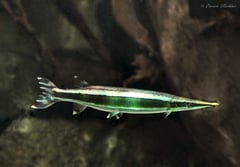
Boulengerella lateristrigaStriped Pike 'Characin'
Ctenoluciidae · (Boulenger, 1895)
The striped pike 'characin', Boulengerella lateristriga, is a ctenoluciid from the rio Negro basin and parts of the upper Río Orinoco. It appears limited to black water rivers and tributaries, where the water is stained darkly with humic acids and the pH can be as low as 3.0 or 4.0. A thin dark stripe from the rear of the eye to the caudal peduncle and dark crossbars on the caudal-fin lobes separate it from the similar B. maculata. It grows to 258 mm SL.
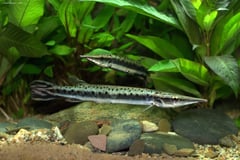
Boulengerella maculata
Ctenoluciidae · (Valenciennes, 1850)
Boulengerella maculata is a pelagic ctenoluciid found throughout much of the Amazon, Orinoco and Tocantins river systems. Colour pattern varies considerably, with some specimens much paler than others, and this may be correlated with water type. Random dark spots on the upper body, and a dark stripe only behind the eye when one is present, separate it from the similar B. lateristriga. It reaches 329 mm SL and needs an aquarium with base dimensions of 240 by 90 cm or more.

Brachychalcinus orbicularisDiscus Tetra
Characidae · (Valenciennes, 1850)
The discus tetra, Brachychalcinus orbicularis, is a deep-bodied characid generally considered endemic to coastal watersheds of Guyana and Suriname. Recent records suggest it, or a similar congener, may also occur in the Orinoco and Negro drainages. The genus is often referred to collectively as 'silver dollar tetras', and although B. orbicularis is normally said to be the species in the trade, identification is challenging.
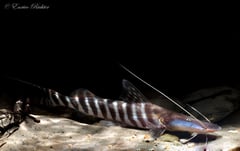
Brachyplatystoma tigrinumZebra Shovelnose
Pimelodidae · (Britski, 1981)
The zebra shovelnose, Brachyplatystoma tigrinum, is a pimelodid catfish from the upper Amazon basin in Brazil, Colombia and Peru. Adults appear to be obligate inhabitants of main river channels with strong flow, often around cataracts and rapids, and most aquarium fish are juveniles collected around Iquitos in Peru. It is sometimes confused with B. juruense, especially when young, but has a more well-defined colour pattern, a slenderer body and longer barbels.
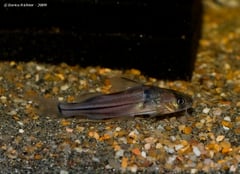
Brachyrhamdia meesi
Heptapteridae · Sands & Black, 1985
Brachyrhamdia meesi is a small heptapterid catfish described from near Belém, at the mouth of the Amazon in Brazil. Its precise distribution is unclear, with one record from the Río Madre de Dios basin in Peru. Rare in the hobby, it is normally imported as bycatch among other fishes, particularly Otocinclus, and juveniles may mimic Otocinclus or smaller Corydoras. A dark vertical bar through the eye separates it from the similar B. marthae.
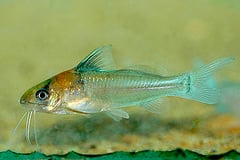
Brachyrhamdia rambarraniFalse Adolfoi
Heptapteridae · (Axelrod & Burgess, 1987)
The false adolfoi, Brachyrhamdia rambarrani, is a heptapterid catfish from the Rio Unini, a blackwater tributary of the lower rio Negro in Brazil. It occurs with, and mimics, Hoplisoma davidsandsi, sharing its basic colour pattern, while the common name comes from its resemblance to H. adolfoi. Rarely seen in the trade, it tends to turn up as a contaminant among shipments of other species.
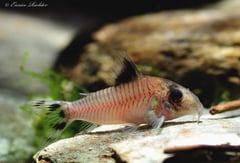
Brochis condiscipulus
Callichthyidae · (Nijssen & Isbrücker, 1980)
Brochis condiscipulus, long known as Corydoras condiscipulus, is an armoured catfish native to the Oyapock (Oiapoque) river system in French Guiana and Amapá state, Brazil. It often occurs alongside the similar-looking Hoplisoma oiapoquense, from which it differs in its larger adult size, narrower body, shorter pectoral spine and longer snout.
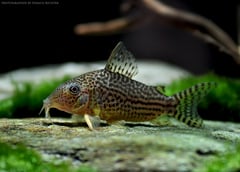
Brochis haraldschultziMosaic Cory
Callichthyidae · (Knaack, 1962)
The mosaic cory, Brochis haraldschultzi, long known as Corydoras haraldschultzi, is an armoured catfish endemic to the rio Guaporé (Río Iténez) in northeastern Bolivia and western Brazil. It resembles Hoplisoma sterbai but has a more extended snout and grows larger, to 85 mm SL. Its head carries dark vermiculations and spots on a light background, where H. sterbai has light markings on dark. The type locality was once modified to the rio Tocantins, well over 1000 km away, but the original Guaporé locality appears to be correct.
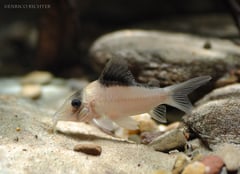
Brochis imitatorImitator Cory
Callichthyidae · (Nijssen & Isbrücker, 1983)
The imitator cory, Brochis imitator, long known as Corydoras imitator, is an armoured catfish endemic to the upper rio Negro basin in northern Brazil and southern Venezuela. It is one of several rio Negro congeners with an oblique dark bar along the dorsal surface of the body, a group that includes Hoplisoma adolfoi, H. burgessi and H. duplicareum. It inhabits pristine blackwater tributaries and flooded forest with tea-coloured water, very little hardness and a pH of 4.0-6.0.
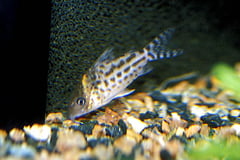
Brochis incolicanaC001
Callichthyidae · (Burgess, 1993)
Brochis incolicana (C001), long known as Corydoras incolicana, is an armoured catfish from the rio Içana in the upper rio Negro basin, northern Brazil. It presumably also occurs in eastern Colombia, where the Içana forms the border. The first fish to receive a 'C' number, in 1993, it was described the same year in a hobbyist magazine and is difficult to identify accurately. The colour pattern is said to be extremely variable, but the dark bar through the eye and the dark marking at the dorsal-fin base are apparently consistent.
Brochis leopardusLeopard Cory
Callichthyidae · (Myers, 1933)
The leopard cory, Brochis leopardus, long known as Corydoras leopardus, is a spotted armoured catfish from the western Amazon basin in Peru, Ecuador, Bolivia and Brazil. It looks very like Hoplisoma julii and H. trilineatum, but has a longer, more pointed snout and grows larger. Dias et al. (2024) moved it to the genus Brochis and put the two lookalikes in Hoplisoma, so the resemblance does not reflect a close relationship. The type specimens were aquarium imports.
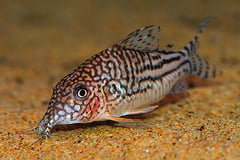
Brochis pinheiroi
Callichthyidae · authority not recorded
Brochis pinheiroi, long known as Corydoras pinheiroi, is an armoured catfish from Rondônia, Brazil, with a pattern similar to that of Hoplisoma sterbai. It lacks the orange pectoral spines of that species and is rare in the hobby. Like other corys it is peaceful, should be kept in a group of at least six, and needs well-oxygenated water and a clean substrate.
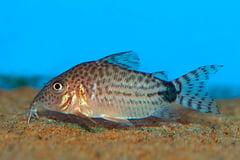
Brochis spectabilisMillenium Cory
Callichthyidae · authority not recorded
The millennium cory, Brochis spectabilis, long known as Corydoras spectabilis, is an armoured catfish from the Guaporé River basin in Brazil. The name comes from its being the first catfish species described in 2000, although the description appeared in late 1999 in a journal dated January 2000. Gastrodermus guapore, C. ourastigma, Hoplisoma simile and H. caudimaculatum can be confused with it, but B. spectabilis has spotted patterning on the body and a caudal spot with a well-defined edge.
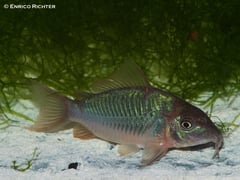
Brochis splendensEmerald 'Brochis'
Callichthyidae · (Castelnau, 1855)
The emerald 'brochis', Brochis splendens, long known as Corydoras splendens, is an armoured catfish recorded throughout much of the Amazon basin in Brazil, Peru, Ecuador and Colombia. It is sometimes called the 'common brochis', and juveniles are sometimes traded as 'hi-fin cory' for their enlarged dorsal fin. Its 10 to 12 dorsal-fin rays separate it from B. britskii and B. multiradiata, the other two species long kept in Brochis, and certain populations are thought likely to represent distinct species.
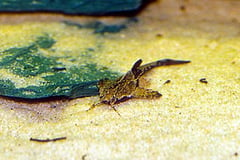
Bunocephalus coracoideusBanjo Catfish
Aspredinidae · authority not recorded
The banjo catfish, Bunocephalus coracoideus, is an aspredinid catfish from Bolivia, Peru and Brazil. The most common member of its genus in dealers' tanks, it inhabits forest streams, lakes and ponds with a lot of leaf litter and is camouflaged to resemble a dead leaf. Largely inactive and secretive, it becomes active only after dark, and like other aspredinids it occasionally sheds its skin.
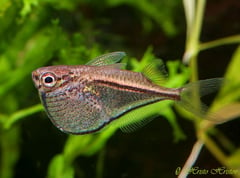
Carnegiella marthaeBlackwing Hatchetfish
Gasteropelecidae · Myers, 1927
The blackwing hatchetfish, Carnegiella marthae, is a small freshwater hatchetfish from the upper Orinoco in Venezuela and the rio Negro in Brazil. It appears to be a stenotypic inhabitant of blackwater, found in igapó and igarapé habitats with overhanging vegetation and leaf litter. Very peaceful but small and timid, it is best kept in a group of 10 or more with similarly sized, peaceful fishes.
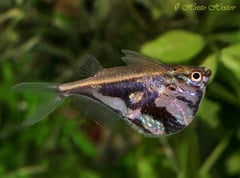
Carnegiella strigataMarbled Hatchetfish
Gasteropelecidae · (Günther, 1864)
The marbled hatchetfish, Carnegiella strigata, is a hatchetfish from the Amazon and Orinoco basins and coastal rivers of Guyana and Suriname. Popular in the hobby, it is collected for the trade mostly in the rio Negro basin in Brazil. Its larger size and dark, marbled pattern set it apart from congeners, though the pattern varies and the wide range may be open to question. It appears to live only in blackwater.
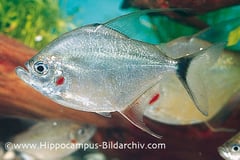
Catoprion mentoWimpel Piranha
Serrasalmidae · authority not recorded
The wimpel piranha, Catoprion mento, is a scale-eating fish from Colombia, Venezuela, Guyana, Brazil and Bolivia. Though not a true piranha, it resembles them and is quite closely related to Pygocentrus species. The common name comes from the German 'Wimpel' (banner), after the extensions to the leading dorsal-fin rays in mature fish. Adults are best housed alone, and it is sensitive to poor water quality and to swings in chemistry.
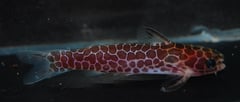
Centromochlus reticulatusReticulated Driftwood Catfish
Auchenipteridae · (Mees, 1974)
The reticulated driftwood catfish, Centromochlus reticulatus, is a small auchenipterid first known from the upper Rupununi River basin in Guyana. Its secretive, mostly nocturnal habits mean it may have been overlooked elsewhere, and it has been recorded from the rio Preto da Eva near Manaus, Brazil. Sometimes traded as 'purple oil catfish', it is highly gregarious and ideally kept in groups of at least eight.
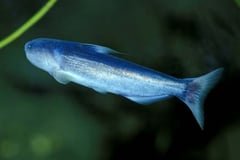
Cetopsis coecutiensBlue Whale Catfish
Cetopsidae · authority not recorded
The blue whale catfish, Cetopsis coecutiens, is a cetopsid catfish from the Amazon, Tocantins and Orinoco river basins. In the wild it swims in voracious feeding groups, homing in on weakened fish by smell and burrowing into prey. It will bite chunks out of tankmates much bigger than itself, so it is best kept alone, and at up to 26.5 cm it needs a large tank with strong water flow and dim lighting.

Chalceus erythrurusTucanfish
Characidae · authority not recorded
The tucanfish, Chalceus erythrurus, is a large characin from parts of the Amazon basin in Peru and Brazil. It lives in the surface waters of floodplain rivers and lakes. The red or yellow caudal fin separates it from the pink-tailed C. macrolepidotus. Fast and a renowned jumper, it needs a lot of swimming space and a well-fitting cover, and it does best singly or in a group of more than six.

Charax condeiSmall-scale Glass Tetra
Characidae · authority not recorded
The small-scale glass tetra, Charax condei, is a characin known only from the Rio Negro basin, Brazil, where it inhabits blackwater streams. Rarely seen, it occasionally shows up in the trade as a contaminant among shipments of more popular species, and older literature sometimes calls it Asiphonichthys condei. A micropredator, it threatens much smaller tankmates and should be kept in a group of at least six.
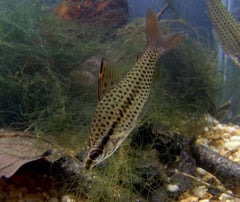
Chilodus punctatusSpotted Headstander
Chilodontidae · Müller & Troschel, 1844
The spotted headstander, Chilodus punctatus, is a headstander from much of the Amazon, the western Orinoco and coastal rivers of Guyana and Suriname. Also called the 'checkered headstander', it lives in slow-moving rivers, oxbows and floodplain lakes, and its colour pattern appears to vary with locality. Shy and peaceful, it is sensitive to dissolved organic wastes and should never be introduced to a biologically-immature aquarium.

Colomesus asellusAmazon Puffer
Tetraodontidae · (Müller & Troschel, 1849)
The Amazon puffer, Colomesus asellus, is a freshwater puffer found throughout much of the Amazon basin, with records north to Guyana and Venezuela. Also traded as the South American puffer or 'SAP', it is told from congeners by a transverse row of dermal flaps across the chin. It lives mostly in well-oxygenated river habitats, is intolerant of organic waste, and forms loose aggregations, so a group of 6 or more is best, away from the general community.
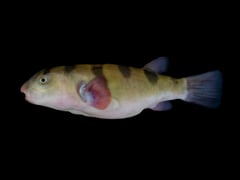
Colomesus psittacusBanded Puffer
Tetraodontidae · (Bloch & Schneider, 1801)
The banded puffer, Colomesus psittacus, is a large puffer of coastal waters from Colombia and Venezuela through the Guianas to northeastern Brazil. It also occurs in Trinidad and Tobago and the Caribbean islands, and inhabits mangrove swamps, estuaries and the lower reaches of rivers. Growing to 290 mm SL, it is the largest of its genus and has six dark bands across the back. Likely to prove aggressive in all but the largest systems, it is not a popular aquarium fish.
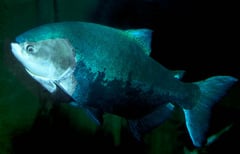
Colossoma macropomumBlack Pacu
Serrasalmidae · authority not recorded
The black pacu, Colossoma macropomum, is a very large serrasalmid from the Orinoco and Amazon basins in Colombia, Venezuela, Peru, Bolivia and Brazil. Known as the tambaqui in its native countries, it is the second largest scaled fish in the Amazon basin and easily capable of reaching 60 cm in captivity. It is regularly sold as a small juvenile, and releases of outgrown fish have led many wildlife authorities in the US to ban its sale. Wild stocks suffer from gross overfishing in many of its native waters.
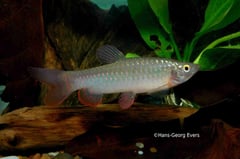
Copeina guttataRed-spotted Tetra
Lebiasinidae · (Steindachner, 1876)
The red-spotted tetra, Copeina guttata, is a lebiasinid from the middle and upper Amazon basin in Brazil, Peru, Ecuador and Colombia. Reaching 76 mm, it needs a tank of at least 120 x 30 cm. The eggs are apparently deposited in a shallow depression dug in the substrate and guarded by the male. Like many fishes from pristine environments it is intolerant of organic pollutants and requires spotless water.
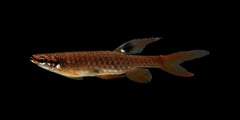
Copella arnoldiSplash Tetra
Lebiasinidae · (Regan, 1912)
The splash tetra, Copella arnoldi, is a lebiasinid from the lower Amazon basin in Brazil and coastal drainages of Guyana, Suriname and French Guiana. It spawns out of the water: a pair leap together onto overhanging vegetation and cling there while the eggs are laid. Zarske (2011) treats the Guianas populations as C. carsevennensis, restricting C. arnoldi sensu stricto to the lower Amazon, though Mol (2012) considers the two synonymous.
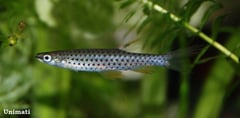
Copella callolepis
Lebiasinidae · (Regan, 1912)
Copella callolepis is a small lebiasinid from the central Amazon region of Brazil, where all recent records come from. It is quite common in the aquarium trade but normally misidentified as C. nattereri or the very similar C. meinkeni. It lacks the dark lateral stripe of C. nattereri, and differs from C. meinkeni in a black triangular marking in the lower caudal-fin lobe and blue-black to dark brownish-red spots.
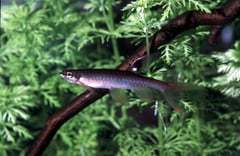
Copella carsevennensis
Lebiasinidae · (Regan, 1912)
Copella carsevennensis is a small lebiasinid from coastal river systems in Guyana, Suriname, French Guiana and Amapá state, Brazil. It appears in the trade from time to time among wild-caught fishes from the Guianas. Zarske (2011) separated it from C. arnoldi, partly because it lays its eggs among submerged vegetation and not out of the water, though Mol (2012) considers the two synonymous.
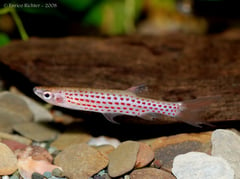
Copella meinkeniSpotted Splashing Tetra
Lebiasinidae · Zarske & Géry, 2006
The spotted splashing tetra, Copella meinkeni, is a small lebiasinid from the central Amazon region, with most records from the rio Negro and Orinoco. It has been widely referred to as C. nattereri in aquarium literature, but lacks that species' dark lateral stripe and has 5-6 rows of bright red spots on the body. The similar C. callolepis is also traded. It inhabits forest streams with tea-coloured water and lays its eggs among vegetation.
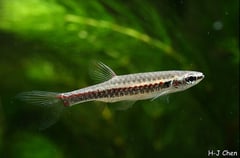
Copella nattereri
Lebiasinidae · (Steindachner, 1876)
Copella nattereri is a small lebiasinid widespread in the middle and upper Amazon drainage in Peru and Brazil. It is sometimes traded as C. sp. 'red line', 'spotted tetra' or C. nigrofasciata, and its name was long applied to C. callolepis and C. meinkeni. Of the three it alone has a dark lateral stripe, and it has no more than three rows of red spots on the flanks. It inhabits forest streams and flooded forest.
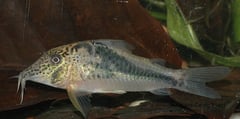
Corydoras fowleriFowler's Cory
Callichthyidae · Böhlke, 1950
Fowler's cory, Corydoras fowleri, is a long-snouted armoured catfish from the Amazon basin in Peru. Also known as the 'huanta cory' and 'milegros cory', it is often confused with C. coriatae and C. semiaquilus, and aquarium fish are regularly misidentified. Most long-snouted cories grow larger and are more aggressive than other Corydoras, and this one is suitable only for larger community aquaria.
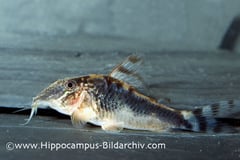
Corydoras semiaquilusPeru Black Cory
Callichthyidae · authority not recorded
The Peru black cory, Corydoras semiaquilis, is a long-nosed armoured catfish from the western Amazon basin in Peru and Brazil. A few colour forms are available in the trade, sometimes under invalid names such as C. 'huanta' or C. 'milagros'. Males can be somewhat aggressive towards one another, although with sufficient space no real damage should occur, and a group of at least six is best.

Crenicara latruncularium
Cichlidae · authority not recorded
Crenicara latruncularium is a South American cichlid from the Rio Guaporé in western Brazil and the Rio Mamoré in Bolivia. Fairly peaceful unless a pair is breeding, it can be kept with tetras, rasboras, small catfish and other small peaceful fish. Spawning takes place in a cave, and the female guards it and will drive away any fish that come near, including the male.
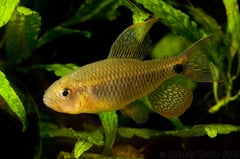
Crenuchus spilurusSailfin Characin
Crenuchidae · Günther, 1863
The sailfin characin, Crenuchus spilurus, is a crenuchid from much of the Amazon and Orinoco drainages and coastal rivers of the Guianas. The only described member of its genus, it varies considerably in colour pattern and morphology across that range. It lives in tea-stained forest streams, and its timid, predominantly benthic nature means it does not always make an ideal community fish. Males guard eggs laid on the roof of a small cave, often formed from leaf litter.
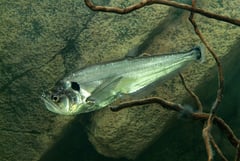
Cynodon gibbus
Cynodontidae · (Agassiz, 1829)
Cynodon gibbus is a cynodontid from much of the Amazon basin, the middle and lower Orinoco, and the Rupununi River in Guyana. A pelagic fish of main river channels and larger tributaries, it grows to around 280 mm SL. It is rare in the trade but arguably more suitable for the home aquarium than some of its better-known relatives, given its size and relatively docile behaviour. Being easily dominated, it is best kept alone or with similarly sized, non-aggressive fishes.

Dicrossus maculatusSpadetailed Checkerboard Cichlid
Cichlidae · Steindachner, 1875
The spadetailed checkerboard cichlid, Dicrossus maculatus, is a cichlid from the Rio Tapajós, Rio Maués and nearby areas of the Brazilian Amazon. Not commonly available in the trade, it is sometimes mistaken for D. filamentosus. A challenge to breed, it needs extremely acidic, very soft water for the eggs to hatch, and a brooding female herds her fry around the tank with signals from her ventral fins.

Exodon paradoxusBucktooth Tetra
Characidae · authority not recorded
The bucktooth tetra, Exodon paradoxus, is a scale-ripping characin widespread in the Brazilian Amazon. The only member of its genus, it has teeth that allow it to tear scales from other fishes. It will relentlessly attack silver-coloured or shiny tankmates, even larger predators, so it is best kept as a large shoal in a species setup. Scaleless and non-reflective fish are generally left alone.
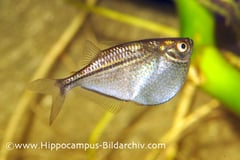
Gasteropelecus levisSilver Hatchetfish
Gasteropelecidae · (Eigenmann, 1909)
The silver hatchetfish (Gasteropelecus levis) is a freshwater hatchetfish found only in the lower Amazon basin in the state of Pará, Brazil. It spends almost all of its time at or just below the surface, and can leap from the water and glide for several metres to catch flying insects or escape predators. It lives in open water of larger igarapés, streams and floodplain lakes.
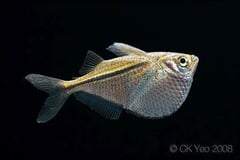
Gasteropelecus sterniclaCommon Hatchetfish
Gasteropelecidae · (Linnaeus, 1758)
The common hatchetfish (Gasteropelecus sternicla) is a freshwater hatchetfish from South America, described from Suriname. Its distribution is questionable, with records from the middle Amazon, Venezuela, Guyana, French Guiana and the Río Paraguay basin. It spends almost all of its time at or just below the surface. The most frequently seen of the silver hatchetfishes, it is peaceful but nervous and shy.

Gastrodermus gracilis
Callichthyidae · (Nijssen & Isbrücker, 1976)
Gastrodermus gracilis, long known as Corydoras gracilis, is a small armoured catfish from the central Amazon basin in Brazil, known from the rio Juriti in Pará to the rio Juma in Amazonas. Sometimes called 'shy cory' in the hobby, it has a lightish body with a dark arched stripe along the upper flank, a pattern shared with Brochis arcuata, C. narcissus and Hoplisoma urucu. Only in G. gracilis does the stripe end at the base of the upper caudal-fin rays. It apparently favours minor tributaries with dense riparian vegetation and acidic, tannin-stained water.
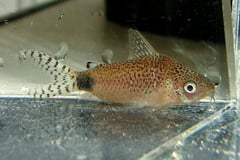
Gastrodermus guaporeGuaporé Cory
Callichthyidae · (Knaack, 1961)
The Guaporé cory, Gastrodermus guapore, long known as Corydoras guapore, is an armoured catfish endemic to the rio Guaporé (Río Iténez) in northeastern Bolivia and western Brazil. Unlike most congeners it forms aggregations in midwater and spends much of its time away from the substrate, with a large eye, a more terminal mouth and a strongly forked caudal fin to match. It partly feeds on pelagic zooplankton, so live Daphnia and Artemia belong in its diet. Similar species such as Hoplisoma simile lack these adaptations.
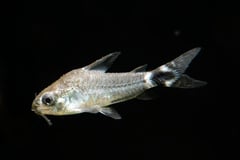
Gastrodermus hastatusTail-spot Pygmy Cory
Callichthyidae · (Eigenmann & Eigenmann, 1888)
The tail-spot pygmy cory, Gastrodermus hastatus, long known as Corydoras hastatus, is a tiny armoured catfish with a wide range across the Amazon and Río Paraguay basins. It is known from Brazil, Bolivia, Paraguay and northeastern Argentina. Unlike most congeners it swims in midwater, forming mixed schools with similarly patterned small characids such as Serrapinnus kriegi. It is frequently confused with G. pygmaeus, but has a dark, roughly diamond-shaped spot on the caudal peduncle where G. pygmaeus has a dark lateral stripe.

Geophagus abalios
Cichlidae · López-Fernández & Taphorn, 2004
Geophagus abalios is a cichlid from black and clear water tributaries of the río Orinoco in Venezuela, across the Llanos and south to the Casiquiare. One of the more commonly-traded members of the genus, it is rarely sold under the correct name and usually misidentified as G. altifrons or G. surinamensis. Juveniles are available cheaply because it is one of the few Geophagus bred commercially. Vertically split anterior flank bars separate it from the very similar G. brokopondo.

Geophagus altifrons
Cichlidae · Heckel, 1840
Geophagus altifrons is a large cichlid from the middle-to-lower Amazon basin in Brazil, including the Xingu, Tapajós, Madeira, Negro and Purus. Despite being the type species it is among the most frequently-misidentified members of the genus, partly because populations from the Orinoco, the Guianas and the Tocantins are now species in their own right. In adults the dark midlateral marking is reduced to 1-2 scales or absent, a feature unique to the species, but juveniles are very difficult to identify.

Geophagus argyrostictus
Cichlidae · Kullander, 1991
Geophagus argyrostictus is a cichlid known only from the rio Xingu system in Brazil, including its major tributary the rio Iriri. It belongs to the five species outside the G. surinamensis group, all with a complete infraorbital stripe, and fish over 70 to 80 mm SL develop silvery reflective scales on the anterior flanks. Markedly more aggressive than most congeners, it is a substrate-spawner and does best in a group of 5-8.

'Geophagus' brasiliensisPearl Cichlid
Cichlidae · (Quoy & Gaimard, 1824)
The pearl cichlid, Geophagus brasiliensis, comes from Atlantic-draining river systems of eastern and southern Brazil and Uruguay. It belongs to the 'G.' brasiliensis group, which still needs definitive classification. Colour and body shape vary with locality, and some coastal lagoon populations have evolved a degree of salt tolerance. Fish sold as Gymnogeophagus australis in Europe are more often this species, and non-native populations exist in several countries.

Geophagus camopiensisOiapoque Eartheater
Cichlidae · Pellegrin, 1903
The Oiapoque eartheater, Geophagus camopiensis, is a cichlid from the Oyapock basin on the Brazil and French Guiana border and the Approuague. Poorly known in the hobby, it is occasionally available through specialist breeders and retailers. A low E1 scale count and usually seven anal-fin rays are shared only with G. parnaibae, which may indicate a close relationship. A larger lateral marking and light caudal-fin spots separate the two.

'Geophagus' iporangensis
Cichlidae · Haseman, 1911
Geophagus iporangensis is a cichlid known only from the rio Ribeira de Iguapé basin, on the border of São Paulo and Paraná states in southern Brazil. A member of the 'G.' brasiliensis group, it reaches 90 to 100 mm, a more manageable size than some related species. Juveniles are readily confused with others in the group, but adults are smaller with comparatively few reflective blue scales. It is not common in the aquarium hobby.

Geophagus megasema
Cichlidae · Heckel, 1840
Geophagus megasema is a cichlid from the upper rio Madeira basin, recorded from the Mamoré and Guaporé drainages in Bolivia and Brazil. Very rare in the aquarium hobby, it has been collected, bred and distributed by some private collectors. It has no dark preopercular or infraorbital markings, no bars on the flanks and a relatively large, roundish midlateral marking.

Geophagus neambi
Cichlidae · Lucinda, Lucena & Assis, 2010
Geophagus neambi is a cichlid from the mid-to-upper rio Tocantins in Brazil, to which it may be endemic. It was in the hobby several years before it was described, traded as G. sp. aff. altifrons 'Tocantins', G. sp. 'Tocantins' or G. sp. 'rio Areoes', and aquarium fish are apparently collected in the rio Das Mortes basin. The 8-9 flank bars are normally visible only when the fish are stressed or spawning.

Geophagus parnaibae
Cichlidae · Staeck & Schindler, 2006
Geophagus parnaibae is a comparatively small cichlid endemic to the rio Parnaíba drainage in Piauí and Maranhão, northeastern Brazil. Only described in 2006, it has been in the hobby since at least 1988, traded as G. sp. 'Parnaíba'. The undescribed G. sp. 'Pindaré' is sometimes labelled with the Parnaíba name but is totally distinct. Maroon and whitish horizontal bands in the caudal fin help identify it.

Geophagus proximus
Cichlidae · (Castelnau, 1855)
Geophagus proximus is a large cichlid from the Amazon system in Peru and Brazil, from the río Ucayali along the Solimões-Amazon to the rio Trombetas. Rare in the hobby, its name is often attached to shipments of other Geophagus species. It has a dark preopercular marking, no bars on the flanks and a large, roughly oblong midlateral marking. It is found mostly in the lower reaches of rivers and in floodplain lakes, favouring clear and black water.

Geophagus sp. 'orange head'
Cichlidae · authority not recorded
Geophagus sp. 'orange head' is an undescribed cichlid confined to the lower rio Tapajós in Brazil, including its tributary the rio Arapiuns. Now one of the more readily available members of the genus, it has suffered from commercial breeders who do not cull deformed fry. Two forms exist, one misleadingly traded as G. sp. 'Araguaia orange head', and the orange on the head is most extensive in dominant adult males.

Geophagus sp. 'Pindaré'
Cichlidae · authority not recorded
Geophagus sp. 'Pindaré' is an undescribed cichlid known only from the rio Pindaré in Maranhão state, north-eastern Brazil. It appears to belong to the G. surinamensis group and is quite easily identified by its deep head and body and proportionately large eye. The trade name G. sp. 'Pindare' (Parnaíba) is confusing, because G. sp. 'Parnaíba' is now described as G. parnaibae. Parts of the Pindaré have been heavily degraded by siltation.

Geophagus winemilleri
Cichlidae · López-Fernández & Taphorn, 2004
Geophagus winemilleri is a cichlid from southern Venezuela and probably northern Brazil, recorded from the upper Río Negro, Río Siapa and Casiquiare. It is rare in the hobby, though other species are sometimes sold under its name. A dark preopercular marking and four ventrally-inclined bars on each flank help identify it, and it may be restricted to acidic blackwater.
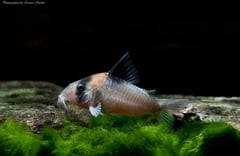
Hoplisoma burgessiBurgess' Cory
Callichthyidae · (Axelrod, 1987)
Burgess' cory, Hoplisoma burgessi, long known as Corydoras burgessi, is an armoured catfish apparently endemic to the upper rio Negro basin in Brazil. One of several similarly patterned congeners, including H. adolfoi, H. davidsandsi and H. duplicareum, it has a black marking restricted to the area beneath the dorsal fin and extending into it, with a yellowish patch on top of the head. Rio Negro habitats are mostly blackwater tributaries and flooded forest.
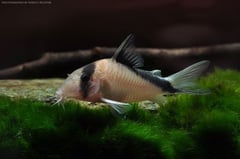
Hoplisoma davidsandsiSand's Cory
Callichthyidae · (Black, 1987)
Sand's cory, Hoplisoma davidsandsi, long known as Corydoras davidsandsi, is an armoured catfish apparently endemic to the rio Unini system in the lower rio Negro basin, Brazil. One of a group of rio Negro species with an oblique dark bar along the back, it shares with H. melini a bar that splits in two above the caudal peduncle. It has a pale orange area between the facial stripe and dorsal bar and no further dark markings on the flanks.
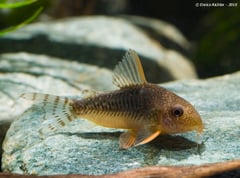
Hoplisoma gosseiPalespotted Cory
Callichthyidae · (Nijssen, 1972)
The palespotted cory, Hoplisoma gossei, long known as Corydoras gossei, is an armoured catfish from the rio Mamoré watershed in Rondônia state, northwestern Brazil. It is also likely to occur in northern Bolivia, since the Mamoré forms the border between the two countries at the type locality. Also known as 'smokey cory' and 'Gosse's cory', it shares its colour pattern with Brochis seussi from the same river, which has a noticeably prolonged snout. A form referred to as 'CW069' appears intermediate between the two.
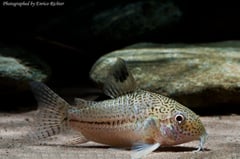
Hoplisoma juliiJulii Cory
Callichthyidae · (Steindachner, 1906)
The julii cory, Hoplisoma julii, long known as Corydoras julii, is an armoured catfish from coastal river systems south of the Amazon delta in northeastern Brazil. Also known as 'leopard cory' or 'three-lined cory', it is often confused with H. trilineatum from the upper Amazon, and many fish traded as C. julii are that species. H. julii has numerous small, distinct spots on the head, where H. trilineatum has vermiform markings, though some H. trilineatum are spotted too.
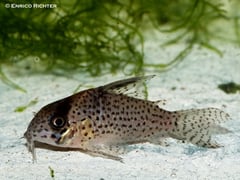
Hoplisoma kaneiC026
Callichthyidae · (Grant, 1998)
Hoplisoma kanei, long known as Corydoras kanei, is an armoured catfish that appears to be native to the rio Negro basin in Brazil, possibly only the rio Branco drainage. Before description it was assigned the 'C' numbers C026 and C046. It is most easily confused with H. atropersonatum and sometimes traded as that species, but has dark markings in the anal and caudal fins, more numerous and smaller dark spots on the body, and a darker base colouration.
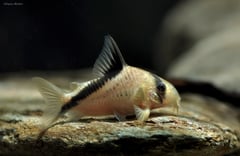
Hoplisoma meliniFalse Bandit Cory
Callichthyidae · (Lönnberg & Rendahl, 1930)
The false bandit cory, Hoplisoma melini, long known as Corydoras melini, is an armoured catfish from tributaries of the rios Negro, Caquetá and Orinoco in Brazil and Colombia. Its oblique dark bar along the back splits into two above the caudal peduncle, a feature shared only with H. davidsandsi, from which the dark markings on its flanks separate it. The rio Tiquié population is known in the hobby as 'C084', and a similar, slightly larger form from Peru as 'C085'.
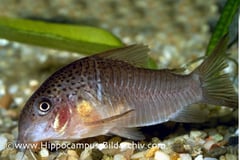
Hoplisoma polystictum
Callichthyidae · authority not recorded
Hoplisoma polystictum, long known as Corydoras polystictus, is a small armoured catfish from the upper Rio Paraguay in the Brazilian state of Mato Grosso. It inhabits small tributaries, creeks, areas of flooded forest and sand banks. It may be confused with H. simile but is easily distinguished by its unpatterned caudal peduncle, since H. simile has a blueish smudge-like marking there. Very peaceful, it is best kept in a group of at least six.
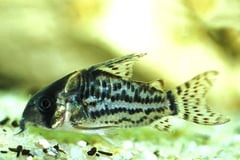
Hoplisoma schwartziSchwartz's Cory
Callichthyidae · authority not recorded
Schwartz's cory, Hoplisoma schwartzi, long known as Corydoras schwartzi, is an armoured catfish endemic to the Rio Purus drainage in Brazil. It inhabits small tributaries, creeks, areas of flooded forest and sand banks. Very peaceful, it is best kept in a group of at least six, and although it can be spawned like many other Corydoras, spawning is apparently tricky to induce in this species.
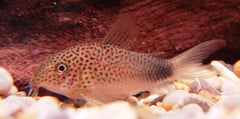
Hoplisoma simileSmudge Spot Cory
Callichthyidae · authority not recorded
The smudge spot cory, Hoplisoma simile, long known as Corydoras similis, is an armoured catfish from the Rio Madeira basin in Brazil. Several species can be confused with it at first glance, including Gastrodermus guapore, H. caudimaculatum, C. ourastigma and Brochis spectabilis, but they are easily told apart on close examination. H. caudimaculatum has a much darker, better-defined blotch at the caudal peduncle, and the long-snouted C. ourastigma has a grey or black blotch where H. simile has a blueish one.
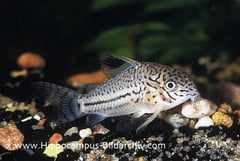
Hoplisoma trilineatumThree-lined Cory
Callichthyidae · authority not recorded
The three-lined cory, Hoplisoma trilineatum, long known as Corydoras trilineatus, is an armoured catfish from the Amazon basin in Colombia, Peru and Brazil and coastal rivers of Suriname. Most of the fish sold as C. julii are in fact this species, and the two are very hard to tell apart without knowing where the fish were collected. Peaceful and hardy, it ranks among the very best choices for the newcomer to catfish and is one of the easiest Corydoras to spawn.
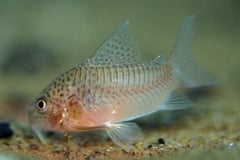
Hoplisoma xinguenseXingu Cory
Callichthyidae · (Nijssen, 1972)
The Xingu cory, Hoplisoma xinguense, long known as Corydoras xinguensis, is a small spotted armoured catfish from creeks in the upper Rio Xingu basin in Mato Grosso, Brazil. It is also sold as the dust cory, and fish traded under the C-numbers C055 and C105 to C108 have all been identified as this species. Dias et al. (2024) moved it to Hoplisoma as Hoplisoma xinguense. One of the smaller corys, it is best kept in a group of ten or more.
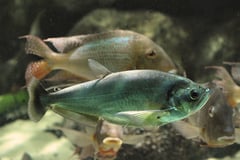
Hydrolycus scomberoidesVampire Tetra
Cynodontidae · (Cuvier, 1819)
The vampire tetra, Hydrolycus scomberoides, is a predatory dogtooth characin from the central and upper Amazon in Brazil, Bolivia, Peru and Ecuador. Also sold as 'scomb' and 'sabre tooth tetra', it is regularly confused with the much larger payara, H. armatus. At up to 300 mm it still needs a huge tank and specialist care, and newly-imported specimens often refuse anything but live food.
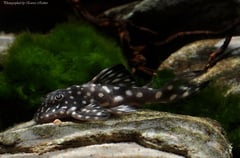
Hypancistrus inspectorL102
Loricariidae · Armbruster, 2002
The snowball pleco (L102), Hypancistrus inspector, is a suckermouth catfish from the upper rio Negro in Brazil and the Casiquiare in Venezuela. Brown to black with large whitish to yellow spots, it is most similar to H. contradens. It is normally collected from rocky rapids, is a cave-spawner with male brood care, and should not be kept with other Hypancistrus in order to prevent hybridisation.
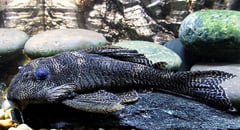
Hypancistrus seideliL066
Loricariidae · Sousa, Sousa, Oliveira, Sabaj, Zuanon & Rapp Py-Daniel, 2025
The king tiger plec, Hypancistrus seideli, is a suckermouth catfish from the lower rio Xingu in Pará state, northern Brazil. Described by Sousa et al. in 2025, it is traded as L066 and L333 and also as 'network pleco' and 'scribbled pleco'. Its colour pattern is highly variable and it is regularly confused with L400. It inhabits turbulent whitewater rapids, much of which is likely to be severely degraded by the Belo Monte dam.
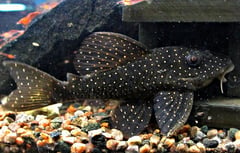
Hypancistrus sp.L004
Loricariidae · authority not recorded
L004, the angelicus pleco, is an undescribed Hypancistrus from tributaries of the lower Amazon near its mouth in Pará state, northern Brazil. It is sometimes traded under the false name 'Peckoltia angelicus', and the codes L004, L005, L028 and L073 represent distinct populations from the Tocantins, Guamá and Pará rivers. Peaceful but territorial towards its own kind, it has been bred in aquaria many times.
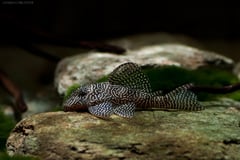
Hypancistrus sp.L260
Loricariidae · authority not recorded
L260, the queen arabesque pleco, is an undescribed Hypancistrus known only from the lower rio Tapajós in Pará state, northern Brazil. Among the most popular loricariids in the hobby, it is available on a regular basis. The larger L411 from the rio Jarí looks similar, but in L260 the white vermiculations are significantly finer. The area where it is collected would be largely destroyed should a planned hydroelectric project go ahead.
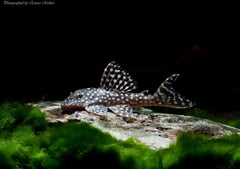
Hypancistrus sp.L136
Loricariidae · authority not recorded
L136 is an undescribed Hypancistrus from the rio Negro basin in Amazonas state, Brazil, collected in particular from the rio Demini. Highly variable in colour pattern, it has been assigned a series of L-numbers as a result. A peaceful cave-spawner with male brood care, it has been bred regularly in aquaria, but should not be kept with other Hypancistrus in order to prevent hybridisation.
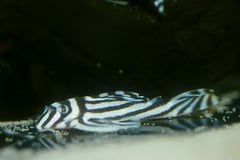
Hypancistrus zebraZebra Plec
Loricariidae · Isbrücker and Nijssen, 1991
The zebra plec, Hypancistrus zebra (L046), is a small loricariid catfish from the Rio Xingú basin in Brazil, named for its zebra pattern. Brazil banned its export in 2004 and captive-bred fish are expensive. Shy and easily outcompeted for food, it needs warm water of 26 to 30 °C, high oxygen levels and pristine conditions, and does not suit the general community tank.

Hyphessobrycon agulha
Characidae · Fowler, 1913
Hyphessobrycon agulha is a small tetra known with certainty only from the rio Madeira system in the Amazon basin of Brazil, Peru and Bolivia. Relatively rare in the hobby, it is occasionally traded as the 'red-tailed flag tetra'. It lends its name to a group of closely-related species with a dark lower half of the body, especially above the anal fin, and it is very peaceful.

Hyphessobrycon amandaeEmber Tetra
Characidae · Géry & Uj, 1987
The ember tetra, Hyphessobrycon amandae, is a tiny characid from the rio das Mortes, a tributary of the Araguaia in Mato Grosso, Brazil. Also traded as the 'Amanda's', 'dwarf red', 'red' and 'fire' tetra, it grows to around 20 mm SL. Very peaceful and gregarious, it makes a good dither fish for Apistogramma and other dwarf cichlids and spawns often in a mature aquarium.

Hyphessobrycon amapaensisAmapá Tetra
Characidae · Zarske & Géry, 1998
The Amapá tetra, Hyphessobrycon amapaensis, is a small characid from the rio Preto and rio Maraca drainages in Amapá state, northeastern Brazil. Also known as the 'red line' or 'scarlet' tetra, it is very similar to the flag tetra, H. heterorhabdus, but has a broader red stripe and a white or creamy central stripe. It comes from clear, light brown savanna streams over sand and gravel.

Hyphessobrycon anisitsiBuenos Aires Tetra
Characidae · (Eigenmann, 1907)
The Buenos Aires tetra, Hyphessobrycon anisitsi, is a characid from the Paraná and Uruguay river systems in Brazil, Paraguay, Argentina and Uruguay. A popular and hardy aquarium fish, it is also available as a line-bred albino strain, sometimes traded as 'golden'. It has a reputation for fin-nipping, though mostly when too few are kept or space is limited, and a group of at least 8-10 is the minimum.

Hyphessobrycon flammeusFlame Tetra
Characidae · Myers, 1924
The flame tetra, Hyphessobrycon flammeus, is a small characid from Rio de Janeiro and São Paulo states in Brazil. Popular in the hobby, it is bred commercially in several countries and also sold as 'red', 'fire', 'rio' and 'Von Rio' tetra. In nature it is now uncommon or even extinct across much of its range, and the São Paulo populations may have been introduced by aquarists or breeders.

Hyphessobrycon herbertaxelrodiBlack Neon Tetra
Characidae · Géry, 1961
The black neon tetra, Hyphessobrycon herbertaxelrodi, is a characid from the upper rio Paraguai in Mato Grosso and Mato Grosso do Sul, Brazil. A ubiquitous aquarium fish since its discovery, it is produced commercially in several countries, so wild fish are no longer collected. It is widespread north and south of the Pantanal, favouring minor tributaries, headwater rivers, oxbows and seasonal floodplains.

Hyphessobrycon heterorhabdusFlag Tetra
Characidae · (Ulrey, 1894)
The flag tetra, Hyphessobrycon heterorhabdus, is a characid from Pará and Maranhão states in eastern Brazil, also known as 'Belgian flag tetra'. Its name has been misapplied to similar fishes across much of the Amazon, the Orinoco and the Guianas, and the true species may reach no further upstream than the rio Tapajós. It lives almost exclusively in small, shaded forest streams called igarapés.

Hyphessobrycon melanostichosBlack Stripe Tetra
Characidae · Carvalho & Bertaco, 2006
The black stripe tetra, Hyphessobrycon melanostichos, is a characid endemic to the Rio Doze de Outubro in the upper Rio Tapajos basin, Brazil. It shares a number of similarities with Hyphessobrycon sp. 'Blue Ribbon' but has a lighter, more streamlined body, a smaller humeral spot and red colouring. It can become territorial in small tanks, but a group of 10 or more should prevent problems.

Hyphessobrycon pulchripinnisLemon Tetra
Characidae · Ahl, 1937
The lemon tetra, Hyphessobrycon pulchripinnis, is a characid from central Brazil, mostly recorded from the rio Tapajós basin. It is bred commercially in several countries, but the origin of the aquarium strain is questionable. Fish identical to it have been photographed in the lower Xingu, while a related 'orange red' form from the Tapajós may not be the same species.

Hyphessobrycon pyrrhonotusFlame-back Bleeding Heart Tetra
Characidae · Burgess, 1993
The flame-back bleeding heart tetra, Hyphessobrycon pyrrhonotus, is a characid endemic to the rio Negro system in Amazonas state, Brazil. The smallest of the three 'bleeding heart' species, it alone has a red, wedge-shaped patch along the upper body from below the dorsal fin to the base of the caudal. It lives in shallow blackwater tributaries near Barcelos, among roots, branches and leaf litter.

Hyphessobrycon roseusYellow Phantom Tetra
Characidae · (Géry, 1960)
The yellow phantom tetra, Hyphessobrycon roseus, is a small characid from Suriname, French Guiana and the Brazilian bank of the Oyapock/Oiapoque. Although popular in the hobby, its identity is somewhat confused, and two colour forms have been traded. It inhabits forest tributaries and igarapés with acidic, brownish water, sandy substrates and leaf litter.

Hyphessobrycon stegemanniSavanna Tetra
Characidae · Géry, 1961
The savanna tetra, Hyphessobrycon stegemanni, is a characid from the middle rio Tocantins and rio Araguaia basins in central Brazil. In the hobby its name has often been misapplied to Hemigrammus ataktos, since both occur in the Tocantins and have a dark lateral stripe. Its range lies almost entirely in the cerrado, the tropical wooded grassland of central Brazil.

Hyphessobrycon vilmae
Characidae · Géry, 1966
Hyphessobrycon vilmae is a small characid that appears to be endemic to the upper rio Tapajós basin in Amazonas and Mato Grosso states, Brazil. It is occasionally traded as 'chocolate neon tetra', and has a continuous, solid dark lateral stripe with no obvious humeral blotch. Generally peaceful, it is best kept in a mixed-sex group of at least 8-10.
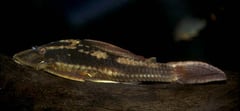
Hypostomus sp.L077
Loricariidae · authority not recorded
L077, the rusty, bruno or violet plec, is an undescribed wood-eating suckermouth catfish of the Hypostomus cochliodon complex from the rio Parnaíba basin in north-eastern Brazil. It grows to around 300 mm SL.

Hypselecara coryphaenoidesRio Negro Chocolate Cichlid
Cichlidae · authority not recorded
The Rio Negro chocolate cichlid, Hypselecara coryphaenoides, comes from rivers in Brazil and Venezuela including the Negro, Trombetas and Tapajós. It is much rarer in the trade than H. temporalis, from which it differs in a more elongate body, darker colour and a flank blotch on and above the lateral line. It lives in sluggish forest tributaries with dark, acidic water.

Iguanodectes adujai
Iguanodectidae · Géry, 1970
Traded as the 'red line lizard tetra', Iguanodectes adujai is a characin from the rio Negro in Brazil and the upper Río Orinoco in Venezuela. It is exported alongside the similar-looking I. geisleri, and differs in lacking the black lateral stripe beneath the red stripe and in having 28 to 34 anal-fin rays (20 to 25 in I. geisleri). It is assumed to live in smaller tributaries containing pristine blackwater.

Iguanodectes geisleri
Iguanodectidae · Géry, 1970
Iguanodectes geisleri is a characin from the rios Madeira and Negro in Brazil and the upper Río Orinoco in Venezuela. Traded with the similar-looking I. adujai as the 'red line lizard tetra', it differs in having a black lateral stripe beneath the red stripe and 20 to 25 anal-fin rays (28 to 34 in I. adujai). Adult males carry red markings in the pectoral, pelvic, anal and caudal fins.

Iguanodectes spilurusGreen Line Lizard Tetra
Iguanodectidae · (Günther, 1864)
The green line lizard tetra, Iguanodectes spilurus, is a characin found throughout the Amazon, Orinoco, Essequibo and Tocantins river systems. The most widespread Iguanodectes species, it has also been called the 'slender', 'spindle' or 'iguana' tetra, and differs from its congeners in its translucent dorsal and anal fins, lack of a red lateral stripe and prominent dark caudal-fin marking. It is sensitive to poor water conditions.
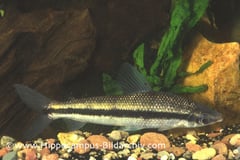
Laemolyta taeniataStriped Headstander
Anostomidae · (Kner, 1858)
The striped headstander, Laemolyta taeniata, is an anostomid from the central Amazon basin, also recorded from the Orinoco system in Venezuela. The largest-growing member of the genus, to 288 mm SL, it is rarely seen in the aquarium trade. Something of a habitat generalist, it migrates into flooded forest in the wet season and has been seen in large migratory shoals with Leporinus fasciatus and L. agassizii. Water quality is of the utmost importance, and anostomids are prodigious jumpers.
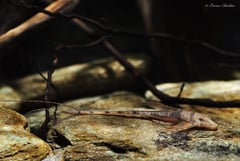
Lamontichthys filamentosusSturgeon Catfish
Loricariidae · (La Monte, 1935)
The sturgeon catfish, Lamontichthys filamentosus, is a loricariid from the central and western Amazon in Brazil, Peru, Ecuador and Bolivia. Above 60 mm SL the pectoral-fin spine extends into a filament that can be over four times the length of the first branched ray, and the dorsal-fin spine carries a similar extension. Relatively common in the hobby but not easy to maintain, it needs clean, well-oxygenated water and a mature aquarium with plenty of algae-covered surfaces.
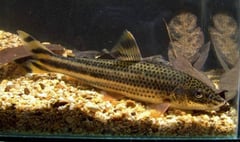
Leporellus vittatus
Anostomidae · (Valenciennes, 1850)
Leporellus vittatus is an anostomid with a huge natural range across the Amazon, Paraná-Paraguay, São Francisco and Orinoco river systems. Unlike most anostomids it is adapted to a benthic existence in flowing water and spends most of its time on or around the substrate. Occasionally exported, it requires quite specialised conditions, an aquarium of at least 210 by 60 cm and ideally a group of six or more.
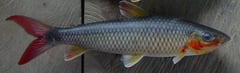
Leporinus brunneus
Anostomidae · Myers, 1950
Leporinus brunneus is an anostomid from the rios Madeira and Negro in Brazil, the Orinoco in Venezuela and Colombia, and the Casiquiare canal. The largest officially recorded specimen measured 256 mm, and an aquarium with base dimensions of at least 210 by 60 cm is needed.
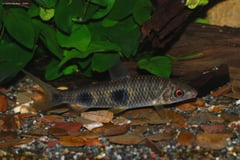
Leporinus copelandii
Anostomidae · Steindachner, 1875
Leporinus copelandii is an anostomid from the Paraíba do Sul and Doce river systems of southeastern Brazil. It reaches at least 200 mm, and an aquarium with base dimensions of 180 by 60 cm should be the smallest considered.
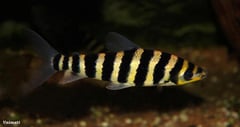
Leporinus fasciatusBanded Leporinus
Anostomidae · (Bloch, 1794)
The banded leporinus, Leporinus fasciatus, is an anostomid from the Amazon and Orinoco systems and coastal Guyana, Suriname and French Guiana. Young fish are often sold without warning of their size and requirements, and it is fairly ubiquitous in public aquarium displays. It is frequently confused with L. affinis, and its dark body bars multiply with age, from five in young fish to around ten in adults.
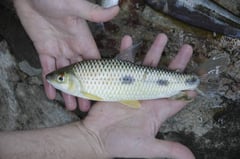
Leporinus fridericiThreespot Leporinus
Anostomidae · (Bloch, 1794)
The threespot leporinus, Leporinus friderici, is an anostomid from much of the Amazon system, with further records from the Guianas and Trinidad. It grows to 350 to 400 mm and needs an aquarium with base dimensions of at least 240 by 90 cm. Across this enormous range the fish differ in morphology and, especially, colour pattern.
Leptodoras linnelliElongate Mouse Catfish
Doradidae · authority not recorded
The elongate mouse catfish, Leptodoras linnelli, is a doradid catfish from river drainages of northern South America in Venezuela, Guyana and Brazil. It is found over sandy substrates in deeper, flowing sections of rivers and prefers cooler water than many related species. Totally unaggressive and schooling in nature, it is seldom exported and usually turns up only as bycatch among shipments of Opsodoras leporhinus or Hassar orestis.

Lugubria johannaRed-finned Pike Cichlid
Cichlidae · (Heckel, 1840)
The red-finned pike cichlid, Lugubria johanna, is a large pike cichlid that ranges over much of northern South America. It is known from the Orinoco, Essequibo, Oyapock and Approuague basins among others, mostly in faster moving rivers and streams, and a number of colour forms have developed across its range. Growing to 30 cm, it can be aggressive, especially towards its own kind, and will eat any fish small enough to be considered food.

Megalamphodus bentosiOrnate Tetra
Characidae · (Durbin, 1908)
The ornate tetra, Megalamphodus bentosi, is a small characid whose type locality lies on the main channel of the lower Amazon at Óbidos, Brazil. It is very similar to a number of congeners, some of them undescribed, and the rosy tetra is the one most often seen in the trade. It may also be sold as 'Bentos' tetra' or 'white-tipped tetra'. It mostly inhabits sluggish tributaries, side arms and forest lakes, often around submerged roots, branches or plants.

Megalamphodus equesSerpae Tetra
Characidae · (Steindachner, 1882)
The serpae tetra, Megalamphodus eques, is a characid with an enormous range through much of the Amazon drainage and the Río Paraguay. Very common in the trade, it is also sold as the 'jewel', 'red minor', 'blood' or 'callistus' tetra, and ornamental strains include 'long-finned' and 'balloon' forms. It has a reputation for nipping the fins of tankmates, although this is most pronounced when too few are kept or space is limited.

Megalamphodus erythrostigmaBleeding Heart Tetra
Characidae · (Fowler, 1943)
The bleeding heart tetra, Megalamphodus erythrostigma, is a characid from the upper Amazon basin where the borders of Brazil, Peru and Colombia meet. The best-known of three similar species in the 'bleeding heart' subgroup, it has the reddish humeral spot found in no other characid. Generally peaceful, although adult males are territorial to an extent, it mostly inhabits sluggish tributaries, side arms and forest lakes.

Megalamphodus haraldschultziCrystal Red Tetra
Characidae · (Travassos, 1960)
The crystal red tetra, Megalamphodus haraldschultzi, is a small characid endemic to the rio Araguaia system in Brazil. It is occasionally available, usually as bycatch among shipments of other fishes, and is sometimes traded as 'Araguaia red' or 'Schultz's tetra'. It is most easily separated from the similar Megalamphodus eques by the dorsal-fin marking, which is less extensive and bordered above by a white blotch and below by a yellowish band.

Megalamphodus megalopterusBlack Phantom Tetra
Characidae · Eigenmann, 1915
The black phantom tetra, Megalamphodus megalopterus, is a characid from the upper rio Madeira and upper rio Paraguai in Bolivia and Brazil. Most records are from the rio Guaporé (Río Iténez in Bolivia). Popular in the hobby and bred commercially in several countries, it is also available as a 'long-finned' strain. Adult males have black fins with the pelvic, dorsal and anal enlarged, while females are deeper-bodied with reddish pelvic, anal and adipose fins.

Megalamphodus socolofiLesser Bleeding Heart Tetra
Characidae · (Weitzman, 1977)
The lesser bleeding heart tetra, Megalamphodus socolofi, is a characid known only from the rio Negro basin and the rio Nhamundá in Brazil. One of three similar species in the 'bleeding heart' subgroup, it shares their reddish humeral spot, found in no other characid. Generally peaceful, although adult males are territorial to an extent, it mostly inhabits sluggish tributaries, side arms and forest lakes.
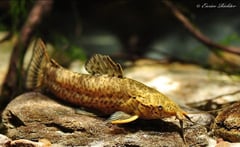
Megalechis pictaBar-tailed Hoplo
Callichthyidae · (Müller & Troschel, 1849)
The bar-tailed hoplo, Megalechis picta, is a callichthyid catfish widely distributed east of the Andes in Brazil, Venezuela and Guyana. It is recorded from the Amazon, Orinoco and upper Essequibo systems. Previously referred to as M. thoracata, it can be told from that species by a dark vertical bar in the caudal-fin and a longer dorsal-fin spine. Peaceful and hardy, it can even tolerate hypoxic conditions, and the male builds a nest.

Mesonauta festivusFlag Cichlid
Cichlidae · authority not recorded
The flag cichlid, Mesonauta festivus, is a cichlid recorded from Venezuela, Peru, Brazil, Bolivia and Paraguay. It lives in well planted, slower-moving waters. Flag cichlids are found in most aquatic stores, but the fish usually sold under the name is M. insignis. It is peaceful, but becomes more aggressive when breeding.
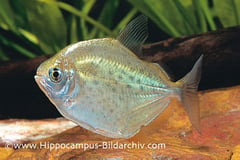
Metynnis lippincottianus
Serrasalmidae · (Cope, 1870)
Metynnis lippincottianus is a spotted silver dollar from Brazil and French Guiana, found in the lower and middle Amazon and the Oyapock system. It is occasionally seen for sale, sometimes as 'silver dollar', and its spotted pattern tells it apart from M. argenteus and M. hypsauchen. The spots are less pronounced than in M. maculatus, with which it shares a common name. The precise extent of its range is unclear.
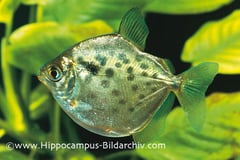
Metynnis maculatusSpotted Metynnis
Serrasalmidae · (Kner, 1858)
The spotted metynnis, Metynnis maculatus, is a silver dollar probably confined to the upper rio Madeira and upper rio Paraguai in Bolivia and Brazil. It is most often confused with M. argenteus and M. lippincottianus, but it has more midlateral scales and more spines on the ventral keel than either. It schools in nature and needs a very large tank with a group of six or more.

Mikrogeophagus altispinosusBolivian Ram
Cichlidae · (Haseman, 1911)
The Bolivian ram, Mikrogeophagus altispinosus, is a cichlid endemic to the upper rio Madeira basin in Bolivia and Brazil. Also traded as 'hi-fin ram' and 'Bolivian butterfly', it is larger and less colourful than M. ramirezi and lacks its blue iridescent markings, and it is arguably a better choice for less-experienced aquarists. A soft, sandy substrate is essential, and it needs pristine water quality.
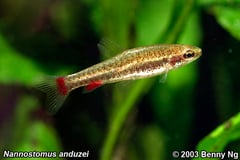
Nannostomus anduzei
Lebiasinidae · Fernandez & Weitzman, 1987
The smallest member of its genus, Nannostomus anduzei is a pencilfish from the upper Orinoco in Venezuela and the rio Negro basin in Brazil. Rarely traded in numbers, it is a relatively common contaminant among shipments of wild fishes from Manaus. Males have an intensely red caudal peduncle and anal-fin, and its size and timid nature suit a tank of its own or diminutive tankmates such as Paracheirodon simulans.
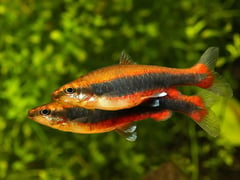
Nannostomus beckfordiGolden Pencilfish
Lebiasinidae · Günther, 1872
The golden pencilfish, Nannostomus beckfordi, is a lebiasinid widely distributed across Guyana, Suriname, French Guiana, Brazil and Venezuela. The type species of the genus and fairly ubiquitous in the trade, it is less demanding than most congeners and a good choice for a newcomer. Many fish on sale are farmed, and wild populations vary in colour pattern, several having been described as species now considered synonyms of N. beckfordi.
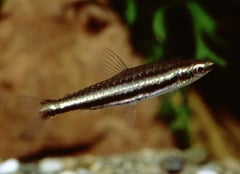
Nannostomus digrammusTwostripe Pencilfish
Lebiasinidae · (Fowler, 1913)
The twostripe pencilfish, Nannostomus digrammus, is a lebiasinid from the central Amazon basin in Brazil and the Rupununi basin in Guyana. Rare in the hobby, it usually arrives as bycatch among shipments of other fishes. It is most similar to N. bifasciatus but has an adipose-fin, and its small size and timid nature make it a poor community fish.
Nannostomus equesHockeystick Pencilfish
Lebiasinidae · Steindachner, 1876
The hockeystick pencilfish, Nannostomus eques, is a lebiasinid from the central and upper Amazon, the Orinoco drainage and rivers of Guyana. It swims at an oblique angle, a trait shared only with N. unifasciatus among congeners, and is also known as the 'rocket', 'diptail' or 'tubemouth' pencilfish. Genetic research on rio Negro populations raises the possibility that the species may be a complex of cryptic taxa.
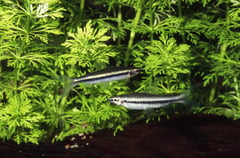
Nannostomus grandis
Lebiasinidae · Zarske, 2011
The largest member of its genus at up to 46 mm, Nannostomus grandis is a pencilfish known only from commercial exports from Belém, Pará state, Brazil. Poorly known in the hobby, it arrives as bycatch, especially among N. beckfordi, which it closely resembles. The simplest difference is that N. grandis lacks pale white or bluish tips to the ventral fins, and it appears to have been traded as N. anomalus in the 1920s and 1930s.
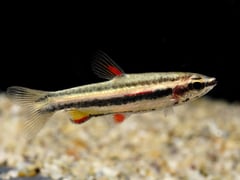
Nannostomus marginatusDwarf Pencilfish
Lebiasinidae · Eigenmann, 1909
The dwarf pencilfish, Nannostomus marginatus, is a lebiasinid of Guyana, Suriname and the middle-to-lower Amazon in Peru, Colombia and Brazil. Enduringly popular, it lacks the red body colour of males of the related N. mortenthaleri and N. rubrocaudatus, showing three dark lateral stripes with no red or purple between them. Colour varies between populations, and its small size and timid nature make it a poor community fish.
Nannostomus marilynaeGreenstripe Pencilfish
Lebiasinidae · Weitzman & Cobb, 1975
The greenstripe pencilfish, Nannostomus marilynae, occurs in the rio Negro in Brazil and the Río Vichada in the upper Orinoco basin, Colombia. Also known as 'Marilyn's pencilfish', it is rarely traded in numbers and more often seen as bycatch among shipments of Paracheirodon axelrodi. It most resembles N. minimus, but males lack the highly modified anal-fin of that species.
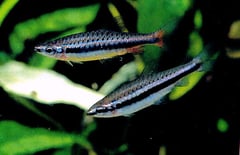
Nannostomus nitidusShining Pencilfish
Lebiasinidae · Weitzman, 1978
The shining pencilfish, Nannostomus nitidus, was described from the Rio Capim, a short river draining into the rio Pará near Belém, Brazil. Poorly known in the hobby, it is rarely traded in numbers and is more often seen as bycatch. Males have a brightly coloured stripe above the primary dark lateral stripe, and some captive-raised fry lacking an adipose-fin have raised questions about the validity of the similar N. limatus.
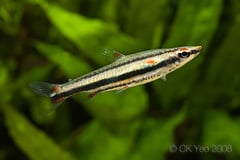
Nannostomus trifasciatusThree-lined Pencilfish
Lebiasinidae · Steindachner, 1876
The three-lined pencilfish, Nannostomus trifasciatus, is a lebiasinid widespread in the western Amazon basin in Brazil, Peru, Colombia and Bolivia. Fairly ubiquitous in the trade, it is less demanding than many congeners and a good choice for a newcomer to pencilfishes. Many fish on sale are farmed, and wild populations vary in colour pattern, one being marketed as 'super red' for its unusually long red stripe.
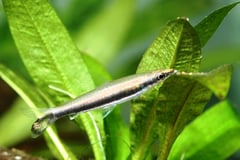
Nannostomus unifasciatusOne-lined Pencilfish
Lebiasinidae · Steindachner, 1876
The one-lined pencilfish, Nannostomus unifasciatus, occurs in the upper Amazon and upper Orinoco basins in Brazil, Bolivia, Colombia and Venezuela. A popular aquarium fish, it swims at an oblique angle, a trait shared only with N. eques. It differs from that species in lacking dark brown spots on the body scales and normally having an ocellus in the upper caudal-fin lobe.
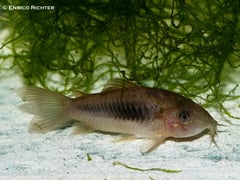
Osteogaster aeneaBronze Cory
Callichthyidae · (Gill, 1858)
The bronze cory, Osteogaster aenea, long known as Corydoras aeneus, is an armoured catfish described from Trinidad and accepted to occur across much of South America. That range looks more like a complex of similar, distinct species than a single one, and fish from outside Trinidad are of uncertain identity. Aquarium fish are almost all commercially farmed, and the names C. schultzei and C. venezuelanus are routinely misapplied to them.
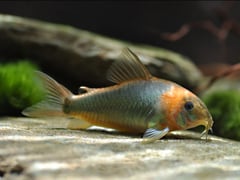
Osteogaster eques
Callichthyidae · (Steindachner, 1876)
Osteogaster eques, long known as Corydoras eques, is an armoured catfish described from the Amazon at Codajás, on the rio Solimões main channel in western Brazil. Its wider range is unclear, although similar-looking fish have been exported from Peru on occasion. It is sometimes confused with C. venezuelanus, and two similar unidentified fishes from Peru carry the codes CW007 and CW043.
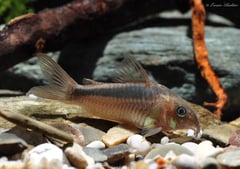
Osteogaster rabautiRusty Cory
Callichthyidae · (La Monte, 1941)
The rusty cory, Osteogaster rabauti, long known as Corydoras rabauti, is an armoured catfish known mostly from the rio Javarí, which forms much of the border between Brazil and Peru. It possibly also occurs in Colombia, but the full extent of its range is somewhat unclear. Often confused with the very similar O. zygata, it can be told apart by the broad dark stripe on the upper body, which extends onto the lower part of the caudal peduncle. An albino form is available on occasion.
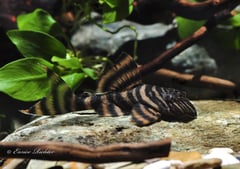
Panaqolus sp.L403
Loricariidae · authority not recorded
L403 is an undescribed wood-eating suckermouth catfish in the genus Panaqolus, known only from the rio Anapu in Pará state, Brazil. The species is xylophagous, feeding primarily on wood, so driftwood must be provided. It should be given a mainly vegetarian diet, with meaty foods kept to a minimum. It has been bred in aquaria.

Paracheirodon axelrodiCardinal Tetra
Characidae · (Schultz, 1956)
The cardinal tetra, Paracheirodon axelrodi, is a small characid from the rio Negro and Orinoco drainages of Brazil, Colombia and Venezuela. Immensely popular in the hobby, it is now commercially bred on a large scale, but a significant proportion of trade fish are still wild caught or come from community-led projects such as Project Piaba. Rio Negro and Orinoco populations differ in colour pattern, and wild fish are less tolerant of deteriorating water conditions than commercially-produced ones.

Paracheirodon simulansGreen Neon Tetra
Characidae · (Géry, 1963)
The green neon tetra, Paracheirodon simulans, is a small characid from the rio Negro and Orinoco drainages of Brazil, Colombia and Venezuela. An exclusive inhabitant of blackwater, it lives only in the upper, terra firme reaches of tributaries and is sometimes traded as 'false neon tetra' or 'blue neon tetra'. A greener lateral stripe that extends to the caudal-fin base and duller red flanks separate it from P. innesi and P. axelrodi.
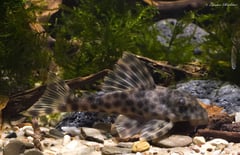
Peckoltia oligospilaL006
Loricariidae · (Günther, 1864)
The brown dot peckoltia (Peckoltia oligospila), also known as L006, is a suckermouth catfish from the rios Tocantins and Capim in Brazil. Only faint spots and saddles mark its body, a pattern it shares among congeners with P. bachi and some specimens of P. furcata alone. Relatively peaceful but territorial with conspecifics, it is a cave-spawner and does best in a tank designed to simulate a flowing stream.
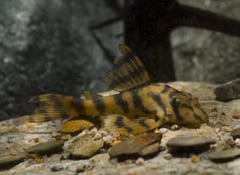
Peckoltia sp.L288
Loricariidae · authority not recorded
L288 is a Peckoltia species, a suckermouth catfish from the rios Curuá Una and Uruará in Pará state, Brazil. The Curuá Una joins the main lower Amazon channel downstream of Santarém and carries a large hydroelectric power plant. The species spawns in caves with the male responsible for brood care.
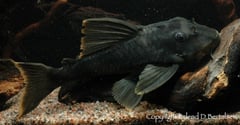
Peckoltia sp.L076
Loricariidae · authority not recorded
L076 is a Peckoltia species, a suckermouth catfish apparently collected from the rio do Pará near Portel in Pará state, northern Brazil. L076 and L099 appear to be the same species, the former showing a darker colour pattern by day, though both look similar at night. It spawns in caves and the male is responsible for brood care.
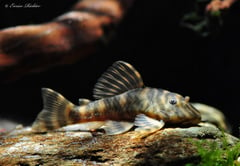
Peckoltia sp.L038
Loricariidae · authority not recorded
L038 is an unidentified Peckoltia, a suckermouth catfish collected near Mocajuba on the lower rio Tocantins in Pará state, Brazil. It is relatively peaceful but territorial with conspecifics and similarly-shaped species, and spawns in caves with the male responsible for brood care.
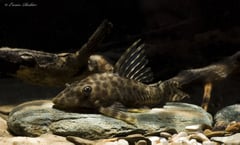
Peckoltichthys bachiL146
Loricariidae · (Boulenger, 1898)
The bola pleco, Peckoltichthys bachi, is a loricariid catfish from the upper Amazon region in Brazil, Colombia, Ecuador and Peru. It has been assigned several L-numbers, including L146 from Colombia and L232 from the Río Putumayo/Içá, and has been exported under other generic names including Hemiancistrus and Sophiancistrus. Its mottled colour pattern separates it from most Peckoltia species, and it lives among submerged grasses and branches in flowing water along the margins of medium to large rivers.

Phenacogaster tegatus
Characidae · (Eigenmann, 1911)
Phenacogaster tegatus is a small characid from the upper rio Paraguay basin in Brazil and Paraguay and the Río Paraná in northeastern Argentina. It has been traded as 'six-eyed tetra', in reference to the two dark spots on each flank plus the eye. Peaceful but somewhat unsuitable for the general community aquarium, it is best kept in a group of at least 8-10 alongside similarly-sized characids and other small, non-predatory fishes.
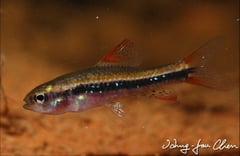
Poecilocharax weitzmaniBlack Darter Tetra
Crenuchidae · Géry, 1965
The black darter tetra, Poecilocharax weitzmani, is a crenuchid recorded from Brazil, Colombia, Peru and Venezuela. It has been collected from the upper Río Negro, Río Orinoco and Río Solimões drainages. Also traded as 'Black Morpho' tetra, it requires specialist care and is notoriously reluctant to accept dried foods. Unlike most small characids it does not form schools, and males are aggressively territorial towards one another. The Peruvian populations may apparently represent an undescribed species.
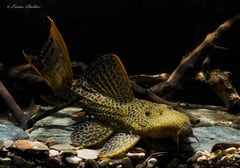
Pseudacanthicus cf. leopardusL114
Loricariidae · authority not recorded
L114, Pseudacanthicus cf. leopardus, is a loricariid collected mostly in the rio Negro basin in Brazil, particularly the rio Demini. P. leopardus was described from the Rupununi River in Guyana, so the identity of this fish remains unconfirmed. Traded as the Demini leopard cactus pleco or simply 'leopard cactus pleco', it grows to 250 mm and needs an aquarium of at least 180 x 60 cm set up to simulate a flowing river.
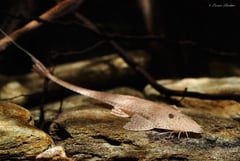
Pseudohemiodon laticepsGiant Whiptail Catfish
Loricariidae · (Regan, 1904)
The giant whiptail catfish, Pseudohemiodon laticeps, is a loricariid from the rios Uruguay, Paraná and Paraguay in Brazil, Paraguay and Argentina. Growing to 300 mm, it stays buried in soft substrate by day and emerges to feed at night, so a sandy substrate and very clean, stable water matter most. The male is a paternal 'lip brooder', carrying the eggs on his labial barbels for 12-14 days, and the species has been bred in aquaria.

Pterophyllum leopoldiRoman Nose Angelfish
Cichlidae · (Gosse, 1963)
The roman nose angelfish, Pterophyllum leopoldi, is a cichlid from the lower Rio Negro in Brazil and the Rupununi and Essequibo basins of Guyana. It can be told from other members of the genus by up to 11 vertical stripes, a dark patch over the operculum and the roman nose that gives it its name. Reportedly one of the more aggressive species in the genus towards conspecifics, it should be kept in a group of four or more to prevent bullying.
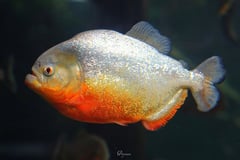
Pygocentrus nattereriRed Bellied Piranha
Serrasalmidae · Kner, 1858
The red bellied piranha, Pygocentrus nattereri, occurs through much of the Amazon basin and south into the Paraná and Uruguay river systems. Famed as a rapacious predator, it is among the most notorious freshwater fishes in the world. According to Herbert Axelrod (1976), the myth began with a feeding frenzy staged for Theodore Roosevelt in Brazil in 1913. Usually only juveniles form aggregations, and the species is relatively easy to breed in the aquarium.

Retroculus lapidifer
Cichlidae · (Castelnau, 1855)
Retroculus lapidifer is a rheophilic cichlid from the rio Tocantins and Araguaia systems and nearby coastal drainages of northeastern Brazil. It lives in rapids and fast-flowing stretches of clear water rivers, and needs a set-up designed to resemble a flowing river, with a base of at least 210 by 60 cm and water of 26 to 32 °C. A biparental substrate-spawner, it has been bred in aquaria and is available in the trade on a sporadic basis.

Retroculus xinguensis
Cichlidae · Gosse, 1971
Retroculus xinguensis is a rheophilic cichlid from the rio Xingu basin in Brazil, with a handful of records from the Tapajós drainage. It occurs in rapids and fast-flowing stretches of clear water rivers, and differs from its congeners in having conspicuous dark bars on the caudal fin. It is available in the trade on a sporadic basis and needs a large set-up designed to resemble a flowing river, with water of 26 to 32 °C.

Satanoperca acuticepsSharphead Eartheater
Cichlidae · (Heckel, 1840)
The sharphead eartheater, Satanoperca acuticeps, is a cichlid from the central Amazon basin in Brazil, including the lower rio Negro and rio Branco. Relatively rare in the trade, it is sometimes confused with S. daemon and S. lilith but has three dark flank blotches (vs. two in S. daemon, one in S. lilith). Unless breeding it is surprisingly peaceful, and it is very rarely bred in aquaria.

Satanoperca daemonThreespot Eartheater
Cichlidae · (Heckel, 1840)
The threespot eartheater, Satanoperca daemon, is a cichlid from the rio Negro, Casiquiare and upper Orinoco systems in Brazil, Venezuela and Colombia. It is mostly observed in acidic, mineral-poor blackwater. Relatively common in the aquarium trade, it is by no means easy to maintain, needing particular attention to space, diet, water quality and chemistry. Two dark blotches on the flank separate it from the similar S. lilith, which has only one.

Satanoperca jurupariDemon Eartheater
Cichlidae · (Heckel, 1840)
The demon eartheater, Satanoperca jurupari, is a cichlid recorded throughout much of the Amazon basin in Brazil, Bolivia, Peru, Ecuador and Colombia. In aquarium literature it is frequently confused with S. leucosticta, which has prominent white spots or vermiform markings on the sides of the head. Its precise identity is a confusing issue, and populations from the Tapajós, Xingu, Araguaia and Paraná are genetically distinct and may represent separate species.

Satanoperca leucostictaWhitespot Eartheater
Cichlidae · (Müller & Troschel, 1849)
The whitespot eartheater, Satanoperca leucosticta, is a cichlid from the Guiana Shield in Guyana, Suriname, eastern Venezuela and northern Brazil. Farmed in several countries, it is frequently available in the ornamental trade. It is often confused with S. jurupari but is easily recognised by the prominent white spots or vermiform markings on the sides of the head. A larvophilous maternal mouthbrooder, it has been bred in aquaria.

Satanoperca lilith
Cichlidae · Kullander & Ferreira, 1988
Satanoperca lilith is an eartheater cichlid known only from Brazil, where it is widely distributed along the Solimões/Amazon main channel. Despite that extensive range it is uncommon in the ornamental trade, where it is sometimes called 'one-spotted demon fish' or 'one spot eartheater'. A single dark blotch on the flank separates it from the closely similar S. daemon, which has two.

Satanoperca pappaterraPantanal Eartheater
Cichlidae · (Heckel, 1840)
The Pantanal eartheater, Satanoperca pappaterra, is a cichlid from the rio Guaporé and upper rio Paraguai basins in Brazil, Bolivia and Paraguay. Relatively rare in the ornamental trade and much sought after, it is easily told from all known congeners by a series of prominent black blotches beneath the dorsal-fin and a well-defined dark band along the side of the body. It has been introduced to the upper rio Paraná in southeastern Brazil.
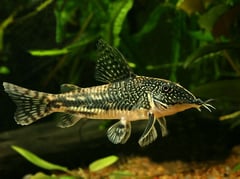
Scleromystax barbatusBanded 'Cory'
Callichthyidae · (Quoy & Gaimard, 1824)
The banded 'cory', Scleromystax barbatus, is an armoured catfish from coastal rivers in south-east Brazil, between Rio de Janeiro and Santa Catarina. At 90-100 mm it is the largest of the Corydoradinae, and it was formerly included in Corydoras. The hobby also knows it as 'bearded cory', 'checkerboard cory' and 'filigree cory'. Males are aggressively territorial towards one another and cannot be kept together in smaller aquaria.
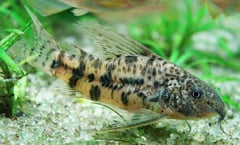
Scleromystax macropterusSailfin 'Cory'
Callichthyidae · (Regan, 1913)
The sailfin 'cory', Scleromystax macropterus, is an armoured catfish from coastal rivers of southern Brazil and the rio Paraná basin in Paraguay. Most have been collected from small blackwater streams draining directly into the Atlantic, but it also inhabits roadside ditches. Males are somewhat territorial towards one another and should not be kept together in smaller aquaria, and its stiffened pectoral-fin spines can give a painful 'sting'.
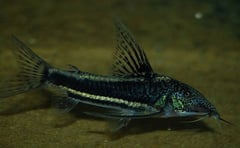
Scleromystax sp. C113
Callichthyidae · authority not recorded
Scleromystax sp. C113 is an unidentified armoured catfish apparently collected in Bahia state, eastern Brazil, south of Salvador da Bahia. Like its congeners it is a facultative air breather and occasionally rises to gulp air at the surface, and its stiffened pectoral-fin spines can give a very painful 'sting'. Males are aggressively territorial towards one another and cannot be kept together in smaller aquaria.
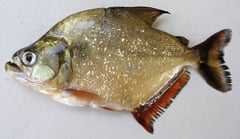
Serrasalmus brandtiiWhite Piranha
Serrasalmidae · Lütken, 1875
The white piranha, Serrasalmus brandtii, may be restricted to the rio São Francisco watershed in eastern Brazil. Also known as 'green piranha' or 'Brandt's pirambeba', it appears infrequently in the trade, and its name is sometimes misapplied to the distantly related Pygopristis denticulata. Adults are uniformly golden-bronze with dark fin margins and a concave head profile above the eye. It is best kept alone as a single specimen.
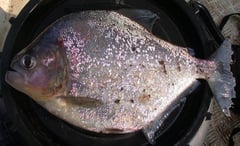
Serrasalmus gouldingiGoulding's Piranha
Serrasalmidae · Fink & Machado-Allison, 1992
Goulding's piranha, Serrasalmus gouldingi, is a deep-bodied piranha from the rio Negro drainage in Brazil and the Casiquiare system in Venezuela. It occasionally appears in the ornamental trade, sometimes as 'blue tiger piranha'. The eye is bluish or coppery, the body carries vertically-elongate dark spots and the caudal-fin has a blackish basal band. Its native rivers are acidic, mineral-poor blackwater, and it is best kept alone.
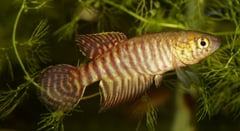
Simpsonichthys myersi
Rivulidae · (de Carvalho, 1971)
Simpsonichthys myersi is an annual killifish from minor coastal river basins in eastern Brazil, in Bahia and Espírito Santo states. Its range lies between the rio Jucuruçu and the rio Doce. It inhabits rain-fed pools and swamps that dry out each year, when the adults die and the eggs wait in diapause until the rains return. Whether it is conspecific with S. izecksohni remains unclear.
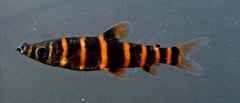
Synaptolaemus latofasciatus
Anostomidae · (Steindachner, 1910)
Synaptolaemus latofasciatus is a headstander from the upper Orinoco, the Casiquiare Canal and the middle-to-lower Amazon in Venezuela and Brazil. Described from a single specimen and placed in Leporinus until 2011, it was then recognised as the fish described as Synaptolaemus cingulatus. Alternating transverse bands of orange or yellow and dark brown or black run along the entire body, and snout shape and colour pattern vary with locality.
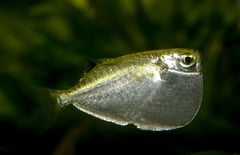
Thoracocharax stellatusSpotfin Hatchetfish
Gasteropelecidae · (Kner, 1858)
The spotfin hatchetfish, Thoracocharax stellatus, is the most widespread neotropical hatchetfish, recorded from much of South America. It is told from its only congener, T. securis, by a prominent dark spot in the dorsal fin, and is sometimes traded as 'platinum hatchetfish'. It feeds almost entirely on insects, and a tightly fitting cover is needed because it can clear several metres in one jump.

Tucanoichthys tucano
Characidae · Géry & Römer, 1997
Tucanoichthys tucano is a miniature characid known only from the rio Uaupés system in the upper Negro basin, Brazil. Adults are less than 17 mm SL, with a conspicuous dark lateral stripe, and the type locality is a small blackwater creek. Much sought after, it is peaceful but not an ideal community fish, given its small size and somewhat specialised requirements.

Wallaciia compressicepsCompressiceps Dwarf Pike Cichlid
Cichlidae · (Ploeg, 1986)
The compressiceps dwarf pike cichlid, Wallaciia compressiceps, is a small pike cichlid known only from the lower Rio Tocantins basin in Brazil. It swims a great deal and can be very quick and very aggressive, so it needs a larger aquarium than its size suggests, and anything half its size will be seen as food. A number of hobbyists have found it very difficult to spawn without target fish in the aquarium.
Xiphophorus helleriiGreen Swordtail
Poeciliidae · Heckel, 1848
The green swordtail, Xiphophorus hellerii, is a livebearer native to southeastern Mexico, Guatemala, Belize and Honduras. Among the world's most recognisable aquarium fishes, it is ubiquitous in the trade, where selective breeding and hybridisation with X. maculatus and X. variatus have produced a bewildering array of ornamental forms. The name is often misspelled X. helleri.
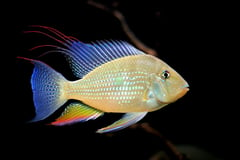
Acarichthys heckeliiThreadfin Acara
Cichlidae · (Müller & Troschel, 1849)
The threadfin acara, Acarichthys heckelii, is a cichlid from the northern Amazon basin in Colombia, Peru and Brazil and the Essequibo in Guyana. The only member of its genus, it grows to around 200 mm and digs incessantly, and it is susceptible to deteriorating water quality. Some adults show sudden, extreme aggression towards conspecifics that can kill weaker fish, and the problem decreases as tank and group size increase.

Aequidens tetramerusSaddle Cichlid
Cichlidae · (Heckel, 1840)
The saddle cichlid, Aequidens tetramerus, is a cichlid found across much of northern South America, from the Amazon and Orinoco basins to the Guianas. The type species of its genus, it occurs in several colour forms, and fish from Ecuador and Peru are sought after for the red or orange colouration on the lower head and belly. As currently recognised it is likely to represent a group of related fishes, some of which may be described as distinct species.

Apistogramma mendeziA220
Cichlidae · Römer, 1994
Apistogramma mendezi is a dwarf cichlid from the lower rio Negro basin in northwestern Brazil, found in blackwater tributaries and flooded forest. Populations coded A220, A221 and A222 may be conspecific and differ in colour pattern, particularly the orientation of the caudal-fin markings. Most collections for the trade appear to come from further upstream, around Santa Isabel do Rio Negro or São Gabriel da Cachoeira.
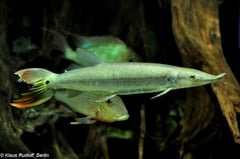
Boulengerella cuvieri
Ctenoluciidae · (Spix & Agassiz, 1829)
Boulengerella cuvieri is a pelagic ctenoluciid characin from much of the Amazon basin, the Río Orinoco and coastal drainages of the Guianas. The largest officially recorded specimen measured 675 mm, but it appears to grow larger, possibly beyond 800 mm. Given that size and its natural behaviour it is largely unsuitable for the home aquarium. Its entire dorsal-fin base lies ahead of the anal-fin origin, a character shared only with B. lucius and B. xyrekes among ctenoluciids.
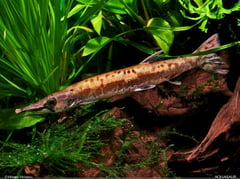
Boulengerella lucius
Ctenoluciidae · (Cuvier, 1816)
Boulengerella lucius is a large, pelagic ctenoluciid from the central Amazon region in Brazil and the Río Orinoco in Venezuela. Named for its resemblance to the northern pike, it grows to 420 mm and is largely unsuitable for the home aquarium. Juveniles and subadults are sometimes available in the trade, often misidentified as B. maculata. Dark patches between the median caudal-fin rays and random dark spots on the lower flanks separate it from B. cuvieri and B. xyrekes.
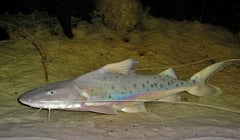
Brachyplatystoma capapretum
Pimelodidae · Lundberg & Akama, 2005
Brachyplatystoma capapretum is a large, piscivorous pimelodid catfish found throughout much of the Amazon basin, from near Belém to Iquitos in Peru. The largest recorded specimen measured 880 mm, and it is suitable only for public aquaria and a very small minority of private aquarists. It is very similar to B. filamentosum but smaller, with shorter maxillary barbels, a moderately forked caudal-fin with lobes of equal size, and adults very dark above.
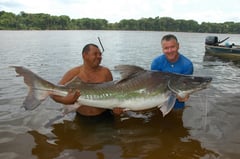
Brachyplatystoma filamentosumPiraíba
Pimelodidae · (Lichtenstein, 1819)
The piraíba, Brachyplatystoma filamentosum, is the largest catfish of the Amazon basin, also found in the Orinoco and river systems of the Guianas. Adults typically measure 2 to 2.5 m and weigh over 150 kg. In the Amazon only fish over around 160 cm are called 'Piraíba', and smaller ones 'filhote'. It is suitable only for public aquaria and a very small minority of private aquarists.
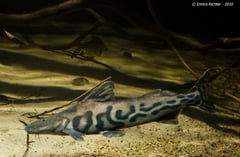
Brachyplatystoma juruenseGold Zebra Catfish
Pimelodidae · (Boulenger, 1898)
The gold zebra catfish, Brachyplatystoma juruense, is a large pimelodid from the middle Amazon and Orinoco basins, described from the rio Juruá. Adults have broad dark vertical, oblique or branching bands on a pale yellowish body and grow to at least 600 mm. It is sometimes confused with B. tigrinum, especially when young, but has a much less defined pattern, a deeper body and shorter barbels. It suits only public aquaria and a very small minority of private aquarists.
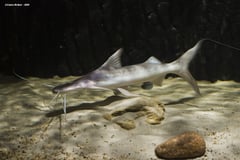
Brachyplatystoma platynemumSlobbering Catfish
Pimelodidae · Boulenger, 1898
The slobbering catfish, Brachyplatystoma platynemum, is a large migratory pimelodid catfish from the Amazon and Orinoco basins. The name refers to its relatively thick barbels, which give the impression that the fish is drooling. It travels considerable distances along deeper, flowing channels, and sexually mature adults have been observed in the upper rio Madeira basin, some 3000 km from the estuary. It grows to 1000 mm SL.
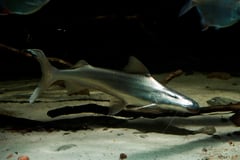
Brachyplatystoma rousseauxiiDourada
Pimelodidae · (Castelnau, 1855)
The dourada, Brachyplatystoma rousseauxii, is a large migratory pimelodid catfish from the Amazon and Orinoco drainages and rivers of the Guianas. Juveniles feed in the Amazon delta, while sexually mature adults are found only in the western Amazon. Some populations cover as much as 5500 km during migration from the delta, the longest known in any freshwater fish, and it is heavily fished during its upstream movement. It grows to 1900 mm SL.
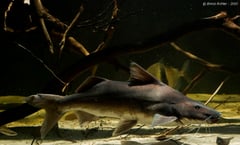
Brachyplatystoma vaillantiiPiramutaba
Pimelodidae · (Valenciennes, 1840)
The piramutaba, Brachyplatystoma vaillantii, is a large migratory pimelodid catfish from the Amazon and Orinoco watersheds and rivers of the Guianas. Juveniles feed in the Amazon delta before migrating upstream in massive numbers, when they are subject to intensive capture by commercial and artisanal fisheries. Sexually mature adults have been observed in the rio Caquetá basin, some 3500 km from the estuary. It grows to 1050 mm SL.
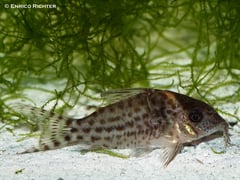
Brochis agassiziiSpotted Cory
Callichthyidae · (Steindachner, 1876)
The spotted cory, Brochis agassizii, long known as Corydoras agassizii, is an armoured catfish from the Amazon around the border of Brazil and Peru, described from near Tabatinga. Its name is commonly misapplied to similar-looking fishes, and it can be hard to identify even when the collection locality is known. It is most often confused with B. ambiacus, and fish matching that species appear far more common in the trade.
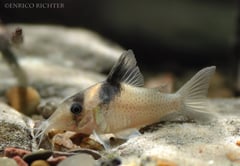
Brochis amandajanea
Callichthyidae · (Sands, 1995)
Brochis amandajanea, long known as Corydoras amandajanea, is an armoured catfish from the Rio Miuã system of streams off the upper Rio Negro in Brazil. It is rare in the aquarium trade and appears to be variable in colour pattern, some individuals having larger dark spots on the body. Little has been written about it since its description, and the congener B. cryptica was described from the same locality.
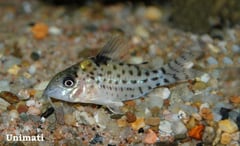
Brochis ambiacus
Callichthyidae · (Cope, 1872)
Brochis ambiacus, long known as Corydoras ambiacus, is an armoured catfish from the upper Amazon tributaries of Peru, Brazil, Colombia and Ecuador, described from the Río Ampiyacu. Its name is commonly misapplied to similar-looking fishes, particularly B. agassizii, and the colour pattern is variable. Cope described a large black spot covering the front half of the dorsal fin, and fish matching this are far more common in the trade than those matching B. agassizii.
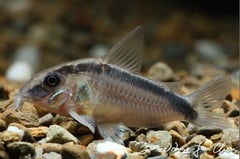
Brochis arcuataSkunk Cory; C020
Callichthyidae · (Elwin, 1938)
The skunk cory, Brochis arcuata, long known as Corydoras arcuatus, is an armoured catfish from the upper Amazon region in Brazil, Peru, Ecuador and Colombia. It is among the more popular Corydoras in the hobby and is also known as the 'arched cory' or C020. Several similar-looking congeners exist, particularly Hoplisoma urucu, in which the black body stripe ends behind the eye, and the larger C. narcissus from the rio Purus.
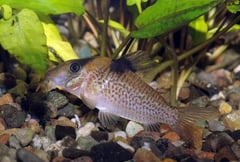
Brochis ephippiferaSaddle Cory
Callichthyidae · (Nijssen, 1972)
The saddle cory, Brochis ephippifera, long known as Corydoras ephippifer, is an armoured catfish native to Amapá state in northeastern Brazil. It resembles several congeners, including B. agassizii, Hoplisoma brevirostre, B. delphax and H. melanistium, but seems unique among them in having all fins except the dorsal transparent and unmarked. Detailed observations from the wild are scarce.
Cichla monoculusTucanare Peacock Bass
Cichlidae · authority not recorded
The tucanare peacock bass, Cichla monoculus, is a large predatory cichlid from Colombia, French Guiana, Peru and Brazil, including the Rio Solimões. Often sold as small juveniles, it grows to around 80 cm and needs a tank of at least 10 x 3 x 4 feet as an adult, so it is more suited to public aquaria. It is territorial and moderately aggressive and will eat any tankmate small enough to be considered food.

Cichla ocellarisPeacock Bass
Cichlidae · authority not recorded
The peacock bass, Cichla ocellaris, is a large predatory cichlid native to Colombia, Venezuela, Guyana, Suriname, French Guiana and Brazil. Introduced populations exist in several countries, including Singapore and the USA. Often sold as small juveniles, it grows to around 75 cm and needs a tank of at least 10 x 3 x 4 feet as an adult, and it will eat any tankmate small enough to be considered food.
Cichla orinocensisOrinoco Peacock bass
Cichlidae · authority not recorded
The Orinoco peacock bass, Cichla orinocensis, is a predatory cichlid from the Orinoco basin in Venezuela and Colombia and the Rio Negro in Brazil. One of the smaller peacock bass, it still grows to around 60 cm and needs a tank of at least 8 x 3 x 3 feet as an adult. It is territorial and moderately aggressive and will eat any tankmate small enough to be considered food.
Cichla temensisSpeckled Pavon
Cichlidae · authority not recorded
The speckled pavon, Cichla temensis, is a large peacock bass from the Rio Negro, Uatumã and Orinoco basins in Colombia, Venezuela, Guyana and Brazil. One of the largest Cichla species at up to 99 cm, it is more suited to public aquaria and needs a tank of at least 10 x 3 x 4 feet as an adult. Often sold as small juveniles, it is also fished as a sport fish.
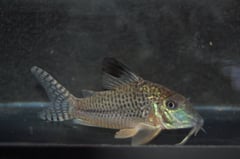
Corydoras acutusBlacktop Cory
Callichthyidae · Cope, 1872
The blacktop cory, Corydoras acutus, is an armoured catfish from the upper Amazon basin in Brazil, Peru, Ecuador and possibly Bolivia. It can be confused with three similar fishes known as C024, C077 and C109. C024 and C109 occur thousands of kilometres outside its range, but C077 lives alongside it in the rio Abunã and is only known to differ in growing smaller. Some specimens lack the dark marking in the dorsal fin.

Ctenopharyngodon idellaGrass Carp
Cyprinidae · (Valenciennes, 1844)
The grass carp, Ctenopharyngodon idella, is a large cyprinid native to the Amur River system in eastern Russia and northeastern China. Adults typically reach 800 to 1200 mm, making it a wholly unsuitable aquarium subject, though an albino form is traded. Widely introduced for aquaculture and weed control, it has caused serious damage to natural waters, and unwanted fish should never be released.
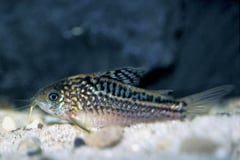
Gastrodermus elegansElegant Cory
Callichthyidae · (Steindachner, 1876)
The elegant cory, Gastrodermus elegans, long known as Corydoras elegans, is an armoured catfish from the western Amazon basin in Peru, Ecuador and Brazil. Unlike most congeners it spends a fair amount of time away from the substrate, often forming groups in midwater. It gives its name to the unofficial 'C. elegans group' of similar species, which includes G. nanus and G. undulatus plus many C- and CW-numbered fishes of uncertain status.
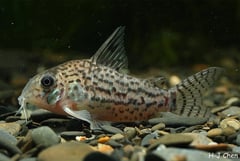
Hoplisoma acrenseAcre Cory
Callichthyidae · (Nijssen, 1972)
The Acre cory, Hoplisoma acrense, long known as Corydoras acrensis, is an armoured catfish that appears to be endemic to the rio Juruá basin in Acre State, Brazil. It was apparently described from a single specimen, and little has been written about it since. Peaceful and gregarious, it should be kept in a group of at least 4-6.
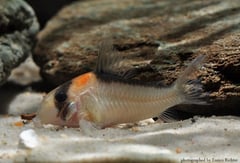
Hoplisoma adolfoiAdolfo's Cory
Callichthyidae · (Burgess, 1982)
Adolfo's cory, Hoplisoma adolfoi, long known as Corydoras adolfoi, is an armoured catfish apparently highly endemic to the upper rio Negro near São Gabriel da Cachoeira, Brazil. One of several rio Negro Corydoras with an oblique dark bar along the back, it is most easily confused with H. duplicareum and cannot be separated from it reliably by colour. It inhabits pristine blackwater tributaries and flooded forest.
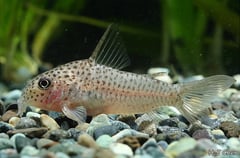
Hoplisoma albolineatumC056
Callichthyidae · (Knaack, 2004)
Hoplisoma albolineatum (C056), long known as Corydoras albolineatus, is an armoured catfish from the Río Iténez, or Guaporé, system in Bolivia and Brazil. It has a wide white longitudinal band and unmarked fins, and may be confused with the deeper-bodied H. xinguense. In the wild it forms aggregations of up to several thousand over sandy substrates and sand banks. It is not common in the hobby but is available occasionally.
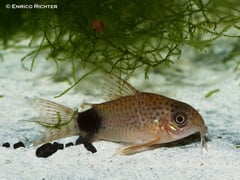
Hoplisoma caudimaculatumTailspot Cory
Callichthyidae · (Rössel, 1961)
The tailspot cory, Hoplisoma caudimaculatum, long known as Corydoras caudimaculatus, is an armoured catfish endemic to the rio Guaporé (Iténez) drainage in western Brazil and Bolivia. A well-defined blackish spot on the caudal peduncle separates it from H. simile, in which the marking is a smudged bluish one. Gastrodermus guapore has a comparable pattern but a distinctly rounded snout, and tends to swim above the substrate.
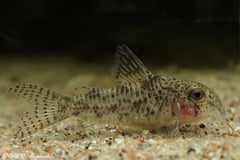
Hoplisoma cochuiBarredtail Cory
Callichthyidae · (Myers & Weitzman, 1954)
The barredtail cory, Hoplisoma cochui, long known as Corydoras cochui, is a small armoured catfish native to the upper rio Araguaia in central Brazil. It grows to around 35 mm SL and has been assigned the code C022. It can be told apart from the similar H. habrosum by the 4 to 5 dark markings along each side of the body, where H. habrosum has 2 to 3.
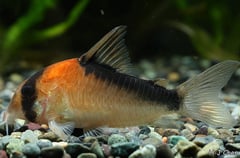
Hoplisoma duplicareum
Callichthyidae · (Sands, 1995)
Hoplisoma duplicareum, long known as Corydoras duplicareus, is an armoured catfish known only from a small portion of the upper rio Negro system in Brazil. It belongs to a group of rio Negro congeners with an oblique dark bar along the back, and is most easily confused with H. adolfoi. The bar tends to be broader and the orange nape patch more intense in H. duplicareum, but neither character separates the two reliably.
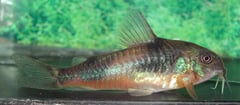
Hoplisoma ehrhardti
Callichthyidae · (Steindachner, 1910)
Hoplisoma ehrhardti, long known as Corydoras ehrhardti, is an armoured catfish from eastern Brazil, known from southern São Paulo to northern Santa Catarina states. It inhabits minor rivers and small streams with soft substrates, a number of them modified by human activity. It is rarely traded and resembles several congeners, including H. carlae, H. paleatum and H. steindachneri.
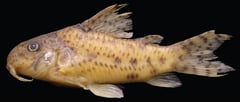
Hoplisoma flaveolum
Callichthyidae · (Ihering, 1911)
Hoplisoma flaveolum, long known as Corydoras flaveolus, is an armoured catfish from tributaries of the rio Tietê in the upper rio Paraná basin, São Paulo state, Brazil. It is exceptionally rare in the hobby. Its closest congener is H. lacrimostigmata, from which it differs in having more serrations on the pectoral- and dorsal-fin spines, a rounded snout and flanks and fins densely patterned with spots and bars.
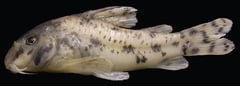
Hoplisoma lacrimostigmata
Callichthyidae · (Tencatt, Britto & Pavanelli, 2014)
Hoplisoma lacrimostigmata, long known as Corydoras lacrimostigmata, is a small armoured catfish known only from the rio Ivaí basin, in the rio Paraná drainage of Paraná state, southern Brazil. It has three nasal pores and four to six small, rounded black blotches along the centre of the flank. It is most similar to H. flaveolum, but has fewer serrations on the pectoral- and dorsal-fin spines, a slightly pointed snout and a more slender body.
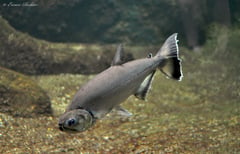
Hydrolycus armatusPayara
Cynodontidae · (Jardine, 1841)
The payara, Hydrolycus armatus, is a large, predatory dogtooth characin from the eastern Amazon, the Orinoco and the Essequibo in Guyana. Given its eventual size and natural behaviour it probably should not be considered a home aquarium subject at all, though juveniles are sometimes sold. It is regularly confused with the smaller H. scomberoides, and no other member of the genus has white margins to the anal and caudal fins.
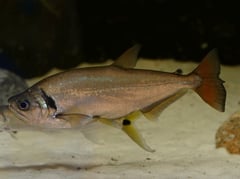
Hydrolycus tatauaia
Cynodontidae · Toledo-Piza, Menezes & Santos, 1999
Hydrolycus tatauaia is a large, predatory dogtooth characin from the lower and central Amazon, the upper Orinoco and coastal drainages of Guyana. A pelagic species of flowing main river channels, it performs long upstream migrations to spawn. Its adult size and natural behaviour mean only a handful of private aquarists have the facilities to house it long-term.

Hyphessobrycon bifasciatusYellow Tetra
Characidae · Ellis, 1911
The yellow tetra, Hyphessobrycon bifasciatus, is a characid from coastal rivers of southeastern Brazil between Espírito Santo and Rio Grande do Sul. It also occurs in parts of the upper Paraná basin, in floodplain tributaries, lakes and streams, usually under forest cover. Two vertically elongate humeral spots, the front one more prominent, help separate it from similar congeners. Generally peaceful, it is best kept as a group of 8-10 or more.

Laetacara araguaiae
Cichlidae · Ottoni & Costa, 2009
Laetacara araguaiae is a small cichlid from Brazil, known from the rios Tapajós, Xingu and Tocantins, right-bank tributaries of the lower Amazon. Known in the hobby as L. sp. 'Buckelkopf' before it was described, it grows to around 35 mm SL and is a biparental substrate-spawner. Some populations differ from one another in colour pattern, and 7-8 dorsal-fin rays separate it from all congeners.

Laetacara curvicepsDwarf Flag Cichlid
Cichlidae · Ahl, 1924
The dwarf flag cichlid, Laetacara curviceps, is a small cichlid from the lower Amazon basin in Brazil. An established aquarium favourite, it has also been called 'flag acara', 'smiling acara', 'sheepshead acara' and 'blunt-headed cichlid'. Populations differ in the degree of red and blue on the body and fins. It favours clear, slow-flowing water over leaf litter and is a biparental substrate-spawner.

Laetacara dorsigeraRedbreast Acara
Cichlidae · (Heckel, 1840)
The redbreast acara, Laetacara dorsigera, is a small cichlid from the Guaporé in Bolivia and Brazil, and the Paraná and Uruguay systems further south. Breeding males and females develop conspicuous red cheeks, opercula and belly, a feature L. curviceps lacks. A dark spot in the middle of the dorsal fin is shared only with L. curviceps and L. flamannellus. Populations vary in colour pattern, and it is a biparental substrate spawner growing to around 37 mm SL.

Laetacara fulvipinnis
Cichlidae · Staeck & Schindler, 2007
Laetacara fulvipinnis is a cichlid from the Orinoco, the Casiquiare and the upper and middle rio Negro in Venezuela and Brazil. Known in the hobby as L. sp. 'orangeflossen' before it was described, it takes its name from the reddish-yellow anal and caudal fins. It has been collected among leaf litter and submerged vegetation in very shallow, soft, acidic blackwater, and grows to around 74 mm SL. A biparental substrate-spawner, it lays its eggs on a solid surface such as a plant leaf.

Laetacara thayeri
Cichlidae · (Steindachner, 1875)
Laetacara thayeri is a cichlid from the middle and upper Amazon basin in western Brazil and northern Peru. It is relatively rare in the aquarium trade. Ctenoid scales on the sides of the head and the lack of a dark spot at the caudal-fin base separate it from all congeners. Males grow larger than females and develop more-extended dorsal, anal and caudal fins.
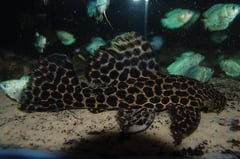
Megalancistrus parananusL113
Loricariidae · (Peters, 1881)
L113, Megalancistrus parananus, is a large suckermouth catfish from the rios Paraná, Paraguay and Uruguay in Brazil, Paraguay, Uruguay and Argentina. It was formerly thought to include L234, but only L113 appears native to these drainages, while L234 comes from the rio São Francisco. The largest recorded specimen measured 588 mm, and it can behave very aggressively in confined surroundings.
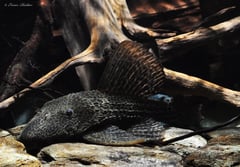
Megalancistrus sp.L234
Loricariidae · authority not recorded
L234, the dragon hi fin pleco, is a large Megalancistrus catfish known only from the rio São Francisco system in eastern Brazil. The L-number was previously applied to Megalancistrus parananus, but that species is native to the Paraná, Paraguay and Uruguay drainages, so L234 appears to be an unidentified species. It grows to 500 to 600 mm and can behave very aggressively in confined surroundings.
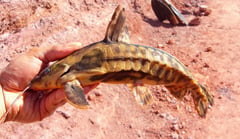
Megalodoras uranoscopusGiant Raphael Catfish
Doradidae · authority not recorded
The giant Raphael catfish, Megalodoras uranoscopus, is a large doradid recorded from the Essequibo, Tocantins and Amazon river systems. It is also known in the US as the 'ripsaw catfish', and older literature often refers to it as M. irwini, now a junior synonym. Growing to 600 to 700 mm, it is very peaceful and can be combined with many other species in suitably sized systems.
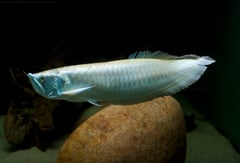
Osteoglossum bicirrhosumSilver Arowana
Osteoglossidae · (Cuvier, 1829)
The silver arowana, Osteoglossum bicirrhosum, is a large predator from the Amazon basin, plus river systems in Guyana and French Guiana. Reaching 80 cm, it is largely unsuitable for the home aquarium, and although juveniles are readily available, few private aquarists can house an adult long-term. Juveniles have a single dark lateral stripe, while in those of its only congener, O. ferreirai, most of the body and fins are dark.
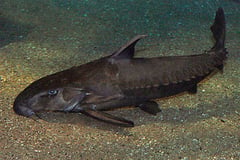
Oxydoras nigerRipsaw Catfish
Doradidae · authority not recorded
The ripsaw catfish, Oxydoras niger, is a large doradid catfish from many of the major river systems of northern South America. Reaching 90 cm, it is only for the experienced fishkeeper and best suited to public aquaria. Much more peaceful than its common name suggests, it takes that name from the spines along the lateral line. It was previously referred to Pseudodoras niger.
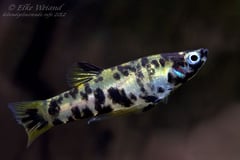
Phalloceros caudimaculatusDusky Millions Fish
Poeciliidae · (Hensel, 1868)
The dusky millions fish, Phalloceros caudimaculatus, is a small livebearer native to Brazil, Paraguay, Uruguay and Argentina. Feral populations in Australia, New Zealand, Ethiopia and Malawi were purportedly introduced for mosquito control and are now considered invasive. Highly variable in colour pattern, it is known in the hobby in spotted and golden ornamental forms. P. caudimaculatus is the type species of a genus that was monotypic until 21 new species were described in 2008.
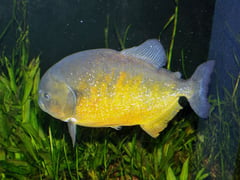
Pygocentrus pirayaPiraya
Serrasalmidae · (Cuvier, 1819)
The piraya, Pygocentrus piraya, is a piranha restricted to the rio São Francisco watershed in eastern Brazil. It can be identified by bright yellow-orange pigmentation on the lower jaw, opercle and flanks in life, and larger specimens have rays in the adipose fin. It is best maintained alone because mature individuals are reported to be extremely aggressive towards one another when space is limited.
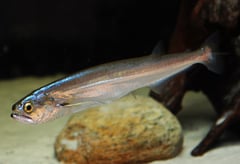
Rhaphiodon vulpinusBiara
Cynodontidae · Spix & Agassiz, 1829
The biara, Rhaphiodon vulpinus, is a dogtooth characin found from the Orinoco and Amazon basins south to the Río de la Plata in Argentina. The only member of its genus, it grows to 600 to 800 mm and is an obligate piscivore, and it is suitable only for public installations or the very largest private aquaria. Juveniles are seen for sale quite regularly, most often without adequate information on their long-term care.
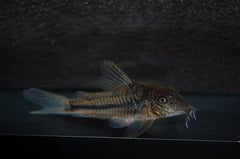
Scleromystax prionotos
Callichthyidae · (Nijssen & Isbrücker, 1980)
Scleromystax prionotos is an armoured catfish known only from coastal rivers in Minas Gerais, Espírito Santo, Rio de Janeiro and São Paulo, Brazil. Like its congeners it is a facultative air breather and occasionally rises to gulp air at the surface. Its stiffened pectoral-fin spines can pierce human skin, so care is needed when handling it.
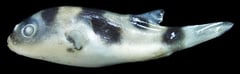
Colomesus tocantinensis
Tetraodontidae · Amaral, Brito, Silva & Carvalho, 2013
Colomesus tocantinensis is a small freshwater pufferfish from Brazil, known only from the Tocantins River near Porto Nacional in Tocantins state. The type series measured up to 34.9 mm, though it should grow larger. It is distinguished from C. asellus and C. psittacus by fewer anal and dorsal-fin rays, a ventrally notched opercle, no dermal flaps on the chin, and a pale yellow back with five dark bands.

Hyphessobrycon balbus
Characidae · Myers, 1927
Hyphessobrycon balbus is a small characid known only from upper Paraná basin headwaters in the Federal District and Goiás, central Brazil. Most records come from the rio São Bartolomeu, including the Bananal, Santa Maria-Torto and Gama tributary systems.

Hyphessobrycon brumado
Characidae · Zanata & Camelier, 2010
Hyphessobrycon brumado is a small characid known only from the rio Brumado, part of the coastal rio de Contas drainage in Bahia state, eastern Brazil. It was collected from moderately-flowing streams at 971-1048 m with rock and sand substrates. It superficially resembles the silver-tipped tetra, Hasemania nana, but has an adipose fin, and a broad black lateral stripe extends onto the median caudal-fin rays.

Iguanodectes variatus
Iguanodectidae · Géry, 1993
Iguanodectes variatus is a characin from Brazil, recorded from the Guaporé, Madeira, Branco, Trombetas and Urubu river systems in the Amazon basin. It belongs to a small genus of elongate fishes in the family Iguanodectidae and grows to around 103 mm SL.

Laetacara flamannellus
Cichlidae · Ottoni, Bragança, Amorim & Gama, 2012
Laetacara flamannellus is a small cichlid from the eastern coastal rivers of Amapá state, Brazil. It has mostly been collected from shallow, still water among sedge-like plants in grasslands that flood between January and June. An orange ring around the dark spot at the dorsal-fin base separates it from L. curviceps and L. dorsigera, and it may have been traded occasionally as L. curviceps.
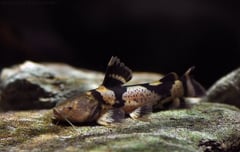
Pseudopimelodus bufoniusGiant Bumblebee Catfish
Pseudopimelodidae · (Valenciennes, 1840)
The giant bumblebee catfish, Pseudopimelodus bufonius, is distributed throughout northeastern South America, from Venezuela to eastern Brazil. Its range extends from the Lake Maracaibo basin, and it grows to 245 mm SL. The type locality is uncertain but probably Cayenne, French Guiana.

Retroculus acherontos
Cichlidae · Landin, Mareira & Figueiredo, 2015
Retroculus acherontos is a cichlid known only from tributaries of the upper rio Tocantins basin in Goiás state, Brazil. It grows to at least 194 mm and differs from its congeners in developing a nuchal hump in both sexes above about 121 mm SL. Based on its morphology it is hypothesised to be less rheophilic than other Retroculus, and it has been collected in small to medium-sized tributaries with clear or sediment-filled water.
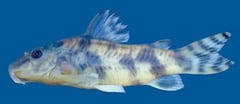
Scleromystax salmacis
Callichthyidae · Britto & Reis, 2005
Scleromystax salmacis is a small armoured catfish known only from the rios Mampituba and Araranguá in Santa Catarina state, southern Brazil. It is most similar to S. macropterus but lacks a black spot at the base of the median caudal-fin rays and has more irregular transverse blotches. The dorsal and pectoral fins are equal in length in both sexes, and the type locality was a small, clear, slow-moving pool over mud-covered rock.