Hypancistrus sp.
L333
On this page12 sections
Quick facts
Difficulty6 of 6 measures
More bars, more demanding.
- Space
- large tank
- Water
- tap water
- Temp
- steady heat
- Temperament
- peaceful
- Social
- shoal
- Compatibility
- not a community fish
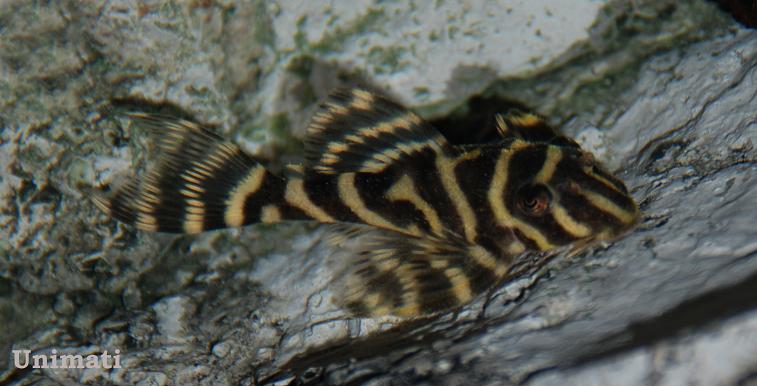
This unidentified species possesses a highly variable colour pattern with the pale, randomly-arranged spots and blotches on the body ranging in colour from whitish to yellowish to rusty orange depending on the specimen. It's regularly confused with similar-looking relativ...
Etymology
Distribution
Aquarium size
An aquarium with base dimensions of 120 ∗ 45 cm48 ∗ 18 in should be the smallest considered.
Maintenance
Not difficult to maintain under the correct conditions; we strongly recommend keeping it in a tank designed to simulate a flowing stream with a substrate of variably-sized rocks, sand, fine gravel, and some water-worn boulders.
This can be further furnished with driftwood branches, terracotta pipes, plant pots, etc., arranged to form a network of nooks, crannies, and shaded spots, thus providing broken lines of sight.
Like many fishes that naturally inhabit running water it's intolerant to accumulation of organic pollutants and requires spotless water in order to thrive. Weekly water changes of 30-50% tank volume should also be considered routine.
Though torrent-like conditions are unnecessary it does best if there is a high proportion of dissolved oxygen and some water movement in the tank meaning power filter(s), additional powerhead(s), or airstone(s) should be employed as necessary.
Water conditions
These boxes carry affiliate links and we may earn a commission. What they recommend comes from each profile’s own figures, never chosen by hand or paid for.
Diet
Wild specimens are likely omnivorous but with a preference for aquatic invertebrates and suchlike.
In the aquarium it does best when offered a varied diet comprising sinking dried foods, frozen Daphnia, mosquito larvae, chironomid larvae (bloodworm), and prawn/shrimp, for, example, while some raw potato and other vegetables might also be accepted.
Home-made foods using a mixture of natural ingredients bound with gelatin are very useful since they can be tailored to contain fresh vegetables, Spirulina or similar plus meatier ingredients.
Behaviour and compatibility
A generally peaceful species which can be maintained in a well-chosen community alongside other quiet fishes.
It should not be maintained alongside other Hypancistrus spp. in order to prevent hybridisation, nor will it compete well with excessively territorial or otherwise aggressive tankmates.
Sexual dimorphism
Adult males possess a broader head plus more extensive odontodes on the leading pectoral-fin rays and interopercular region than females, while older males may darken in colour somewhat.
Males are also more slender and less stocky than females, a difference which is easily observed when the fish are viewed from above.
Reproduction
Cave-spawner with the male responsible for brood care.
It's been bred regularly in aquaria and in a set-up with sufficient cover fry can be reared alongside the adults.
Notes
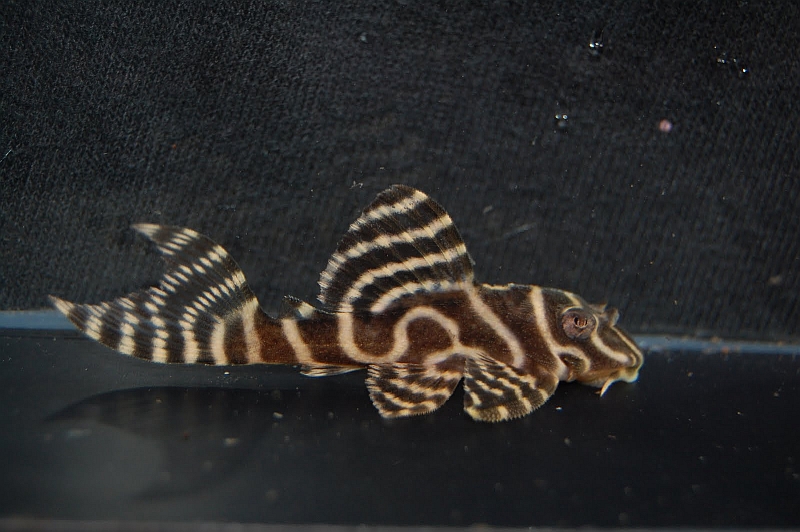
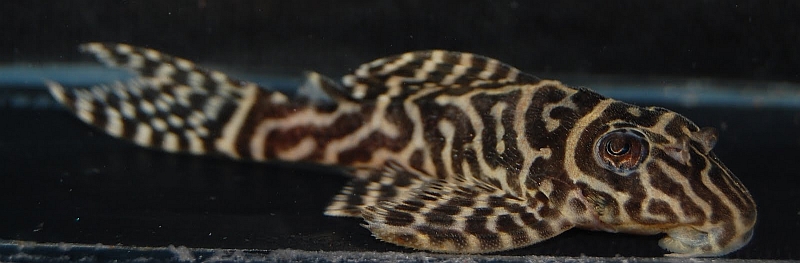
This unidentified species possesses a highly variable colour pattern with the pale, randomly-arranged spots and blotches on the body ranging in colour from whitish to yellowish to rusty orange depending on the specimen.
It's regularly confused with similar-looking relatives such as L066 and L400, but differs from the former in possessing a darker base body colour and less fine pattern of pale markings and the latter in its less elongate, squatter body shape.
The attractive whitish variants are sometimes sold under the incorrect code L236 in order to fetch a higher price.
At least one albino specimen has been offered in the aquarium trade while a number of forms which appear to have been selectively-bred or even hybridised have also become available.
The genus Hypancistrus is diagnosed from all other loricariids by a wide separation between the metapterygoid and lateral ethmoid, presence of a sharply angled adductor palatini crest of the hyomandibula, and no lateral wall in the metapterygoid channel.
More useful for aquarists is the fact that in Hypancistrus the dentary teeth are about twice as long as the premaxillary teeth (vs. dentary and premaxillary teeth of approximately equal length).
The genus is otherwise remarkable for the fact that the majority of species have not yet been described to science although many are well known in the aquarium hobby. As of January 2016, there are eight described species in the genus: the type species H. zebra Isbrücker and Nijssen 1991, H. inspector Armbruster 2002, H. contradens Armbruster et al. 2007, H.debiliterra Armbruster et al. 2007, H. furunculus Armbruster et al. 2007, H. lunaorum Armbruster et al. 2007, H. margaritatus Tan & Armbruster 2016 and H. phantasma Tan & Armbruster 2016.
References
- Stawikowski, R., A. Werner and I. Seidel (2004). DATZ Special: L-Numbers. DATZ, 1-132
- Armbruster, J. W., N. K. Lujan and D. C. Taphorn (2007). Four new Hypancistrus (Siluriformes: Loricariidae) from Amazonas, Venezuela. Copeia 2007(1), 62-79
- Armbruster, J. W. (2002). Hypancistrus inspector: a new species of suckermouth armored catfish (Loricariidae: Ancistrinae). Copeia 2002(1), 86-92
- Tan, M. and J. Armbruster (2016). Two new species of spotted Hypancistrus from the Rio Negro drainage (Loricariidae, Hypostominae) ZooKeys 552, 123-135
Species images · 3
Used with the photographer’s permission. Not licensed for reuse.