River
Xingu
Only species with a profile on Seriously Fish are counted.
- Species
- 31
- Families
- 13
- Photographed
- 31 of 31
- Difficulty rated
- 31 of 31
Basin
Also in the Amazon basinspecies recorded from both
Shares fishes with rivers elsewherespecies recorded from both
Runs through
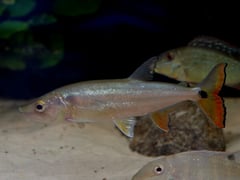
Acestrorhynchus altusRed Barracuda Tetra
Acestrorhynchidae · Menezes, 1969
The red barracuda tetra, Acestrorhynchus altus, is a predatory acestrorhynchid that may be restricted to the lower Amazon in Brazil. A member of the A. lacustris group, it has a round humeral spot and is virtually impossible to tell from its relatives in the trade unless collection data is known. An obligate piscivore of open water, it is best kept in a group of four or more of comparable size, since acestrorhynchids are cannibalistic.
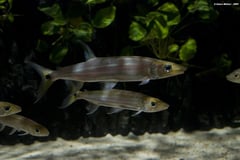
Acestrorhynchus falcirostrisBig-Eyed Cachorro
Acestrorhynchidae · Cuvier, 1819
The big-eyed cachorro, Acestrorhynchus falcirostris, is a large predatory acestrorhynchid from northern Amazon drainages and the Orinoco. The two dark body stripes of the A. nasutus group appear only in its juveniles, and at 320 to 350 mm SL it grows far larger than the other members. A black fringe to the rear of the operculum gives it a 'collared' look. It needs open water, and a group must be of comparable size because acestrorhynchids are cannibalistic.
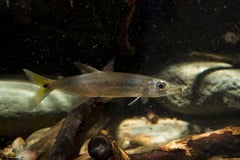
Acestrorhynchus microlepisPike Tetra
Acestrorhynchidae · Jardine, 1841
The pike tetra, Acestrorhynchus microlepis, is a predatory acestrorhynchid from northern Amazon drainages and the Orinoco. It also occurs in coastal rivers of Guyana, Suriname and French Guiana. A member of the A. microlepis group, it has a small blackish spot behind the gill cover and is separable from the very similar A. grandoculis only by counts. It tends to take smaller prey such as tetras, and acestrorhynchids are cannibalistic, so a group must be of comparable size.
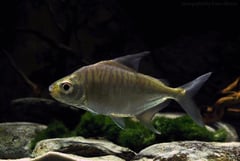
Acnodon normaniSheep Pacu
Serrasalmidae · Gosline, 1951
The sheep pacu, Acnodon normani, is a serrasalmid from Brazil, possibly restricted to the Xingu and Tocantins watersheds of the Amazon basin. Also known in the trade as 'tiger pacu', it is often said to be a frugivore or herbivore, but aquarium observations suggest it also feeds on the scales of other fishes. That makes it unsuitable for the community aquarium, although it does not seem to target much smaller species.
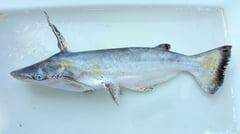
Ageneiosus inermisManduba
Auchenipteridae · Linnaeus, 1766
The manduba, Ageneiosus inermis, is a large auchenipterid catfish found throughout much of South America east of the Andes. At around 470 mm SL it would need an aquarium in excess of 400 x 120 cm as an adult and is largely unsuitable for private aquaria. An obligate carnivore, it can take surprisingly large prey, and the larger Ageneiosus species are often used as food fishes in their native countries.
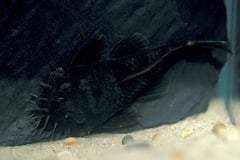
Ancistrus ranunculusL034
Loricariidae · Muller, Rapp Py-Daniel & Zuanon, 1994
Ancistrus ranunculus, the medusa pleco (L034), is a wide-headed, flattened suckermouth catfish from the rio Xingu and rio Tocantins basins in Brazil. It lives among rocks in shallow, fast-flowing water, needs well-oxygenated water with plenty of movement and a protein-rich diet, and is often in poor condition after import. Juveniles carry light spots like the similarly shaped L255, but in A. ranunculus these fade as the fish matures.
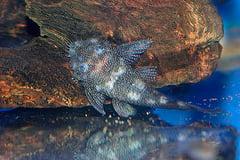
Ancistrus sp.L255
Loricariidae · authority not recorded
L255, the spotted medusa plec, is a wide-headed, flattened Ancistrus known only from the middle rio Xingu basin in Pará state, Brazil. It lives among rocks in shallow, fast-flowing water, needs well-oxygenated water with plenty of movement and a protein-rich diet, and is often in poor condition after import. It resembles A. ranunculus, but keeps its light body markings throughout life, whereas those of A. ranunculus fade as the fish matures.

Astyanax bimaculatusTwo Spot Astyanax
Characidae · Linnaeus, 1758
The two spot astyanax, Astyanax bimaculatus, is a characid ranging from Panama through most of the Amazon and Orinoco basins. It lives in a wide variety of biotopes, from swiftly-flowing rivers and streams to ponds, ditches and reservoirs. The name is currently applied to what is considered a species complex of at least four taxa, and aquarium fish most often arrive as contaminants among shipments of other species.
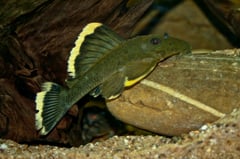
Baryancistrus chrysolomusMango Pleco
Loricariidae · Rapp Py-Daniel, Zuanon & Ribeiro de Oliveira, 2011
The mango pleco, Baryancistrus chrysolomus, traded as L047, is a loricariid endemic to the rio Xingu basin in Pará state, Brazil. A broad, usually yellowish band along the edges of the dorsal and caudal fins throughout life separates it from B. xanthellus, whose bands shrink to tips in adults. It grows to around 220 mm SL, and males in particular become highly intolerant of conspecifics as they age.
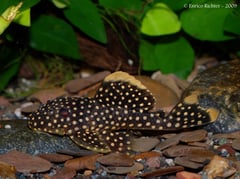
Baryancistrus xanthellusGold Nugget Pleco
Loricariidae · Rapp Py-Daniel, Zuanon & Ribeiro de Oliveira, 2011
The gold nugget pleco, Baryancistrus xanthellus, is a suckermouth catfish endemic to the rio Xingu basin in Pará state, Brazil. It lives in whitewater rapids in the Volta Grande do rio Xingu, between Belo Monte falls and the mouth of the rio Iriri. Before its description it was traded as L018, L085, L177 and LDA060, and L081 is the same fish. Males become highly intolerant of conspecifics as they age.

Colomesus asellusAmazon Puffer
Tetraodontidae · Müller & Troschel, 1849
The Amazon puffer, Colomesus asellus, is a freshwater puffer found throughout much of the Amazon basin, with records north to Guyana and Venezuela. Also traded as the South American puffer or 'SAP', it is told from congeners by a transverse row of dermal flaps across the chin. It lives mostly in well-oxygenated river habitats, is intolerant of organic waste, and forms loose aggregations, so a group of 6 or more is best, away from the general community.

Geophagus altifrons
Cichlidae · Heckel, 1840
Geophagus altifrons is a large cichlid from the middle-to-lower Amazon basin in Brazil, including the Xingu, Tapajós, Madeira, Negro and Purus. Despite being the type species it is among the most frequently-misidentified members of the genus, partly because populations from the Orinoco, the Guianas and the Tocantins are now species in their own right. In adults the dark midlateral marking is reduced to 1-2 scales or absent, a feature unique to the species, but juveniles are very difficult to identify.

Geophagus argyrostictus
Cichlidae · Kullander, 1991
Geophagus argyrostictus is a cichlid known only from the rio Xingu system in Brazil, including its major tributary the rio Iriri. It belongs to the five species outside the G. surinamensis group, all with a complete infraorbital stripe, and fish over 70 to 80 mm SL develop silvery reflective scales on the anterior flanks. Markedly more aggressive than most congeners, it is a substrate-spawner and does best in a group of 5-8.
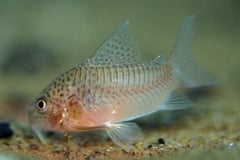
Hoplisoma xinguenseXingu Cory
Callichthyidae · (Nijssen, 1972)
The Xingu cory, Hoplisoma xinguense, long known as Corydoras xinguensis, is a small spotted armoured catfish from creeks in the upper Rio Xingu basin in Mato Grosso, Brazil. It is also sold as the dust cory, and fish traded under the C-numbers C055 and C105 to C108 have all been identified as this species. Dias et al. (2024) moved it to Hoplisoma as Hoplisoma xinguense. One of the smaller corys, it is best kept in a group of ten or more.
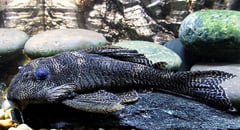
Hypancistrus seideliL066
Loricariidae · Sousa, Sousa, Oliveira, Sabaj, Zuanon & Rapp Py-Daniel, 2025
The king tiger plec, Hypancistrus seideli, is a suckermouth catfish from the lower rio Xingu in Pará state, northern Brazil. Described by Sousa et al. in 2025, it is traded as L066 and L333 and also as 'network pleco' and 'scribbled pleco'. Its colour pattern is highly variable and it is regularly confused with L400. It inhabits turbulent whitewater rapids, much of which is likely to be severely degraded by the Belo Monte dam.
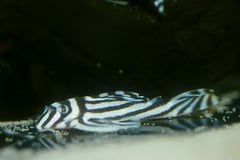
Hypancistrus zebraZebra Plec
Loricariidae · Isbrücker and Nijssen, 1991
The zebra plec, Hypancistrus zebra (L046), is a small loricariid catfish from the Rio Xingú basin in Brazil, named for its zebra pattern. Brazil banned its export in 2004 and captive-bred fish are expensive. Shy and easily outcompeted for food, it needs warm water of 26 to 30 °C, high oxygen levels and pristine conditions, and does not suit the general community tank.

Hyphessobrycon pulchripinnisLemon Tetra
Characidae · Ahl, 1937
The lemon tetra, Hyphessobrycon pulchripinnis, is a characid from central Brazil, mostly recorded from the rio Tapajós basin. It is bred commercially in several countries, but the origin of the aquarium strain is questionable. Fish identical to it have been photographed in the lower Xingu, while a related 'orange red' form from the Tapajós may not be the same species.

Iguanodectes spilurusGreen Line Lizard Tetra
Iguanodectidae · Günther, 1864
The green line lizard tetra, Iguanodectes spilurus, is a characin found throughout the Amazon, Orinoco, Essequibo and Tocantins river systems. The most widespread Iguanodectes species, it has also been called the 'slender', 'spindle' or 'iguana' tetra, and differs from its congeners in its translucent dorsal and anal fins, lack of a red lateral stripe and prominent dark caudal-fin marking. It is sensitive to poor water conditions.
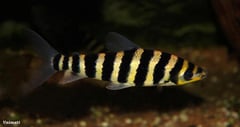
Leporinus fasciatusBanded Leporinus
Anostomidae · Bloch, 1794
The banded leporinus, Leporinus fasciatus, is an anostomid from the Amazon and Orinoco systems and coastal Guyana, Suriname and French Guiana. Young fish are often sold without warning of their size and requirements, and it is fairly ubiquitous in public aquarium displays. It is frequently confused with L. affinis, and its dark body bars multiply with age, from five in young fish to around ten in adults.
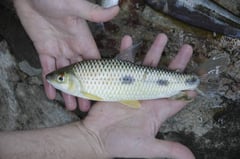
Leporinus fridericiThreespot Leporinus
Anostomidae · Bloch, 1794
The threespot leporinus, Leporinus friderici, is an anostomid from much of the Amazon system, with further records from the Guianas and Trinidad. It grows to 350 to 400 mm and needs an aquarium with base dimensions of at least 240 by 90 cm. Across this enormous range the fish differ in morphology and, especially, colour pattern.
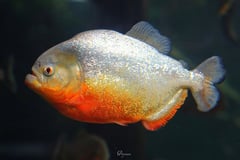
Pygocentrus nattereriRed Bellied Piranha
Serrasalmidae · Kner, 1858
The red bellied piranha, Pygocentrus nattereri, occurs through much of the Amazon basin and south into the Paraná and Uruguay river systems. Famed as a rapacious predator, it is among the most notorious freshwater fishes in the world. According to Herbert Axelrod (1976), the myth began with a feeding frenzy staged for Theodore Roosevelt in Brazil in 1913. Usually only juveniles form aggregations, and the species is relatively easy to breed in the aquarium.

Retroculus xinguensis
Cichlidae · Gosse, 1971
Retroculus xinguensis is a rheophilic cichlid from the rio Xingu basin in Brazil, with a handful of records from the Tapajós drainage. It occurs in rapids and fast-flowing stretches of clear water rivers, and differs from its congeners in having conspicuous dark bars on the caudal fin. It is available in the trade on a sporadic basis and needs a large set-up designed to resemble a flowing river, with water of 26 to 32 °C.
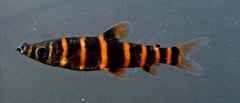
Synaptolaemus latofasciatus
Anostomidae · Steindachner, 1910
Synaptolaemus latofasciatus is a headstander from the upper Orinoco, the Casiquiare Canal and the middle-to-lower Amazon in Venezuela and Brazil. Described from a single specimen and placed in Leporinus until 2011, it was then recognised as the fish described as Synaptolaemus cingulatus. Alternating transverse bands of orange or yellow and dark brown or black run along the entire body, and snout shape and colour pattern vary with locality.
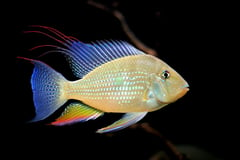
Acarichthys heckeliiThreadfin Acara
Cichlidae · Müller & Troschel, 1849
The threadfin acara, Acarichthys heckelii, is a cichlid from the northern Amazon basin in Colombia, Peru and Brazil and the Essequibo in Guyana. The only member of its genus, it grows to around 200 mm and digs incessantly, and it is susceptible to deteriorating water quality. Some adults show sudden, extreme aggression towards conspecifics that can kill weaker fish, and the problem decreases as tank and group size increase.

Aequidens tetramerusSaddle Cichlid
Cichlidae · Heckel, 1840
The saddle cichlid, Aequidens tetramerus, is a cichlid found across much of northern South America, from the Amazon and Orinoco basins to the Guianas. The type species of its genus, it occurs in several colour forms, and fish from Ecuador and Peru are sought after for the red or orange colouration on the lower head and belly. As currently recognised it is likely to represent a group of related fishes, some of which may be described as distinct species.
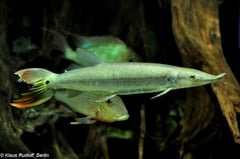
Boulengerella cuvieri
Ctenoluciidae · Spix & Agassiz, 1829
Boulengerella cuvieri is a pelagic ctenoluciid characin from much of the Amazon basin, the Río Orinoco and coastal drainages of the Guianas. The largest officially recorded specimen measured 675 mm, but it appears to grow larger, possibly beyond 800 mm. Given that size and its natural behaviour it is largely unsuitable for the home aquarium. Its entire dorsal-fin base lies ahead of the anal-fin origin, a character shared only with B. lucius and B. xyrekes among ctenoluciids.
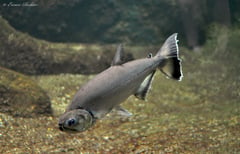
Hydrolycus armatusPayara
Cynodontidae · Jardine, 1841
The payara, Hydrolycus armatus, is a large, predatory dogtooth characin from the eastern Amazon, the Orinoco and the Essequibo in Guyana. Given its eventual size and natural behaviour it probably should not be considered a home aquarium subject at all, though juveniles are sometimes sold. It is regularly confused with the smaller H. scomberoides, and no other member of the genus has white margins to the anal and caudal fins.
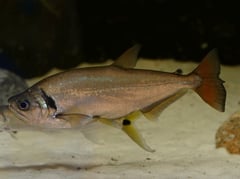
Hydrolycus tatauaia
Cynodontidae · Toledo-Piza, Menezes & Santos, 1999
Hydrolycus tatauaia is a large, predatory dogtooth characin from the lower and central Amazon, the upper Orinoco and coastal drainages of Guyana. A pelagic species of flowing main river channels, it performs long upstream migrations to spawn. Its adult size and natural behaviour mean only a handful of private aquarists have the facilities to house it long-term.
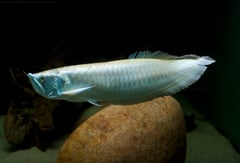
Osteoglossum bicirrhosumSilver Arowana
Osteoglossidae · Cuvier, 1829
The silver arowana, Osteoglossum bicirrhosum, is a large predator from the Amazon basin, plus river systems in Guyana and French Guiana. Reaching 80 cm, it is largely unsuitable for the home aquarium, and although juveniles are readily available, few private aquarists can house an adult long-term. Juveniles have a single dark lateral stripe, while in those of its only congener, O. ferreirai, most of the body and fins are dark.
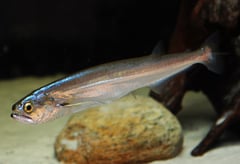
Rhaphiodon vulpinusBiara
Cynodontidae · Spix & Agassiz, 1829
The biara, Rhaphiodon vulpinus, is a dogtooth characin found from the Orinoco and Amazon basins south to the Río de la Plata in Argentina. The only member of its genus, it grows to 600 to 800 mm and is an obligate piscivore, and it is suitable only for public installations or the very largest private aquaria. Juveniles are seen for sale quite regularly, most often without adequate information on their long-term care.

Laetacara araguaiae
Cichlidae · Ottoni & Costa, 2009
Laetacara araguaiae is a small cichlid from Brazil, known from the rios Tapajós, Xingu and Tocantins, right-bank tributaries of the lower Amazon. Known in the hobby as L. sp. 'Buckelkopf' before it was described, it grows to around 35 mm SL and is a biparental substrate-spawner. Some populations differ from one another in colour pattern, and 7-8 dorsal-fin rays separate it from all congeners.