Genus
Ancistrus
- Species
- 6
- Photographed
- 6 of 6
- Difficulty rated
- 6 of 6
Where the name comes fromEdit
etymology not explained, but understood to be derived from the Greek άγκιστρο ágkistron (Gr. ἄγκιστρον), meaning 'fish hook, hook of a spindle', in reference to the hooked interopercular odontodes possessed by genus members.
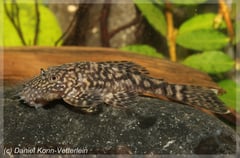
Ancistrus claroLDA 008
Knaack, 1999
Ancistrus claro, the gold marble bristlenose catfish (LDA 008), is a suckermouth catfish from the rios Claro and Coxipó in Mato Grosso, Brazil. It inhabits flowing streams over boulders and bedrock. Sometimes confused with unidentified fishes such as A. sp. 'L352', it has long maxillary barbels and small spots on the head, with vermiform lines on the body in males and spots all over in females. A peaceful cave-spawner, it has been bred in aquaria on numerous occasions.
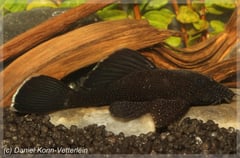
Ancistrus dolichopterusL183
Kner, 1854
Ancistrus dolichopterus, the starlight ancistrus (L183), is a bristlenose catfish most likely endemic to the middle and lower rio Negro, Brazil. It inhabits blackwater streams. The name has been used for the common bristlenose and other similar species, while this fish has been called A. hoplogenys, and much of the literature confuses them. It differs from all congeners in having 9 soft dorsal-fin rays, and is territorial with conspecifics and similarly-shaped species.
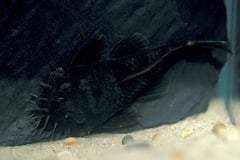
Ancistrus ranunculusL034
Muller, Rapp Py-Daniel & Zuanon, 1994
Ancistrus ranunculus, the medusa pleco (L034), is a wide-headed, flattened suckermouth catfish from the rio Xingu and rio Tocantins basins in Brazil. It lives among rocks in shallow, fast-flowing water, needs well-oxygenated water with plenty of movement and a protein-rich diet, and is often in poor condition after import. Juveniles carry light spots like the similarly shaped L255, but in A. ranunculus these fade as the fish matures.
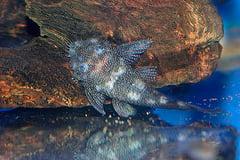
Ancistrus sp.L255
authority not recorded
L255, the spotted medusa plec, is a wide-headed, flattened Ancistrus known only from the middle rio Xingu basin in Pará state, Brazil. It lives among rocks in shallow, fast-flowing water, needs well-oxygenated water with plenty of movement and a protein-rich diet, and is often in poor condition after import. It resembles A. ranunculus, but keeps its light body markings throughout life, whereas those of A. ranunculus fade as the fish matures.
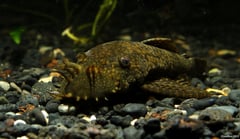
Ancistrus sp. '3'Common Bristlenose Catfish
authority not recorded
The common bristlenose catfish, Ancistrus sp. '3', is the loricariid sold everywhere as the 'bristlenose', of unknown origin and bred commercially. It was once thought close to the Argentinian A. cirrhosus, but genetic data suggests otherwise, and some consider it a hybrid. Adult males carry fleshy tentacles on the head, and the species spawns in caves with the male guarding the brood.
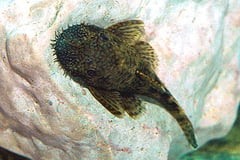
Ancistrus triradiatusHorned Bristlenose Pleco
Eigenmann, 1918
The horned bristlenose pleco, Ancistrus triradiatus, is a small suckermouth catfish from Colombia and Venezuela, found among rocks in flowing streams. It is often confused with the common bristlenose, Ancistrus sp. (3), and other congeners, and some are so similar that a definite identification needs the collection locality. Imported fish are almost always wild-caught. Mainly vegetarian and peaceful, it is easy to breed once mature.