Hypostomus sp.
L229
Last revised 2026Edit this page
On this page12 sections
Quick factsEdit
Difficulty5 of 8 measures
- Space
- large tank
- Water
- flexible
- Temp
- needs a steady temperature
- Diet
- needs wood to graze
- Temperament
- peaceful
- Social
- unknown
- Compatibility
- unknown
Other demands
Each of these can raise the rating on its own, whatever the measures above say.
- Hardiness
- unknown
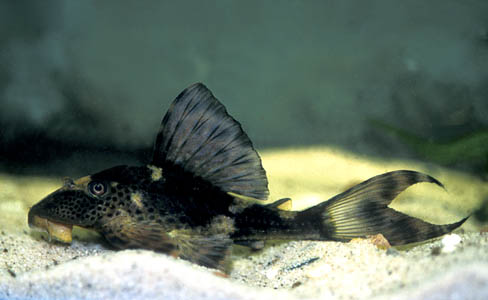
L229 is an undescribed wood-eating suckermouth catfish of the Hypostomus cochliodon complex from the Río Ucayali, Peru. Like others in the group it develops a hump-backed profile and spoon-shaped teeth. It lives around driftwood in flowing parts of rivers and streams, and grows to around 200 mm SL.
Distribution
EditHabitat
Write a noteEditIt lives in and around pieces of driftwood in flowing parts of rivers and streams.
Aquarium size
Write a noteEditA tank at least 120 cm long is needed.
Maintenance
Write a noteEditA spacious tank is required, preferably with a sandy substrate. Provide dim lighting and hiding places in the form of some big chunks of driftwood (which it also feeds on, see below). Aquatic plants are not a feature of its natural waters, and would most likely be eaten anyway, although some surface vegetation is not a bad idea. It also needs well-oxygenated water, ideally with a good amount of movement and flow.
Water conditions
EditTemperature: 23 – 27 °C73 – 81 °F
pH: 6.0-7.5
Hardness: 3-15°H
Diet
Write a noteEditFeeds mainly by rasping wood and will not do well without access to it. Studies of the Cochliodon group and of Panaque have found their guts full of wood particles, but the wood passes through in under four hours and little of it is digested. The fish live mainly on the decaying wood and the microbes that break it down. It also enjoys munching on greenery such as cucumber, courgette, blanched spinach etc. and will also accept sinking dried foods.[1][2]
Behaviour and compatibility
Write a noteEditA peaceful species that can be kept with a variety of tankmates, such as larger characins, cyprinids, peaceful cichlids and other catfish. It's surprisingly non-territorial and can be kept both in a species group or other peaceful Loricariids. Bear in mind that smaller species may be intimidated by its size.
Sexual dimorphism
Write a noteEditUnknown.
Reproduction
Write a noteEditUnreported in the hobby.
Notes
EditThis undescribed species is part of the Hypostomus cochliodon species complex, all members of which were previously included in the genus Cochliodon, now considered a synonym of Hypostomus. Members of this group can be distinguished from congeners by several differences in morphology, most notably the hump-backed profile of mature fish and spoon-shaped dentition. These features, along with the fishes tendency to eat wood, are shared with the Panaque genus of the Ancistrinae subfamily, but the two genera are known to have evolved convergently (independently) of one another. It's thought that the wood-eating behaviour of the fish has developed as they inhabit areas where fallen wood litters much of the substrate, and not much light penetrates the water to initiate algal growth, giving fish with the ability to use wood as a food source a competitive advantage. It's certainly an impressive specialisation, as these loricariids are the only fishes known to feed mainly on wood.
As always when buying Loricariids, check the fish has a rounded belly and that its eyes aren't sunken, as these are classic signs of emaciation in newly imported specimens.
References
- German, Donovan P. (2009). Inside the guts of wood-eating catfishes: can they digest wood? Journal of Comparative Physiology B 179(8), 1011-1023doi.org/10.1007/s00360-009-0381-1
- Lujan, Nathan K.; German, Donovan P.; Winemiller, Kirk O. (2011). Do wood‐grazing fishes partition their niche?: morphological and isotopic evidence for trophic segregation in Neotropical Loricariidae Functional Ecology 25(6), 1327-1338doi.org/10.1111/j.1365-2435.2011.01883.x
Species images · 3
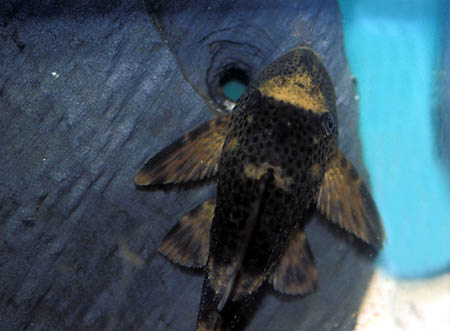
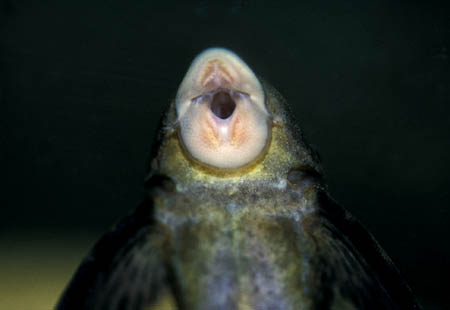
These photographs are used with each photographer's permission.
Send a photographDistribution
Profile completeness20 of 24
83% complete
Also missing: taxonomic authority, etymology.
Community
Questions about Hypostomus sp.?
Ask on Discord