Every species
Filters
Aphyosemion rectogoense
Radda & Huber, 1977
Max lengthnot recordedTanknot recordedTemp20–26°C68–79°FpH5.0–6.5Aphyosemion rectogoense is a killifish known only from the Batéké plateau region and surrounding area in southeastern Gabon. It has been recorded from the Léconi-Djouya and upper Mpassa rivers, part of the much larger Ogooué basin, and the type locality is 6 km west of Léconi township.
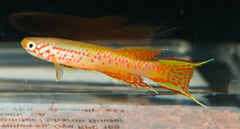
Aphyosemion sp. 'Oyo' RPC 91/8
authority not recorded
Max length50mm SL2.0in SLTank45 × 30cm18 × 12inTemp18–23°C64–73°FpH5.5–7.0Aphyosemion sp. 'Oyo' RPC 91/8 is a killifish collected for the aquarium hobby in 1991 near the town of Oyo, Republic of the Congo. Oyo lies on the Alima River, a right bank tributary of the middle Congo system. This fish may be synonymous with the congener A. castaneum, and it is best maintained alone with the emphasis on captive breeding.
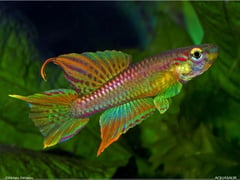
Aphyosemion splendopleureSplendid Lyretail
(Brüning, 1929)
Max length60mm SL2.4in SLTank45 × 25cm18 × 10inTemp22–26°C72–79°FpH6.0–7.2The splendid lyretail, Aphyosemion splendopleure, is a killifish from the coastal lowlands of Nigeria, Cameroon, Equatorial Guinea and Gabon. It lives in slow-moving areas of small streams. Several colour forms exist depending on collection locality, and these should not be kept together, to prevent hybridisation. Very shy, it does not compete well with other species and is not recommended for the community aquarium.
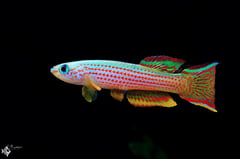
Aphyosemion striatumRed-Striped Lyretail
(Boulenger, 1911)
Max length50mm SL2.0in SLTank45 × 30cm18 × 12inTemp20–26°C68–79°FpH6.5–7.5The red-striped lyretail, Aphyosemion striatum, is a killifish from coastal Equatorial Guinea and Gabon, as far south as the lower Ogooué basin. It inhabits perennial lowland rainforest streams, pools and freshwater swamps. Easy to breed and relatively long-lived, since it is not an annual species, it is a good beginner's killifish, though a shy one easily out-competed by more vigorous fishes.

Apistogramma agassiziiAgassiz's Dwarf Cichlid
(Steindachner, 1875)
Max length♂ 75 · ♀ 50mm SL♂ 3.0 · ♀ 2.0in SLTank60 × 30cm24 × 12inTemp22–29°C72–84°FpH3.0–4.0Apistogramma agassizii is a dwarf cichlid found through much of the Amazon/Solimões basin, from the Río Ucayali in Peru to the Capim River in Brazil. Colour and pattern vary considerably with locality, and numerous ornamental forms have been selectively bred for the trade. It inhabits slower-moving tributaries and creeks where leaf litter collects. Captive-raised fish suit the community aquarium, while wild fish are best kept alone or with small dither fishes.
Apistogramma alacrinaRedspot Dwarf Cichlid
Kullander, 2004
Max length♂ 55 · ♀ 37mm SL♂ 2.2 · ♀ 1.5in SLTank45 × 30cm18 × 12inTemp23–29°C73–84°FpH4.0–7.0The redspot dwarf cichlid, Apistogramma alacrina, is from the Río Guaviare (Orinoco) and Río Orteguaza (Amazon) drainages in Colombia. It differs from all other described members of the genus in having dark blotches at the dorsal and ventral base of the pectoral fins. Three very similar fishes coded A106, A107 and A108 may or may not be conspecific with it, since they show some differences in colour pattern and morphology.

Apistogramma baenschiA188
Römer, Hahn, Römer, Soares & Wöhler, 2004
Max length♂ 55 · ♀ 40mm SL♂ 2.2 · ♀ 1.6in SLTank80 × 30cm31 × 12inTemp20–26°C68–79°FpH4.0–6.5The Inca dwarf cichlid, Apistogramma baenschi, is from tributaries of the lower Río Huallaga in the Amazonian portion of northern Peru. Coded A188 under the DATZ system, it is produced on a commercial basis and is perhaps among the most suitable Apistogramma for those new to dwarf cichlids. Wild fish come from shallow forest tributaries with very soft, tea-stained water and a pH measured between 4.1 and 6.3.

Apistogramma barlowiA174
Römer & Hahn, 2008
Max length♂ 65 · ♀ 40mm SL♂ 2.6 · ♀ 1.6in SLTank60 × 30cm24 × 12inTemp22–29°C72–84°FpH4.5–6.5Barlow's dwarf cichlid, Apistogramma barlowi, may be endemic to the Ampiyacu River system, an affluent of the Amazon in northeastern Peru. Adult males have a disproportionately large head with enormous jaws and hypertrophied lips. It is one of only two Apistogramma known to be facultative, biparental, larviphorous mouthbrooders, and apparently favours cool, flowing forest streams (igarapés).

Apistogramma bitaeniataTwo-Striped Dwarf Cichlid
Pellegrin, 1936
Max length♂ 75 · ♀ 55mm SL♂ 3.0 · ♀ 2.2in SLTank60 × 30cm24 × 12inTemp22–29°C72–84°FpH4.5–7.0The two-striped dwarf cichlid, Apistogramma bitaeniata, ranges across the Peruvian, Colombian and Brazilian Amazon, from the Marañón to the Tapajós. Also known as the banded dwarf cichlid, it occurs in several colour forms depending on locality, loosely grouped as 'red', 'blue', 'orange' and 'yellow' in the hobby. Many locality names are in use for these forms, and several are regularly applied incorrectly.

Apistogramma borelliiBorelli's Dwarf Cichlid
(Regan, 1906)
Max length♂ 65 · ♀ 50mm SL♂ 2.6 · ♀ 2.0in SLTank45 × 30cm18 × 12inTemp20–26°C68–79°FpH5.0–8.0Borelli's dwarf cichlid, Apistogramma borellii, is from southern Brazil, Paraguay, Argentina and Uruguay. Also known as the umbrella or yellow dwarf cichlid, it occurs in creeks and tributaries of the rio Paraguay, lower rio Paraná and Uruguay systems. Captive-raised fish are the recommended choice for the community aquarium, while wild examples are best kept alone or with small dither fishes.
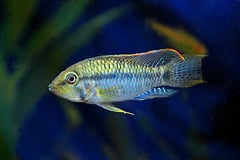
Apistogramma brevis
Kullander, 1980
Max length60mm SL2.4in SLTank45 × 38cm18 × 15inTemp26–28°C79–82°FpH6.0–7.0Apistogramma brevis is a dwarf cichlid from the Rio Uaupés basin in far northwestern Brazil and the Rio Tiquié in southern Colombia. It has also been recorded in the upper Rio Negro and Rio Orinoco, and inhabits slow-moving blackwater streams where the pH can drop as low as 4.0 or 5.0. Coded A168, it is the type species of the A. brevis group, and breeding is not too difficult if very soft, acidic water can be provided.

Apistogramma cacatuoidesCockatoo Cichlid
Hoedeman, 1951
Max length♂ 75 · ♀ 50mm SL♂ 3.0 · ♀ 2.0in SLTank60 × 30cm24 × 12inTemp22–29°C72–84°FpH5.0–6.0The cockatoo cichlid, Apistogramma cacatuoides, is a small cichlid from the upper Amazon basin, from the Ucayali in Peru to the Solimões in Brazil. It lives in slow tributaries, backwaters and creeks where leaf litter collects. Numerous line-bred forms such as 'double red' and 'orange flash' are traded, and captive-raised fish suit a community aquarium, while wild fish are best kept alone or with small dither fishes.

Apistogramma cinilabraAsh Lipped Apisto (A80)
Romer, Duponchelle, Diaz, Davilla, Sirvas, Catchay and Renno, 2011
Max length♂ 70 · ♀ 40mm SL♂ 2.8 · ♀ 1.6in SLTank60 × 30cm24 × 12inTemp21–27°C70–81°FpH4.5–7.0The ash lipped apisto, Apistogramma cinilabra, is a cichlid from shallow blackwater backwaters between Iquitos and Nauta in Loreto, Peru. Males carry the namesake ash-grey lips, red pectoral bases and red spots on the chest, and the body is disproportionately high. The description suggests it may be threatened in its native range, though not enough data exist to confirm this, and the emphasis should be on forming a captive population.

Apistogramma commbraeA93
(Regan, 1906)
Max length♂ 50 · ♀ 30mm SL♂ 2.0 · ♀ 1.2in SLTank60 × 30cm24 × 12inTemp15–27°C59–81°FpH6.0–7.4The Corumbá dwarf cichlid, Apistogramma commbrae, is widespread in the Paraguay River watershed of Argentina, Bolivia, Brazil and Paraguay. One of the smallest members of the genus, it is told apart with the rest of the A. commbrae complex by a conspicuous double caudal peduncle spot. Its habitats cool seasonally to as low as 16 °C, and it should be kept cooler over winter.

Apistogramma elizabethaeA208
Kullander, 1980
Max length50mm SL2.0in SLTank45 × 30cm18 × 12inTemp23–29°C73–84°FpH4.0–6.0Apistogramma elizabethae is a dwarf cichlid from the rio Uaupés and adjacent rio Içana, both tributaries of the upper rio Negro in Brazil. Coded A208, it is among the more sought-after Apistogramma in the hobby. Içana fish tend to have more blue on the head than those from the Uaupés, a reddish population is traded as A. elizabethae 'super red', and none of the forms should be mixed in aquaria.

Apistogramma eremnopygeA218
Ready & Kullander, 2004
Max length♂ 70 · ♀ 50mm SL♂ 2.8 · ♀ 2.0in SLTank60 × 30cm24 × 12inTemp22–28°C72–82°FpH4.0–6.0Apistogramma eremnopyge (A218) is a dwarf cichlid known only from Loreto region in northeastern Peru, in the Itaya, Nanay and Tapiche drainages. Traded under names including A. sp. 'strawberry', 'red beard' and 'diamante', it has a dark blotch low on the caudal peduncle in both sexes. Pairs can apparently be kept only when other pairs are visible in adjacent tanks, so a group of several males with more females is preferable.

Apistogramma eunotus
Kullander, 1981
Max length♂ 55 · ♀ 40mm SL♂ 2.2 · ♀ 1.6in SLTank45 × 30cm18 × 12inTemp23–29°C73–84°FpH5.5–7.0Apistogramma eunotus is a dwarf cichlid from the Río Ucayali in Peru and the Solimões/Amazon in Colombia and Brazil, as far east as the Japurá. Coded A73 under the DATZ system, it has similar-looking, possibly conspecific populations referred to as A74 to A77 depending on locality. It inhabits slow-moving streams, creeks and tributaries, and captive-raised fish are the recommended choice for the community aquarium.
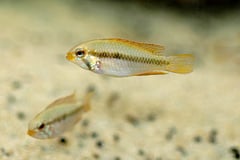
Apistogramma gibbicepsBlackline Apisto
Meinken, 1969
Max length45mm SL1.8in SLTank45 × 30cm18 × 12inTemp27–29°C81–84°FpH5.0–6.5The blackline apisto, Apistogramma gibbiceps, is a dwarf cichlid from the Rio Branco and middle Rio Negro basins in Brazil. It is identified by a row of short dark marks low on the flank below the lateral band, which show most clearly on a settled fish. Meinken's type series held three species, and A. roraimae from the Rio Branco has been treated as a synonym since 2003.

Apistogramma hoignei
Meinken, 1965
Max length60mm SL2.4in SLTank45 × 30cm18 × 12inTemp23–29°C73–84°FpH5.0–7.0Apistogramma hoignei is a dwarf cichlid from the Río Orinoco basin in Venezuela, including the Apure, Arauca and Caura drainages. It is also known from much of the lower Orinoco mainstream. Coded A116 under the DATZ system, it has similar-looking, possibly conspecific populations referred to as A117 or A118, and inhabits slower-moving tributaries, backwaters and creeks where leaf litter collects.

Apistogramma hongsloi
Kullander, 1979
Max length60mm SL2.4in SLTank45 × 30cm18 × 12inTemp23–29°C73–84°FpH5.5–7.0Apistogramma hongsloi is a dwarf cichlid from the Río Vichada and middle Río Meta basins in Colombia and the middle Orinoco in Venezuela. Coded A110 under the DATZ system, it has similar-looking, possibly conspecific populations referred to as A111 to A115 depending on locality. It lives in small tributaries and still waters, and males grow to 55 to 60 mm and females to 40 to 45 mm.