Stunted growth means stunted lives
The first of a series supporting BIAZA's Big Fish Campaign, on why aquarium fishes are treated as disposable and why, in some cases, size really does matter.
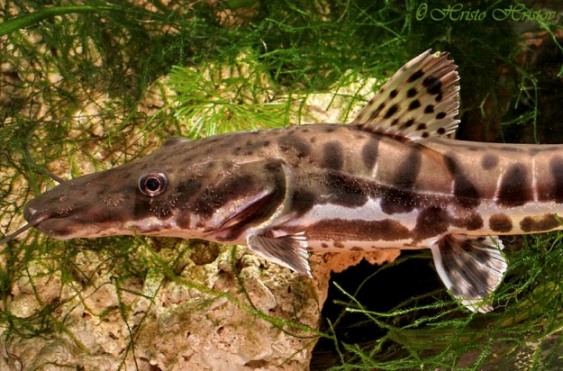
It's fair to assume that not many of us consider animal cruelty or neglect to be positive things, yet in one respect the aquarium hobby is arguably among the worst offenders in the global pet trade.
In the first of a series of articles in support of BIAZA's 'Big Fish Campaign' we explain why, in some cases, size really does matter...
Why are fishes viewed as disposable?
Consider for a second your favourite non-aquatic animal. Be it bird, cat, dog, chameleon or panda, would you condone it being maintained in cramped, dirty housing while being offered an inappropriate diet, with the animal unable to display natural behaviour, suffering extreme growth issues and early death as a result?
Most reasonable people would surely answer 'no'. Yet why do we as aquarists, and the ornamental fish industry in general, appear to turn a blind eye when it comes to fishes which clearly grow too large for the vast majority of home aquaria?
The popular view appears to remain that fishes have not evolved the neuro-anatomical and physiological characters that permit sentience, despite scientific evidence suggesting that they do in fact percieve pain, fear, and stress in pretty much the same way as tetrapods (Chandroo et al., 2004).
Ergo, the same myths and excuses regarding 'big' fishes continue to be peddled and their availability remains undiminished.
Farmed for food, not fish tanks
The majority of 'problem' species, i.e., those available in large numbers at low prices such as Pangasius, Pangasiodon, Pseudoplaytstoma, Phractocephalus, Colossoma, Piaractus, Clarias, etc., are not produced by ornamental fish farms but as by-product of intensive aquaculture projects, hence juveniles are very cheap to buy.
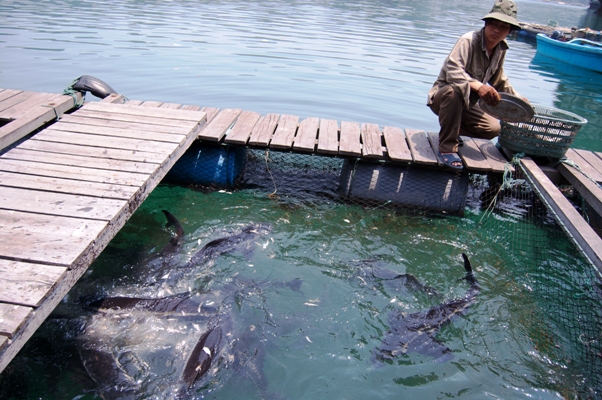
This also means fat profit margins for exporters so they're unlikely to disappear from trade lists anytime soon, while self-regulation within the hobby has not proven effective thus far, something the Big Fish Campaign hopes to change.
As is typical of young animals these species are appealing to look at, therefore easy to sell, and invariably die quite quickly, thus sales are often repeated. Hundreds of thousands of juveniles are sold for aquaria each year, with most doomed to a drastically-reduced lifespan.
It's tempting to sensationalise but perhaps less people would buy these fishes if they realised the underlying cruelty involved in doing so.
In this series of articles we'll try to provide some factual reasons why the trade and purchase of such species represents a major animal welfare issue, beginning with the most obvious which are of course adult size and the fact that the majority of big fishes maintained in aquaria fail to achieve their potential.
The myth of fish vs. aquarium size
A classic misconception is that the growth rate and eventual size of a fish will somehow be regulated by the size of the aquarium it inhabits, and to a new fishkeeper this may appear to be the case.
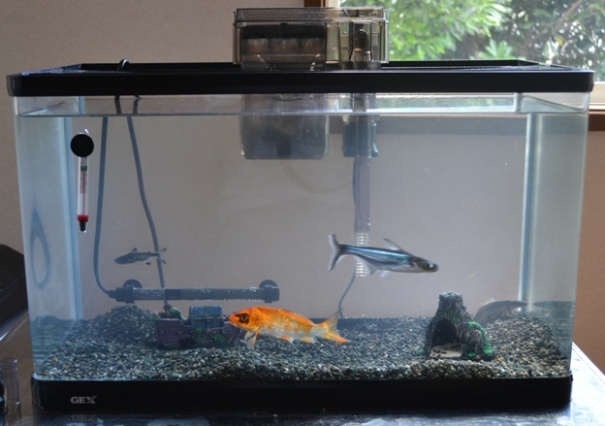
For example a goldfish, Carassius auratus, maintained in a 30 cm x 20 cm aquarium may survive for a number of years and remain at a manageable size of a few centimetres in length, and initially this might seem a reasonable outcome.
However, when maintained properly C. auratus can reach 30 cm SL and live for 30 or 40 years meaning the hypothetical individual described above would not only be highly stunted in terms of growth but fail to reach a quarter of its potential age even if it survives for 5 or 6 years.
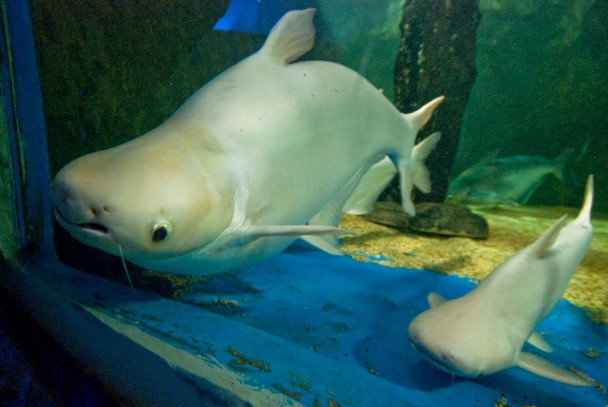
Heavily-stunted individuals of giant catfishes such as Pangasius, Phractocephalus, or Pseudoplatystoma species, typically measuring 30 - 60 cm in length, are common residents of public aquaria and often exhibit deformities of the spine or skull caused by years of maintenance in small private set-ups.
Unable to grow further due to these skeletal abnormalities and prolonged exposure to stress these fish normally fail to attain even half the size of wild adults, even after being rehomed in larger quarters.
So what causes a fish maintained in cramped conditions to stop growing, and does this have any knock-on effect in terms of its overall well-being and longevity?
Growth-suppressing hormones?
It's often said that fishes release growth limiting or inhibiting hormones or pheromones into the water which allow them to regulate their growth based on their surroundings, and this is typically offered as a reason why fish will 'grow to the size of their tank' without any ill-effects.
However, while it's well-documented that fishes do excrete growth hormone, and its activity may be altered or suppressed by external stress factors known as 'stressors' such as pollution or overcrowding, we've been unable to find any scientific evidence to suggest that they also produce growth-limiting chemicals. In short, the latter do not appear to exist.
Instead it appears that secretion and activity of growth hormone itself is modified under certain sets of circumstances and this may be among the primary reasons for big fishes becoming stunted in aquaria, even when well-fed and apparently healthy.
Chemicals, stress, and suppression of growth
Growth hormone is known to play a part in the regulation of major physiological processes such as governance of ionic and osmotic balance, lipid, protein, and carbohydrate metabolism, skeletal and soft tissue growth, appetite, reproduction and immune functions.
Stress can be defined as the physiological response to a stressor and it also performs a key role in the ability of fishes to perform life functions such as growth by bringing about disturbances in homeostasis (Van Weerd and Komen, 1998).
When a fish senses a stressor, there is an accompanying 'stress response', which is essentially a series of physiological events which have evolved to help the individual overcome the stress caused by the stressor.
This is communicated to the body by the central nervous system via both neuronal and hormonal pathways, and comprises two stages.
The primary stress response is mostly endocrine in nature with the purpose of gathering the energy required to overcome the stressor, while the secondary response controls adaptation of the metabolic system and reestablishment of homeostatis.
Under natural conditions fishes will of course be exposed to brief periods of stress, bringing about a temporary disturbance in homeostasis as levels of cortisol and other chemical substances temporarily rise or otherwise fluctuate.
In the aquarium, however, exposure to stressors is often of a continuous or prolonged nature, and the accompanying chronic stress thus leads to an extended imbalance in homeostasis to which adaptation is impossible or only after a significant period of time.
The stress response thus becomes a maladaptive, rather than adaptive, process and can lead to a number of detrimental consequences including decreased resistance to disease, impaired reproduction, and reduced growth. This is known as the tertiary stress response.
But which stressors are aquarium fish exposed to? They look pretty relaxed to me!
Well, it's not always easy to establish what constitutes 'normal' fish behaviour and consequently the methods required to provide for it in captivity.
In addition, one could argue that it's comparatively difficult to empathise with a fish and the general assumption seems to be that if a specimen is swimming and feeding 'normally' then everything is fine and its requirements are being catered for.
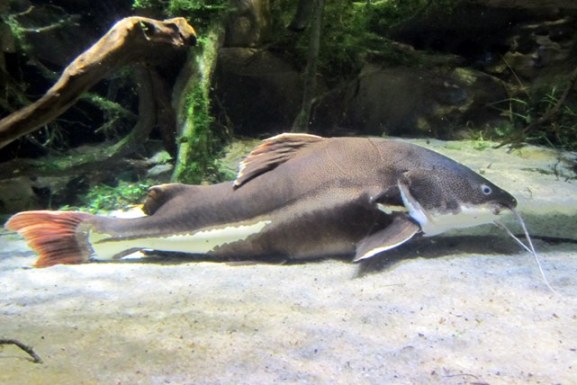
We're not so sure, and reckon 'big' fishes are often exposed to conditions or practises that could be considered stressors, some of which may not be obvious initially. These include:
Hunger due to underfeeding, inappropriate feeding regime, competition via presence of dominant individuals, or insufficient knowledge on the part of the aquarist regarding nutritional requirements of juvenile 'big' fish.
Malnutrition. Such deficiences can arise even if the diet is well-balanced, especially in juveniles which naturally grow at a faster rate than adults. This is likely a major cause of stunting and associated skeletal deformities in aquarium 'big' fish, as is the use of 'feeder' goldfish in the diet of predatory species. We'll be covering this in more detail later.
Fear and distress caused by presence of predatory or dominant fish, repeated handling, sudden changes in lighting, etc.
Poor water quality and environmental conditions; in particular low dissolved oxygen, inappropriate or fluctuating pH, inappropriate temperature and lack of diurnal rhythym, high levels of carbon dioxide, excessive suspended solids, and high levels of nitrogenous waste products such as ammonia and nitrite. Another principle reason for stunting and poor growth in these species under captive conditions.
Confinement stress and subsequent inability to swim in a natural fashion; this being especially acute in those 'big' fishes which are naturally migratory or move over long distances in nature. More on this in a future article.
Over-stocking and/or over-crowding.
Lack of environmental stimulation has not been well-studied in fishes but may be more significant than is traditionally accepted (Southgate, 2010), especially in those maintained in completely bare set-ups.
So are captive 'big' fishes constantly stressed?
Not necessarily, but the failure of the vast majority to reach their potential in terms of adult size and lifespan would suggest sustained exposure to a variety of stressors and a noteworthy hindrance in development.
This in itself contravenes animal welfare law in a number of countries, including the U.S. and U.K. where it extends to all vertebrates including fishes.
Wholesalers, retailers, and hobbyists...
...please support the Big Fish Campaign. The trade of these fishes should not necessarily be prevented, but the sale of thousands of juveniles each year represents a serious animal welfare issue and they should be reserved for those who can afford to maintain them correctly.
Consumers, feel free to buy big fishes but only if you possess the resources required to do so!!!
Useful links
Additional information can also be found on the BIAZA website.
We'd also love your views on this sensitive issue, no matter on which side of the fence you sit on, so please post below, on our Facebook page, or Tweet us @seriouslyfish!
Retailers and organisations can also pledge support in the comments here and we'll forward your details to the campaign organisers for addition to the list on their official website.
References
Almeida, D., A. Almodóvar, G. G. Nicola, and B. Elvira. 2008. Fluctuating asymmetry, abnormalities and parasitism as indicators of environmental stress in cultured stocks of goldfish and carp. Aquaculture 279: 120–125
Bernier, N. J., N. Bedard, and R. E. Peter. 2004. Effects of cortisol on food intake, growth, and forebrain neuropeptide Y and corticotropin-releasing factor gene expression in goldfish. General and Comparative Endocrinology 135: 230–240
Chandroo, K. P., I. J. H. Duncan, and R. D. Moccia. 2004. Can fish suffer?: perspectives on sentience, pain, fear and stress. Applied Animal Behaviour Science 86: 225–250
Chizinski, C. J., K. L. Pope, G. R. Wilde, and R. E Strauss. 2010. Implications of stunting on morphology of freshwater fishes. Journal of Fish Biology 76: 564-579
Conte, S. F. 2004. Stress and the welfare of cultured fish. Applied Animal Behaviour Science 86: 205–223
Dyer,A. R., Z. Upton, D. Stone, P. M. Thomas, K. L. Soole, N. Higgs, K. Quinn, and J. F. Carragherd. 2004. Development and validation of a radioimmunoassay for fish
insulin-like growth factor I (IGF-I) and the effect of aquaculture related stressors on circulating IGF-I levels. General and Comparative Endocrinology 135: 268–275
Fagundes, M., and E. Criscuolo Urbinati. 2008. Stress in pintado (Pseudoplatystoma corruscans) during farming procedures. Aquaculture 276: 112–119
Leatherland, J. F., and P. T. K. Woo (eds). 2010. Fish Diseases and Disorders, Volume 2: Non-infectious Disorders. CABI Publishing: 1-416
Pankhurst, N. W., S. L. Ludke, H. R. King, and R. E. Peter. 2008. The relationship between acute stress, food intake, endocrine status and life history stage in juvenile farmed Atlantic salmon, Salmo salar. Aquaculture 275: 311–318
Schreck, C. L. 2010. Stress and fish reproduction: The roles of allostasis and hormesis. General and Comparative Endocrinology 165: 549–556
Talbot, C. 1993. Some aspects of the biology of feeding and growth in fish. Proceedings of the Nutrition Society 52(3): 403-416
Van Weerd, J. H., and J. Komen. 1998. The effects of chronic stress on growth in fish: a critical appraisal. Comparative Biochemistry and Physiology Part A 120: 107–112
Wendelaar Bonga, S. E. 1997. The stress response in fish. Physiological Reviews 77(3): 591-625