Basin
Barak basin
Only species with a profile on Seriously Fish are counted.
- Species
- 10
- Rivers
- 1
- Photographed
- 9 of 10
- Difficulty rated
- 10 of 10
Rivers in this basinspecies recorded from each
Runs through

Badis tuivaiei
Badidae · Vishwanath & Shanta, 2004
Badis tuivaiei is a badid from northeastern India, described from the Tuivai and Irang rivers in the Barak system of Manipur state. It has since been found in the Wahumiam River in Meghalaya, where fish collected in 2006 were first thought to be undescribed and called B. sp. 'Wahumiam River' or 'terracotta'. It is very similar to B. badis, B. chittagongis and B. kanabos and is separated from them by meristic counts. At the Wahumiam locality the water was clear, shallow and slow over boulders, pebbles and sand.

Barilius vagra
Cyprinidae · Hamilton, 1822
Barilius vagra is a cyprinid widely distributed in the Ganges and Brahmaputra river systems of northern India, Nepal and Bangladesh. Poorly known in the hobby but exported on occasion, it has 10 to 14 vertical bars on each flank that do not extend below the lateral line. It inhabits well-oxygenated, fast-flowing rivers and tributaries with gravel, cobble and boulder substrates, and its speed and vigorous feeding make it unsuitable for the general community.
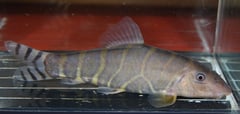
Botia darioBengal Loach
Botiidae · Hamilton, 1822
The Bengal loach, Botia dario, is a botiid loach from the middle to lower Ganges and Brahmaputra drainages in northern India, Bangladesh and Bhutan. Its yellow to golden body carries 7-9 dark bars with thinner, lighter bars between, and its particularly curved head makes it among the most easily recognisable in the genus. Botia macrolineata, described from aquarium fish shipped via Bombay, represents the same species. It is among the botiids produced commercially using hormones.
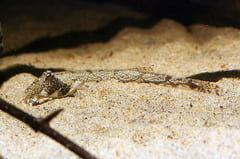
Canthophrys gongotaMoose-faced Loach
Cobitidae · Hamilton, 1822
The moose-faced loach, Canthophrys gongota, is a cobitid loach from the Ganges and Brahmaputra river systems in Nepal, northern India and Bangladesh. Often referred to as Somileptes gongota in aquarium literature, it is rarely seen in the trade, being notoriously delicate and difficult to ship. It mostly inhabits slow-moving, shallow tributaries and minor rivers over mud, sand or gravel.
Channa stewartiiAssamese Snakehead
Channidae · (Playfair, 1867)
The Assamese snakehead, Channa stewartii, is a snakehead of the C. gachua group from the Brahmaputra and Ganges basins of India, Bangladesh and Nepal. It is also listed from Bhutan and Myanmar and grows to about 30 cm TL. Keepers give it a cooler winter of about 16-18 °C, it is aggressive towards its own kind, and the male broods the eggs in his mouth.
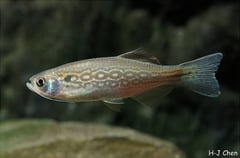
Danio dangilaMoustached Danio
Cyprinidae · (Hamilton, 1822)
The moustached danio, Danio dangila, is a cyprinid from the Ganges and Brahmaputra drainages, with most records from Nepal, India and Bangladesh. The common name refers to its exceptionally long barbels, and despite its apparent abundance in nature it remains uncommon in the hobby. Its constant activity can upset slow-moving or timid tankmates, so it suits larger tanks with similarly-sized fishes, and adult size appears to vary by population from 60 to 130 mm.
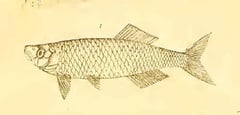
Devario aequipinnatus
Cyprinidae · (McClelland, 1839)
Devario aequipinnatus is a striped devario from hill streams in northeastern India, Bangladesh and Nepal. It is recognised by three straight dark stripes along each side, of which the middle one is widest. The name was long applied to almost any striped Devario, including the commercially bred giant danio, which is covered here under D. malabaricus.

Opsarius barna
Cyprinidae · Hamilton, 1822
Traded as 'striped hill trout' or 'banded hill trout', Opsarius barna is a cyprinid from the Ganges and Brahmaputra basins in northern India. It is thought to also occur in the Mahanadi and in river systems in Nepal, Bhutan, Bangladesh and Rakhine State, Myanmar, in well-oxygenated, fast-flowing rivers over gravel, cobbles and boulders. An extremely fast swimmer and vigorous feeder, it is unsuitable for the general community.
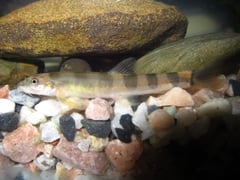
Schistura aizawlensis
Nemacheilidae · Lalramliana, 2012
Schistura aizawlensis is a nemacheilid loach known only from the Muthi River, a tributary of the Tuirial in Mizoram state, India. It has been collected for the aquarium hobby under an unknown trade name. Adults have 5-7 broad vertical bars on the flanks and an orange patch before the caudal-fin base. The type series came from a moderate to strongly-flowing stream with a substrate of gravel and rocks.

Gymnostomus ariza
Cyprinidae · Hamilton, 1807
Gymnostomus ariza is a cyprinid widely distributed from the Indus basin in Pakistan through India, Bangladesh and Myanmar. Growing to around 300 mm SL, it inhabits flowing streams and tributaries with clear water. It has a confusing taxonomic history, having been placed in Bangana, Cirrhinus and Labeo in recent years. It breeds in temporarily-inundated zones in the wet season and is also produced commercially for food.