Country · Asia
India
Only species with a profile on Seriously Fish are counted, whether native or introduced.
- Species
- 167
- Families
- 25
- Genera
- 62
- Found only here
- 85
- Photographed
- 165 of 167
Regions here
Shares its fishes withspecies recorded in both
Found only here85
85 of the species on this page are recorded in India and in no other country. This is not the same as being endemic.
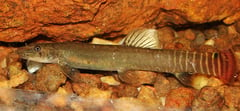
Aborichthys elongatusRed-Tailed Squirrel Loach
Nemacheilidae · Hora, 1921
The red-tailed squirrel loach, Aborichthys elongatus, is a nemacheilid loach from Darjeeling District, West Bengal, in north-east India. It lives among rocks and cobbles in shallow, swift streams running down from the Sivalik Hills into the Teesta and Brahmaputra drainage. The species is quite rare in the trade, and most fish sold under the name are collected at lower altitudes in Jalpaiguri District and probably represent different species.
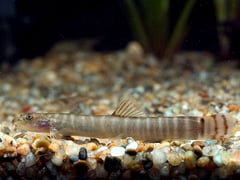
Aborichthys sp. 'AR01'
Nemacheilidae · authority not recorded
Aborichthys sp. 'AR01' is a nemacheilid loach, apparently undescribed, known only from the Raidak I River basin in West Bengal, India. It is usually traded as A. elongatus, but that species appears endemic to higher-altitude waters in Darjeeling District, and the colour and patterning of the two are clearly different. It inhabits shallow, swiftly-flowing water over gravel and small rocks.
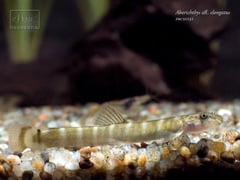
Aborichthys sp. 'AR02'
Nemacheilidae · authority not recorded
Aborichthys sp. 'AR02' is a small nemacheilid loach, apparently undescribed, known only from the Raidak I River basin in West Bengal, India. It occasionally turns up as a contaminant in shipments of A. sp. 'AR01'. Its small adult size, which seems to be 30 to 35 mm SL, and its relatively wide dark vertical bars along the body and single reddish bar in the caudal fin set it apart from others in the genus.
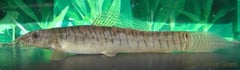
Acanthocobitis pavonaceaPeacock Loach
Nemacheilidae · McClelland, 1839
The peacock loach, Acanthocobitis pavonacea, is a large nemacheilid loach from the Brahmaputra River drainage in Assam, northeastern India. At 120 to 156 mm SL it is one of the largest nemacheilids, and Singer and Page (2015) treat it as the only member of Acanthocobitis. It isn't common in the trade, but occasional specimens turn up among wild-caught shipments from northeast India, sometimes sold as 'panther' or 'puma' loach.
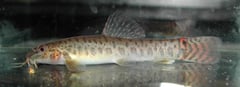
Acanthocobitis sinuata
Nemacheilidae · Day, 1870
Acanthocobitis sinuata is a nemacheilid loach from peninsular India, described from Wayanad district in Kerala. It appears widespread in drainages south of the Krishna. Most authorities treat it as a synonym of A. mooreh, but the two differ in distribution, dorsal-fin ray count and colour pattern, and they are apparently being revalidated. Both have a reduced lateral line ending around the dorsal fin, which in the similar A. botia is complete or ends above the anal fin.
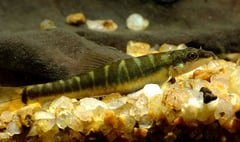
Acoura savonaHalf-banded Loach
Nemacheilidae · (Hamilton, 1822)
The half-banded loach, Acoura savona, is a nemacheilid loach from Ganges tributaries draining the eastern Himalayas in India, Nepal and Bangladesh. The species is seen in the trade fairly often and is sometimes sold as 'bicolor loach' in the United States. Its colour pattern of 9-10 thin, yellowish bars on a dark upper body, with plain whitish lower parts, separates it from similar loaches, and it is among the less aggressive of them.

Akysis prashadiIndawgyi Stream Catfish
Akysidae · Hora, 1936
The Indawgyi stream catfish, Akysis prashadi, is an akysid catfish from Lake Indawgyi and the upper Ayeyarwady drainage in northern Myanmar. It has also been recorded from the Lokchao river in Manipur, India. At up to 62 mm SL it ranks among the largest in the genus, and though it has been exported for the hobby it is by no means common.
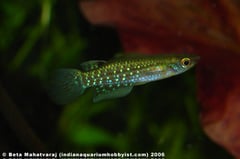
Aplocheilus blockiiGreen Panchax
Aplocheilidae · Arnold, 1911
The green panchax, Aplocheilus blockii, is a small killifish from Sri Lanka and southern India, growing to around 45 mm SL. Euryhaline, it mostly inhabits lowland, often coastal, still or slow-moving brackish or fresh water with surface vegetation or overhanging cover, and is commonly found in mangrove swamps and rice paddies.
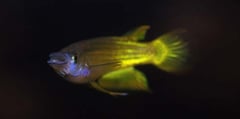
Aplocheilus lineatusStriped Panchax
Aplocheilidae · (Valenciennes, 1846)
The striped panchax, Aplocheilus lineatus, is a predatory killifish from peninsular India and northern Sri Lanka, growing to 10 cm TL. It lives in permanent water from mountain streams and lakes to swamps and rice paddies, and is not an annual species. The golden wonder panchax sold in the trade is a golden form selectively bred in the hobby that does not occur in the wild.
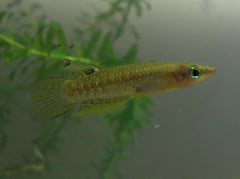
Aplocheilus parvusDwarf Panchax
Aplocheilidae · Sundara Raj, 1916
The dwarf panchax, Aplocheilus parvus, is a small killifish from Sri Lanka and Tamil Nadu state, southeastern India, growing to around 40 mm SL. Euryhaline, it mostly inhabits lowland, often coastal, still or slow-moving brackish or fresh water, and is commonly found in mangrove swamps and rice paddies.

Badis assamensis
Badidae · Ahl, 1937
Badis assamensis is a badid from the Brahmaputra River basin in Assam state, northeast India, and the largest species in its genus. Like most badids it is poorly documented. Its body patterning is almost identical to that of B. blosyrus, but it grows slightly larger, to 65 to 75 mm, and has a noticeably shorter jaw profile. The neotype was collected from a slow-moving forest stream in the Dibru River drainage, and it is a slow-moving, retiring fish that more boisterous tankmates can outcompete for food.

Badis badisBadis
Badidae · Hamilton, 1822
The badis, Badis badis, is a small badid from the Ganges river system in India, Nepal and Bangladesh, with further records in Assam and the Mahanadi. Sometimes sold as the 'chameleon fish' for its ability to change colour rapidly, especially when breeding or stressed, it was one of only two badids popular in the hobby before 2002. Several congeners share its dark cleithral spot and can be hard to tell apart. It is sluggish and retiring, and rival males can be quite aggressive towards one another in confined spaces.

Badis blosyrus
Badidae · Kullander & Britz, 2002
Badis blosyrus is a badid from western Assam and northern West Bengal in India, in the Brahmaputra drainage. Like most badids it is poorly documented. Its body patterning is almost identical to that of B. assamensis, but it is slightly smaller and has a noticeably elongated, better-developed jaw. In the Raidak River it was collected from cool, shallow, flowing water over small rocks and sand, with thick marginal vegetation.

Badis sp. 'Buxar'
Badidae · authority not recorded
Badis sp. 'Buxar' is an undescribed badid from India, named after the Buxa (often spelled 'Buxar') National Park in West Bengal. It has been in the hobby since 2006 and is also sold as B. sp. 'flame dot', after the red centres to the body scales of males. It appears to belong to the B. corycaeus group. Rival males can be very aggressive towards one another, especially in smaller tanks.

Badis tuivaiei
Badidae · Vishwanath & Shanta, 2004
Badis tuivaiei is a badid from northeastern India, described from the Tuivai and Irang rivers in the Barak system of Manipur state. It has since been found in the Wahumiam River in Meghalaya, where fish collected in 2006 were first thought to be undescribed and called B. sp. 'Wahumiam River' or 'terracotta'. It is very similar to B. badis, B. chittagongis and B. kanabos and is separated from them by meristic counts. At the Wahumiam locality the water was clear, shallow and slow over boulders, pebbles and sand.

Barilius ardens
Cyprinidae · Knight, Rai, d'Souza & Vijaykrishnan, 2015
Barilius ardens is a fast-swimming cyprinid from the Sita and Swarna river systems of the Western Ghats in Karnataka, southwestern India. Before its description it was usually identified in the trade as B. canarensis. A row of bluish-green vertical markings along the body and broad orange margins on the dorsal and anal fins distinguish it. It lives in well-oxygenated, moderate to fast-flowing rivers and streams.

Barilius bakeri
Cyprinidae · Day, 1865
Barilius bakeri is a fast-swimming cyprinid endemic to the Western Ghats of southwestern India, with records from many rivers in Kerala and Karnataka. It is traded as 'royal danio', 'blue-spotted hill trout' and 'blue-dotted mirror fish', and has a single row of bluish-green spots that get smaller with age. Its well-oxygenated, fast-flowing rivers are being polluted and degraded by exotic species and sand mining.

Barilius bendelisis
Cyprinidae · Hamilton, 1807
Barilius bendelisis is a large, fast-swimming cyprinid from India, Bangladesh, Nepal and probably Bhutan. Occasionally sold as 'Indian hill trout' or 'Hamilton's baril', it has 8 to 12 bluish vertical bars and, in adults, a blue-black spot on each scale. It grows to around 200 mm SL and inhabits well-oxygenated, fast-flowing rivers and streams, and its speed and vigorous feeding make it unsuitable for the general community.

Barilius canarensis
Cyprinidae · Jerdon, 1849
Barilius canarensis is a cyprinid from southwestern India, known with certainty only from the Netravathi and Tungabhadra river systems in Karnataka. Its name has historically been applied in the trade to B. ardens and B. malabaricus, and it was redescribed in 2015. Two rows of bluish-green spots and broad white margins on the dorsal and anal fins distinguish it. It inhabits well-oxygenated, fast-flowing rivers and streams.

Barilius gatensisMalabar Baril
Cyprinidae · Valenciennes, 1844
The Malabar baril, Barilius gatensis, is a cyprinid endemic to the Western Ghats of southern India, in Karnataka, Kerala and Tamil Nadu. Occasionally seen in the trade, it has 13 to 15 dark blue vertical bars that often almost break up in adults. It inhabits well-oxygenated, fast-flowing rivers and streams, apparently favouring slower runs and pools, and its speed and vigorous feeding make it unsuitable for the general community.

Barilius malabaricus
Cyprinidae · Jerdon, 1849
Barilius malabaricus is a cyprinid from southwestern India, known with certainty only from the Payaswini and Valapattanam river systems in Kerala. Before its revalidation in 2015 it was usually traded as B. canarensis or B. bakeri 'orange fin'. Bluish-green spots along the body and broad orange margins on the dorsal and anal fins distinguish it. It probably inhabits well-oxygenated, fast-flowing rivers and streams.

Barilius shacra
Cyprinidae · Hamilton, 1822
Barilius shacra is a cyprinid from the Himalayan foothills of Nepal and northern India, in the Ganges and Brahmaputra systems, and from Bangladesh. Poorly known in the hobby but exported on occasion, it has around 12 vertical bars on each flank and a black band in the upper third of the dorsal fin. It inhabits well-oxygenated, fast-flowing rivers with gravel, cobble and boulder substrates, and is too fast and vigorous a feeder for the general community.

Barilius vagra
Cyprinidae · Hamilton, 1822
Barilius vagra is a cyprinid widely distributed in the Ganges and Brahmaputra river systems of northern India, Nepal and Bangladesh. Poorly known in the hobby but exported on occasion, it has 10 to 14 vertical bars on each flank that do not extend below the lateral line. It inhabits well-oxygenated, fast-flowing rivers and tributaries with gravel, cobble and boulder substrates, and its speed and vigorous feeding make it unsuitable for the general community.

Batasio travancoriaMalabar Batasio
Bagridae · Hora & Law, 1941
The Malabar batasio, Batasio travancoria, is a bagrid catfish endemic to southern Kerala, India, in the Pamba, Chittar and Kallada drainages. Its darkish midlateral stripe and poorly-defined post-opercular spot separate it from B. sharavtiensis, the only other described member of the genus in southwestern India. Like its congeners it is an obligate inhabitant of shallow, fast-flowing, highly-oxygenated headwater streams.

Betadevario ramachandrani
Cyprinidae · Pramod, Fang, Rema Devi, Liao, Indra, Jameela Beevi & Kullander, 2010
Betadevario ramachandrani is a danionin cyprinid known only from two sites in the upper Sita River drainage near Agumbe, Karnataka, India. Agumbe lies in heavily forested country in the Western Ghats and is among the rainiest places in India. An active species, it suits a tank set up like a flowing stream at 18 to 23 °C, and its constant movement and vigorous feeding can stress less active tankmates.
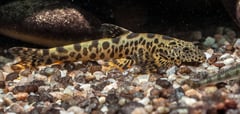
Bhavania australis
Balitoridae · Jerdon, 1849
Bhavania australis is a balitorid loach endemic to the Western Ghats mountains of southern India, recorded from Kerala, Tamil Nadu and Karnataka. An obligate dweller of shallow, fast-flowing, highly-oxygenated headwaters and minor tributaries, it has a flattened head and body and horizontally extended paired fins that form a powerful sucking cup for clinging to rocks. It is very rarely seen in the international aquarium trade but is maintained by a number of Indian aquarists.
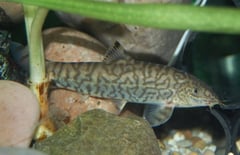
Botia almorhaeYo-Yo Loach
Botiidae · Gray, 1831
The yo-yo loach, Botia almorhae, is a botiid loach from parts of the Ganges River drainage in northern India and possibly Nepal. It is often called the 'Pakistani' loach, but that name is a misnomer. B. almorhae sensu stricto appears to belong to a group of closely-related species and has possibly never been seen in the aquarium trade, where the most commonly available members seem to be B. lohachata, B. sp. 'Kosi' and B. sp. 'Teesta', plus assorted hybrids.
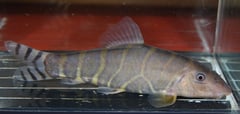
Botia darioBengal Loach
Botiidae · Hamilton, 1822
The Bengal loach, Botia dario, is a botiid loach from the middle to lower Ganges and Brahmaputra drainages in northern India, Bangladesh and Bhutan. Its yellow to golden body carries 7-9 dark bars with thinner, lighter bars between, and its particularly curved head makes it among the most easily recognisable in the genus. Botia macrolineata, described from aquarium fish shipped via Bombay, represents the same species. It is among the botiids produced commercially using hormones.
Botia histrionica
Botiidae · Blyth, 1860
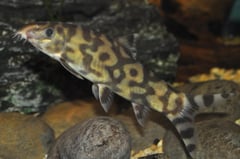
Known in the trade as the 'Burmese loach', Botia histrionica is a botiid loach from Myanmar, Manipur in India and Yunnan, China. Young fish all carry five solid dark bars on each flank and are often confused with B. kubotai, but in B. histrionica the bars stay solid for longer and the central bar usually forms a 'y' shape. Adult patterning varies considerably between the Ayeyarwady, Salween, Manipur and Ataran forms, and there has been speculation that some represent distinct species.
Botia rostrata
Botiidae · Günther, 1868
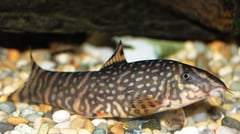
Botia rostrata is a botiid loach from the lower Ganges and middle to lower Brahmaputra basins in northern India and Bangladesh. Traded as the 'Gangetic loach', 'twin-banded loach' or 'ladder loach', almost all fish sold under the name are B. sp. 'upper Brahmaputra', and B. rostrata sensu stricto is rarely, if ever, available. Juveniles carry 9-10 dark body bars, usually in pairs, which break up to differing extents as the fish grow.
Botia striataZebra Loach
Botiidae · Narayan Rao, 1920
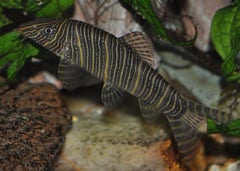
The zebra loach, Botia striata, is a botiid loach from the Krishna River system in southern India, described from the Tunga River in Karnataka. Its yellow to golden body with blue, green, grey or black bars and typically red mouthparts make it one of the most easily recognised in the genus, although the bars break up entirely in some specimens. Given its adult size and peaceable nature it is perhaps the best choice of Botia for the general community.

Butis amboinensisOlive Flathead Gudgeon
Butidae · Bleeker, 1853
The olive flathead gudgeon, Butis amboinensis, is a nocturnal ambush predator from the eastern Indian Ocean to the West Central Pacific. It inhabits brackish estuaries, lagoons and mangroves, entering tidal freshwater rivers to an extent, and often aligns itself with solid surfaces or swims upside-down. It is occasionally exported as bycatch and differs from congeners in lacking enlarged outer teeth and scales on the cheek. It is territorial and should probably be kept singly.

Butis butisCrazy Fish
Butidae · Hamilton, 1822
The crazy fish, Butis butis, is a flathead gudgeon of coastal and brackish waters across the Indo-Pacific, from eastern Africa to Fiji. The most commonly traded member of the genus, it has many other names, including crocodile fish, duckbill sleeper and upside-down sleeper. A nocturnal ambush predator, it often swims upside-down, and it is territorial and not sociable with conspecifics, so is best kept singly.
Canthophrys gongotaMoose-faced Loach
Cobitidae · Hamilton, 1822
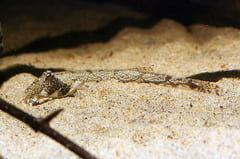
The moose-faced loach, Canthophrys gongota, is a cobitid loach from the Ganges and Brahmaputra river systems in Nepal, northern India and Bangladesh. Often referred to as Somileptes gongota in aquarium literature, it is rarely seen in the trade, being notoriously delicate and difficult to ship. It mostly inhabits slow-moving, shallow tributaries and minor rivers over mud, sand or gravel.

Chagunius chagunio
Cyprinidae · Hamilton, 1822
Chagunius chagunio is a large cyprinid endemic to the Ganges and Brahmaputra river basins in northern India, Nepal and Bangladesh. Growing to 400-450 mm, it can only be considered suitable for public aquaria and a very small minority of private aquarists. Rarely seen in the trade, it looks almost identical to C. baileyi and C. nicholsi but has more circumferential and circumpeduncular scales.
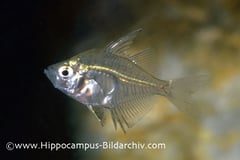
Chanda rangaIndian Glass Fish
Ambassidae · Hamilton, 1822
The Indian glass fish, Chanda ranga, is a small ambassid from South and Southeast Asia, with translucent skin that shows its bones and organs. For many years it was injected with luminous dyes on Asian fish farms and sold as 'painted' glass fish, and most injected fish do not survive more than a few months. It is found most often in freshwater, frequently soft and acidic, and needs no added salt. Parambassis lala and C. siamensis are often imported under its name.

Channa andraoLal Cheng
Channidae · Britz, 2013
Traded for years as 'Lal Cheng', Channa andrao is a snakehead endemic to the Brahmaputra River basin in northeastern India. It stays at a manageable size while showing much of the behaviour and colour of larger members of the genus. It lacks pelvic fins and is most often confused with C. bleheri, from which it differs in fin markings and in being a paternal mouthbrooder.

Channa aurantimaculataOrange-spotted Snakehead
Channidae · Musikasinthorn, 2000
The orange-spotted snakehead, Channa aurantimaculata, is a snakehead endemic to the Brahmaputra basin in Assam and Arunachal Pradesh, India. Also traded as 'golden cobra snakehead', it has seven or eight large, irregular orange blotches on a dark upper body. Aggressively territorial towards its own kind, it needs a species tank, and violence can break out suddenly even in pairs kept together for a long time.

Channa bleheriRainbow snakehead
Channidae · Vierke, 1991
The rainbow snakehead, Channa bleheri, is a snakehead endemic to the Brahmaputra basin in Assam and Arunachal Pradesh, northeastern India. A popular aquarium fish, it lacks pelvic fins and has reddish orange markings on the caudal fin. Both parents guard the floating eggs. It has been recommended as a concern for conservation because of its restricted range and burrow habitat, though it is unclear whether collection for the trade affects wild populations.

Channa gachuaDwarf Snakehead
Channidae · Hamilton, 1822
The dwarf snakehead, Channa gachua, is a snakehead recorded across an enormous range from Iran to Taiwan and Bali. There is significant evidence that C. gachua as currently understood is a complex of similar-looking species in need of taxonomic review. A mouthbrooder bred regularly in captivity, it can share a well-chosen community with peaceful fishes too large to be prey, but populations should not be mixed as some may hybridise.
Channa stewartiiAssamese Snakehead
Channidae · (Playfair, 1867)
The Assamese snakehead, Channa stewartii, is a snakehead of the C. gachua group from the Brahmaputra and Ganges basins of India, Bangladesh and Nepal. It is also listed from Bhutan and Myanmar and grows to about 30 cm TL. Keepers give it a cooler winter of about 16-18 °C, it is aggressive towards its own kind, and the male broods the eggs in his mouth.

Chela cachiusNeon Hatchet Fish
Cyprinidae · Hamilton, 1822
The neon hatchet fish, Chela cachius, is a deep-bodied cyprinid mostly recorded from the Ganges and Brahmaputra systems of India and Bangladesh. Its extremely deep body means it is unlikely to be confused with any related species, and it is the only valid member of the genus. A habitat generalist, it is an active schooling fish that is best kept in a group of at least 8-10 in a tank with a tightly-fitting cover, since it is an accomplished jumper.

Crossocheilus latius
Cyprinidae · Hamilton, 1822
Crossocheilus latius is a cyprinid widespread in India, described from the Tista River on the border with Bangladesh. It lives everywhere from boulder-strewn Himalayan hill streams to silt-laden tributaries and pools. Not often available in the trade, it sometimes turns up in shipments of Indian Garra, and its relatively plain pattern makes it unlikely to be confused with congeners. Juveniles are gregarious and active, but adults tend to become sedentary and solitary.

Ctenops nobilisFrail Gourami
Osphronemidae · McClelland, 1845
The frail gourami, Ctenops nobilis, is an anabantoid from the Ganges and Brahmaputra systems in northeastern India, Bangladesh and Nepal. The only recognised member of its genus and a paternal mouthbrooder, it is usually regarded as very difficult to keep but is quite adaptable once acclimatised. It appears to react poorly to export and shipping, so imports are often in poor condition and prone to Oödinium. Adults can be openly hostile towards conspecifics.
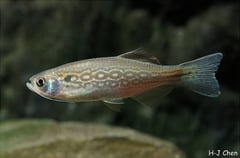
Danio dangilaMoustached Danio
Cyprinidae · (Hamilton, 1822)
The moustached danio, Danio dangila, is a cyprinid from the Ganges and Brahmaputra drainages, with most records from Nepal, India and Bangladesh. The common name refers to its exceptionally long barbels, and despite its apparent abundance in nature it remains uncommon in the hobby. Its constant activity can upset slow-moving or timid tankmates, so it suits larger tanks with similarly-sized fishes, and adult size appears to vary by population from 60 to 130 mm.

Danio jaintianensis
Cyprinidae · (Sen, 2007)
Danio jaintianensis is a small cyprinid known only from the Jaintia Hills of Meghalaya, in the Brahmaputra system of northeastern India. It is likely to be restricted to small, slower-moving hill streams with gravel and rocky substrates and thick marginal vegetation. It is best kept in an unheated tank and tends to struggle above 25 °C for long periods. Its temperature needs and rarity make it hard to recommend for the general community.
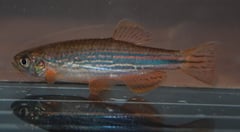
Danio meghalayensis
Cyprinidae · Sen & Dey, 1985
Much of Meghalaya consists of forested hills which receive a great deal of rainfall and many of its waters flow swiftly. This species typically inhabits high elevation (> 1000 m amsl) streams running over rocky, boulder-strewn substrates with few aquatic plants, although at some localities the flow may be more sluggish with riparian vegetation providing shade.

Danio rerioZebra Danio
Cyprinidae · (Hamilton, 1822)
The zebra danio, Danio rerio, is a small cyprinid from India and Bangladesh, found mostly in slow or still pools and mature rice paddies. Peaceful, hardy and inexpensive, it has been mass-produced for many years and quality stock can be hard to find. The spotted 'leopard danio' is a spontaneous mutation of the striped form that also occurs in the wild.

Danionella priapus
Cyprinidae · Britz, 2009
Danionella priapus is a miniature cyprinid known only from the Jorai River, a Sankosh tributary in the Brahmaputra drainage of West Bengal, India. Males have a conical projection of the genital papilla forming a funnel between the pelvic fins, a feature that may be unique within the Cypriniformes. Referred to as D. sp. 'Jorai River' before its description, it grows to 16 mm SL and was collected from a sluggish, densely vegetated stream alongside Dario dario.

Dario darioScarlet Badis
Badidae · Hamilton, 1822
The scarlet badis, Dario dario, is a tiny badid from tributaries of the Brahmaputra in West Bengal and Assam, India. Among the smallest percoid fishes known, it grows to 20 mm SL and is a popular choice for 'nano' aquaria. Males are the only Dario with seven iridescent blue vertical bars on the flanks, and rival males can be very aggressive towards one another in confined spaces.

Dario kajal
Badidae · Britz & Kullander, 2013
Dario kajal is a tiny badid from the Meghna drainage, described from the Jaintia Hills of Meghalaya, India, and also found in Bangladesh. It was referred to as Dario sp. 'Jaintia Hills' or D. sp. 'Bangladesh' before its description, and its name alludes to its prominent orbital stripes. Males have bars arranged in pairs on the upper half of the body, and given its rarity it is best kept alone with the emphasis on captive reproduction.

Datnioides polotaSilver Tiger Perch
Datnioididae · Hamilton, 1822
The silver tiger perch, Datnioides polota, is a tiger perch widely distributed in southeastern Asia, from India and Bangladesh east to Indonesia. Mostly found in brackish habitats such as estuaries, mangroves and coastal lagoons, it has a highly variable colour pattern with up to 7 dark bars. The name D. quadrifasciatus is sometimes applied to it, but that name is a junior homonym and polota takes precedence.

Dawkinsia arulius
Cyprinidae · Jerdon, 1849
Dawkinsia arulius is a cyprinid from Karnataka, southwestern India, apparently now restricted to the upper Cauvery and the Tungabhadra headwaters. Adults have three large, diffuse dark markings on the body. It appears extirpated at its type locality, most likely because of the Krishna Raja Sagara dam upstream, and the fish traded as 'arulius barb' is often the related D. tambraparniei, in which males have filamentous dorsal-fin rays.

Dawkinsia assimilisMascara Barb
Cyprinidae · Jerdon, 1849
The mascara barb, Dawkinsia assimilis, is a cyprinid from the Netravati, Chalakudy and Kallada basins of Karnataka and Kerala, India. The caudal-fin lobes are tipped with a black band about as wide as the eye, faint or absent in Kallada fish. Misidentified in the past as Puntius mahecola, it still appears on trade lists as 'mahecola barb', and some populations might represent distinct species.

Dawkinsia exclamatio
Cyprinidae · Pethiyagoda & Kottelat, 2005
Dawkinsia exclamatio is a cyprinid from the Kallada River in southern Kerala, India, and may be endemic to that river system. Rare in the hobby, it occasionally arrives as bycatch among similar-looking species such as D. assimilis. Two black blotches on each flank set it apart from the rest of the group, but there is a case that it is a natural hybrid between D. assimilis and a D. arulius-like fish found with it at its type locality.

Dawkinsia filamentosaFilament Barb
Cyprinidae · Valenciennes, 1844
The filament barb, Dawkinsia filamentosa, is a cyprinid endemic to the Western Ghats region of southern India, in Kerala, Tamil Nadu and Karnataka. Adult males and some females develop filament-like extensions to the branched dorsal-fin rays. Most common in lowland coastal floodplains, it occurs in fresh and brackish water, and it also appears on trade lists as 'blackspot barb' or 'mahecola barb'.

Dawkinsia rohani
Cyprinidae · Rema Devi, Indra & Knight, 2010
Dawkinsia rohani is a cyprinid known only from Kanyakumari District, Tamil Nadu state, at the southern tip of the Indian peninsula. A single black club-shaped blotch running back to the caudal-fin base, with no other body markings in front of it, separates it from congeners. Habitat data are lacking, but it is a pelagic, riverine species and apparently most common in hill streams.

Dawkinsia rubrotinctus
Cyprinidae · Jerdon, 1849
Dawkinsia rubrotinctus is a cyprinid from southern India, considered widespread throughout the Cauvery drainage in Karnataka, Kerala and Tamil Nadu. It may have appeared in the trade under the misapplied names Puntius arulius and P. tambraparniei. Three small, well-defined dark body markings separate it from D. arulius, D. srilankensis and D. tambraparniei, in which the markings are larger and more diffuse.

Dawkinsia tambraparniei'Arulius' Barb
Cyprinidae · Silas, 1954
The 'arulius' barb, Dawkinsia tambraparniei, is a cyprinid possibly restricted to the middle Tambraparni River basin in Tamil Nadu, southern India. Described as a subspecies of D. arulius, it appears in most earlier aquarium literature as Puntius arulius or 'arulius barb' and is often still traded as such, although D. arulius is quite different-looking and rarely exported. Many fish in the trade are likely to have been bred commercially.

Devario acuticephala
Cyprinidae · (Hora, 1921)
Devario acuticephalus is a small devario from Manipur state in northeastern India, also known from neighbouring Nagaland. It is rare in the hobby but traded on occasion. D. apogon from Yunnan, China, is very similar but has dark vertical bars on the front of the flanks. During a 2010 IUCN assessment it was recorded from only a handful of localities, and it is likely restricted to small hill streams.
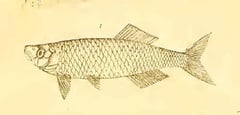
Devario aequipinnatus
Cyprinidae · (McClelland, 1839)
Devario aequipinnatus is a striped devario from hill streams in northeastern India, Bangladesh and Nepal. It is recognised by three straight dark stripes along each side, of which the middle one is widest. The name was long applied to almost any striped Devario, including the commercially bred giant danio, which is covered here under D. malabaricus.

Devario assamensis
Cyprinidae · (Barman, 1984)
Devario assamensis is a deep-bodied devario from Assam and West Bengal in northeastern India, in tributaries of the lower Brahmaputra. It has been traded as Devario sp. 'Mirik red', D. sp. 'redline' and D. sp. 'blood stripe', but is very rare in the hobby. If the distribution records are correct, it occurs from around 250 m AMSL in Darrang to 1767 m at Mirik, and possibly higher in Bhutan.

Devario devarioBengal Danio
Cyprinidae · (Hamilton, 1822)
The Bengal danio, Devario devario, is a devario from the Ganges and Brahmaputra river systems in northern India, Nepal and Bangladesh. Also known as the 'Sind danio', it is told apart from congeners by a single, interrupted lateral stripe on each flank. It is relatively common in the trade and produced commercially, with an albino form and a short-bodied variant sometimes sold as D. sp. 'mini Putao'.

Devario malabaricusGiant 'Danio'
Cyprinidae · (Jerdon, 1849)
The giant 'danio', Devario malabaricus, is a deep-bodied devario from peninsular India, living in hill streams and upper parts of small rivers. Most older aquarium literature labels it D. aequipinnatus, but genetic and morphological data have shown the traded fish to be D. malabaricus. It has a blue-and-yellow colour pattern and a P stripe extending to the fork of the caudal-fin. Its true range is uncertain and may be confined to western-flowing drainages of India.

Devario neilgherriensisPeninsular 'Danio'
Cyprinidae · (Day, 1867)
The peninsular 'danio', Devario neilgherriensis, appears endemic to tributaries of the Bhavani river system in the Nilgiri Hills, southern India. It is almost unheard of in the trade and little is known about it. Day described it with silvery flanks and a broad, indistinct steel-blue stripe bounded above and below by a narrow bright yellow band. Several of its hill-stream habitats lie around 2000 m AMSL.

Esomus danricaFlying Barb
Cyprinidae · Hamilton, 1822
The flying barb, Esomus danrica, is a cyprinid with an enormous range across Pakistan, Nepal, Bangladesh, most of India, Myanmar and Sri Lanka. It shows a marked preference for shallow, slow-moving and standing waters such as rice paddies with dense vegetation, and is generally absent from major river channels. Reports on its suitability for community aquaria are mixed, with some keepers seeing a pronounced tendency to nip fins.

Etroplus canarensisCanara Pearlspot Cichlid
Cichlidae · Day, 1877
The Canara pearlspot cichlid, Etroplus canarensis, appears to be endemic to the Kumaradhara-Netravati river system in southern Karnataka, India. Also known as the banded chromide or 'roman numeral' cichlid, it lives only in oxygen-rich fresh water, unlike its euryhaline relatives. Unmanaged collection raised concerns over its status, and commercial breeding in Southeast Asia has since reduced the pressure on wild stocks. Sexual maturity takes around 24 months.

Garra bicornutaRhino Garra
Cyprinidae · Narayan Rao, 1920
The rhino garra, Garra bicornuta, is a cyprinid from the Tunga River in the upper Krishna drainage, Karnataka, southern India. No other Garra is known to have a pair of rostral processes, which males develop and hold erect when sparring. A blue opercular spot ringed with gold blotches also identifies it. It is traded as 'Tunga garra' or 'lionhead garra', and can be territorial, especially at feeding time.

Gymnothorax tile'Freshwater' Moray Eel
Muraenidae · Hamilton, 1822
The 'freshwater' moray eel, Gymnothorax tile, is a moray from coastal regions of the Indo-West Pacific, from eastern India to the Philippines. Although typically sold as a freshwater fish, this is not strictly the case, and the profile treats a marine salt mix as mandatory. It has small pale spots on a darker head and body, where the congener G. polyuranodon has much larger dark spots on a paler background. Highly piscivorous, it is best kept alone in all but the very largest aquaria.

Haludaria fasciataMelon Barb
Cyprinidae · Jerdon, 1849
The melon barb, Haludaria fasciata, is a small cyprinid endemic to the Western Ghats of southern India, in Goa, Karnataka, Kerala and Tamil Nadu. It exists in a number of colour forms, and it is undecided whether they are geographical variants or a complex of closely-related species. Also traded as the 'ember barb', 'banded barb' and 'black spot barb', it is relatively peaceful and hardy, but a vigorous feeder that may outcompete slower or more timid fishes.

Labeo bogaViolet Shark
Cyprinidae · Hamilton, 1822
The violet shark, Labeo boga, is a cyprinid from most major river systems in India, Pakistan, Nepal, Bangladesh and Myanmar. It inhabits major river channels and larger tributaries and grows to 250 mm, needing a tank of at least 240 x 60 cm. It is unsuitable for most home aquaria but turns up in the trade irregularly, also as the 'violet-gilled shark' or 'blushing violet shark'. L. boga as currently recognised probably represents a complex of closely-related species.

Laubuka dadiburjoriDadio
Cyprinidae · Menon, 1952
The dadio, Laubuka dadiburjori, is a small cyprinid endemic to southern India, recorded from Goa, Karnataka, Kerala and Tamil Nadu. It has also been marketed as 'Burjor's brilliance', 'orange chela' and 'orange hatchetfish', and does not exceed 30 mm SL. A dark bluish stripe runs from the eye to the caudal peduncle, typically forming 2-5 round spots. There is a suggestion that it is not a direct relative of other Laubuka and may warrant its own genus.

Laubuka fasciataMalabar Hatchet Chela
Cyprinidae · Silas, 1958
The Malabar hatchet chela, Laubuka fasciata, is a cyprinid endemic to the state of Kerala in southwestern India. A dark stripe runs from the eye to the caudal peduncle, and it favours slow-moving, shallow margins of rivers and streams over rock and gravel. It is occasionally available in the aquarium trade, apparently collected only in small numbers, and is an accomplished jumper.

Laubuka laubucaIndian Glass Barb
Cyprinidae · Hamilton, 1822
The Indian glass barb, Laubuka laubuca, is a cyprinid probably endemic to the Ganges-Brahmaputra system in northern India, Bangladesh and Nepal. Traditionally considered to occur across the Indian subcontinent and most of Southeast Asia, it appears to be far more restricted, and many fish in the trade are probably L. siamensis. L. laubuca has a roundish, ocellated humeral spot and a thin, less conspicuous stripe interrupted by vertical markings. Other names include 'Indian hatchet fish' and 'winged danio'.
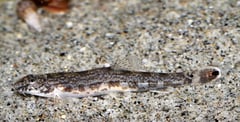
Lepidocephalichthys annandalei
Cobitidae · Chaudhuri, 1912
Lepidocephalichthys annandalei is a cobitid loach from the mid-to-lower Ganges and Brahmaputra systems in Nepal, Bangladesh and north-east India. Rarely traded, it has been sold as L. sp. 'peacock', presumably for its caudal-fin pattern of two dark v-shaped markings, unique within the genus. Fish in the trade differ slightly from the original description, in particular lacking a notched caudal fin.
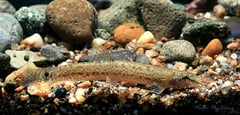
Lepidocephalichthys berdmorei
Cobitidae · Blyth, 1860
Lepidocephalichthys berdmorei is a cobitid loach found across Myanmar, Thailand, Laos, north-eastern India and Bangladesh. One of the most frequently-traded members of the genus, it is an excellent choice for those new to keeping loaches. Unlike most congeners it shows a preference for headwaters and streams with clear, flowing water, and its larger adult size separates it from the similar L. thermalis.
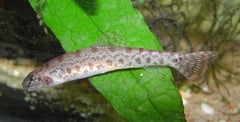
Lepidocephalichthys goalparensis
Cobitidae · Pillai & Yazdani, 1976
Lepidocephalichthys goalparensis is a cobitid loach from the Brahmaputra, Ganges and upper Irrawaddy basins in India, Nepal, Bangladesh and Myanmar. Rarely seen in the hobby, it was imported into the UK in late 2011 as bycatch among mastacembelid eels from northern India, and the identification was confirmed by Justin Havird. The forked caudal fin normally carries four or five broad, dark V-shaped bars.
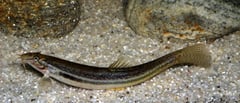
Lepidocephalichthys guntea
Cobitidae · Hamilton, 1822
Lepidocephalichthys guntea is a cobitid loach from the Ganges and Brahmaputra systems of northern India, Nepal and Bangladesh, and much of Myanmar. One of the most frequently-traded members of the group, it is an excellent choice for those new to keeping loaches. Males carry a solid, dark lateral stripe and females spotted flanks, and patterning varies with origin. It is also used as a food fish, eaten fresh and dried.
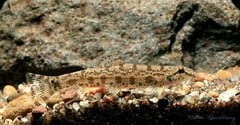
Lepidocephalichthys micropogon
Cobitidae · Blyth, 1860
Lepidocephalichthys micropogon is a cobitid loach from Myanmar, western Thailand, Bangladesh and Assam, India. Known from the Salween, Sittaung, Irrawaddy and Brahmaputra drainages and occasionally exported as bycatch, it grows to 55 mm SL and has a strongly forked caudal fin with broad, dark V-shaped bars. Kottelat (2012) treats L. manipurensis as a synonym, though Havird and Page (2010) list the two separately.
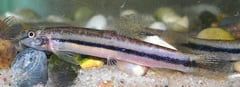
Lepidocephalichthys sp. 'LE2'
Cobitidae · authority not recorded
Lepidocephalichthys sp. 'LE2' is a cobitid loach from northern West Bengal, India, and most likely an undescribed species. It was apparently collected in the Buxa Tiger Reserve alongside the dwarf snakehead traded as Channa sp. 'Assam' or 'Lal Cheng'. It shows characters of both L. alkaia and L. guntea, has been referred to as L. cf. guntea, and the specimens pictured reached the UK in 2007.
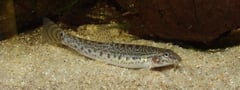
Lepidocephalichthys thermalis
Cobitidae · Valenciennes, 1846
Lepidocephalichthys thermalis is a cobitid loach from Sri Lanka and Peninsular India, described from the hot waters of Cania, Sri Lanka. Available sporadically, it makes an excellent choice for those new to keeping loaches. Unlike most of the genus it shows a preference for headwaters and clear, flowing streams. It was for a number of years included in Lepidocephalus until Havird and Page (2010) placed it in Lepidocephalichthys.
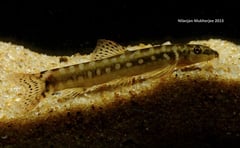
Mesonoemacheilus guentheri
Nemacheilidae · Day, 1867
Mesonoemacheilus guentheri is a loach from the Western Ghats of southern India, described from the Nilgiri Hills and since recorded in Kerala. Outside India it is most often seen as bycatch among shipments of M. triangularis. It is often confused with M. herrei, since both have rows of yellowish, dark-edged spots, but its spots are rounded where those of M. herrei are 'Y' or 'V' shaped. Some aquarists report it as peaceful and others as territorial and aggressive.
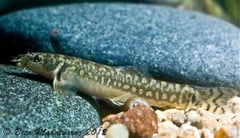
Mesonoemacheilus herrei
Nemacheilidae · Nalbant & Bãnãrescu, 1982
Mesonoemacheilus herrei is a loach from the Anaimalai Hills of the Western Ghats in Tamil Nadu, southern India. It is unclear if it has ever been exported outside India, though the odd specimen may turn up among shipments of M. guentheri or M. triangularis. It was earlier considered synonymous with M. guentheri and shares its rows of yellowish, dark-edged spots, which in this species are 'Y' or 'V' shaped.
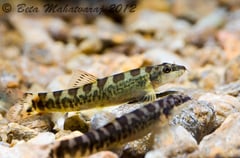
Mesonoemacheilus petrubanarescui
Nemacheilidae · Menon, 1984
Mesonoemacheilus petrubanarescui is a loach from the Netravati and Kabini river basins in the Western Ghats of southern India. It may be endemic to these two drainages. The dorsal surface carries 7-8 dark, saddle-shaped markings and the flanks a varying number of broken bars. It is unclear if it has been traded outside India, but it may turn up among shipments of M. guentheri or M. triangularis.
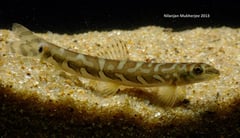
Mesonoemacheilus triangularisZodiac Loach
Nemacheilidae · Day, 1865
The zodiac loach, Mesonoemacheilus triangularis, is a loach from the Western Ghats of Kerala and Tamil Nadu in southern India. Also called the 'Batik loach', it is relatively common in the aquarium trade. Pale, black-edged saddles along the back and a similar set of bars from the belly set it apart from its congeners. Aquarists differ on its temperament, some finding it peaceful and others territorial and aggressive.
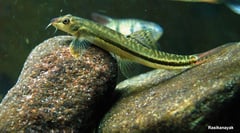
'Nemacheilus' anguilla
Nemacheilidae · Annandale, 1919
Nemacheilus anguilla is a loach endemic to the Western Ghats of southwestern India, recorded from rivers in Maharashtra, Karnataka and Kerala. Dark flank markings merged into a lateral stripe separate it from other Indian congeners, and its generic placement requires further study. It inhabits well-oxygenated, moderate to fast-flowing rivers over gravel and boulders, and is peaceful with its own kind, best kept in a group of four or more.
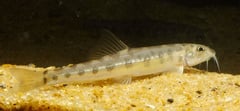
'Nemacheilus' corica
Nemacheilidae · Hamilton, 1822
Nemacheilus corica is a loach from Himalayan foothill rivers of the Ganges and Brahmaputra systems in Nepal, northern India and Bangladesh. Usually referred to Schistura in the hobby, it has been placed in Nemacheilus by most authors since the late 1970s, though its generic placement requires further study. A row of variably sized dark spots runs along the back and another along each flank, both ending in a dark blotch at the caudal-fin base.
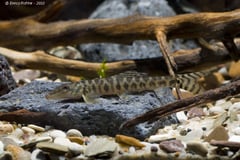
Nemachilichthys rueppelli
Nemacheilidae · Sykes, 1839
Nemachilichthys rueppelli is a nemacheilid loach from the upper Krishna River system in the Western Ghats, India. It inhabits moderate to fast-flowing streams and rivers, usually on the bed among aquatic vegetation and submerged roots. N. shimogensis was long treated as a separate species, but Keskar et al. (2015) examined topotypes of both and concluded they are conspecific.

Opsarius barna
Cyprinidae · Hamilton, 1822
Traded as 'striped hill trout' or 'banded hill trout', Opsarius barna is a cyprinid from the Ganges and Brahmaputra basins in northern India. It is thought to also occur in the Mahanadi and in river systems in Nepal, Bhutan, Bangladesh and Rakhine State, Myanmar, in well-oxygenated, fast-flowing rivers over gravel, cobbles and boulders. An extremely fast swimmer and vigorous feeder, it is unsuitable for the general community.

Opsarius dogarsinghiManipur Baril
Cyprinidae · Hora, 1921
The Manipur baril, Opsarius dogarsinghi, is a cyprinid from the Chindwin river system in Manipur and Nagaland, northeastern India, and Myanmar. It occasionally appears in the trade as 'Burmese hill trout' or 'striped hill trout'. A large dark blotch at the caudal-fin base and 8-9 dark blue vertical bars help separate it from congeners, and it has been bred in aquaria.

Oreichthys cosuatis
Cyprinidae · Hamilton, 1822
Oreichthys cosuatis is a small cyprinid probably restricted to the Ganges and Brahmaputra River basins in Nepal, India and Bangladesh. Several undescribed Oreichthys spp. from India, Myanmar and Thailand continue to be traded under its name, and apparent records from those places likely represent other species. It lacks a black blotch on the caudal peduncle, and adults have a dark triangular blotch in the anal-fin.

Oreichthys crenuchoidesDrape Fin Barb
Cyprinidae · Schäfer, 2009
The drape fin barb, Oreichthys crenuchoides, is a small cyprinid possibly endemic to Brahmaputra tributaries in West Bengal, eastern India. The species is sometimes traded as Oreichthys cosuatis, O. sp. 'high fin', Puntius 'arunavii' or 'neon highfin barb'. Males have a significantly enlarged dorsal-fin, and a large black marking at the caudal-fin base with no dark marking in the anal-fin separates it from congeners.

Oryzias dancenaIndian Ricefish
Adrianichthyidae · Hamilton, 1822
The Indian ricefish, Oryzias dancena, is widely distributed through eastern and southern India, Sri Lanka, Bangladesh and Myanmar. Mostly coastal but adaptable, it has been collected from strongly brackish mangrove swamps to acidic freshwater forest streams. It continues to be misidentified as O. melastigma, a name most recent workers consider invalid, or as O. javanicus, a valid but distinct taxon.
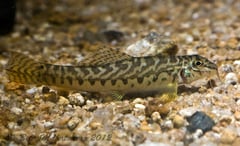
Paracanthocobitis botiaZipper Loach
Nemacheilidae · Hamilton, 1822
The zipper loach, Paracanthocobitis botia, is a nemacheilid loach from the Brahmaputra River in Assam, northeastern India. It was long thought to range from Pakistan to western Thailand, and several populations once included under the name are now treated as separate species. Relatively hardy and peaceful, it is one of the better choices for those new to nemacheilids, and its dark, eye-like ocellus at the top of the caudal peduncle is normally more intense in younger fish.
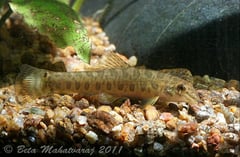
Paracanthocobitis mooreh
Nemacheilidae · Sykes, 1839
Paracanthocobitis mooreh is a nemacheilid loach known only from the Godavari, Krishna and Kaveri (Cauvery) systems in western and southern India. An incomplete lateral line ending near the pelvic-fin origin, with small, mostly vertical blotches along it connected to the dorsal saddles, separates it from congeners. It favours stretches of streams and small rivers where leaf litter collects over sand, cobbles and boulders, and is generally non-aggressive.
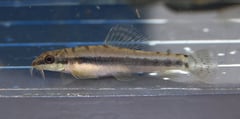
Paracanthocobitis zonalternans
Nemacheilidae · Blyth, 1860
Paracanthocobitis zonalternans is a nemacheilid loach ranging from Manipur in India through Myanmar into western and peninsular Thailand. Several species are thought to be confused under the name, and Singer and Page (2015) consider it likely to be a species complex. Among the more peaceful members of the genus, it does best in a mixed-sex group of at least half a dozen, and it has been bred in aquaria, first by UK aquarist Mick Wright.

Pethia aurea
Cyprinidae · Knight, 2013
Pethia aurea is a small cyprinid known from ponds in South 24 Parganas District, West Bengal, in the Ganges delta of northern India. Considered a phenotype of the similar P. gelius before its description, it has a yellowish-golden body, a broad black band around the caudal peduncle and a black blotch beneath the dorsal-fin origin. Very peaceful but timid, it does best in a group of at least 8-10 alongside other diminutive species.

Pethia canius
Cyprinidae · Hamilton, 1822
Pethia canius is a small cyprinid from West Bengal in northern India, with recent collections from Cooch Behar and Nadia districts. Long considered a synonym of the closely related P. gelius, it had its identity settled and a neotype designated by Knight (2013). It inhabits ponds and other still-to-sluggish waters, and its small size and timid nature mean it does best alone or with other diminutive species.

Pethia conchoniusRosy Barb
Cyprinidae · Hamilton, 1822
The rosy barb, Pethia conchonius, is a small cyprinid found from Pakistan throughout India, Nepal and Bangladesh. Generally considered one of the hardiest small cyprinids in the hobby, it is an excellent choice for newcomers. Wild specimens are not usually available and the vast majority are commercially bred, with long-finned, 'veil-tail', 'super red', 'neon' and 'golden' strains among the forms selective breeding has produced. Feral populations exist in several countries.

Pethia geliusGolden Dwarf Barb
Cyprinidae · Hamilton, 1822
The golden dwarf barb, Pethia gelius, is a small cyprinid native to the Ganges and Brahmaputra river drainages of northern India and Bangladesh. Records suggest a wider range, including Tamil Nadu and the Ayeyarwady delta in Myanmar, though the latter may warrant investigation. Knight (2013) settled its identity, revalidating P. canius and describing P. aurea, both previously treated as phenotypes of P. gelius. Very peaceful but timid, it does best alone or with other diminutive species.

Pethia manipurensis
Cyprinidae · Menon, Rema Devi & Vishwanath, 2000
Pethia manipurensis is a small cyprinid apparently endemic to Loktak Lake in Bishnupur District, Manipur state, northeastern India. The species is considered endangered with a declining population trend, though it is bred commercially for the aquarium hobby. Males carry orange-red pigmentation on the flanks and caudal fin, as in P. meingangbii and P. padamya, but its humeral marking is a small spot where both of those have a large, vertically-elongated one.

Pethia nigripinnis
Cyprinidae · Knight, Rema Devi, Indra & Arunachalam, 2012
Pethia nigripinnis is a small cyprinid of cool, flowing hill streams in Kerala and Tamil Nadu, apparently endemic to the southern Western Ghats. Adult males have black dorsal, anal, pelvic and pectoral fins. Its need for cooler temperatures makes it unlikely to suit the general community aquarium, and it will probably do best alone or with comparably-sized species needing similar conditions.

Pethia phutunioDwarf Barb
Cyprinidae · Hamilton, 1822
The dwarf barb, Pethia phutunio, is a small cyprinid from the lower Ganges and Brahmaputra river basins in Bangladesh and India. Frequently misidentified and quite rare in the trade, it is sometimes called 'spotted-sail barb' or 'spotted-tail barb'. Several congeners share its two black flank blotches, but it is smaller than all of them at 25 to 30 mm. It inhabits sluggish rivers, streams, ponds and swamps, often over deep mud or silt.

Pethia pookodensisPookode Lake Barb
Cyprinidae · Mercy & Jacob, 2007
The Pookode Lake barb, Pethia pookodensis, is a small cyprinid described from Pookode Lake in Wayanad district, Kerala, and possibly endemic there. Pookode is a small forest lake and tourist destination that has suffered some degradation, and the IUCN classify the species as 'Critically Endangered'. It is most similar to P. ticto and P. punctata, with two dark flank markings, one on the front of the body and one on the caudal peduncle.

Pethia punctata
Cyprinidae · Day, 1865
Pethia punctata is a small cyprinid endemic to the Western Ghats of southwestern India, where it appears restricted to west-flowing rivers. Poorly known in the hobby, it has a confusing taxonomic history and has been treated as both a synonym and a subspecies of P. ticto. It has a complete lateral line, two dark body blotches with the front one a scale row below the lateral line, and rows of spots in the dorsal fin.

Pethia setnaiNarayan Barb
Cyprinidae · Chhapgar & Sane, 1992
The Narayan barb, Pethia setnai, is a small cyprinid common in rivers draining the Western Ghats of India, described from Sanguem in Goa. It is widely traded as 'Puntius' narayani, though the trade fish all have the serrated dorsal-fin spine of P. setnai, a feature 'P.' narayani lacks. The central of its three dark flank markings, beneath the dorsal fin, is uniquely pale and diffuse. In hill streams and smaller rivers it gathers in backwater pools and deeper, slower areas.

Pethia shalyniusShalyni Barb
Cyprinidae · Yazdani & Talukdar, 1975
The Shalyni barb, Pethia shalynius, is a small cyprinid that appears to be endemic to Meghalaya state in northeastern India. It is known from only a handful of localities in the Khasi and Jaintia hills, mostly streams above 1200 metres with cool, clear, well-oxygenated water, and is apparently under threat from industrial activity. Very peaceful, it is still a poor choice for the general community aquarium because of its preference for cooler temperatures.

Pethia stoliczkana
Cyprinidae · Day, 1871
Pethia stoliczkana is a small cyprinid that appears to range from Manipur state in northeastern India through Myanmar and Thailand to western Laos. Much of the literature confuses it with P. ticto, but the two do not occur in the same waters and the lateral line is complete in this species and incomplete in P. ticto. The form from Mandalay division in Myanmar is sometimes sold as Puntius sp. 'pearlscale'. It mostly inhabits shady, flowing streams and tributaries.

Pethia tictoTicto Barb
Cyprinidae · Hamilton, 1822
The ticto barb, Pethia ticto, is a small cyprinid widely distributed through most of the Indian subcontinent, from Pakistan and Nepal to Bangladesh. Its name is frequently misapplied to P. padamya in aquarium literature, though P. ticto is much the less colourful fish and males lack reddish-orange pigmentation on the body. Morphology and colour pattern vary by population, and some populations have already been described as distinct species.

Pseudetroplus maculatusOrange Chromide
Cichlidae · (Bloch, 1795)
The orange chromide, Pseudetroplus maculatus, is a euryhaline cichlid native to peninsular India and Sri Lanka. It mostly inhabits brackish estuaries, coastal lagoons and the lower reaches of rivers, and can be kept in fresh or brackish water so long as acidic conditions are avoided. Wild examples are rarely seen in the hobby, where selectively bred strains traded as 'red' or 'yellow' chromide are widely available.

Pseudosphromenus cupanusSpiketail Paradisefish
Osphronemidae · Cuvier, 1831
The spiketail paradisefish, Pseudosphromenus cupanus, is a small labyrinth fish restricted to southern India and Sri Lanka. It lives in sluggish and still waters such as rice paddies, swamps and weedy ponds. It lacks the two dark lateral stripes of its only congener, P. dayi. A secretive bubble nester, it is peaceful but too small and timid for most community aquaria.

Pseudosphromenus dayiBrown Spike-tailed Paradise Fish
Osphronemidae · Engman, 1909
The brown spike-tailed paradise fish, Pseudosphromenus dayi, is a small labyrinth fish from coastal drainages of the Western Ghats in Kerala, India. It is known only from the Chalakkudy, Muvattupuzha and Periyar rivers, though it may be more widely distributed. Two dark, irregular lateral stripes on the head and body, and a more extended caudal fin in males, separate it from its only congener, P. cupanus. A secretive bubble nester, it is peaceful but small and timid.

Puntius bimaculatusTwo-spotted Barb
Cyprinidae · Bleeker, 1863
The two-spotted barb, Puntius bimaculatus, is a small cyprinid from Sri Lanka and southern India. It lives in flowing hill streams and quieter stretches in the middle reaches of rivers, but tends to be absent from lowland environments. Also called the 'redside barb', it has 7 branched dorsal-fin rays and round dark spots at the base of the dorsal and caudal fins. Generally very peaceful, it is a schooling species and at least 6-10 should be kept.

Puntius cholaSwamp Barb
Cyprinidae · (Hamilton, 1822)
The swamp barb, Puntius chola, is a cyprinid from much of Pakistan, India, Nepal, Bhutan, Bangladesh, Sri Lanka, Myanmar and western Thailand. Sometimes called the 'chola' or 'green' barb, it has a single pair of barbels and dark blotches behind the operculum and near the caudal-fin base. It apparently prefers stiller waters over mud or silt, and makes an ideal addition to a peaceful community of riverine fishes.

'Puntius' guganioGlass Barb
Cyprinidae · Hamilton, 1822
The glass barb, Puntius guganio, is a small cyprinid widespread in the Ganges and Brahmaputra river systems of Bangladesh, Nepal and northern India. It lives in slow-moving or standing waters such as pools, ditches and minor rivers. Poorly known in the hobby, it is of uncertain taxonomic placement, and its stiff, serrated last dorsal-fin ray, incomplete lateral line and 36-39 lateral scales are shared only with 'P.' nangalensis.

Puntius mahecola
Cyprinidae · Valenciennes, 1844
Puntius mahecola is a cyprinid from rivers draining much of the Western Ghats mountains in Kerala, Karnataka and Tamil Nadu states, southern India. The name was misapplied to members of Dawkinsia for over a century, while the fish itself was widely misidentified as P. amphibius. A relatively plain fish, it has a single dark blotch on the caudal peduncle behind the anal fin. D. assimilis and other Dawkinsia species appear on trade lists as 'mahecola barb'.

Puntius sahyadriensisMaharaja Barb
Cyprinidae · Silas, 1953
The maharaja barb, Puntius sahyadriensis, is a cyprinid endemic to the northern and central Western Ghats mountains of India. It lives in hill streams shaded by the forest canopy and dense marginal vegetation, over boulders, stones, sand or gravel. The angular body, colour pattern and enlarged male dorsal fin make it difficult to confuse with any other member of the genus, and it is occasionally traded as the 'Khavli' barb.

Puntius sharmai
Cyprinidae · Menon & Rema Devi, 1993
Puntius sharmai is a small cyprinid known only from a handful of localities around Chennai in Tamil Nadu, India. It mostly inhabits ponds and lakes, many of them in urban areas under pressure from urbanisation. Very peaceful but small and timid, it does best alone or with other diminutive species, and it is almost unheard of in the hobby outside India.

Puntius terioOnespot Barb
Cyprinidae · Hamilton, 1822
The onespot barb, Puntius terio, is a cyprinid widely distributed from Pakistan through northern India, Nepal and Bangladesh. Its range covers parts of the Indus, Ganges and Brahmaputra drainages, where it apparently prefers stiller waters over mud or silt. Populations vary in colour pattern to an extent, but all share a diffuse yellow-golden marking on the operculum and a dark spot on the caudal peduncle.

Puntius vittatusGreenstripe Barb
Cyprinidae · Day, 1865
The greenstripe barb, Puntius vittatus, is a small cyprinid widely distributed in India, with further populations in Pakistan and Sri Lanka. Sometimes called the 'kooli barb', it lacks barbels and has a vertical black streak and an orange-marked black tip on the dorsal fin. It most commonly occurs in lowland streams, pools, irrigation channels and rice paddies over mud or silt, and is not an especially popular aquarium fish despite its wide range.

Sahyadria chalakkudiensis
Cyprinidae · Menon, Rema Devi & Thobias, 1999
Sahyadria chalakkudiensis is a cyprinid from Kerala, southern India, known from the Chalakudy, Periyar, Pamba and Achankovil rivers. It was first exported in 1996 under the name S. denisonii, from which it differs in its inferior mouth, a black marking in the dorsal fin, and a duller scarlet body stripe. It can be belligerent and is unsuitable for the general community aquarium.

Sahyadria denisoniiRed-line Torpedo Barb
Cyprinidae · Day, 1865
The red-line torpedo barb, Sahyadria denisonii, is a cyprinid endemic to Kerala and Karnataka in southern India. Extremely popular since it appeared in the trade in the late 1990s, it is listed as Endangered by the IUCN, and collection for the aquarium trade has been held largely responsible for its decline. Large numbers are produced in Southeast Asia and Eastern Europe. The similar S. chalakkudiensis is occasionally traded as this species and is more belligerent.
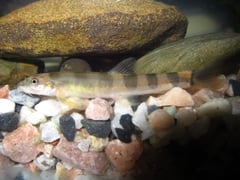
Schistura aizawlensis
Nemacheilidae · Lalramliana, 2012
Schistura aizawlensis is a nemacheilid loach known only from the Muthi River, a tributary of the Tuirial in Mizoram state, India. It has been collected for the aquarium hobby under an unknown trade name. Adults have 5-7 broad vertical bars on the flanks and an orange patch before the caudal-fin base. The type series came from a moderate to strongly-flowing stream with a substrate of gravel and rocks.
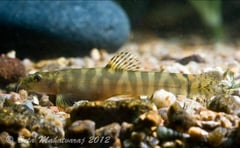
Schistura denisonii
Nemacheilidae · Day, 1867
Schistura denisonii is a nemacheilid loach from the Western Ghats of southern India, described from the Bhavani River in the Cauvery system. Widely referred to Nemacheilus, it matches the diagnostic characters of Schistura. The number and arrangement of its vertical body bars vary greatly, and whether it represents a complex of species or a single taxon remains unclear. Feisty, it is largely unsuitable for the general community aquarium.
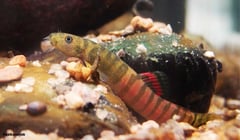
Schistura kodaguensis
Nemacheilidae · Menon, 1987
Schistura kodaguensis is a small nemacheilid loach from the Western Ghats of Karnataka, India, confirmed only from a tributary of the Cauvery. It is not a well-known aquarium fish but is maintained by a number of Indian enthusiasts. The very similar S. nilgiriensis, also from the Western Ghats, has a black spot at the base of the dorsal-fin and lacks the rows of spots on the caudal-fin.
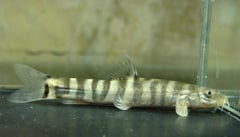
Schistura sp. 3
Nemacheilidae · authority not recorded
Schistura sp. 3 is an unidentified nemacheilid loach thought to have been exported from northern India. It has been traded as Schistura scaturigina but does not appear to be that species, since it has 9 regular vertical bars extending the full depth of the body and a dark marking at the anterior dorsal-fin base. Several vertically-barred Schistura from northern India have confused identities.
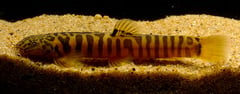
Schistura sp. 4Grizzled Loach
Nemacheilidae · authority not recorded
The grizzled loach, Schistura sp. 4, is a nemacheilid loach from a hill stream in the Siwalik hills around Darjeeling, West Bengal, northern India. Its identity is unclear, and though collected close to the type locality of S. multifasciata it does not match the description of that species. The stream is small, shallow and clear, well over 1000 m AMSL, and the fish is likely to attain 90-100 mm.
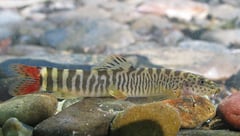
Schistura vinciguerrae
Nemacheilidae · Hora, 1935
Schistura vinciguerrae is a nemacheilid loach from the Irrawaddy, Salween and Chindwin river basins in Myanmar and northeastern India. Traded fairly regularly, it belongs to the Schistura multifasciata group, in which the anterior flank bars are divided and thinner than those behind. Males lack a suborbital flap, and this separates it from S. bella, S. mahnerti, S. reticulata and S. udomritthiruji. It inhabits clear, well-oxygenated forest streams over coarse sand, gravel, rocks and boulders.
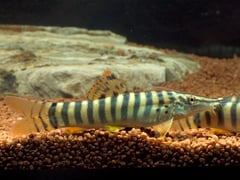
Syncrossus berdmoreiRedfin Tiger Loach
Botiidae · Blyth, 1860
The redfin tiger loach, Syncrossus berdmorei, is a botiid loach from the Irrawaddy, Sittaung and Salween systems in Myanmar and Manipur, India. It looks very similar to S. beauforti but has 11-14 branched dorsal-fin rays, and in young fish its larger dark markings appear first behind the opercle. Colour and pattern vary with locality and age, and some of these forms may turn out to be separate species.

Trichogaster chunaHoney Gourami
Osphronemidae · Hamilton, 1822
The honey gourami, Trichogaster chuna, is a labyrinth fish from the Ganges and Brahmaputra systems of India and Bangladesh, with records from Nepal. Virtually all fish on sale are commercially produced, and ornamental strains such as 'red', 'sunset' and 'golden' exist. Slow-moving and easily outcompeted, it needs peaceful tankmates and does best in a group of four to six.

Xenentodon cancilaFreshwater Needlefish
Belonidae · Hamilton, 1822
The freshwater needlefish, Xenentodon cancila, is a belonid from Pakistan east through India, Bangladesh, Nepal, Sri Lanka, Myanmar and Thailand. Often called 'freshwater garfish', it only superficially resembles the true gars, and most of its relatives in the Belonidae are marine or estuarine. A near-exclusive inhabitant of the upper water column, it is surprisingly peaceful with anything too large to swallow and is best kept in numbers of four or more, in a tank of 180 ∗ 60 cm or more.
Xiphophorus helleriiGreen Swordtail
Poeciliidae · Heckel, 1848
The green swordtail, Xiphophorus hellerii, is a livebearer native to southeastern Mexico, Guatemala, Belize and Honduras. Among the world's most recognisable aquarium fishes, it is ubiquitous in the trade, where selective breeding and hybridisation with X. maculatus and X. variatus have produced a bewildering array of ornamental forms. The name is often misspelled X. helleri.

Allenbatrachus grunniensFreshwater Toadfish
Batrachoididae · Linnaeus, 1758
The freshwater toadfish, Allenbatrachus grunniens, is a euryhaline toadfish from the Ganges delta in India and Bangladesh east to the Philippines. It is relatively common in the hobby and, contrary to popular belief, not venomous, but its dorsal and opercular spines can pierce the skin, so it needs netting with extreme caution. It rarely does well when kept in freshwater for prolonged periods.

Anabas testudineusClimbing Perch
Anabantidae · Bloch, 1792
The climbing perch, Anabas testudineus, is a labyrinth fish found from Pakistan and Sri Lanka east to southern China, Indonesia and Singapore. It lives in almost every kind of lowland water from rice paddies to main river channels, and can cross several hundred metres of land provided it stays moist. Its taxonomy is confused, and additional taxa probably exist. Its size and predatory nature make it unsuitable for the general community.

Bagarius yarrelliGoonch
Sisoridae · Sykes, 1839
The goonch, Bagarius yarrelli, is a very large sisorid catfish recorded from the Indus in Pakistan east through Indochina to Sumatra and Borneo. Also known as the 'giant devil catfish' and 'sand shark', it reaches 1300 to 2000 mm and is fished for food across much of its range. That wide distribution appears doubtful, and Indian and Southeast Asian populations may prove not to be conspecific. It lives among boulders in the fast, turbulent rapids of large rivers.

Brachygobius nunus
Gobiidae · Hamilton, 1822
Brachygobius nunus is a bumblebee goby described from the Ganges delta near Kolkata, more likely restricted to India, Bangladesh and Sri Lanka. Reports of its wider range vary, and it may also occur in Myanmar. The name is widely misapplied to B. doriae and B. sabanus, which may give a false impression of its availability, though it looks completely different, with four black bands on the body and a black stripe through the eye. It lives in fresh and brackish lowland coastal habitats.
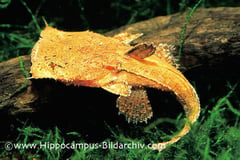
Chaca chacaFrogmouth Catfish
Chacidae · authority not recorded
The frogmouth catfish, Chaca chaca, is an ambush predator from still and slow-moving waters in India, Nepal, Bangladesh and Indonesia. Also known as the angler catfish, it lies hidden among leaf litter and mulm and moves its barbels like a worm to lure prey, which can be almost as big as itself. It is usually lighter than C. bankanensis and has small hooklets on the lower lip and body that its relative lacks.

Channa barca
Channidae · Hamilton, 1822
Channa barca is a large snakehead from the Brahmaputra basin in Assam and Nagaland, northeastern India, where it is scarce. Rarely available but considered highly desirable in the hobby, it grows to 800-900 mm. In the wild it lives in vertical burrows around the margins of wetlands that dry out in winter, and its restricted range and specialised habitat have led to it being recommended as a concern for conservation.

Channa diplogrammaMalabar Snakehead
Channidae · Day, 1865
The Malabar snakehead, Channa diplogramma, is a large snakehead endemic to the southern Western Ghats in Kerala and Tamil Nadu, India. Treated as a synonym of the Indochinese C. micropeltes for over a century, it was revalidated in 2011 and has 103-105 lateral line scales, more than any other Channa. Its colour pattern changes markedly with age, and unlike most snakeheads it is pelagic and needs plenty of room to swim.

Channa maruliusBullseye Snakehead
Channidae · Hamilton, 1822
The bullseye snakehead, Channa marulius, is a large snakehead recorded from Pakistan across southern Asia to southern China, Laos and Vietnam. Also called the 'giant', 'cobra' or 'Indian' snakehead, it is widely accepted to represent a complex of related species in need of further research. Reports of 120-180 cm remain to be proven, with 500-600 mm a more common adult size, and it is suitable only for public installations or the very largest private aquaria.

Channa sp. 'five stripe'
Channidae · authority not recorded
Channa sp. 'five stripe' is an unidentified snakehead apparently collected near Alipurduar in West Bengal, close to India's border with Bhutan. It carries a series of five oblique dark bars on the upper flank and has also been traded as C. sp. 'Kerala', a misnomer since Kerala is in southwestern India. It must not be kept at a constant temperature but given defined winter and summer periods, and it is a paternal mouthbrooder bred fairly regularly in captivity.

Chitala chitalaIndian Featherback
Notopteridae · Hamilton, 1822
The Indian featherback, Chitala chitala, is a very large notopterid probably restricted to Pakistan, India, Nepal and Bangladesh. Its name has been widely misapplied in the trade, most often to the Southeast Asian C. ornata, but it is very rarely exported for aquaria and is fished and cultured for food in India. Growing to 1220 mm SL, it has non-ocellated black spots above the anal fin and is the only Chitala normally showing gold or silver bars on the back.

Crossocheilus burmanicus
Cyprinidae · Hora, 1936
Crossocheilus burmanicus is a cyprinid from Myanmar plus northeastern India and western Thailand, in rivers draining to the Irrawaddy and Salween. It lives in clear, flowing streams over boulders, pebbles, gravel and sand, browsing the biofilm on submerged surfaces. Its dark lateral stripe does not extend into the caudal fin, which separates it from the fish traded as 'Siamese algae eater' or 'SAE'.

Ctenopharyngodon idellaGrass Carp
Cyprinidae · Valenciennes, 1844
The grass carp, Ctenopharyngodon idella, is a large cyprinid native to the Amur River system in eastern Russia and northeastern China. Adults typically reach 800 to 1200 mm, making it a wholly unsuitable aquarium subject, though an albino form is traded. Widely introduced for aquaculture and weed control, it has caused serious damage to natural waters, and unwanted fish should never be released.

Etroplus suratensisGreen Chromide
Cichlidae · Bloch, 1790
The green chromide, Etroplus suratensis, is a euryhaline cichlid from peninsular India and Sri Lanka, growing to 350 mm SL. It mostly inhabits brackish estuaries, coastal lagoons and lower river reaches. Not especially popular in the hobby, it is an important food fish, and some populations have crashed through over-exploitation. In Sri Lanka's Negombo Lagoon Pseudetroplus maculatus has been seen acting as its cleaner while also eating its eggs and fry.

Hemibagrus punctatusPorthole Bagrid
Bagridae · Jerdon, 1849
The porthole bagrid, Hemibagrus punctatus, is a catfish known only from the Cauvery (Kaveri) river system in southern India. The IUCN lists it as Critically Endangered (possibly extinct), and at its confirmed localities in the Kabini, Bhadra and Moyar systems it was last collected in 1998 or earlier. It has been available only very occasionally in the aquarium trade, and its flanks carry dark spots arranged in vertical columns.

Notopterus notopterusBronze Featherback
Notopteridae · Pallas, 1769
The bronze featherback, Notopterus notopterus, is an air-breathing notopterid from the Indian subcontinent and Southeast Asia. Also called 'Asian knifefish' or 'ghost knifefish' in the trade, it grows to 600 mm and arguably has no place in the ornamental hobby given its adult size and specialised requirements. The single species in Notopterus is likely to represent a complex of closely-related species.
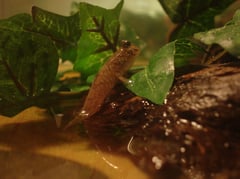
Periophthalmus novemradiatusDwarf Indian Mudskipper
Gobiidae · (Hamilton, 1822)
The dwarf Indian mudskipper, Periophthalmus novemradiatus, is an amphibious goby of coasts from eastern India to southern Thailand. It lives on mudflats in estuarine mangrove swamps and is thought to be the smallest species in the genus. An aquarium needs exposed land areas and a very humid atmosphere at the same temperature as the water, and the fish is territorial with conspecifics.
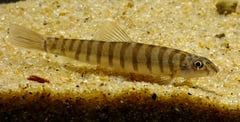
Schistura sp. 1Ring Loach
Nemacheilidae · authority not recorded
The ring loach, Schistura sp. 1, is a nemacheilid loach collected for the trade in the Torsa river, a Brahmaputra tributary in West Bengal, India. Its identity is unclear: it has been considered to represent S. beavani, S. montana and S. himachalensis, but its bar count and plain fins argue against each. Unlike many congeners it is peaceful with conspecifics, and it has a propensity to bury itself when startled.
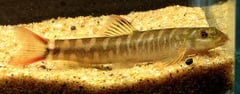
Schistura sp. 6
Nemacheilidae · authority not recorded
Schistura sp. 6 is an unidentified nemacheilid loach from the south Garo Hills in Meghalaya state, northeastern India. It was collected for the aquarium trade during 2012. The body apparently becomes suffused with red once the fish is settled, and its colour pattern recalls the Schistura multifasciata group, in which the anterior flank bars are divided.
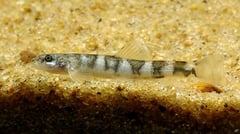
Schistura devdeviSaddleback Loach
Nemacheilidae · Hora, 1935
The saddleback loach, Schistura devdevi, is a nemacheilid loach from upland parts of Assam, Sikkim, Arunachal Pradesh and West Bengal, northern India. It has been collected for the aquarium trade in limited quantities and is sometimes called 'firefly loach'. Records from Nepal apparently require confirmation. It is unlikely to prove aggressive and should suit a community aquarium provided tankmates are selected with care.

Bangana devdevi
Cyprinidae · Hora, 1936
Bangana devdevi is a cyprinid known with certainty from the Irrawaddy system in Manipur, India, and Myanmar, and the Salween in Myanmar and Thailand. Records from the Red River basin in Vietnam appear questionable. It presumably inhabits flowing river channels and larger tributaries and migrates seasonally, as related species do.

Dario urops
Badidae · Britz, Ali & Philip, 2012
Dario urops is a badid from the Western Ghats of southwestern India, recorded from the Valapattanam and upper Cauvery systems in Karnataka and Kerala. Unlike the rest of the genus it occurs in southwestern India, grows to at least 28 mm SL, and has a conspicuous black eye spot on the caudal peduncle. Though described in 2012, it was first collected in the 19th century, when Day recorded Badis dario from 'Wynaad'.

Garra arupi
Cyprinidae · Nebeshwar, Vishwanath & Das, 2009
Garra arupi is a cyprinid from the upper Brahmaputra River basin in Arunachal Pradesh, northern India. It is sympatric with the congeners G. kempi and G. lissorynchus, and is told apart from them by scale and fin-ray counts, a transverse band of tubercles on the snout tip, and other characters. It grows to around 75 mm SL.

Garra dampaensis
Cyprinidae · Laironunga, Lainuntluanga & Lairamliana, 2013
Garra dampaensis is a cyprinid known only from the Seling River in the Dampa tiger reserve, Mizoram, northeastern India. The Seling belongs to the Karnaphuli drainage. It has been collected from clear, shallow, moderately fast-flowing streams with rocky substrates, and is recognised among Indian Garra partly by a W-shaped black band across the middle of the caudal fin.

Garra hughiCardamom Garra
Cyprinidae · Silas, 1955
The Cardamom garra (Garra hughi) is a cyprinid from the Anamalai, Cardamom, Palani and Ashambu Hills of the Western Ghats, southern India. It appears occasionally in the ornamental trade, where it may be labelled 'chocolate algae eater'. The flanks are grey and the belly yellowish-white, with a conspicuous dark lateral band running to the caudal-fin base. It inhabits swiftly-flowing headwaters and tributaries.

Garra kalpangi
Cyprinidae · Nebeshwar, Bagra & Das, 2012
Garra kalpangi is a small cyprinid known only from the Kalpangi River, a Brahmaputra tributary in the Himalayan foothills of Arunachal Pradesh, India. It grows to around 75 mm SL and has two pairs of barbels and a weakly developed proboscis on the snout, a feature it shares with G. gravelyi, G. rotundinasus and G. elongata. Like other Garra it has a lower lip modified to form an adhesive disc.

Garra mullya
Cyprinidae · Sykes, 1839
Garra mullya is a cyprinid endemic to and widespread within peninsular India, in rivers including the Tapti, Narmada, Godavari, Krishna and Cauvery. It has been recorded from flowing headwater streams to low altitude main river channels, including polluted stretches, and at least some populations migrate upstream to breed. Wild fish feed on algae, diatoms and organic detritus.

Garra nambulica
Cyprinidae · Vishwanath & Joyshree, 2005
Garra nambulica is a small cyprinid known only from tributary streams of the Nambul River, in the Chindwin basin of Manipur state, northeastern India. It has a squarish head, no proboscis or transverse groove on the snout, and a W-shaped blue-black band on the caudal fin. It grows to around 65 mm SL.

Garra surendranathanii
Cyprinidae · Shaji, Arun & Easa, 1996
Garra surendranathanii is a cyprinid known only from the Chalakkudy, Periyar and Pamba river basins in Kerala, southwestern India. It has appeared in the aquarium trade on a handful of occasions, marketed as 'green algae-eater'. The body is elongate and shallow, with black-edged scales and a black spot at the upper extremity of the opercle. It grows to around 150 mm SL.

Gymnostomus ariza
Cyprinidae · Hamilton, 1807
Gymnostomus ariza is a cyprinid widely distributed from the Indus basin in Pakistan through India, Bangladesh and Myanmar. Growing to around 300 mm SL, it inhabits flowing streams and tributaries with clear water. It has a confusing taxonomic history, having been placed in Bangana, Cirrhinus and Labeo in recent years. It breeds in temporarily-inundated zones in the wet season and is also produced commercially for food.

Hemibagrus microphthalmus
Bagridae · Day, 1877
Hemibagrus microphthalmus is a very large bagrid catfish from the Salween, Irrawaddy and Sittaung systems of Myanmar and western Thailand. It also occurs in the Manipur River drainage in northeastern India. Known to reach 1500 mm SL and to live for several decades, it cannot be considered a suitable home aquarium subject, and it is likely to prove aggressively territorial.

Hemibagrus peguensis
Bagridae · Boulenger, 1894
Hemibagrus peguensis is a bagrid catfish from the Irrawaddy, Bago and Sittaung drainages of Myanmar and the Chindwin basin in northeastern India. Sometimes referred to as 'Sittang mystus', it has been widely confused with H. menoda in the past and seems virtually unknown in the aquarium hobby. It grows to 286 mm SL and can be told from H. menoda by its almost truncate snout.

Labeo angra
Cyprinidae · Hamilton, 1822
Labeo angra is a benthic cyprinid from Pakistan, Nepal, northern India, Bangladesh and Myanmar, described from the Brahmaputra. It can be identified by a brownish back, yellowish flanks and belly, and a black to bluish stripe from the eye to the caudal-fin base. It undertakes annual spawning migrations within its native river systems.

Labeo calbasuOrangefin Labeo
Cyprinidae · Hamilton, 1822
The orangefin labeo, Labeo calbasu, is a large cyprinid from Pakistan, Nepal, India, Bangladesh, Myanmar and southern China. Growing to 800 mm, it is an important food and game fish across its native range and is not a suitable subject for the home aquarium. It is known as 'black rohu' in parts of India and Bangladesh, and inhabits the lower reaches of major rivers, lakes and reservoirs.
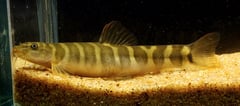
Schistura sp. 7
Nemacheilidae · authority not recorded
Schistura sp. 7 is an unidentified nemacheilid loach from the south Garo Hills in Meghalaya state, northeastern India. It was collected for the aquarium hobby during 2012 and may have been traded as 'green loach'.

Bagarius bagarius
Sisoridae · Hamilton, 1822
Bagarius bagarius is a sisorid catfish with a wide but disjointed recorded range, from the Indus in Pakistan east to the Mekong and Malay Peninsula. Its identity is confused: the name has been widely applied to a small fish said to reach only 200 mm SL, but it may be the only Bagarius in the Indian subcontinent, in which case it can reach 2 metres. It is mostly collected from fast, turbulent rapids in larger rivers, where it shelters among boulders, and is best kept alone.