Basin
Barito basin
Only species with a profile on Seriously Fish are counted.
- Species
- 24
- Rivers
- 1
- Photographed
- 24 of 24
- Difficulty rated
- 24 of 24
Rivers in this basinspecies recorded from each
Runs through
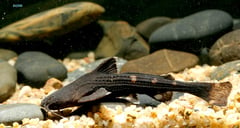
Acrochordonichthys rugosusAsian Banjo Catfish
Akysidae · Bleeker, 1846
The Asian banjo catfish, Acrochordonichthys rugosus, is an akysid catfish from Java, Sumatra, Borneo, Peninsular Malaysia and southern Thailand. The most commonly encountered member of the genus in the trade, it is still by no means common, and body colouration varies widely even among fish from a single locality. Like its congeners it can secrete a milky substance from the axillary pore when stressed, and this can quickly kill other fishes in the confines of an aquarium.

Belontia hasseltiJava Combtail
Osphronemidae · Cuvier, 1831
The Java combtail, Belontia hasselti, is a labyrinth fish from peninsular Thailand, Peninsular Malaysia, Singapore, Sumatra, Borneo and Java. Also known as the 'Malay combtail', it mostly inhabits acidic forest peat swamps with little water movement. It differs from its only congener, B. signata, in its brownish grey body and the mosaic pattern in its unpaired fins. Growing to 200 mm SL, it will eat very small fishes and is not recommended for the average community aquarium.

Betta edithae
Osphronemidae · Vierke, 1984
Betta edithae is a paternal mouthbrooding labyrinth fish from Indonesia, recorded across Kalimantan, southern Sumatra, Bangka, Belitung and Bintan. The only member of the B. edithae group, it is separated from all other Betta spp. by its opaque or translucent branchiostegal membrane and posterior opercle. Fish from Bintan differ from Bornean specimens in several characters, and it remains unclear whether all populations are conspecific.
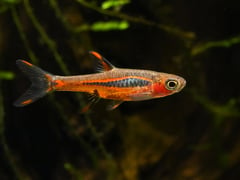
Boraras brigittaeMosquito Rasbora
Cyprinidae · Vogt, 1978
The mosquito rasbora, Boraras brigittae, is a miniature cyprinid that appears to be endemic to southwestern Borneo. It inhabits blackwater streams and pools associated with forest peat swamps, where the water is very soft and acidic. The congener B. urophthalmoides is often traded under its name, but B. brigittae is larger, lacks a distinct dark blotch at the caudal peduncle and has brighter, more uniformly red patterning. Striped males of B. merah have led to speculation that the two are the same species.
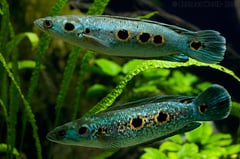
Channa pleurophthalmaOcellated Snakehead
Channidae · Bleeker, 1851
The ocellated snakehead, Channa pleurophthalma, is a snakehead native to southeastern Sumatra and the Kapuas and Barito basins of Indonesian Borneo. It lives in streams and mangroves and is among the few snakeheads known to form aggregations throughout its life. Unlike most Channa spp. it is pelagic and needs plenty of swimming room, with a tank of at least 240 x 60 cm recommended for a fish reaching 350 mm SL.

Datnioides polotaSilver Tiger Perch
Datnioididae · Hamilton, 1822
The silver tiger perch, Datnioides polota, is a tiger perch widely distributed in southeastern Asia, from India and Bangladesh east to Indonesia. Mostly found in brackish habitats such as estuaries, mangroves and coastal lagoons, it has a highly variable colour pattern with up to 7 dark bars. The name D. quadrifasciatus is sometimes applied to it, but that name is a junior homonym and polota takes precedence.
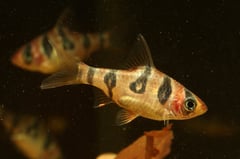
Desmopuntius rhomboocellatusSnakeskin Barb
Cyprinidae · Koumans, 1940
The snakeskin barb, Desmopuntius rhomboocellatus, is a cyprinid endemic to southern Kalimantan, the Indonesian portion of Borneo. It has been recorded from several river systems including the Kapuas, Kepayang and Barito. It most often inhabits peat swamps, black water streams and other still waters with submerged plants and dense riparian vegetation.
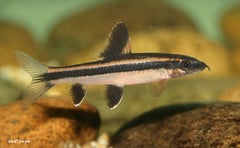
Epalzeorhynchos kalopterumFlying Fox
Cyprinidae · Bleeker, 1850
The flying fox, Epalzeorhynchos kalopterum, is a cyprinid from southern Thailand, Peninsular Malaysia and the Greater Sunda Islands. Fishes sold as 'false flying fox' or 'Siamese flying fox', such as Garra cambodgiensis and Gyrinocheilus aymonieri, are often confused with it, but it has white-edged red and black fins and two pairs of barbels. It grows increasingly territorial with age and can live for over 15 years.
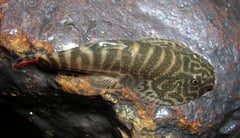
Gastromyzon sp. 'SK02'
Gastromyzontidae · authority not recorded
Gastromyzon sp. 'SK02' is an undescribed hillstream loach from the Sungai Amandit headwaters in South Kalimantan, Indonesian Borneo. The Amandit is a tributary of the Barito basin in the Meratus mountain range. Based on colour pattern this species appears similar to members of the G. ridens group, and it has occasionally been maintained by private collectors. Like its congeners it needs clean, well-oxygenated water with strong flow.
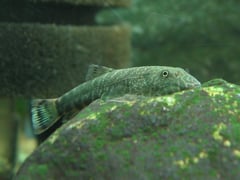
Gastromyzon sp. 'SK03'
Gastromyzontidae · authority not recorded
Gastromyzon sp. 'SK03' is an undescribed hillstream loach from a tributary of the Sungai Riam Kiwa in South Kalimantan, Indonesian Borneo. The Riam Kiwa feeds the Martapura, a major tributary of the Barito. The 'SK' code refers to South Kalimantan, home to several unidentified members of the genus. Based on colour pattern it appears similar to members of the G. ridens group, and it has occasionally been maintained by private collectors.
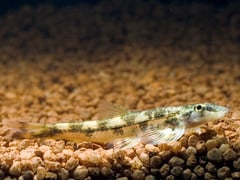
Homalopteroides nebulosus
Balitoridae · Alfred, 1969
Homalopteroides nebulosus is a small hillstream loach described from the Sok River in northern Peninsular Malaysia and since recorded from Borneo. Poorly known in the aquarium hobby, it may never have been exported for the ornamental trade. Its eyes sit in a comparatively raised position on the head, as in H. tweediei, but it has more lateral line scales. Little is known of its habitat, which is presumed to be swiftly-flowing streams and headwaters.
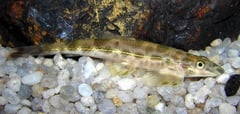
Homalopteroides stephensoni
Balitoridae · Hora, 1932
Homalopteroides stephensoni is a hillstream loach from Borneo, recorded from Kalimantan in Indonesia and from Sabah and Sarawak in Malaysia. Poorly known in the aquarium hobby, it may never have been exported for the ornamental trade. Originally described in Homaloptera, it was placed in Balitoropsis by Kottelat (2012), who subsequently followed Randall and Page (2012) in treating it as a Homalopteroides. Like its congeners it inhabits swiftly-flowing, clear, oxygen-saturated streams.

Kryptopterus bicirrhis
Siluridae · Valenciennes, 1840
Kryptopterus bicirrhis is a silurid catfish from much of Southeast Asia, including the Mekong and Chao Phraya and the Greater Sunda Islands. Uncommon in the aquarium trade, its name was widely misapplied to K. vitreolus in older literature, but the two are easily told apart because K. bicirrhis does not have a transparent body in life. It tends to form schools, so four or more should be kept.
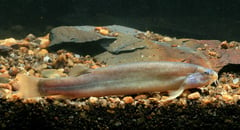
Lepidocephalus macrochir
Cobitidae · Bleeker, 1854
Lepidocephalus macrochir is a cobitid loach described from Sumatra and since recorded from Thailand, Peninsular Malaysia, Java and Borneo. It is traded sporadically as the 'pinky loach', 'deep water kuhli loach' and 'Borneo high body cave loach'. Although sometimes said to be a cave loach, Thai collectors report it from deep water, and in aquaria it spends a lot of time buried in soft substrates.
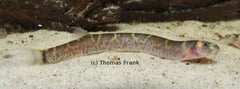
Pangio sp. 'PAN03'
Cobitidae · authority not recorded
Pangio sp. 'PAN03' is an unidentified kuhli loach that appears to be native to the Barito River basin in Indonesian Borneo. It belongs to the P. kuhlii-oblonga group and has been misidentified and traded as P. alternans, a different-looking species. Like its congeners it needs a soft, sandy substrate, since it digs and spends some of its time buried.
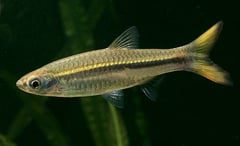
Rasbora dusonensis
Cyprinidae · Bleeker, 1850
Rasbora dusonensis is a cyprinid from Sumatra, Peninsular Malaysia and Borneo, found in larger river channels and peat swamp blackwaters. Its identity was unclear for decades before its redescription by Ng and Kottelat (2013). It is very similar to R. tornieri, which shares the Musi river with it, but has a bright yellow caudal fin with a broad dark margin, against carmine red in R. tornieri. One specimen measured 162 mm SL, although 95 to 105 mm is a more commonly reported adult size.

Betta pallifina
Osphronemidae · Tan & Ng, 2005
Betta pallifina is a large paternal mouthbrooding labyrinth fish from a remote part of the upper Barito basin in Central Kalimantan, Borneo. A member of the B. unimaculata complex, it grows to 90 mm SL, and females have an orange band in the anal fin. It inhabits forested headwater streams with clear, flowing water, dense marginal plants and a pH of 6.6-7.4.

Channa micropeltesGiant Snakehead
Channidae · Cuvier, 1831
The giant snakehead, Channa micropeltes, is a predatory fish from Southeast Asia that grows to well over a metre. Juveniles are sold as 'red' or 'redline' snakehead, but it is suitable only for public installations or the very largest private aquaria. Unlike most Channa species it is pelagic and needs plenty of room to swim, and adults become aggressive at sexual maturity.

Hemibagrus wyckiiCrystal-eyed Catfish
Bagridae · Bleeker, 1858
The crystal-eyed catfish, Hemibagrus wyckii, is a bagrid with an enormous distribution across central Indochina and western Indonesia. Juveniles are sometimes available in the aquarium trade, but buying them is strongly discouraged: it reaches 710 mm SL, is aggressively territorial and can live for several decades. Despite the common name, the blue eye is not given as a distinguishing character in any diagnosis we've seen.

Macrochirichthys macrochirusGiant Sword Minnow
Cyprinidae · Valenciennes, 1844
The giant sword minnow, Macrochirichthys macrochirus, is a large pelagic cyprinid widespread in Southeast Asia, from the Mekong to Borneo and Sumatra. Growing to 600 to 800 mm and becoming increasingly piscivorous as it grows, it is unsuitable for the majority of private aquaria, although juveniles are traded on occasion. It is thought to have been extirpated from the Chao Phraya, Mae Klong, Lake Songkhla and Java, and the Mekong populations have been drastically reduced.

Phalacronotus apogon
Siluridae · Bleeker, 1851
Phalacronotus apogon is a large silurid catfish from much of Southeast Asia, including Thailand, the Mekong basin and the Greater Sunda Islands. It reaches 700 mm and arguably should not be considered a home aquarium subject at all, but juveniles are sometimes sold as 'blue neon sheatfish' or 'metallic cheatfish' without adequate information on long-term care. It is an important food fish across much of its native range.

Scleropages formosusAsian Arowana
Osteoglossidae · Müller & Schlegel, 1840
The Asian arowana, Scleropages formosus, is an osteoglossid from the Mekong system, eastern Thailand, Peninsular Malaysia, Sumatra and Borneo. Highly valued in the aquarium trade since the 1970s and listed on Appendix I of CITES since 1975, it is now extirpated across much of its range. It occurs in several colour forms, such as the 'super red' of the upper Kapuas, and three were described as species in 2003, though the majority view treats all of them as S. formosus pending review.
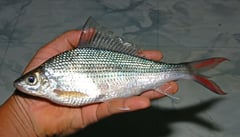
Labiobarbus fasciatus
Cyprinidae · Bleeker, 1853
Labiobarbus fasciatus is a labeonin cyprinid from the Pahang River system in Peninsular Malaysia and the islands of Sumatra and Borneo. It has a red caudal fin with a thin dark stripe along each lobe, and longitudinal stripes formed by spots on the scales. Like other Labiobarbus it has two pairs of well-developed barbels and an extremely long dorsal fin, and the genus was known as Dangila for over 100 years.
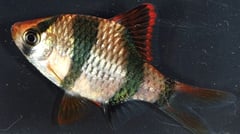
Puntigrus navjotsodhii
Cyprinidae · Tan, 2012
Puntigrus navjotsodhii is a small cyprinid known only from the upper Katingan and Barito river basins in Central Kalimantan, Indonesian Borneo. The type series came from a small clear-water hill stream of riffles and deeper pools over sand, gravel and rocks. Among the four-barred Puntigrus species it has broad black bars up to five scales wide, black lips and almost entirely red pelvic fins in life.