Kryptopterus bicirrhis
Formerly Silurus bicirrhis Valenciennes, 1840 · Cryptopterus amboinensis Günther, 1864
Last revised 2026Edit this page
On this page13 sections
Quick factsEdit
Difficulty7 of 8 measures
- Space
- large tank
- Water
- flexible
- Temp
- flexible
- Diet
- unknown
- Temperament
- peaceful
- Social
- needs to be in a group
- Compatibility
- choose tankmates carefully
Other demands
Each of these can raise the rating on its own, whatever the measures above say.
- Hardiness
- needs a well-established tank
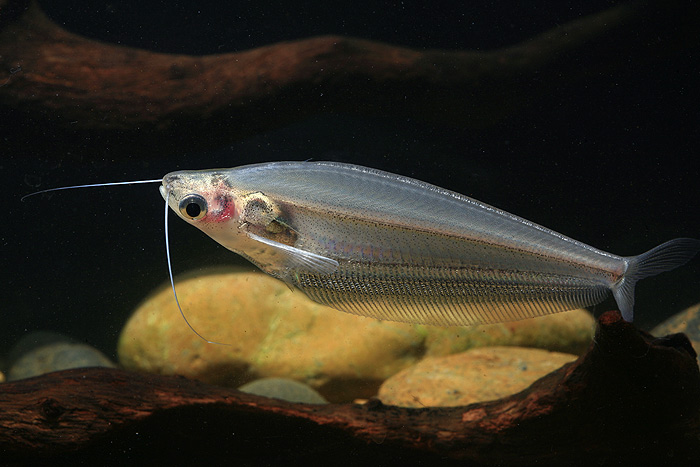
Kryptopterus bicirrhis is a silurid catfish from much of Southeast Asia, including the Mekong and Chao Phraya and the Greater Sunda Islands. Uncommon in the aquarium trade, its name was widely misapplied to K. vitreolus in older literature, but the two are easily told apart because K. bicirrhis does not have a transparent body in life. It tends to form schools, so four or more should be kept.
Etymology
EditKryptopterus: from the Greek kryptos, meaning 'hidden', and pterýgio, meaning 'fin', in reference to the reduced or absent dorsal-fin in members of this genus.
Distribution
EditType locality is given simply as 'Java, Indonesia', and this species is currently understood to occur throughout much of Southeast Asia including major river systems in Thailand, Laos, Cambodia, Vietnam and Peninsular Malaysia plus the Greater Sunda Islands of Sumatra, Borneo and Java.
It's been extensively recorded from the Mekong, Chao Phraya, Batang Hari, Rajang and Kapuas rivers plus numerous smaller drainages across this range.
Habitat
Write a noteEditKottelat and Widjanarti (2005) report that it tends to occur in fast-flowing water and is abundant at the end of the wet season in the Danau Sentarum lakes complex, West Kalimantan (Kalimantan Barat) province, Indonesia (Borneo).
In the Mekong it's said to be most common in the lowland floodplains but also occurs in some higher altitude habitats in the middle part of the system (Rainboth, 1996)[6].
Aquarium size
Write a noteEditAn aquarium with base dimensions of 120 ∗ 45 cm48 ∗ 18 in or equivalent should be the smallest considered.
Maintenance
Write a noteEditDécor is relatively unimportant although this species prefers weakly-lit conditions and may become skittish in the absence of cover.
Do not add introduce it to a biologically immature aquarium as it can be susceptible to swings in water chemistry.
Water conditions
EditThese recommendations come from this profile’s own figures. They contain affiliate links, so we may earn a commission.
Diet
Write a noteEditChiefly a predator feeding on crustaceans, invertebrates and smaller fishes in nature, although there should be no need to use such live foods in captivity.
Offer a varied diet comprising sinking dried foods, live and frozen bloodworm, Tubifex, etc., and perhaps the occasional small earthworm.
Behaviour and compatibility
Write a noteEditGenerally peaceful though it may predate on smaller fishes and is somewhat timid so does not compete well with much larger, robust or otherwise boisterous species.
Peaceful, comparably-sized cyprinids, loaches and other catfishes perhaps constitute the best options but be sure to research your choices thoroughly prior to purchase.
K. bicirrhis is gregarious and tends to form schools so ideally four or more specimens should be purchased.
Sexual dimorphism
Write a noteEditAdult males should appear noticeably slimmer than females.
Reproduction
Write a noteEditUnrecorded.
Notes
EditThis species is uncommon in the aquarium trade although it's name has been widely misapplied to the congener K. vitreolus in older literature.
These two are easily told apart since K. bicirrhis does not possess a transparent body in life.
Kryptopterus species are found only in Southeast Asia and the genus has been considered polyphyletic since Bornbusch (1995) with some former species already moved to the genera Phalacronotus and Micronema.
Those still contained within the genus are assigned to a number of putative species groups as follows:
K. bicirrhis group: K. bicirrhis, K. lais, K. palembangensis, K. macrocephalus, K. minor, K. piperatus, K. vitreolus
K. cryptopterus group: K. cryptopterus, K. geminus
K. limpok group: K. limpok, K. mononema, K. dissitus, K. baramensis, K. hesperius
K. schilbeides group: K. schilbeides, K. paraschilbeides
Bombusch (1995) identified the K. bicirrhis group as a distinct clade although he didn't propose any synapomorphy to diagnose it.
Ng and Kottelat (2013)[9] later noted that members normally have fewer anal-fin rays (46–67 vs. 64–85) than other congeners and placed K. piperatus and K. vitreolus within the group based on this character.
References
- Kottelat, M. and E. Widjanarti (2005). The fishes of Danau Sentarum National Park and the Kapuas Lakes area, Kalimantan Barat, Indonesia. Raffles Bulletin of Zoology Supplement 13, 139-173
- Parenti, L. R. and K. K. P. Lim (2005). Fishes of the Rajang Basin, Sarawak, Malaysia. Raffles Bulletin of Zoology Supplement 13, 175-208
- Ferraris, C. J., Jr. (2007). Checklist of catfishes, recent and fossil (Osteichthyes: Siluriformes), and catalogue of siluriform primary types. Zootaxa 1418, 1-628
- Bornbusch, A. H. (1995). Phylogenetic relationships within the Eurasian catfish family Siluridae (Pisces: Siluriformes), with comments on generic validities and biogeography. Zoological Journal of the Linnean Society 115, 1-46
- Tan, H. H. and H. H. Ng (2000). The catfishes (Teleostei: Siluriformes) of central Sumatra. Journal of Natural History 34(2), 267-303
- Rainboth, W. J. (1996). FAO species identification field guide for fishery purposes. Fishes of the Cambodian Mekong. Rome, FAO, 1-265
- Roberts, T. R. (1993). The freshwater fishes of Java, as observed by Kuhl and van Hasselt in 1820-23. Zoologische Verhandelingen (Leiden) 285, 1-94
- Roberts, T. R. (1989). The freshwater fishes of western Borneo (Kalimantan Barat, Indonesia). Memoirs of the California Academy of Sciences 14, 1-210
- Ng, H-H. and M. Kottelat (2013). After eighty years of misidentification, a name for the glass catfish (Teleostei: Siluridae). Zootaxa 3630, 308-316
Species images · 2
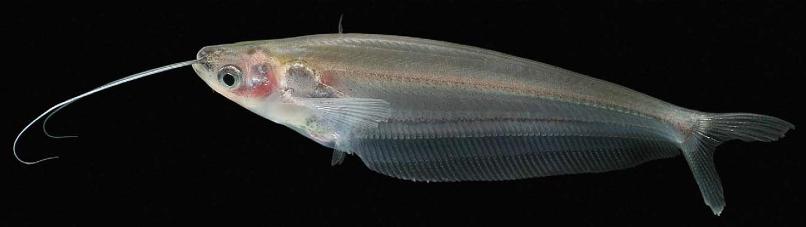
These photographs are used with each photographer's permission.
Send a photographDistribution
Profile completeness22 of 24
Community
Questions about Kryptopterus bicirrhis?
Ask on Discord