Basin
Chaliyar basin
Only species with a profile on Seriously Fish are counted.
- Species
- 4
- Rivers
- 1
- Photographed
- 4 of 4
- Difficulty rated
- 4 of 4
Rivers in this basinspecies recorded from each
Runs through

Barilius bakeri
Cyprinidae · Day, 1865
Barilius bakeri is a fast-swimming cyprinid endemic to the Western Ghats of southwestern India, with records from many rivers in Kerala and Karnataka. It is traded as 'royal danio', 'blue-spotted hill trout' and 'blue-dotted mirror fish', and has a single row of bluish-green spots that get smaller with age. Its well-oxygenated, fast-flowing rivers are being polluted and degraded by exotic species and sand mining.
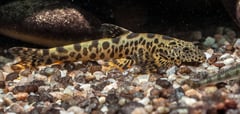
Bhavania australis
Balitoridae · Jerdon, 1849
Bhavania australis is a balitorid loach endemic to the Western Ghats mountains of southern India, recorded from Kerala, Tamil Nadu and Karnataka. An obligate dweller of shallow, fast-flowing, highly-oxygenated headwaters and minor tributaries, it has a flattened head and body and horizontally extended paired fins that form a powerful sucking cup for clinging to rocks. It is very rarely seen in the international aquarium trade but is maintained by a number of Indian aquarists.

Laubuka fasciataMalabar Hatchet Chela
Cyprinidae · Silas, 1958
The Malabar hatchet chela, Laubuka fasciata, is a cyprinid endemic to the state of Kerala in southwestern India. A dark stripe runs from the eye to the caudal peduncle, and it favours slow-moving, shallow margins of rivers and streams over rock and gravel. It is occasionally available in the aquarium trade, apparently collected only in small numbers, and is an accomplished jumper.

Sahyadria denisoniiRed-line Torpedo Barb
Cyprinidae · Day, 1865
The red-line torpedo barb, Sahyadria denisonii, is a cyprinid endemic to Kerala and Karnataka in southern India. Extremely popular since it appeared in the trade in the late 1990s, it is listed as Endangered by the IUCN, and collection for the aquarium trade has been held largely responsible for its decline. Large numbers are produced in Southeast Asia and Eastern Europe. The similar S. chalakkudiensis is occasionally traded as this species and is more belligerent.