Basin
Dong Nai basin
Only species with a profile on Seriously Fish are counted.
- Species
- 31
- Rivers
- 1
- Photographed
- 31 of 31
- Difficulty rated
- 31 of 31
Rivers in this basinspecies recorded from each
Runs through

Barbodes aurotaeniatus
Cyprinidae · Tirant, 1885
Barbodes aurotaeniatus is a small cyprinid from the middle and lower Mekong basin in Laos, Vietnam, Cambodia and Thailand. Uncommon in the aquarium trade, it has a single pair of maxillary barbels, lacking the rostral barbels of other Barbodes, and usually four small vertical black markings on the flanks. It inhabits streams, irrigation canals and ditches, and is apparently very peaceful, best kept in a mixed-sex group of 6 to 10.

Barbonymus gonionotus
Cyprinidae · Bleeker, 1849
Barbonymus gonionotus is a large cyprinid with an enormous distribution across Southeast Asia, from the Mekong to Java and Sumatra. It inhabits larger, slow-moving rivers and their floodplains, moving into flooded forest to feed and spawn, and is increasingly found in man-made canals and lakes. Plain grey caudal and dorsal fins and pale yellow pelvic and anal fins separate it from congeners. Populations in Peninsular Malaysia appear to be introduced.

Barbonymus schwanefeldiiTinfoil barb
Cyprinidae · Bleeker, 1854
The tinfoil barb, Barbonymus schwanefeldii, is a large cyprinid found across much of Southeast Asia, from the Mekong to Borneo and Sumatra. Usually sold at 50 to 75 mm, it grows to 355 mm SL, and tinfoil barbs are among the species most often returned to shops having outgrown their aquarium. Selectively-bred 'golden' and 'blushing' strains exist, and the species has also been subjected to artificial dyeing.

Channa gachuaDwarf Snakehead
Channidae · Hamilton, 1822
The dwarf snakehead, Channa gachua, is a snakehead recorded across an enormous range from Iran to Taiwan and Bali. There is significant evidence that C. gachua as currently understood is a complex of similar-looking species in need of taxonomic review. A mouthbrooder bred regularly in captivity, it can share a well-chosen community with peaceful fishes too large to be prey, but populations should not be mixed as some may hybridise.

Crossocheilus reticulatus
Cyprinidae · Fowler, 1934
Usually offered as the reticulated or fishnet flying fox, Crossocheilus reticulatus is a cyprinid from the Chao Phraya and Mekong basins. A silvery body, dark-edged scales and a dark caudal peduncle blotch set it apart from similar congeners. Patterning varies with collection locality, which led to several names now treated as synonyms. A fish of flowing streams, it is best kept in a group of six or more, since weaker individuals can be bullied in smaller numbers.

Cyclocheilichthys apogonBeardless Barb
Cyprinidae · Valenciennes, 1842
The beardless barb, Cyclocheilichthys apogon, is a cyprinid ranging from Myanmar to Vietnam and south via Peninsular Malaysia to Borneo and Sumatra. Also sold as 'skinhead barb', it lacks barbels and has a black blotch at the caudal-fin base plus rows of dark spots along the scale rows. It favours slower-moving or still water and grazes the biofilm on submerged roots and branches. Rarely imported in numbers, it most often arrives as bycatch.

Cyclocheilichthys armatus
Cyprinidae · Valenciennes, 1842
Cyclocheilichthys armatus is a cyprinid ranging from the Mekong region through Thailand and Peninsular Malaysia to Borneo, Sumatra and Java. It forages from mid-water to the bottom of rivers in the dry season and is thought to migrate into flooded forest to breed. Rarely imported in numbers and most often arriving as bycatch, it makes a peaceful, unusual addition to larger aquaria in a group of at least six.

Esomus metallicusStriped Flying Barb
Cyprinidae · Ahl, 1923
The striped flying barb, Esomus metallicus, is a cyprinid found from the Salween basin in Myanmar east across Thailand to Laos and Cambodia. It is abundant over most of this range and moves into rice paddies and other flooded ground at the onset of the wet season, returning to permanent water when the flooding recedes. Its lateral stripe grows more intense towards the tail and ends at the caudal-fin base.

Gyrinocheilus aymonieriSucking 'Loach'
Gyrinocheilidae · Tirant, 1883
The sucking 'loach', Gyrinocheilus aymonieri, is a stream fish from the Mae Klong, Chao Phraya, Mekong and Dong Nai basins in Indochina. Often sold as a loach, or as the 'Indian' or 'Chinese' algae eater, it is neither a loach nor native to either country. It can live for more than 15 years and is largely unsuitable for the general community aquarium. It is farmed in large numbers, including albino, 'golden', 'piebald' and 'short-bodied' forms.

Helostoma temminkiiKissing Gourami
Helostomatidae · Cuvier, 1829
The kissing gourami, Helostoma temminkii, is an anabantoid from southern Indochina and the Malay Archipelago, and the sole member of its family. The widely traded pinkish-white form is a leucistic variant bred for ornamental purposes, and the 'balloon' variety is intentionally disfigured and much shorter-lived. Its often belligerent behaviour, adult size and life span of over 20 years make it unsuitable for most home aquaria. The 'kissing' appears at least in part related to establishing social dominance.

Hypsibarbus vernayi
Cyprinidae · Norman, 1925
Hypsibarbus vernayi is a cyprinid widespread in mainland Southeast Asia, from the Mekong basin in southern China to northern Peninsular Malaysia. Very similar to H. wetmorei, it has yellow pectoral, pelvic and anal fins (orange to red in H. wetmorei), so yellow-finned fish sold as H. wetmorei or 'lemon fin barb' appear likely to be this species. It prefers flowing water with abundant riparian vegetation and migrates seasonally.

Labiobarbus leptocheilus
Cyprinidae · Valenciennes, 1842
Labiobarbus leptocheilus is a large cyprinid widespread in Southeast Asia, from the Mekong and Salween to the Greater Sunda Islands. Different populations vary somewhat in appearance, and it may turn out to represent a group of closely-related species. The Cambodian Mekong population has been considered a distinct species, Labiobarbus lineatus, and that name is widely used in the ornamental trade although it is currently a synonym. It grows to 260 mm SL and needs spotless, well-oxygenated water.

Laubuka siamensis
Cyprinidae · Fowler, 1939
Laubuka siamensis is a cyprinid from the Mekong, the Chao Phraya and Mae Klong in Thailand, and smaller drainages south to Peninsular Malaysia. Long considered synonymous with L. laubuca, it seems likely to be the species behind many of the fish entering the trade under that name. A conspicuous dark stripe, iridescent blue in life, runs uninterrupted along the rear of the body to an oval blotch on the caudal peduncle. It swims in groups at or just below the surface and is an accomplished jumper.
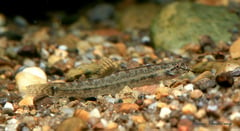
Lepidocephalichthys hasselti
Cobitidae · Valenciennes, 1846
Lepidocephalichthys hasselti is a cobitid loach described from Java and recorded from Myanmar to Vietnam, Peninsular Malaysia, Sumatra and Borneo. Its wide distribution makes it relatively common in the aquarium hobby. Colour and pattern vary with locality and have led to problems with identification, and the flanks usually show a row of dark blotches or a solid stripe with a light, unpigmented stripe above.

Lobocheilos melanotaenia
Cyprinidae · Fowler, 1935
Lobocheilos melanotaenia is a grazing cyprinid from the Mekong in Laos, Thailand, Cambodia and Vietnam, plus the Dong Nai, Chao Phraya and Mae Klong. One of the most abundant species in the seasonal cyprinid migrations of the mainstream Mekong, it is available on a sporadic basis. It is told from L. rhabdoura by its deeper body, narrower mouth and a dark area in the dorsal-fin. It can be aggressive at feeding times and is not particularly tolerant of conspecifics.

Lobocheilos rhabdoura
Cyprinidae · Fowler, 1934
Lobocheilos rhabdoura is a grazing cyprinid from Indochina, found in the Mekong, Chao Phraya and Mae Klong systems and south to Peninsular Malaysia. One of the most abundant species in the seasonal cyprinid migrations of the mainstream Mekong, it is available on a sporadic basis. It differs from L. melanotaenia in its shallower body, wider mouth and larger snout tubercules. It can be aggressive at feeding times and is not particularly tolerant of conspecifics.

Macropodus opercularisParadise Fish
Osphronemidae · Linnaeus, 1758
The paradise fish, Macropodus opercularis, is a labyrinth fish from China south of the Yangtze, including Taiwan and Hainan, plus Vietnam and Laos. Imported to France in 1869, it was among the very first ornamental fish brought to Europe. Wild examples are uncommon in the hobby since it is farmed extensively, and xanthic, albino, red, blue and stripeless strains exist. Males are territorially aggressive, especially when breeding, and should not be housed together unless the aquarium is very large.

Mystacoleucus obtusirostris
Cyprinidae · Valenciennes, 1842
Mystacoleucus obtusirostris is a riverine cyprinid found from Myanmar and southwestern China to Vietnam, Borneo, Sumatra and Java. Referred to as M. marginatus for decades, it is the most widely distributed member of the genus, and populations vary somewhat in colour pattern. It is occasionally marketed as 'Burmese rainbow barb'. A group of six or more is the smallest to consider, and like all Mystacoleucus it has a forward-pointing predorsal spine that can snag in a net.

Nemacheilus pallidus
Nemacheilidae · Kottelat, 1990
Nemacheilus pallidus is a nemacheilid loach from the Mae Klong, Chao Phraya and Mekong systems in Thailand, Laos, Cambodia and Vietnam. It inhabits streams and small rivers with clear to turbid water and substrates of mud, sand or small rocks. The similar-looking N. masyae is sometimes traded under this name, but N. pallidus has a deeper body and dark bars and saddles thinner than the light interspaces between them.
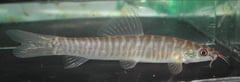
Nemacheilus platiceps
Nemacheilidae · Kottelat, 1990
Nemacheilus platiceps is a nemacheilid loach native to the Mekong basin in Laos, Thailand, Cambodia and Vietnam, and the Dong Nai system. It has been collected from shallow, slow-moving hill stream pools where leaf litter collects, and from faster-flowing stretches over gravel. It is only occasionally available in the aquarium trade and has 12-16 dark, irregular body bars, usually split vertically.

Opsarius koratensis
Cyprinidae · Smith, 1931
Opsarius koratensis is a cyprinid of the middle and lower Mekong in Thailand, Laos and Cambodia, and the Chao Phraya, Mae Klong and Dong Nai systems. It apparently inhabits larger, deeper and more turbid rivers than many congeners. Genetic evidence from Tang et al. (2010) suggests it may represent a distinct genus, and it occasionally appears in the ornamental trade.

Puntigrus partipentazona
Cyprinidae · Fowler, 1934
Puntigrus partipentazona is a small cyprinid recorded from numerous river basins in Vietnam, Cambodia, Laos, Thailand and Peninsular Malaysia. It is easily told from congeners because the dark blotch on its dorsal fin extends onto the body. Typically found in heavily vegetated parts of rivers and sluggish streams, it is generally peaceful, though rival males continually battle for position within the group.

Trichopsis vittataCroaking gourami
Osphronemidae · Cuvier, in Cuvier & Valenciennes, 1831
The croaking gourami, Trichopsis vittata, is a labyrinth fish found through much of Indochina, Peninsular Malaysia and Singapore. The largest of its genus, it produces audible sounds with a specialised pectoral mechanism unique within the Osphronemidae. Wild populations vary in colour pattern, and records from Borneo, Sumatra and Java might refer to a distinct species.
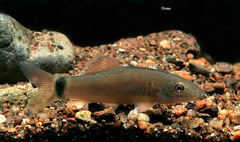
Yasuhikotakia eosSun Loach
Botiidae · Taki, 1972
The sun loach, Yasuhikotakia eos, is a botiid loach from the middle and lower Mekong in Laos, Cambodia and Thailand, and the Dong Nai in Vietnam. Its yellow to reddish brown body with a metallic sheen and a large dark marking on each side of the caudal peduncle make it difficult to confuse with any congener. It has a reputation for aggression and can be fiercely territorial where space or shelter is limited, so it suits only larger, well-structured aquaria with other sturdy fishes.

Channa micropeltesGiant Snakehead
Channidae · Cuvier, 1831
The giant snakehead, Channa micropeltes, is a predatory fish from Southeast Asia that grows to well over a metre. Juveniles are sold as 'red' or 'redline' snakehead, but it is suitable only for public installations or the very largest private aquaria. Unlike most Channa species it is pelagic and needs plenty of room to swim, and adults become aggressive at sexual maturity.

Datnioides pulcherSiamese Tiger Perch
Datnioididae · Kottelat, 1998
The Siamese tiger perch, Datnioides pulcher, is a large tiger perch from the Mae Klong, Chao Phraya, Mekong and Dong Nai river systems. Wild populations are hypothesised to have declined by more than 90% since the mid-1980s, and it has been locally extinct in Thailand since the 1990s. Highly sought after by aquarists, it usually has 4 broad dark bars, and D. microlepis is sometimes sold as D. pulcher to raise prices.

Hampala macrolepidotaHampala Barb
Cyprinidae · Kuhl & van Hasselt, 1823
The hampala barb, Hampala macrolepidota, is a cyprinid ranging from Myanmar through Thailand to the Mekong, and south to Borneo, Sumatra and Java. Also known as 'jungle perch' or 'sidebar barb', it can grow to over 2 feet and 5 kg and is a powerful, pelagic predator and not an aquarium subject in all but the most extreme circumstances. Prized as a food and sport fish, it has been introduced to numerous water bodies.

Hemibagrus spilopterus
Bagridae · Ng & Rainboth, 1999
Hemibagrus spilopterus is a bagrid catfish from the Mekong and several other river systems in Laos, Vietnam, Cambodia and Thailand. Relatively common in the ornamental trade, it has been widely misidentified as H. nemurus, a Javan species that may never have been exported for aquaria. Given its size of up to 500 mm SL, its aggressive nature and a lifespan of several decades, it shouldn't be considered a home aquarium subject in all but the most exceptional circumstances.

Labeo chrysophekadionBlack Shark
Cyprinidae · Bleeker, 1849
The black shark, Labeo chrysophekadion, is a large cyprinid from Southeast Asia, including the Mekong, Chao Phraya and the Greater Sunda Islands. Also known as the black sharkminnow, it reaches 600 mm and is aggressively territorial towards conspecifics and similarly-shaped fishes. It continues to be sold despite its patent unsuitability for the home aquarium, and an albino form has been selectively bred for the trade.

Hypsibarbus pierreiYellow Eyed Silver Barb
Cyprinidae · Sauvage, 1880
The yellow eyed silver barb, Hypsibarbus pierrei, is a large cyprinid from the middle and lower Mekong basin in Laos, Thailand, Cambodia and Vietnam. It also occurs in the Dong Nai drainage, and migrates seasonally from larger river channels in the dry season to spawning grounds that remain unknown. Reaching at least 300 mm, it is a valued food fish, and most Hypsibarbus species are thought to be in decline because of the damming of rivers and agriculture.

Labeo pierrei
Cyprinidae · Sauvage, 1880
Labeo pierrei is a large cyprinid from the Mekong river system in southern China, Laos, Thailand, Cambodia and Vietnam, and the Dong Nai in Vietnam. It grows to 800 mm and inhabits main river channels and large, deep tributaries. It migrates seasonally, moving upstream into the Sekong, Sesan and Srepok rivers at the onset of the wet season and returning downstream in the dry months.