Labeo pierrei
Formerly Lobochilus pierrei Sauvage, 1880
Last revised 2014Edit this page
On this page6 sections
Quick factsEdit
Difficulty3 of 8 measures
Rated difficult because it needs a tank at least 2 m long.
- Space
- very large tank
- Water
- unknown
- Temp
- unknown
- Diet
- unknown
- Temperament
- unknown
- Social
- fine alone
- Compatibility
- choose tankmates carefully
Other demands
Each of these can raise the rating on its own, whatever the measures above say.
- Hardiness
- unknown
- Needs a tank at least 2 m long
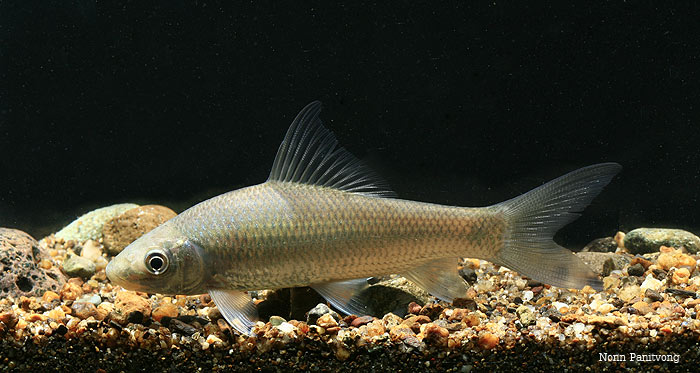
Labeo pierrei is a large cyprinid from the Mekong river system in southern China, Laos, Thailand, Cambodia and Vietnam, and the Dong Nai in Vietnam. It grows to 800 mm and inhabits main river channels and large, deep tributaries. It migrates seasonally, moving upstream into the Sekong, Sesan and Srepok rivers at the onset of the wet season and returning downstream in the dry months.
Etymology
EditLabeo: from the Latin labeo, meaning 'one with lips', in allusion to the remarkably thick, fleshy lips in members of this genus.
pierrei: in honor of “Pierre” who collected the type specimen, with no other information provided.
Distribution
EditKnown from throughout the Mekong river system in southern China, Laos, Thailand, Cambodia, and Vietnam, the Dong Nai river system in Vietnam and possibly the Chao Phraya basin in Thailand.
Type locality is 'Vietnam: Bien Hoa Province: rapids on the Dung-nai', which corresponds to the Dong Nai watershed.
Habitat
Write a noteEditMostly inhabits main river channels and large, deep tributaries. It undergoes seasonal migrations, moving upstream into the Sekong, Sesan, and Srepok rivers in May and June, at the onset of the wet season, and returning downstream during the dry months between November and February.
Notes
EditThis species can be distinguished by the following characters: juveniles with brown body and dark marking at base of caudal-fin; 37-42 + 3-4 lateral line scales; 11½ branched dorsal-fin rays; 7½ scale rows between lateral line and dorsal-fin origin; 20-25 predorsal scales; dorsal-fin relatively small with anterior branched rays shorter than head in juveniles, slightly longer than head in adults.
The genus Labeo is an enigmatic grouping containg more than 100 species which is critically in need of revision. Members occur throughout much of Africa and Asia, and they are considered members of the tribe Labeonini within the putative cyprinid subfamily Cyprininae or simply the subfamily Labeoninae (name varies with author). According to the most recent phylogenetic research, this grouping is further divided into four subtribes; Labeoina, Garraina, Osteochilina, and Semilabeoina (Yang et al., 2012). Among these, Labeo is included in the Labeoina alongside Bangana sensu stricto (which includes the genus Nukta), Cirrhinus sensu stricto, Cirrhinus microlepis (which is of a different genetic lineage to other Cirrhinus species), Gymnostomus, and Incisilabeo.
Thirty Labeo species were used in the study, and the genus was found to be polyphyletic, although all were nested within the Labeoina clade (Yang et al., 2012). Labeo boggut, L. bata and L. bata var. formed a clade with Incisilabeo behri, Schismatorhynchos nukta, and Bangana dero (the type species of the genus) and B. sp. Salween. All other Labeo species comprised a group referred to as Labeo sensu stricto which also includes Gibelion catla, and the authors recommended that the latter be synonymised with Labeo, although this does not appear to have been widely accepted (eg. Kottelat, 2013).
References
- Kottelat, M. (2013). The fishes of the inland waters of southeast Asia: a catalogue and core bibiography of the fishes known to occur in freshwaters, mangroves and estuaries. The Raffles Bulletin of Zoology Supplement 27, 1-663
- Sauvage, H.-E. (1880). Notice sur quelques poissons de l'île Campbell et de l'Indo-Chine. Bulletin de la Société philomathique de Paris (7th Série) v. 4:, 228-233
- Rainboth, W. J. (1996). FAO species identification field guide for fishery purposes. Fishes of the Cambodian Mekong. Rome, FAO, 1-265
- Freyhof, J., D. V. Serov and T. N. Nguyen (2000). A preliminary checklist of the freshwater fishes of the River Dong Nai, South Vietnam. Bonner Zoologische Beiträge 49(1-4), 93-99
- Roberts, T. R. (2007). Two southeast Asian species of the cyprinid fish genus Labeo, L. erythropterus and L. pierrei. Natural History Bulletin of the Siam Society 54(2), 299-303
- Kottelat, M. (2001). Fishes of Laos. WHT Publications, Colombo, 1-198
- Yang, L., M. Arunachalam, T. Sado, B. A. Levin, A. S. Golubtsov, J. Freyhof, J. P. Friel, W-J. Chen, M. V. Hirt, R. Manickam, M. K. Agnew, A. M. Simons, K. Saitoh, M. Miya, R. L. Mayden, and S. He (2012). Molecular phylogeny of the cyprinid tribe Labeonini (Teleostei: Cypriniformes). Molecular Phylogenetics and Evolution 65(2), 362-379
Species images · 1
These photographs are used with each photographer’s permission.
Send a photographDistribution
Profile completeness12 of 24
50% complete
Also missing: aquarium size, a common name, aquarium size notes, maintenance, water condition notes, diet, behaviour and compatibility, sexual dimorphism, reproduction.
Community
Questions about Labeo pierrei?
Ask on Discord