Basin
Endau basin
Only species with a profile on Seriously Fish are counted.
- Species
- 30
- Rivers
- 1
- Photographed
- 30 of 30
- Difficulty rated
- 30 of 30
Rivers in this basinspecies recorded from each
Runs through
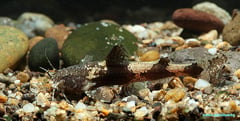
Akysis hendricksoniHendrickson's Stream Catfish
Akysidae · Alfred, 1966
Hendrickson's stream catfish, Akysis hendricksoni, is a small akysid catfish from much of Peninsular Malaysia and the extreme south of Thailand. One of the few members of the family exported for the hobby, it grows to around 50 mm SL and spends some of its time buried in sand with only the eyes showing. Colour pattern varies with locality, and like many fishes from running water it is intolerant of organic pollutants and needs spotless water.
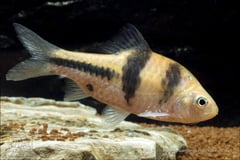
Barbodes lateristrigaSpanner Barb
Cyprinidae · Valenciennes, 1842
The spanner barb or 'T-barb', Barbodes lateristriga, is a cyprinid from peninsular Thailand, Peninsular Malaysia, Singapore, Sumatra and Java. Its colour pattern varies with locality, and the form most commonly seen in the trade corresponds most closely to fish from Johor. The species may prove to be a complex of closely-related taxa. Quite boisterous, it can intimidate more timid species with its size and activity, especially at feeding times.

Barbonymus schwanefeldiiTinfoil barb
Cyprinidae · Bleeker, 1854
The tinfoil barb, Barbonymus schwanefeldii, is a large cyprinid found across much of Southeast Asia, from the Mekong to Borneo and Sumatra. Usually sold at 50 to 75 mm, it grows to 355 mm SL, and tinfoil barbs are among the species most often returned to shops having outgrown their aquarium. Selectively-bred 'golden' and 'blushing' strains exist, and the species has also been subjected to artificial dyeing.
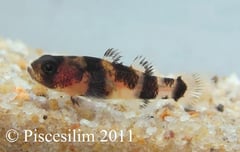
Brachygobius xanthomelas
Gobiidae · Herre, 1937
Brachygobius xanthomelas is a small bumblebee goby recorded throughout much of Peninsular Malaysia and southern Thailand. It lives in lowland freshwater swamps, streams and forest peat swamps and, unlike most congeners, does not appear to occur in brackish water. The name is widely misapplied to an unidentified member of the genus, the fish in most online images, which has a dark marking at the front of the first dorsal-fin base where B. xanthomelas is colourless.

Channa gachuaDwarf Snakehead
Channidae · Hamilton, 1822
The dwarf snakehead, Channa gachua, is a snakehead recorded across an enormous range from Iran to Taiwan and Bali. There is significant evidence that C. gachua as currently understood is a complex of similar-looking species in need of taxonomic review. A mouthbrooder bred regularly in captivity, it can share a well-chosen community with peaceful fishes too large to be prey, but populations should not be mixed as some may hybridise.

Channa luciusForest Snakehead
Channidae · Cuvier, 1831
The forest snakehead, Channa lucius, is a predatory snakehead from Indochina, Peninsular Malaysia and the Greater Sunda Islands. Also referred to as the 'splendid' or 'shiny' snakehead, it occurs on Sumatra, Borneo and Java, grows to 400 mm SL and favours forest swamps and tributaries. Like others in the genus it breathes atmospheric air, and it needs a dimly-lit tank with plenty of cover and a tightly-fitting lid, since Channa spp. are notorious for their ability to escape.

Cyclocheilichthys apogonBeardless Barb
Cyprinidae · Valenciennes, 1842
The beardless barb, Cyclocheilichthys apogon, is a cyprinid ranging from Myanmar to Vietnam and south via Peninsular Malaysia to Borneo and Sumatra. Also sold as 'skinhead barb', it lacks barbels and has a black blotch at the caudal-fin base plus rows of dark spots along the scale rows. It favours slower-moving or still water and grazes the biofilm on submerged roots and branches. Rarely imported in numbers, it most often arrives as bycatch.

Cyclocheilichthys armatus
Cyprinidae · Valenciennes, 1842
Cyclocheilichthys armatus is a cyprinid ranging from the Mekong region through Thailand and Peninsular Malaysia to Borneo, Sumatra and Java. It forages from mid-water to the bottom of rivers in the dry season and is thought to migrate into flooded forest to breed. Rarely imported in numbers and most often arriving as bycatch, it makes a peaceful, unusual addition to larger aquaria in a group of at least six.

Cyclocheilichthys repasson
Cyprinidae · Bleeker, 1853
Cyclocheilichthys repasson is a cyprinid with an enormous range, from the Mekong region and Myanmar through Peninsular Malaysia to Borneo and Sumatra. It grows to around 280 mm SL and favours slower-moving or still water, grazing the biofilm on submerged roots and branches. It is not often seen in the hobby. Most populations have a dark caudal peduncle spot, stripes formed by dark markings on the scales, and two pairs of barbels.
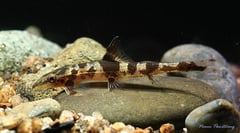
Homaloptera ogilviei
Balitoridae · Alfred, 1967
Homaloptera ogilviei is a small 'lizard' loach recorded through much of the Malay Peninsula in both Malaysia and southern Thailand. Quite rare in the trade, it is sometimes imported as bycatch and sold as 'lizard' or 'gecko' loach. Its paired fins are orientated vertically, unlike those of other members of the genus, and in aquaria it perches on the tips of its fins at rest. It favours slower stretches among plants, roots or leaf litter.
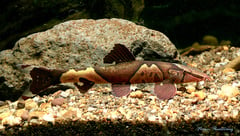
Homaloptera parclitella
Balitoridae · Tan & Ng, 2005
Homaloptera parclitella is a 'lizard' loach from Peninsular Malaysia and the Sai Buri, Bang Nara and Kolok river systems of southern Thailand. It was previously considered a form of H. orthogoniata and may be seen identified as such online and in print. It always has two large, saddle-shaped markings on the back, where H. orthogoniata has three, and it lives in swift, clear, oxygen-saturated streams.
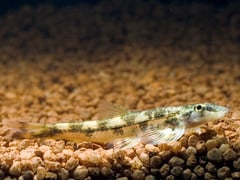
Homalopteroides nebulosus
Balitoridae · Alfred, 1969
Homalopteroides nebulosus is a small hillstream loach described from the Sok River in northern Peninsular Malaysia and since recorded from Borneo. Poorly known in the aquarium hobby, it may never have been exported for the ornamental trade. Its eyes sit in a comparatively raised position on the head, as in H. tweediei, but it has more lateral line scales. Little is known of its habitat, which is presumed to be swiftly-flowing streams and headwaters.
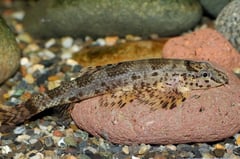
Homalopteroides tweediei
Balitoridae · Herre, 1940
Homalopteroides tweediei is a small hillstream loach from Peninsular Malaysia, the Mekong system and West Kalimantan in Indonesian Borneo. It is often confused with the congener H. smithi. Rainboth (1996) found it less likely to occur in riffles or runs than other members of the genus, and it shows a preference for moderately-flowing stretches of clear, oxygen-rich streams among patches of live or dead vegetation.

Mystacoleucus obtusirostris
Cyprinidae · Valenciennes, 1842
Mystacoleucus obtusirostris is a riverine cyprinid found from Myanmar and southwestern China to Vietnam, Borneo, Sumatra and Java. Referred to as M. marginatus for decades, it is the most widely distributed member of the genus, and populations vary somewhat in colour pattern. It is occasionally marketed as 'Burmese rainbow barb'. A group of six or more is the smallest to consider, and like all Mystacoleucus it has a forward-pointing predorsal spine that can snag in a net.
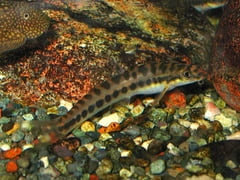
Nemacheilus masyaeArrow Loach
Nemacheilidae · Smith, 1933
Nemacheilus masyae is a nemacheilid loach from Thailand and Peninsular Malaysia. Its flanks carry 14-18 short dark bars and its back 12-17 saddles. It occurs in both small blackwater forest streams and turbid main river channels. It is very similar to N. pallidus but has a more slender body, and its dark bars and saddles are wider than the light interspaces between them.
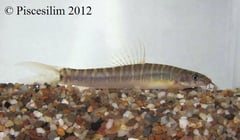
Nemacheilus selangoricus
Nemacheilidae · Duncker, 1904
Nemacheilus selangoricus is a nemacheilid loach ranging from southern Thailand through Peninsular Malaysia and Singapore to western Borneo and Sumatra. It is most common in shallow, flowing forest streams over sand, gravel and detritus. It belongs to the N. selangoricus group and is most similar to N. spiniferus, from which it differs in its 8-12 very regular dark bars on the flanks.
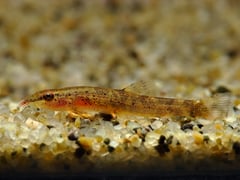
Neohomaloptera johorensis
Balitoridae · Herre, 1944
Neohomaloptera johorensis is a tiny balitorid loach from Peninsular Malaysia, found mainly in peat swamps and associated blackwater streams. Its small adult size and orange to reddish-brown colour make it difficult to confuse with any other balitorid. The water in its habitat is stained brown, with negligible mineral content and pH as low as 3.0 or 4.0. It needs well-oxygenated water free of organic pollutants.
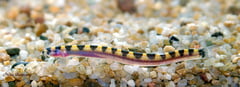
Pangio cuneovirgata
Cobitidae · Raut, 1957
Pangio cuneovirgata is a small kuhli loach from southern Thailand, Peninsular Malaysia, Sumatra and western Java, found in forest streams and swamps. It has 7-13 dark saddles on the upper half of the body and looks most like P. malayana, but has nasal barbels and a truncate caudal-fin. It is infrequently encountered in the trade, most often as bycatch among shipments of similar-looking congeners.
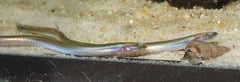
Pangio doriae
Cobitidae · Perugia, 1892
Traded as 'eel loach', Pangio doriae is a worm-like cobitid loach from Sarawak in Borneo and from Peninsular Malaysia. Some authors have suggested it is synonymous with P. anguillaris, but it can be told apart by a pair of prominent nasal barbels. The Sumatran population once identified as this species was described as P. bitaimac in 2009. It is most commonly available as bycatch among shipments of other fishes.

Puntigrus partipentazona
Cyprinidae · Fowler, 1934
Puntigrus partipentazona is a small cyprinid recorded from numerous river basins in Vietnam, Cambodia, Laos, Thailand and Peninsular Malaysia. It is easily told from congeners because the dark blotch on its dorsal fin extends onto the body. Typically found in heavily vegetated parts of rivers and sluggish streams, it is generally peaceful, though rival males continually battle for position within the group.
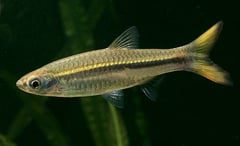
Rasbora dusonensis
Cyprinidae · Bleeker, 1850
Rasbora dusonensis is a cyprinid from Sumatra, Peninsular Malaysia and Borneo, found in larger river channels and peat swamp blackwaters. Its identity was unclear for decades before its redescription by Ng and Kottelat (2013). It is very similar to R. tornieri, which shares the Musi river with it, but has a bright yellow caudal fin with a broad dark margin, against carmine red in R. tornieri. One specimen measured 162 mm SL, although 95 to 105 mm is a more commonly reported adult size.

Sphaerichthys osphromenoidesChocolate Gourami
Osphronemidae · Canestrini, 1860
The chocolate gourami, Sphaerichthys osphromenoides, is a small gourami from Peninsular Malaysia, Sumatra and Borneo. By far the best known member of the genus, it mostly inhabits peat swamps and black water streams where the pH can drop to 3.0 or 4.0. A maternal mouthbrooder, it is slow-moving and easily outcompeted for food by more boisterous tankmates.

Trichopsis vittataCroaking gourami
Osphronemidae · Cuvier, in Cuvier & Valenciennes, 1831
The croaking gourami, Trichopsis vittata, is a labyrinth fish found through much of Indochina, Peninsular Malaysia and Singapore. The largest of its genus, it produces audible sounds with a specialised pectoral mechanism unique within the Osphronemidae. Wild populations vary in colour pattern, and records from Borneo, Sumatra and Java might refer to a distinct species.
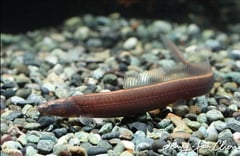
Vaillantella maassiFork-tailed Loach
Vaillantellidae · Weber & de Beaufort, 1912
The fork-tailed loach, Vaillantella maassi, is a loach from Sumatra, Borneo, Peninsular Malaysia and southern Thailand. Traded as 'chocolate scissor-tailed loach' and 'dragon loach' among other names, it has a bluish-brown body with an orange to yellow dorsal stripe. Rarely traded in numbers, it is among the more reclusive loaches and can be aggressive with its own kind and other fishes.

Xenentodon canciloides
Belonidae · Bleeker, 1854
Xenentodon canciloides is a freshwater needlefish from Borneo, Sumatra, Peninsular Malaysia and Thailand, and is considered to occur in the Mekong. Rarely seen in the ornamental trade, it is far less common there than its congener X. cancila, from which it differs in its slender, delicate jaws and smaller size, not exceeding 30 cm TL. A near-exclusive inhabitant of the upper water column, it is surprisingly peaceful with anything too large to swallow and is best kept in numbers of four or more.

Channa micropeltesGiant Snakehead
Channidae · Cuvier, 1831
The giant snakehead, Channa micropeltes, is a predatory fish from Southeast Asia that grows to well over a metre. Juveniles are sold as 'red' or 'redline' snakehead, but it is suitable only for public installations or the very largest private aquaria. Unlike most Channa species it is pelagic and needs plenty of room to swim, and adults become aggressive at sexual maturity.

Chitala lopisGiant Featherback
Notopteridae · Bleeker, 1851
The giant featherback, Chitala lopis, is a notopterid accepted to range from the Mekong basin to Peninsular Malaysia, Sumatra, Borneo and Java. That range appears to require confirmation: it may already be extinct on Java, and the species may comprise several closely-related taxa. Older juveniles and adults lack the dark body markings of other Chitala and have a more pronounced jaw, and at up to 1500 mm SL it is suitable only for public installations or the very largest private aquaria.

Cyclocheilos enoplos
Cyprinidae · Bleeker, 1849
Cyclocheilos enoplos is a large cyprinid from the Mekong region and Thailand south through Peninsular Malaysia to Borneo, Sumatra and Java. Growing to around 750 mm SL, it is clearly unsuitable for aquaria and scarce to non-existent in the ornamental trade. In the Mekong it makes long seasonal migrations, and adults move upstream above Khone Falls in what appear to be spawning migrations.

Hampala macrolepidotaHampala Barb
Cyprinidae · Kuhl & van Hasselt, 1823
The hampala barb, Hampala macrolepidota, is a cyprinid ranging from Myanmar through Thailand to the Mekong, and south to Borneo, Sumatra and Java. Also known as 'jungle perch' or 'sidebar barb', it can grow to over 2 feet and 5 kg and is a powerful, pelagic predator and not an aquarium subject in all but the most extreme circumstances. Prized as a food and sport fish, it has been introduced to numerous water bodies.

Notopterus notopterusBronze Featherback
Notopteridae · Pallas, 1769
The bronze featherback, Notopterus notopterus, is an air-breathing notopterid from the Indian subcontinent and Southeast Asia. Also called 'Asian knifefish' or 'ghost knifefish' in the trade, it grows to 600 mm and arguably has no place in the ornamental hobby given its adult size and specialised requirements. The single species in Notopterus is likely to represent a complex of closely-related species.