Basin
Golok basin
Only species with a profile on Seriously Fish are counted.
- Species
- 9
- Rivers
- 1
- Photographed
- 9 of 9
- Difficulty rated
- 9 of 9
Rivers in this basinspecies recorded from each
Runs through
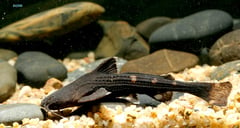
Acrochordonichthys rugosusAsian Banjo Catfish
Akysidae · Bleeker, 1846
The Asian banjo catfish, Acrochordonichthys rugosus, is an akysid catfish from Java, Sumatra, Borneo, Peninsular Malaysia and southern Thailand. The most commonly encountered member of the genus in the trade, it is still by no means common, and body colouration varies widely even among fish from a single locality. Like its congeners it can secrete a milky substance from the axillary pore when stressed, and this can quickly kill other fishes in the confines of an aquarium.
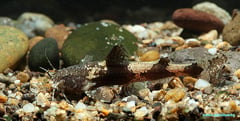
Akysis hendricksoniHendrickson's Stream Catfish
Akysidae · Alfred, 1966
Hendrickson's stream catfish, Akysis hendricksoni, is a small akysid catfish from much of Peninsular Malaysia and the extreme south of Thailand. One of the few members of the family exported for the hobby, it grows to around 50 mm SL and spends some of its time buried in sand with only the eyes showing. Colour pattern varies with locality, and like many fishes from running water it is intolerant of organic pollutants and needs spotless water.

Belontia hasseltiJava Combtail
Osphronemidae · Cuvier, 1831
The Java combtail, Belontia hasselti, is a labyrinth fish from peninsular Thailand, Peninsular Malaysia, Singapore, Sumatra, Borneo and Java. Also known as the 'Malay combtail', it mostly inhabits acidic forest peat swamps with little water movement. It differs from its only congener, B. signata, in its brownish grey body and the mosaic pattern in its unpaired fins. Growing to 200 mm SL, it will eat very small fishes and is not recommended for the average community aquarium.

Betta pi
Osphronemidae · Tan, 1998
Betta pi is a large paternal mouthbrooding labyrinth fish from peat swamps in southern Thailand and the states of Kelantan and Terengganu, Malaysia. A member of the B. waseri group, it is named for the dark marking on the throat shaped like the Greek letter pi. It is not among the more aggressive members of the genus and can be maintained in a pair or group.
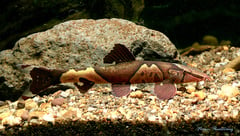
Homaloptera parclitella
Balitoridae · Tan & Ng, 2005
Homaloptera parclitella is a 'lizard' loach from Peninsular Malaysia and the Sai Buri, Bang Nara and Kolok river systems of southern Thailand. It was previously considered a form of H. orthogoniata and may be seen identified as such online and in print. It always has two large, saddle-shaped markings on the back, where H. orthogoniata has three, and it lives in swift, clear, oxygen-saturated streams.
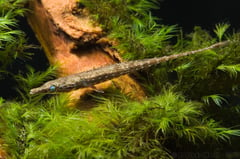
Indostomus crocodilus
Indostomidae · Britz & Kottelat, 1999
Indostomus crocodilus is a tiny indostomid, 25 to 30 mm long, from southern Thailand and Kelantan state in northeastern Peninsular Malaysia. Its type series came from a blackwater stream in peat swamp forest, among submerged roots and leaf litter in slow-moving or standing water. A poor competitor, it is best kept alone or with similarly-sized, placid species, and males have dark brown to black bars in the dorsal and anal fins.
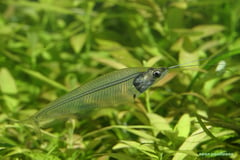
Kryptopterus vitreolusGlass Catfish
Siluridae · Ng & Kottelat, 2013
The glass catfish, Kryptopterus vitreolus, is a transparent silurid catfish from coastal river basins of peninsular and southeastern Thailand. Available in the trade for decades, it was widely misidentified as K. bicirrhis or K. minor until its description in 2013, so older literature uses those names. It is also sold as the 'Asian glass catfish', 'ghost catfish' or 'phantom catfish'. Its status in the wild requires investigation since it is collected intensively and has a restricted range.

Puntigrus partipentazona
Cyprinidae · Fowler, 1934
Puntigrus partipentazona is a small cyprinid recorded from numerous river basins in Vietnam, Cambodia, Laos, Thailand and Peninsular Malaysia. It is easily told from congeners because the dark blotch on its dorsal fin extends onto the body. Typically found in heavily vegetated parts of rivers and sluggish streams, it is generally peaceful, though rival males continually battle for position within the group.

Scleropages formosusAsian Arowana
Osteoglossidae · Müller & Schlegel, 1840
The Asian arowana, Scleropages formosus, is an osteoglossid from the Mekong system, eastern Thailand, Peninsular Malaysia, Sumatra and Borneo. Highly valued in the aquarium trade since the 1970s and listed on Appendix I of CITES since 1975, it is now extirpated across much of its range. It occurs in several colour forms, such as the 'super red' of the upper Kapuas, and three were described as species in 2003, though the majority view treats all of them as S. formosus pending review.