Basin
Kinabatangan basin
Only species with a profile on Seriously Fish are counted.
- Species
- 8
- Rivers
- 1
- Photographed
- 8 of 8
- Difficulty rated
- 8 of 8
Rivers in this basinspecies recorded from each
Runs through

Betta ocellata
Osphronemidae · de Beaufort, 1933
Betta ocellata is a large paternal mouthbrooding labyrinth fish from Sabah, northeastern Borneo, and the Sebuku River basin in East Kalimantan. A member of the B. unimaculata complex, it grows to 90 mm SL and has a pointed, slightly conical head. It has been collected from clear flowing streams, elevated headwater pools, turbid forest streams, ox-bow lakes and ponds in oil palm plantations.
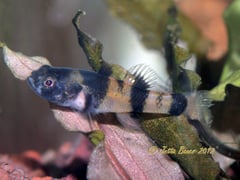
Brachygobius sabanusSabanus Bumblebee Goby
Gobiidae · Inger, 1958
The Sabanus bumblebee goby, Brachygobius sabanus, is a small goby described from the Kinabatangan district of Sabah, northeastern Borneo. Among the more frequently traded members of the genus, it is easily confused with B. doriae, but the last one or two rays of its first dorsal-fin are colourless and less than half of the pectoral-fin is black. Its full range is unclear, and populations in Singapore are not thought to be natural. It lives in fresh and brackish lowland coastal habitats.
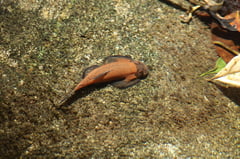
Gastromyzon lepidogaster
Gastromyzontidae · Roberts, 1982
Gastromyzon lepidogaster is a hillstream loach from northern Borneo and the most widely-distributed member of the genus. It occurs in Sabah, Brunei and East Kalimantan. Colour is variable: large adults may be bright green, orange or barred, and can apparently change from barred to plain in a few seconds. It is occasionally available in the trade, where the orange form is particularly sought after.
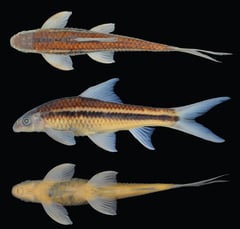
Crossocheilus elegans
Cyprinidae · Kottelat & Tan, 2011
Crossocheilus elegans is a cyprinid known only from the Segama and Kinabatangan river systems in Sabah, northern Borneo. It is mostly collected in or near the riffles of fast-flowing, rocky headwater hill streams. A pale yellowish brown stripe between the dark brown back and the blackish midlateral stripe separates it from other black-striped Crossocheilus, and before its description it was referred to as Epalzeorhynchos kalliurus and C. cobitis.
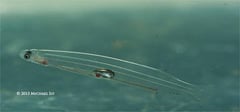
Sundasalanx microps
Sundasalangidae · Roberts, 1981
Sundasalanx microps is a miniature clupeiform from Borneo, in Indonesia and Malaysia, described from the Kapuas River. Adults are sexually mature at less than 20 mm SL and resemble the larval form of their larger ancestors. It has a small eye, less than 4% of SL. Sundasalanx species inhabit turbid, slow to moderately flowing water over silt, sand or mud in the lower parts of river basins, and little else is known of their ecology.
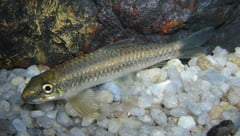
Garra borneensis
Cyprinidae · Vaillant, 1902
Garra borneensis is a cyprinid endemic to northern and western Borneo, in Kalimantan, Brunei, Sabah and Sarawak. No other member of the genus is known from the island. An obligate dweller of swiftly-flowing streams and headwaters, it lives in clear, oxygen-saturated water over gravel, rocks and bedrock carpeted with biofilm.
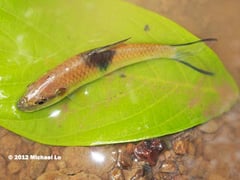
Hampala sabana
Cyprinidae · Inger & Chin, 1962
Hampala sabana is a large riverine cyprinid endemic to the Malaysian state of Sabah in northern Borneo. It inhabits clear, well-oxygenated running water and apparently favours deeper, slower-moving stretches. It has a single body marking and a higher count of circumpeduncular scales than its congeners. Growing to 410 mm SL, it is poorly known in the ornamental trade, and its size more-or-less precludes it as an aquarium fish.
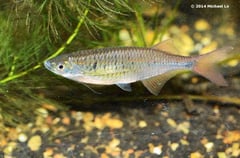
Nematabramis everetti
Cyprinidae · Boulenger, 1894
Nematabramis everetti is a cyprinid endemic to Borneo, known from Sarawak and Sabah plus East and North Kalimantan. It has a distinctive dark, vertically-elongate humeral marking, more prominent than in other Nematabramis species. Juveniles and subadults appear to favour fast-moving water, while adults are found in deeper, slower stretches of minor tributaries.