Basin
Musi basin
Only species with a profile on Seriously Fish are counted.
- Species
- 18
- Rivers
- 1
- Photographed
- 18 of 18
- Difficulty rated
- 18 of 18
Rivers in this basinspecies recorded from each
Runs through
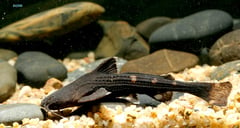
Acrochordonichthys rugosusAsian Banjo Catfish
Akysidae · Bleeker, 1846
The Asian banjo catfish, Acrochordonichthys rugosus, is an akysid catfish from Java, Sumatra, Borneo, Peninsular Malaysia and southern Thailand. The most commonly encountered member of the genus in the trade, it is still by no means common, and body colouration varies widely even among fish from a single locality. Like its congeners it can secrete a milky substance from the axillary pore when stressed, and this can quickly kill other fishes in the confines of an aquarium.

Belontia hasseltiJava Combtail
Osphronemidae · Cuvier, 1831
The Java combtail, Belontia hasselti, is a labyrinth fish from peninsular Thailand, Peninsular Malaysia, Singapore, Sumatra, Borneo and Java. Also known as the 'Malay combtail', it mostly inhabits acidic forest peat swamps with little water movement. It differs from its only congener, B. signata, in its brownish grey body and the mosaic pattern in its unpaired fins. Growing to 200 mm SL, it will eat very small fishes and is not recommended for the average community aquarium.

Betta pardalotos
Osphronemidae · Tan, 2009
Betta pardalotos is a large paternal mouthbrooding labyrinth fish from the Musi drainage near Palembang, South Sumatra, Indonesia. A member of the B. waseri group, it is best told from its relatives by the throat, which has two white, roundish patches on a black background. It is possibly endemic to the lower Musi basin, and the type series came from small freshwater channels draining into the river.
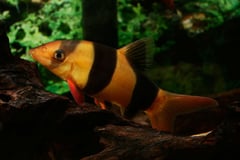
Chromobotia macracanthusClown Loach
Botiidae · Bleeker, 1852
The clown loach, Chromobotia macracanthus, is a large botiid loach native to river systems of Borneo and Sumatra in Indonesia. Widely sold, it is wholly unsuitable for smaller aquaria: a group needs a tank of at least 180 x 60 cm, and a properly kept fish can live for more than twenty years. Bornean and Sumatran populations differ slightly in pattern, and in the Batang Hari, Sumatra, drifting larvae are now collected and grown on for the trade.
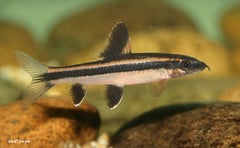
Epalzeorhynchos kalopterumFlying Fox
Cyprinidae · Bleeker, 1850
The flying fox, Epalzeorhynchos kalopterum, is a cyprinid from southern Thailand, Peninsular Malaysia and the Greater Sunda Islands. Fishes sold as 'false flying fox' or 'Siamese flying fox', such as Garra cambodgiensis and Gyrinocheilus aymonieri, are often confused with it, but it has white-edged red and black fins and two pairs of barbels. It grows increasingly territorial with age and can live for over 15 years.
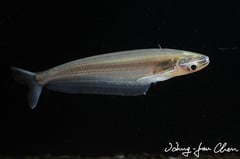
Kryptopterus cryptopterusBlue Sheatfish
Siluridae · Bleeker, 1851
The blue sheatfish, Kryptopterus cryptopterus, is a silurid catfish from the Malay Peninsula, Singapore, Sumatra, Borneo and Java. It inhabits flowing rivers and larger streams with turbid water, and is sometimes traded as 'smokey glass catfish'. Populations from Thailand, Cambodia, Laos and Vietnam once considered conspecific are now referred to K. geminus, its closest relative, from which it differs in having a wider head and a shorter snout and anal fin.
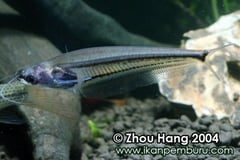
Kryptopterus palembangensis
Siluridae · Bleeker, 1852
Kryptopterus palembangensis is a silurid catfish known only from central and southern Sumatra, in the provinces of Jambi and South Sumatra. It is closely related to K. bicirrhis but is told apart by a prominent, dark lateral stripe on each flank. Almost unheard of in the aquarium trade, it may occasionally be exported among shipments of wild fishes from Sumatra.
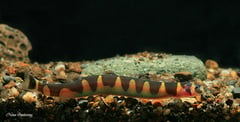
Pangio semicincta'Kuhli' Loach
Cobitidae · Fraser-Brunner, 1940
Usually sold as the 'kuhli' loach, Pangio semicincta is a cobitid loach from Peninsular Malaysia, Sumatra and Borneo. It lives in shallow forest streams and swamps, often in black water, and is typically abundant in leaf litter. P. kuhlii itself is currently considered endemic to Java and has possibly never been seen in aquaria, so the common aquarium 'kuhli' is more likely to be this species or an unidentified relative.
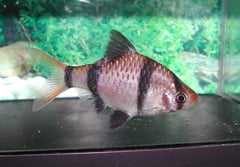
Puntigrus tetrazonaTiger Barb
Cyprinidae · Bleeker, 1855
The tiger barb, Puntigrus tetrazona, is a small cyprinid probably endemic to central and southern Sumatra, Indonesia. Among the most ubiquitous species in the aquarium trade, it is seen mostly as commercially-produced fish and ornamental strains, and wild examples are rarely traded. The identity of the 'aquarium' tiger barb is the subject of ongoing confusion, and many farmed fish are weak or deformed through inbreeding.
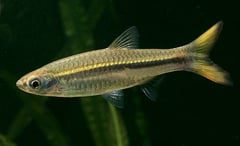
Rasbora dusonensis
Cyprinidae · Bleeker, 1850
Rasbora dusonensis is a cyprinid from Sumatra, Peninsular Malaysia and Borneo, found in larger river channels and peat swamp blackwaters. Its identity was unclear for decades before its redescription by Ng and Kottelat (2013). It is very similar to R. tornieri, which shares the Musi river with it, but has a bright yellow caudal fin with a broad dark margin, against carmine red in R. tornieri. One specimen measured 162 mm SL, although 95 to 105 mm is a more commonly reported adult size.
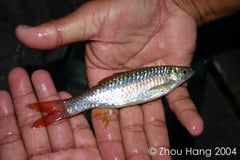
Rasbora tornieri
Cyprinidae · Ahl, 1922
Rasbora tornieri is a cyprinid from Sumatra, Borneo, Peninsular Malaysia and the Mekong drainage in Cambodia. Its identity was unclear for decades before its redescription by Ng and Kottelat (2013). It is very similar to R. dusonensis, which shares the Musi river with it, but its caudal fin is carmine red, against bright yellow in R. dusonensis. It lives in flowing streams and peat swamp blackwaters alike.
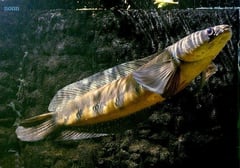
Channa marulioidesEmperor Snakehead
Channidae · Bleeker, 1851
The emperor snakehead, Channa marulioides, is a large snakehead from southern Thailand, Malaysia and Indonesia, including Borneo and Sumatra. Colour pattern varies with locality, and it is often confused with C. marulius and C. melanoptera, all three presenting taxonomic problems. Growing to 650 mm SL, it is pelagic, turns aggressive towards its own kind at sexual maturity and is suitable only for public installations or the very largest private aquaria.

Channa micropeltesGiant Snakehead
Channidae · Cuvier, 1831
The giant snakehead, Channa micropeltes, is a predatory fish from Southeast Asia that grows to well over a metre. Juveniles are sold as 'red' or 'redline' snakehead, but it is suitable only for public installations or the very largest private aquaria. Unlike most Channa species it is pelagic and needs plenty of room to swim, and adults become aggressive at sexual maturity.

Cyclocheilos enoplos
Cyprinidae · Bleeker, 1849
Cyclocheilos enoplos is a large cyprinid from the Mekong region and Thailand south through Peninsular Malaysia to Borneo, Sumatra and Java. Growing to around 750 mm SL, it is clearly unsuitable for aquaria and scarce to non-existent in the ornamental trade. In the Mekong it makes long seasonal migrations, and adults move upstream above Khone Falls in what appear to be spawning migrations.
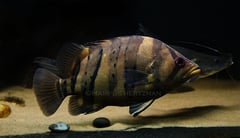
Datnioides microlepisIndonesian Tiger Perch
Datnioididae · Bleeker, 1854
The Indonesian tiger perch, Datnioides microlepis, is a large tiger perch from Peninsular Malaysia, Sumatra and Indonesian Borneo. It has 6 to 7 wide dark bars and small body scales, lives only in large, deep lowland rivers, and grows to 500 mm SL. Juveniles may form groups, but adults are not gregarious and respond aggressively to conspecifics and similarly-shaped fishes.

Hemibagrus wyckiiCrystal-eyed Catfish
Bagridae · Bleeker, 1858
The crystal-eyed catfish, Hemibagrus wyckii, is a bagrid with an enormous distribution across central Indochina and western Indonesia. Juveniles are sometimes available in the aquarium trade, but buying them is strongly discouraged: it reaches 710 mm SL, is aggressively territorial and can live for several decades. Despite the common name, the blue eye is not given as a distinguishing character in any diagnosis we've seen.
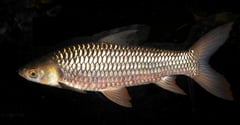
Leptobarbus hoeveniiMad Barb
Cyprinidae · Bleeker, 1851
The mad barb, Leptobarbus hoevenii, is a large pelagic cyprinid apparently native to Peninsular Malaysia, Borneo, Sumatra and Java. A popular sport fish growing to 800 to 1000 mm, it is wholly unsuitable for private aquaria but is readily available at 100 to 150 mm. The congener L. rubripinna was referred to as L. hoevenii for decades and both are traded under the same name. L. hoevenii lacks the broad dark midlateral stripe and has dark grey pelvic and anal fins.
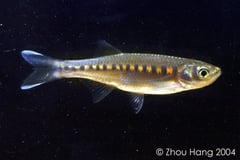
Luciosoma spilopleura
Cyprinidae · Bleeker, 1855
Luciosoma spilopleura is a small cyprinid known only from Sumatra and the Indonesian part of Borneo, where it prefers fast-flowing headwater streams. The species is poorly known and is not present in the ornamental trade, although its name has been widely misapplied to other Luciosoma species for decades. The largest known specimen measured 81.9 mm, so it appears to grow much smaller than its congeners.