Basin
Netravati basin
Only species with a profile on Seriously Fish are counted.
- Species
- 9
- Rivers
- 1
- Photographed
- 9 of 9
- Difficulty rated
- 9 of 9
Rivers in this basinspecies recorded from each
Runs through
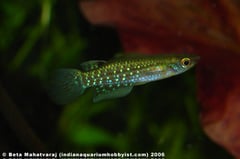
Aplocheilus blockiiGreen Panchax
Aplocheilidae · Arnold, 1911
The green panchax, Aplocheilus blockii, is a small killifish from Sri Lanka and southern India, growing to around 45 mm SL. Euryhaline, it mostly inhabits lowland, often coastal, still or slow-moving brackish or fresh water with surface vegetation or overhanging cover, and is commonly found in mangrove swamps and rice paddies.

Barilius canarensis
Cyprinidae · Jerdon, 1849
Barilius canarensis is a cyprinid from southwestern India, known with certainty only from the Netravathi and Tungabhadra river systems in Karnataka. Its name has historically been applied in the trade to B. ardens and B. malabaricus, and it was redescribed in 2015. Two rows of bluish-green spots and broad white margins on the dorsal and anal fins distinguish it. It inhabits well-oxygenated, fast-flowing rivers and streams.

Dawkinsia assimilisMascara Barb
Cyprinidae · Jerdon, 1849
The mascara barb, Dawkinsia assimilis, is a cyprinid from the Netravati, Chalakudy and Kallada basins of Karnataka and Kerala, India. The caudal-fin lobes are tipped with a black band about as wide as the eye, faint or absent in Kallada fish. Misidentified in the past as Puntius mahecola, it still appears on trade lists as 'mahecola barb', and some populations might represent distinct species.

Etroplus canarensisCanara Pearlspot Cichlid
Cichlidae · Day, 1877
The Canara pearlspot cichlid, Etroplus canarensis, appears to be endemic to the Kumaradhara-Netravati river system in southern Karnataka, India. Also known as the banded chromide or 'roman numeral' cichlid, it lives only in oxygen-rich fresh water, unlike its euryhaline relatives. Unmanaged collection raised concerns over its status, and commercial breeding in Southeast Asia has since reduced the pressure on wild stocks. Sexual maturity takes around 24 months.
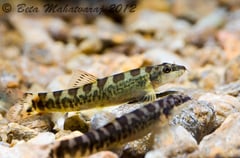
Mesonoemacheilus petrubanarescui
Nemacheilidae · Menon, 1984
Mesonoemacheilus petrubanarescui is a loach from the Netravati and Kabini river basins in the Western Ghats of southern India. It may be endemic to these two drainages. The dorsal surface carries 7-8 dark, saddle-shaped markings and the flanks a varying number of broken bars. It is unclear if it has been traded outside India, but it may turn up among shipments of M. guentheri or M. triangularis.

Pseudetroplus maculatusOrange Chromide
Cichlidae · (Bloch, 1795)
The orange chromide, Pseudetroplus maculatus, is a euryhaline cichlid native to peninsular India and Sri Lanka. It mostly inhabits brackish estuaries, coastal lagoons and the lower reaches of rivers, and can be kept in fresh or brackish water so long as acidic conditions are avoided. Wild examples are rarely seen in the hobby, where selectively bred strains traded as 'red' or 'yellow' chromide are widely available.

Pseudosphromenus cupanusSpiketail Paradisefish
Osphronemidae · Cuvier, 1831
The spiketail paradisefish, Pseudosphromenus cupanus, is a small labyrinth fish restricted to southern India and Sri Lanka. It lives in sluggish and still waters such as rice paddies, swamps and weedy ponds. It lacks the two dark lateral stripes of its only congener, P. dayi. A secretive bubble nester, it is peaceful but too small and timid for most community aquaria.

Xenentodon cancilaFreshwater Needlefish
Belonidae · Hamilton, 1822
The freshwater needlefish, Xenentodon cancila, is a belonid from Pakistan east through India, Bangladesh, Nepal, Sri Lanka, Myanmar and Thailand. Often called 'freshwater garfish', it only superficially resembles the true gars, and most of its relatives in the Belonidae are marine or estuarine. A near-exclusive inhabitant of the upper water column, it is surprisingly peaceful with anything too large to swallow and is best kept in numbers of four or more, in a tank of 180 ∗ 60 cm or more.

Etroplus suratensisGreen Chromide
Cichlidae · Bloch, 1790
The green chromide, Etroplus suratensis, is a euryhaline cichlid from peninsular India and Sri Lanka, growing to 350 mm SL. It mostly inhabits brackish estuaries, coastal lagoons and lower river reaches. Not especially popular in the hobby, it is an important food fish, and some populations have crashed through over-exploitation. In Sri Lanka's Negombo Lagoon Pseudetroplus maculatus has been seen acting as its cleaner while also eating its eggs and fry.