Basin
Sungai Fly basin
Only species with a profile on Seriously Fish are counted.
- Species
- 4
- Rivers
- 1
- Photographed
- 4 of 4
- Difficulty rated
- 4 of 4
Rivers in this basinspecies recorded from each
Runs through
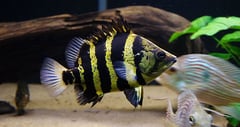
Datnioides campbelliNew Guinea Tiger Perch
Datnioididae · Whitley, 1939
The New Guinea tiger perch, Datnioides campbelli, is a large tiger perch from southern New Guinea, recorded mostly from the lower Fly River basin. A golden yellow base colour with 4 to 6 wide, diffuse dark bars separates it from its congeners. The species is euryhaline, found in brackish tidal creeks as well as in tributaries and swamps at least 900 km from the sea, and it grows to 350 mm SL.
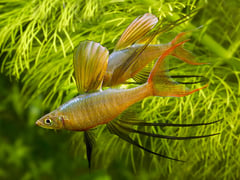
Iriatherina werneriThreadfin Rainbowfish
Melanotaeniidae · Meinken, 1974
The threadfin rainbowfish, Iriatherina werneri, is a small rainbowfish from southern New Guinea, Cape York in Queensland and the Northern Territory. Although widely traded and produced on a commercial scale, it is quite delicate with rather specific care requirements and is not a recommended beginner's fish. Easily outcompeted for food, and with long-finned males that some common species nip, it is best kept alone or with fishes of comparable size and disposition.
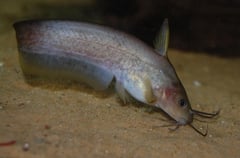
Neosilurus brevidorsalisShortfin Tandan
Plotosidae · Günther, 1867
The shortfin tandan, Neosilurus brevidorsalis, is a plotosid catfish restricted to the tips of northern Australia and southern Papua New Guinea. In Australia it is recorded only from the Jardine and Jackson river systems on the Cape York Peninsula, and in Papua New Guinea from the Fly River and some other drainages.
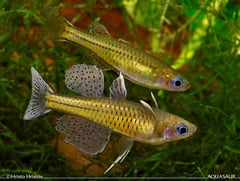
Pseudomugil gertrudaeSpotted Blue-eye
Pseudomugilidae · Weber, 1911
The spotted blue-eye, Pseudomugil gertrudae, is a pseudomugilid from northern Australia, Papua New Guinea and the Aru Islands, eastern Indonesia. Wild populations are isolated from one another and differ in colour pattern, body size and fin morphology, but the fish on sale are of a single, commercially produced ornamental strain. Dark spots in the dorsal, anal and caudal fins separate it from other members of the genus except P. paskai and Pseudomugil sp. 'red neon'.