Basin
Tapi basin
Only species with a profile on Seriously Fish are counted.
- Species
- 17
- Rivers
- 2
- Photographed
- 17 of 17
- Difficulty rated
- 17 of 17
Rivers in this basinspecies recorded from each
Runs through
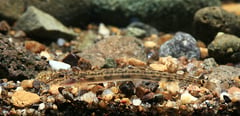
Acanthopsoides molobrion
Cobitidae · Siebert, 1991
Acanthopsoides molobrion is a dwarf horse-faced loach from Borneo, Peninsular Malaysia and southern Thailand. Like others in the genus it lives in flowing, clear-water river channels over sand, fine gravel or mud, and needs a soft, sandy substrate because it spends some of its time completely buried. Several Acanthopsoides in the trade have proven very tricky to identify. This one has 10 to 15 mid-dorsal markings and three bands in the caudal fin.
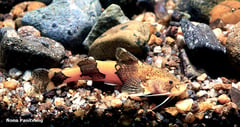
Akysis pulvinatusKra Stream Catfish
Akysidae · Ng, 2007
The Kra stream catfish, Akysis pulvinatus, is a small akysid catfish from southern Thailand. Known from streams on the western side of the Kra Isthmus and the upper Tapi basin, it grows to around 30 mm SL and has been exported for the hobby on an extremely limited basis. It most resembles A. vespa, and differs in its longer adipose fin base, deeper caudal peduncle and a caudal fin with the lower lobe longer than the upper.
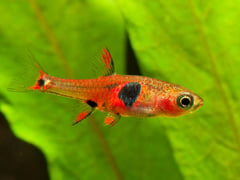
Boraras naevus
Cyprinidae · Conway & Kottelat, 2011
Boraras naevus is a miniature cyprinid known only from the lower Tapi river drainage in Surat Thani province, southern (peninsular) Thailand. Before its description it was traded as B. sp. 'micros', 'red micros', 'Petch Noi' and 'strawberry rasbora', and it is exported only sporadically. It lives in shallow, clear swamps and marshes. Males have an anterior flank blotch much larger than that of females, a feature unique to this species within the genus.

Helostoma temminkiiKissing Gourami
Helostomatidae · Cuvier, 1829
The kissing gourami, Helostoma temminkii, is an anabantoid from southern Indochina and the Malay Archipelago, and the sole member of its family. The widely traded pinkish-white form is a leucistic variant bred for ornamental purposes, and the 'balloon' variety is intentionally disfigured and much shorter-lived. Its often belligerent behaviour, adult size and life span of over 20 years make it unsuitable for most home aquaria. The 'kissing' appears at least in part related to establishing social dominance.
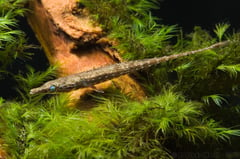
Indostomus crocodilus
Indostomidae · Britz & Kottelat, 1999
Indostomus crocodilus is a tiny indostomid, 25 to 30 mm long, from southern Thailand and Kelantan state in northeastern Peninsular Malaysia. Its type series came from a blackwater stream in peat swamp forest, among submerged roots and leaf litter in slow-moving or standing water. A poor competitor, it is best kept alone or with similarly-sized, placid species, and males have dark brown to black bars in the dorsal and anal fins.

Labiobarbus leptocheilus
Cyprinidae · Valenciennes, 1842
Labiobarbus leptocheilus is a large cyprinid widespread in Southeast Asia, from the Mekong and Salween to the Greater Sunda Islands. Different populations vary somewhat in appearance, and it may turn out to represent a group of closely-related species. The Cambodian Mekong population has been considered a distinct species, Labiobarbus lineatus, and that name is widely used in the ornamental trade although it is currently a synonym. It grows to 260 mm SL and needs spotless, well-oxygenated water.

Laubuka siamensis
Cyprinidae · Fowler, 1939
Laubuka siamensis is a cyprinid from the Mekong, the Chao Phraya and Mae Klong in Thailand, and smaller drainages south to Peninsular Malaysia. Long considered synonymous with L. laubuca, it seems likely to be the species behind many of the fish entering the trade under that name. A conspicuous dark stripe, iridescent blue in life, runs uninterrupted along the rear of the body to an oval blotch on the caudal peduncle. It swims in groups at or just below the surface and is an accomplished jumper.
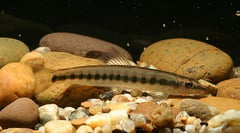
Nemacheilus ornatus
Nemacheilidae · Kottelat, 1990
Nemacheilus ornatus is a small nemacheilid loach known only from the Tapi river drainage in Surat Thani province, southern Thailand. It is said to occur in shallow riffles with clear, moderately-flowing water over small pebbles. Its colour pattern is a black lateral stripe with 9-16 vertical blotches extending above and below it, and the first of these blotches is ringed with lighter pigment to form an ocellus.
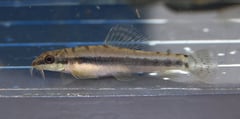
Paracanthocobitis zonalternans
Nemacheilidae · Blyth, 1860
Paracanthocobitis zonalternans is a nemacheilid loach ranging from Manipur in India through Myanmar into western and peninsular Thailand. Several species are thought to be confused under the name, and Singer and Page (2015) consider it likely to be a species complex. Among the more peaceful members of the genus, it does best in a mixed-sex group of at least half a dozen, and it has been bred in aquaria, first by UK aquarist Mick Wright.
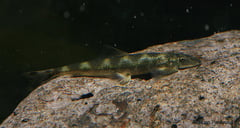
Pseudohomaloptera leonardi
Balitoridae · Hora, 1941
Pseudohomaloptera leonardi is a 'lizard' loach ranging through Peninsular Malaysia and north into Thailand as far as the Tapi river drainage. Seriously Fish referred to it as Homaloptera sp. 'H01' before its identity was established. It is very similar to P. sexmaculata, and both are sometimes misidentified as H. yunnanensis. Naturally reclusive, it needs clean, fast-flowing, well-oxygenated water and a group of four or more.

Puntigrus partipentazona
Cyprinidae · Fowler, 1934
Puntigrus partipentazona is a small cyprinid recorded from numerous river basins in Vietnam, Cambodia, Laos, Thailand and Peninsular Malaysia. It is easily told from congeners because the dark blotch on its dorsal fin extends onto the body. Typically found in heavily vegetated parts of rivers and sluggish streams, it is generally peaceful, though rival males continually battle for position within the group.
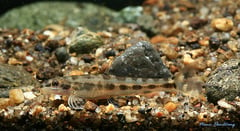
Schistura geisleri
Nemacheilidae · Kottelat, 1990
Schistura geisleri is a small nemacheilid loach widespread in the Chao Phraya river system of western Thailand. It differs from most congeners in its small adult size, sociable behaviour and tendency to bury itself in the substrate when threatened. Peaceful with conspecifics, it is best kept in a group of four or more. It is available in the trade from time to time but is by no means common.
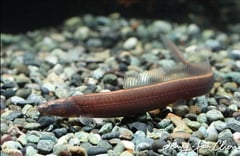
Vaillantella maassiFork-tailed Loach
Vaillantellidae · Weber & de Beaufort, 1912
The fork-tailed loach, Vaillantella maassi, is a loach from Sumatra, Borneo, Peninsular Malaysia and southern Thailand. Traded as 'chocolate scissor-tailed loach' and 'dragon loach' among other names, it has a bluish-brown body with an orange to yellow dorsal stripe. Rarely traded in numbers, it is among the more reclusive loaches and can be aggressive with its own kind and other fishes.

Channa micropeltesGiant Snakehead
Channidae · Cuvier, 1831
The giant snakehead, Channa micropeltes, is a predatory fish from Southeast Asia that grows to well over a metre. Juveniles are sold as 'red' or 'redline' snakehead, but it is suitable only for public installations or the very largest private aquaria. Unlike most Channa species it is pelagic and needs plenty of room to swim, and adults become aggressive at sexual maturity.

Etroplus suratensisGreen Chromide
Cichlidae · Bloch, 1790
The green chromide, Etroplus suratensis, is a euryhaline cichlid from peninsular India and Sri Lanka, growing to 350 mm SL. It mostly inhabits brackish estuaries, coastal lagoons and lower river reaches. Not especially popular in the hobby, it is an important food fish, and some populations have crashed through over-exploitation. In Sri Lanka's Negombo Lagoon Pseudetroplus maculatus has been seen acting as its cleaner while also eating its eggs and fry.

Macrochirichthys macrochirusGiant Sword Minnow
Cyprinidae · Valenciennes, 1844
The giant sword minnow, Macrochirichthys macrochirus, is a large pelagic cyprinid widespread in Southeast Asia, from the Mekong to Borneo and Sumatra. Growing to 600 to 800 mm and becoming increasingly piscivorous as it grows, it is unsuitable for the majority of private aquaria, although juveniles are traded on occasion. It is thought to have been extirpated from the Chao Phraya, Mae Klong, Lake Songkhla and Java, and the Mekong populations have been drastically reduced.

Garra mullya
Cyprinidae · Sykes, 1839
Garra mullya is a cyprinid endemic to and widespread within peninsular India, in rivers including the Tapti, Narmada, Godavari, Krishna and Cauvery. It has been recorded from flowing headwater streams to low altitude main river channels, including polluted stretches, and at least some populations migrate upstream to breed. Wild fish feed on algae, diatoms and organic detritus.