Country · North & Central America
Cuba
Only species with a profile on Seriously Fish are counted, whether native or introduced.
- Species
- 3
- Families
- 3
- Genera
- 3
- Found only here
- 1
- Photographed
- 3 of 3
Shares its fishes withspecies recorded in both
Found only here1
1 of the species on this page are recorded in Cuba and in no other country. This is not the same as being endemic.
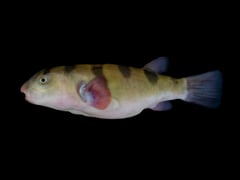
Colomesus psittacusBanded Puffer
Tetraodontidae · Bloch & Schneider, 1801
The banded puffer, Colomesus psittacus, is a large puffer of coastal waters from Colombia and Venezuela through the Guianas to northeastern Brazil. It also occurs in Trinidad and Tobago and the Caribbean islands, and inhabits mangrove swamps, estuaries and the lower reaches of rivers. Growing to 290 mm SL, it is the largest of its genus and has six dark bands across the back. Likely to prove aggressive in all but the largest systems, it is not a popular aquarium fish.

Ctenopharyngodon idellaGrass Carp
Cyprinidae · Valenciennes, 1844
The grass carp, Ctenopharyngodon idella, is a large cyprinid native to the Amur River system in eastern Russia and northeastern China. Adults typically reach 800 to 1200 mm, making it a wholly unsuitable aquarium subject, though an albino form is traded. Widely introduced for aquaculture and weed control, it has caused serious damage to natural waters, and unwanted fish should never be released.
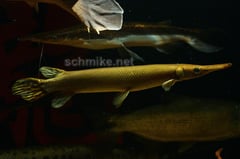
Atractosteus tristoechusCuban Gar
Lepisosteidae · Bloch & Schneider, 1801
The Cuban gar, Atractosteus tristoechus, known locally as 'manjuari', is a gar endemic to western Cuba and Isla de la Juventud. Endangered across most of its range, it grows to 1800 mm SL and lives for several decades, so it should not be considered a home aquarium subject. Captive breeding efforts are well-established, and some public aquaria maintain it long-term.