Country · Africa
Sierra Leone
Only species with a profile on Seriously Fish are counted, whether native or introduced.
- Species
- 4
- Families
- 3
- Genera
- 3
- Found only here
- 1
- Photographed
- 4 of 4
Shares its fishes withspecies recorded in both
Found only here1
1 of the species on this page are recorded in Sierra Leone and in no other country. This is not the same as being endemic.

Anomalochromis thomasiAfrican Butterfly Cichlid
Cichlidae · Boulenger, 1915
The African butterfly cichlid, Anomalochromis thomasi, is a dwarf cichlid from forest streams in Sierra Leone, Guinea and Liberia. Juveniles can look a little dull on sale, but it is peaceful, relatively undemanding and easily bred, and one of the best choices for the newcomer to dwarf cichlids. The genus is monotypic, although several colour forms are available from time to time and some may prove to be distinct species.
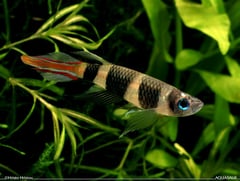
Epiplatys annulatusClown Killifish
Nothobranchiidae · Boulenger, 1915
The clown killifish, Epiplatys annulatus, is a small killifish from coastal lowlands of southern Guinea, Sierra Leone and northwestern Liberia. Also traded as 'rocket killifish' and 'banded panchax', it has four very broad dark bars alternating with yellowish ones. Fin colour varies between populations, which aquarists keep labelled by locality, and it is relatively easy to breed.
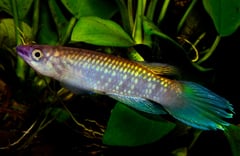
Epiplatys fasciolatusBanded Epiplatys
Nothobranchiidae · Günther, 1866
The banded epiplatys, Epiplatys fasciolatus, is a killifish from coastal Guinea-Bissau, Guinea and Sierra Leone to western Liberia. It mostly inhabits freshwater swamps and minor tributary streams, in grassy savannah at some localities and rainforest at others. Males carry metallic blue or green pigmentation on the body and fins, with a red submarginal band on the anal and lower caudal fins.

Ladigesia roloffiJelly Bean Tetra
Alestidae · Géry, 1968
The jelly bean tetra, Ladigesia roloffi, is a small alestid from Sierra Leone, known with certainty only from the Kasewe Forest reserve. Also called the 'Sierra Leone dwarf characin', it is the only member of its genus and grows to around 31 mm SL. The IUCN assesses it as Endangered, and over 97% of Sierra Leone's primary forest has been destroyed, surviving only in protected reserves such as Kasewe. Soft, acidic water is a prerequisite for breeding.