Epiplatys annulatus
Clown Killifish
Formerly Haplochilus annulatus Boulenger, 1915 · Pseudepiplatys annulatus Boulenger, 1915 · Aplocheilus annulatus Boulenger, 1915
Last revised 2026Edit this page
On this page13 sections
Quick factsEdit
Difficulty7 of 8 measures
Rated moderate because it needs a well-established tank and stable water.
- Space
- medium tank
- Water
- flexible
- Temp
- flexible
- Diet
- unknown
- Temperament
- peaceful
- Social
- needs to be in a group
- Compatibility
- choose tankmates carefully
Other demands
Each of these can raise the rating on its own, whatever the measures above say.
- Hardiness
- needs a well-established tank
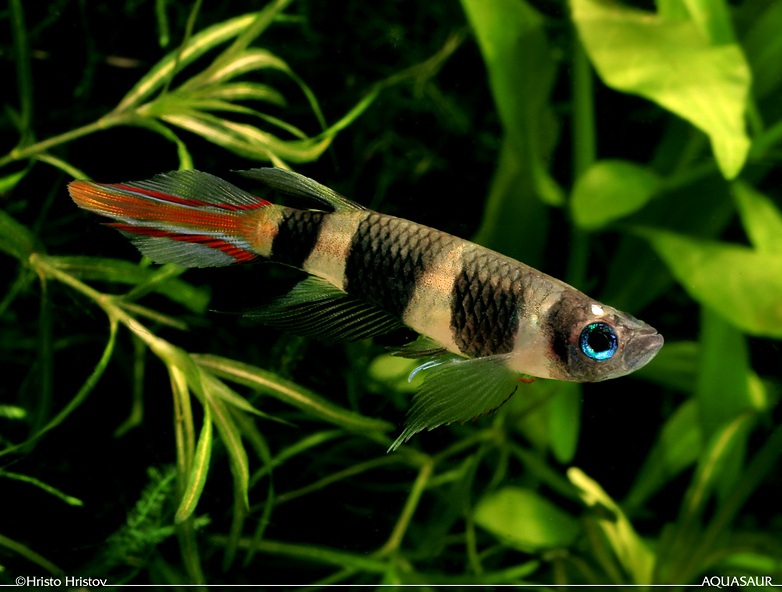
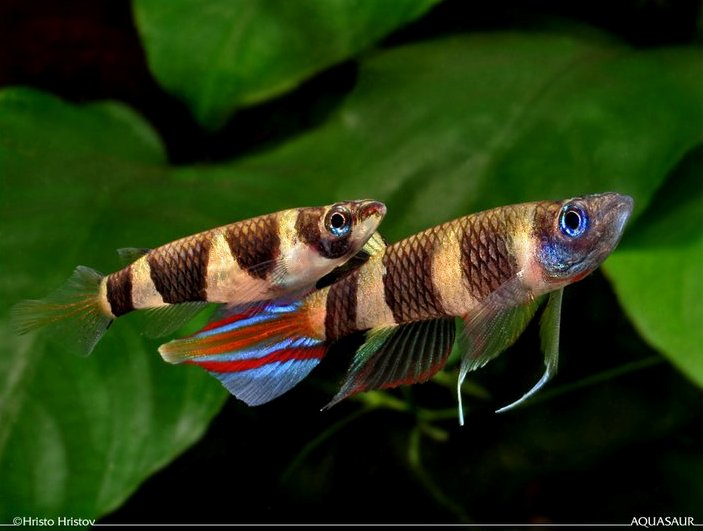
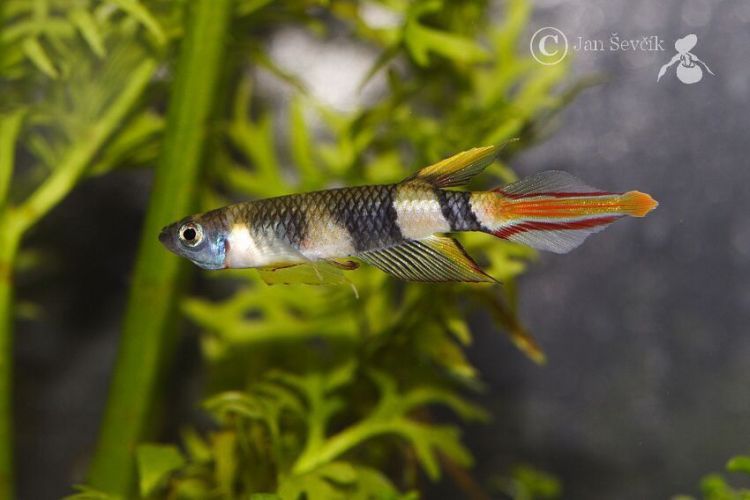
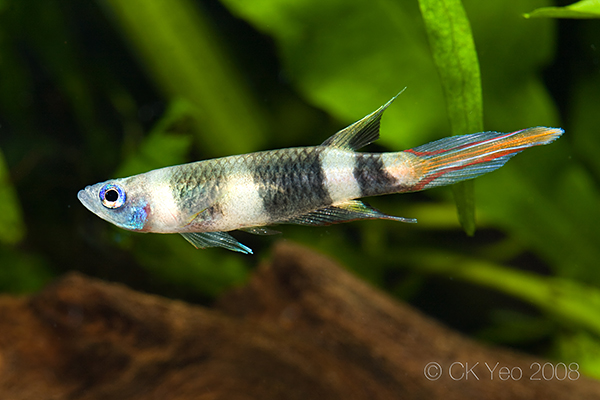
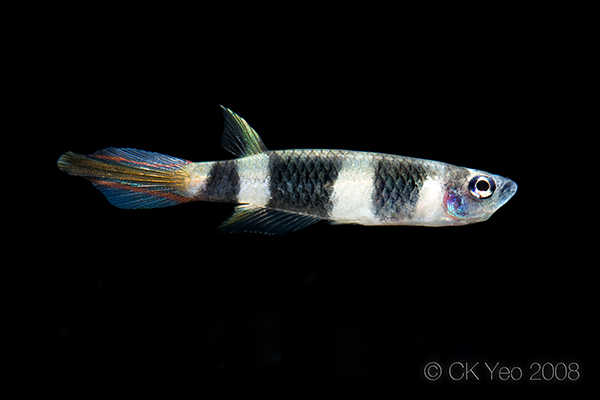
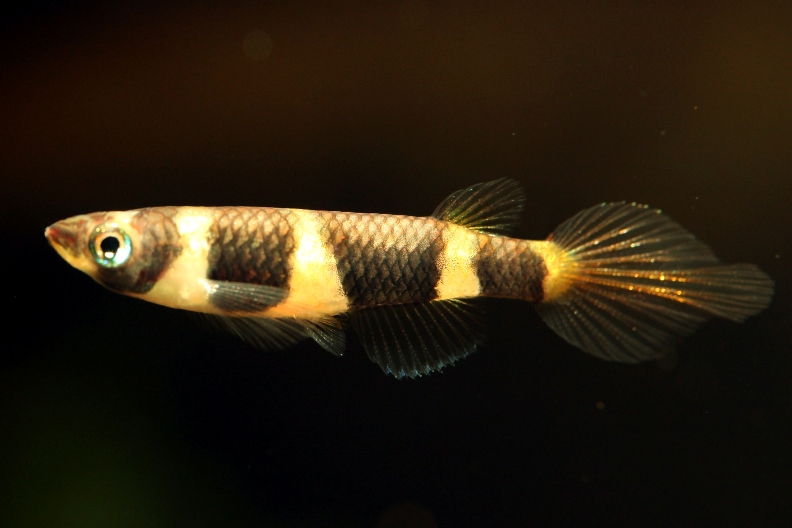
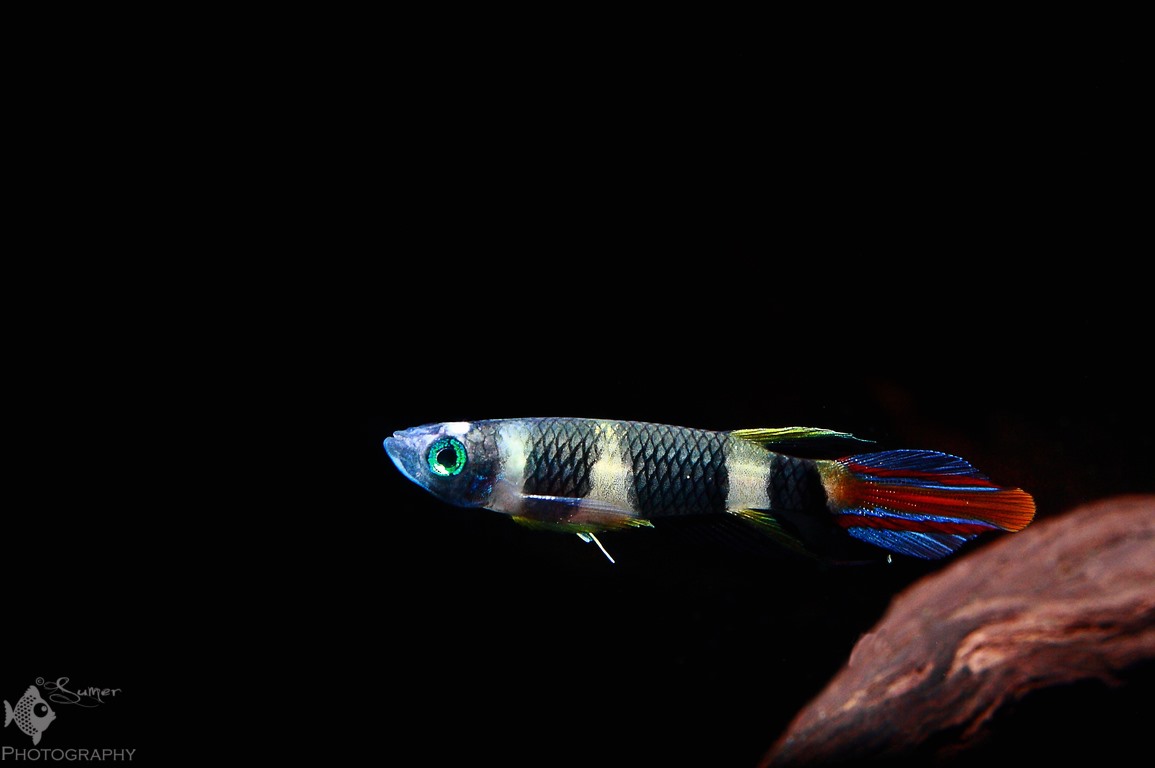
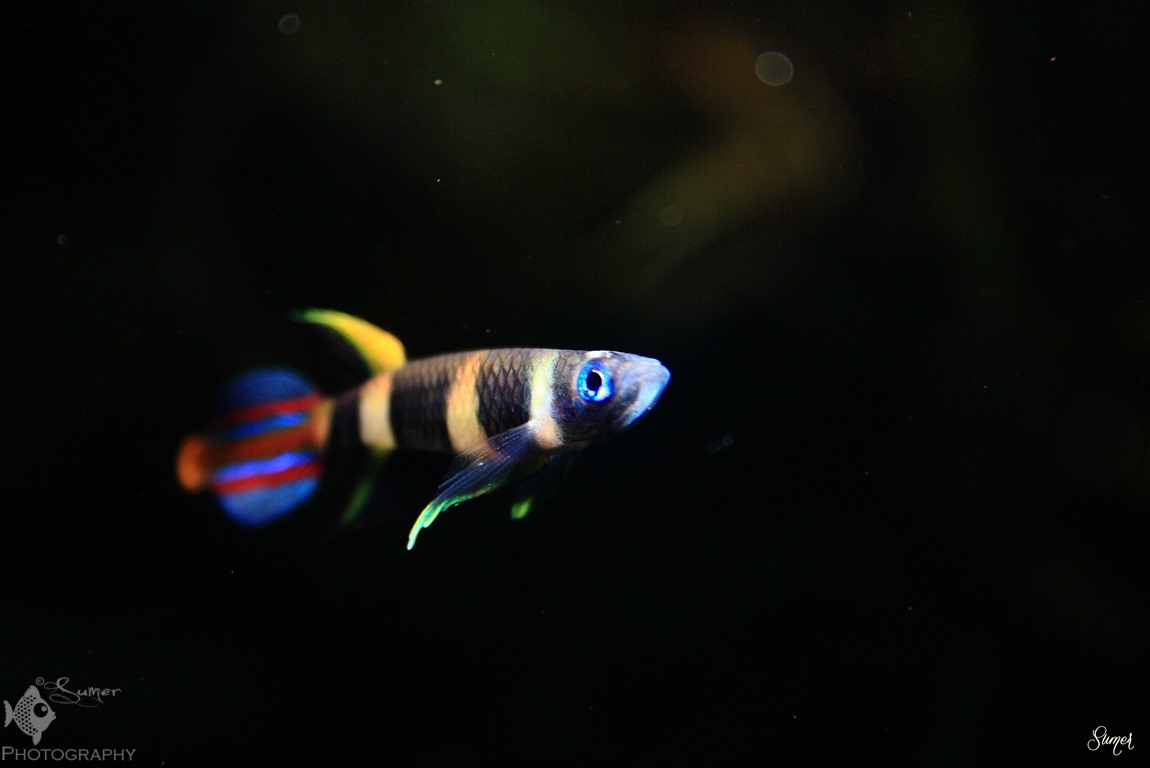
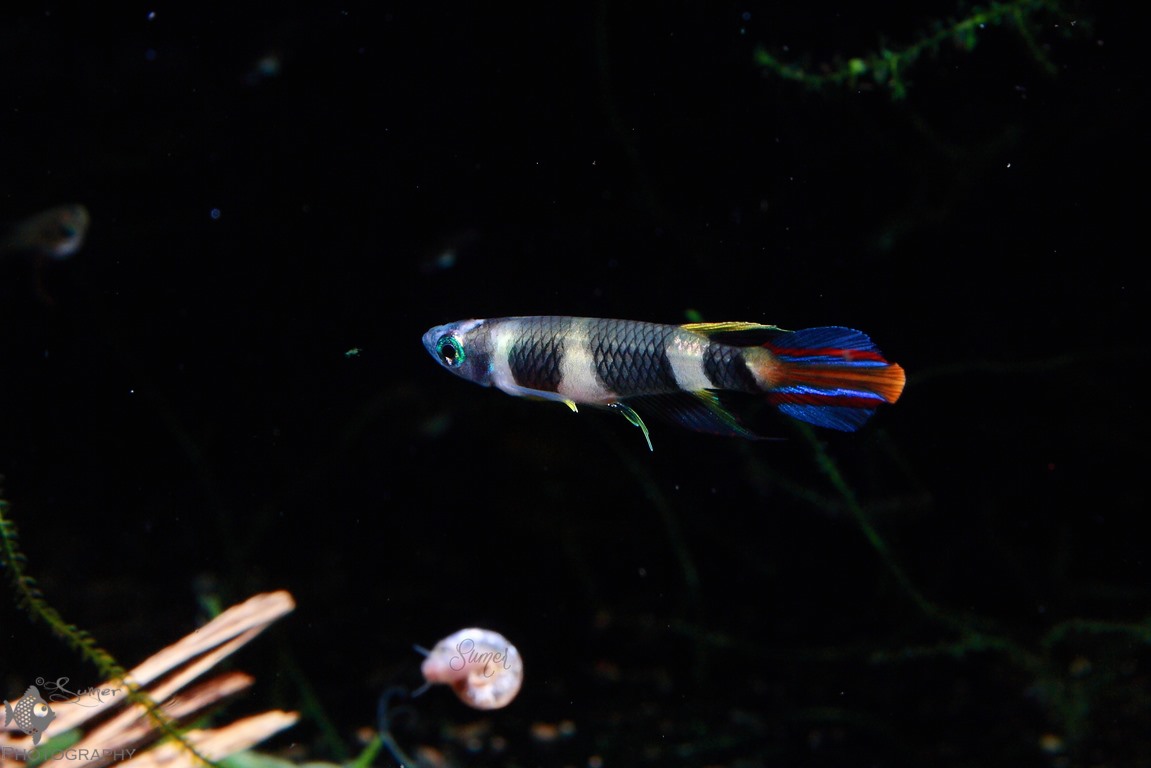
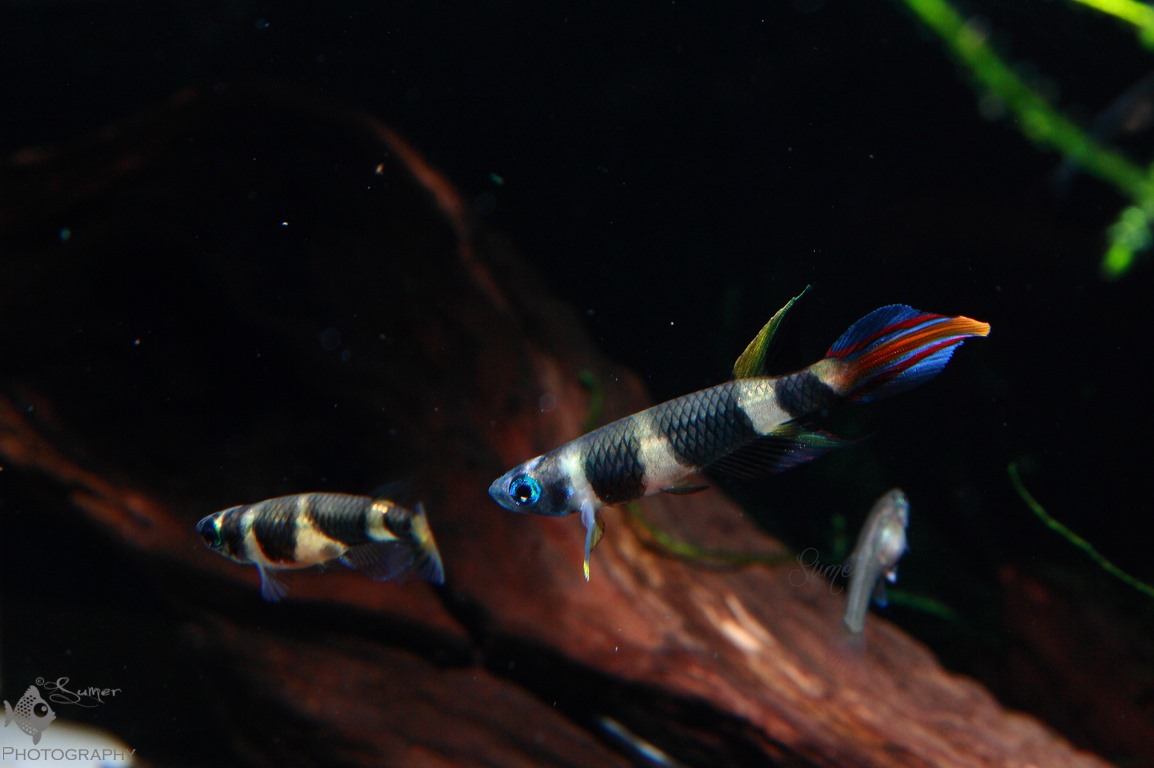
The clown killifish, Epiplatys annulatus, is a small killifish from coastal lowlands of southern Guinea, Sierra Leone and northwestern Liberia. Also traded as 'rocket killifish' and 'banded panchax', it has four very broad dark bars alternating with yellowish ones. Fin colour varies between populations, which aquarists keep labelled by locality, and it is relatively easy to breed.
Etymology
EditEpiplatys: from the Greek ἐπί (epí), meaning 'above, on top of', and πλατύς (platýs), meaning 'flat, broad', in reference to the flat dorsal surface of the anterior half of the body in members of this genus.
annulatus: from the Latin annulus, meaning 'ring', in reference to this species' banded colour pattern.
Distribution
EditWidely-distributed in coastal lowlands of southern Guinea and Sierra Leone to northwestern Liberia (around Monrovia).
Boulenger gave the type locality as 'Matea, Sierra Leone' with this assumed to refer to a settlement currently known as 'Maka' in the Moka river system, southern Sierra Leone.
When the collection locality is known aquarists tend to label the fish as such in order to avoid hybridisation and preserve bloodlines, e.g., Brama Town, Conakry, Fallaba, Fandié, Kasewe, Kinkon, Kobora, Maboshi, Maka, Monrovia, Njala, Petifu-Junction, Robertsport, Serabu, Sogiyah, Sowoja., etc.
Habitat
Write a noteEditInhabits lowland swamps, slowly-moving streams and small rivers in areas of open savannah and tropical rainforest where it's found among marginal vegetation or aquatic plants.
Most habitats are freshwater although it also occurs in slightly brackish conditions at some localities.
The climate across its range is hot and wet with a pronounced wet season between April-May and October-November), and most rivers tend to run perennially.
The water is generally warm, soft and acidic but much primary rainforest has been destroyed with surviving pockets existing as protected forest reserves in many cases.
Kasewe is one such reserve in Moyamba district, Sierra Leone, and comprises an area of hills composed of volcanic rock covered by moist, semi-deciduous and evergreen forests.
Other fish species known from Kasewe include Ladigesia roloffi, Scriptaphyosemion chaytori, Pelvicachromis humilis, Mochokiella paynei and Notoglanidium thomasi.
Aquarium size
Write a noteEditMinimum base dimensions of 45 ∗ 30 cm18 ∗ 12 in or equivalent are recommended although smaller aquaria can be used for breeding purposes.
Maintenance
Write a noteEditPerhaps looks best in a heavily-planted set-up or natural-style arrangement comprising a sandy substrate plus some driftwood roots and branches.
The addition of dried leaf litter would further emphasise the natural feel and as well as offering additional cover for the fish brings with it the growth of microbe colonies as decomposition occurs.
These can provide a valuable secondary food source for fry and the humic substances released by the decaying leaves are also considered beneficial, with alder cones also useful in this respect.
There’s no need to use natural peat, the collection of which is both unsustainable and environmentally-destructive.
This species seems to do best under fairly dim lighting but you can add aquatic plant species that can survive under such conditions such as Microsorum, Taxiphyllum or Anubias spp., while floating vegetation, such as Ceratopteris spp., is also appreciated.
It’s also sensitive to fluctuating or deteriorating water conditions and should never be added to biologically-immature aquaria.
Water conditions
EditThese recommendations come from this profile’s own figures. They contain affiliate links, so we may earn a commission.
Diet
Write a noteEditProbably a micropredator feeding on terrestrial and aquatic invertebrates and other zooplankton in nature.
In the aquarium it will accept dried foods of a suitable size but should also be offered daily meals of small live and frozen fare such as Artemia nauplii, Daphnia, Moina, grindal worm, etc.
Behaviour and compatibility
Write a noteEditPeaceful with other species but does not make an ideal community fish due to its small size and somewhat specialised requirements.
Small tetras such as Ladigesia roloffi, Lepidarchus adonis or Neolebias ansorgii make good tankmates as in fact do most similarly-sized, quiet species that enjoy comparable conditions such as many smaller cyprinids, anabantoids, callicthyids and loricariids.
It’s also a suitable companion for many smaller cichlid species, but in all cases thorough research should be conducted prior to purchase.
Try to buy at least 8-10 specimens since this species is relatively gregarious and the fish will not only be less shy but display more interesting behaviour when maintained in larger groups.
Sexual dimorphism
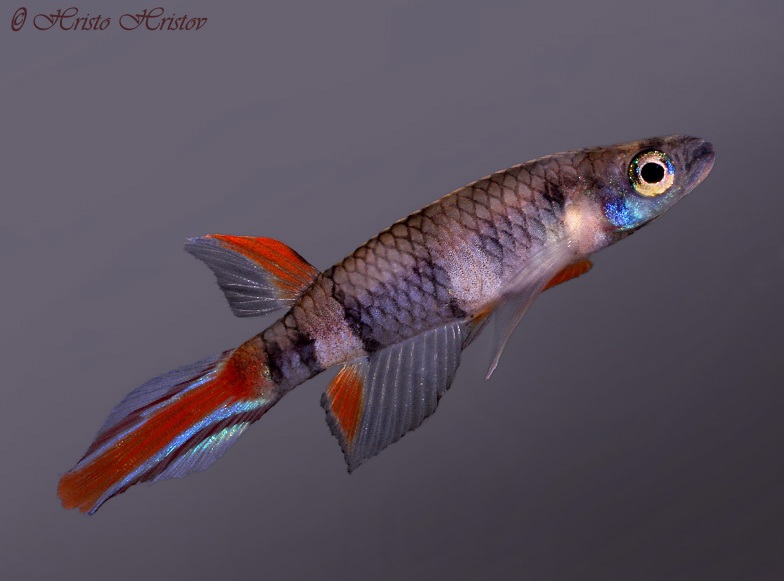
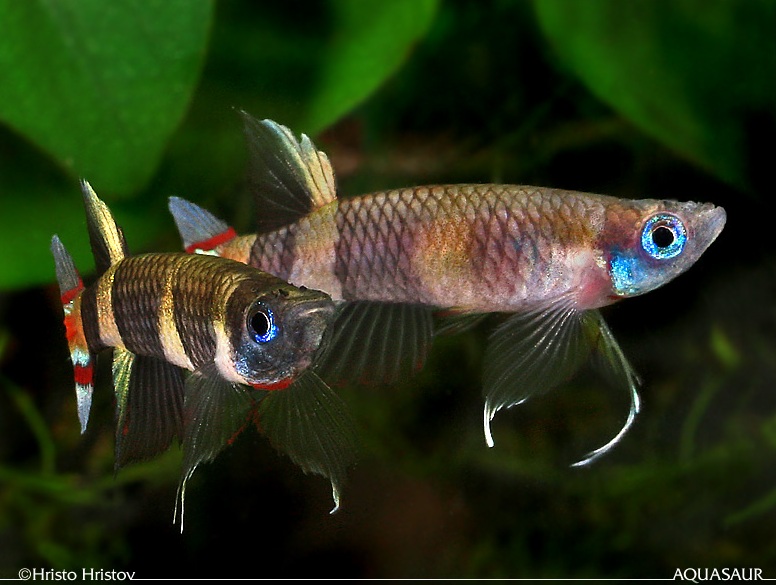
Write a noteEditMales are more colourful, develop more-extended fins and grow larger than females.
Reproduction
Write a noteEditRelatively easy to breed and in a well-decorated, mature species set-up fry may begin to appear without further intervention.
If the adults are being maintained in a community tank, however, it's best to organise a separate aquarium for breeding purposes.
This can be very simple provided it contains a suitable medium for the fish to deposit their eggs in with Riccia, Taxiphylum spp. mosses, the roots of floating plants or woollen spawning mops all equally suitable, and if filtration is desired a small air-driven sponge-type unit is best.
Most breeders use a pair or single male plus two or more females with some preferring to remove and replace the medium every few days, incubating and hatching the eggs elsewhere, while others simply leave everything in situ until free-swimming fry can be seen near the water surface.
Incubation is around 9-12 days at 24 – 25 °C75 – 77 °F.
Provided the plants used are mature the fry are usually able to survive on the microorganisms which are present naturally, and a dried leaf or two can be added which will also promote the growth of such animals.
If raising the fry in more sterile conditions they initially require microscopic foods such as rotifers until large enough to accept Artemia nauplii and suchlike.
Apparently the adults don't predate their offspring but older fry do eat the younger so should be moved elsewhere as soon as they're large enough.
It's important to omit larger invertebrates such as snails or shrimp from the breeding tank as they will consume E. annulatus eggs.
Notes
EditThis species is also traded as 'rocket killifish' and 'banded panchax' and has previously been included in the monotypic genus Pseudepiplatys.
The latter is not currently considered valid since it was found to render the remaining group of Epiplatys species paraphyletic.
E. annulatus exhibits differences in colour pattern depending on population especially in the unpaired fins. The anal-fin may or may not have a red distal margin, for example, while in some forms the dorsal and anal fins are yellow.
Following the key of Romand (1992) it can be told apart from congeners by the following combination of characters: presence of 4 very broad, dark, transverse bars alternating with yellowish bars between the snout and caudal-fin; longitudinal bands never present; adult size < 50 mm2.0 in SL.
Epiplatys is the most widely-distributed genus of West African aplocheiloid killifish with a range overlapping that of the other genera native to the region which are more restricted and split into eastern and western groups based on their respective patterns of distribution.
For example, Callopanchax is restricted to coastal lowlands of far Western Africa with Scriptaphyosemion and Archiaphyosemion known only from the interior of the Western rainforest, whereas Aphyosemion and Fundulopanchax present more easterly ranges extending south and eastward from Nigeria.
Although previously considered closely-related to the genus Aplocheilus due to shared similarities such as possessing an upturned mouth and dwelling mostly near the water surface Epiplatys is in fact affiliated with the western group above, i.e., its closest relatives are Callopanchax, Scriptaphyosemion and Archiaphyosemion.
In addition the phylogenetic analysis of Collier et al. (2009) revealed the existence of two distinct clades within Epiplatys itself, one comprising those species restricted to the Western rainforest (the western/savanna clade) and other those inhabiting lowland (coastal) swamps and streams west of the Dahomey Gap.
Most members of the coastal clade have a colour pattern consisting of broad, dark vertical bars which are present in juveniles of those species which lack them as adults, plus many populations possess an asymmetric caudal-fin shape with an extended lower lobe, whereas western clade species tend to lack or only possess thin oblique dark bars on the body and have symmetrically-shaped caudal fins.
References
- Boulenger, G. A. (1915). Descriptions of new freshwater fishes from Sierra Leone. Annals and Magazine of Natural History (Series 8) v. 15 (no. 86), 202-204
- Hertwig, S. T. (2008). Phylogeny of the Cyprinodontiformes (Teleostei, Atherinomorpha): the contribution of cranial soft tissue characters. Zoologica Scripta 37(2), 141-174
- Collier, G. E., W. J. Murphy and M. Espinoza (2009). Phylogeography of the genus Epiplatys (Aplocheiloidea: Cyprinodontiformes). Molecular Phylogenetics and Evolution 50(1), 190-196
- Aarn, A. and M. A. Shepherd (2001). Descriptive anatomy of Epiplatys sexfasciatus (Cyprinodontiformes: Aplocheilidae) and a phylogenetic analysis of Epiplatina. Cybium 25(3), 209-225
- Paugy, D., C. Lévêque and G. G. Teugels (2004). The Fresh and Brackish Water Fishes of West Africa Volume 2. RD Éditions, Publication scientifiques du Muséum, MRAC, 1-816
- Romand, R. Cyprinodontidae. In: Lévêque, C., D. Paugy and G. G. Teugels (eds) (1992). Faune des poissons d'eaux douces et saumâtres de l'Afrique de l'Ouest Tome 2. Collection Fauna Tropicale no. XXVIII. Musée Royal de l'Afrique Centrale, Tervuren, Belgique and O.R.S.T.O.M., Paris, France, 389-902
Species images · 12
These photographs are used with each photographer's permission.
Send a photograph