Country · Africa
Uganda
Only species with a profile on Seriously Fish are counted, whether native or introduced.
- Species
- 8
- Families
- 5
- Genera
- 8
- Found only here
- 1
- Photographed
- 8 of 8
The country
These figures are from Wikidata, checked on 24 October 2026.
Shares its fishes withspecies recorded in both
Found only here1
1 of the species on this page are recorded in Uganda and in no other country. This is not the same as being endemic.

Ctenopoma murieiOcellated Bushfish
Anabantidae · authority not recorded
The ocellated bushfish, Ctenopoma muriei, is one of the smallest members of its genus, recorded from Egypt and Sudan south to Tanzania and Zambia. It lives in sluggish or still waters such as pools, lagoons and swamps, many of them low in dissolved oxygen. Rarely seen in the trade, it will eat only the tiniest fish and suits an African community with Alestiid tetras, dwarf cichlids and small Mochokid catfish.

Haplochromis latifasciatus
Cichlidae · authority not recorded
Haplochromis latifasciatus is a cichlid found only in Lake Kyoga and the adjacent Lake Nawampasa, satellite lakes north of Lake Victoria in Uganda. Critically endangered in nature and possibly extinct in Lake Kyoga, it is quite easily bred in aquaria. It is often sold under the invalid name Astatotilapia latifasciata, or as Haplochromis sp. 'zebra obliquidens' or H. obliquidens, a Victorian species from a different lake. A maternal mouthbrooder, it must not be kept with Victorian Mbipi as they may hybridise.

Oreochromis niloticusNile Tilapia
Cichlidae · (Linnaeus, 1758)
The Nile tilapia, Oreochromis niloticus, is a cichlid with a very wide natural range in Africa, from Senegal east to Egypt and Uganda. Bred in huge numbers as a food fish, it has been introduced to over 70 other countries and is one of the most invasive fish species in the world. It reaches 60 cm, though usually around 35 cm, breeds readily, is very messy and does not make a good aquarium subject.
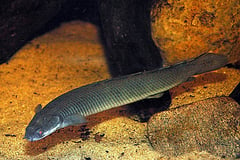
Polypterus senegalusSenegal Bichir
Polypteridae · Cuvier, 1829
The Senegal bichir, Polypterus senegalus, is the most widespread bichir, found in 26 African countries including Egypt and Senegal. It is usually found in shallow, slow-moving swamps, marshes and freshwater lagoons. One of the more peaceful and active Polypterus, it reaches 50 cm, is recommended for beginners with these fish, and has lived for over 30 years in aquaria.

Pundamilia nyererei
Cichlidae · (Witte-Maas & Witte, 1985)
Pundamilia nyererei is a maternally mouthbrooding cichlid endemic to Lake Victoria, recorded only from the southern part of the lake in Tanzania. It is mostly restricted to rocky, littoral habitats around islands. At least 11 populations are known and male colour varies with locality, so fish are labelled with collection details to avoid hybridisation in aquaria. Males are aggressive and can kill other males if the tank lacks cover.
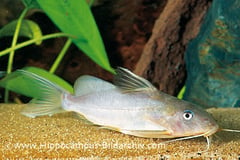
Synodontis schall
Mochokidae · authority not recorded
Synodontis schall is a large, predatory Synodontis catfish recorded from seventeen African countries, among them Nigeria, Egypt and Kenya. Regarded as the 'bad boy' of the genus in aquarium circles, it grows to 375 mm SL, is randomly aggressive and will eat smaller fish, so it should be kept only with tankmates that can stand their own ground. It is an important food fish in some of its native countries.
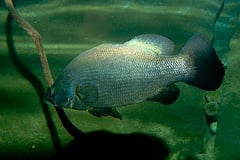
Lates niloticusNile Perch
Latidae · authority not recorded
The Nile perch, Lates niloticus, is a giant predatory fish from Central and Western Africa, reaching 193 cm and up to 200 kg. Introduced into many African countries as a food fish, it is thought to have contributed to the extinction of over 200 endemic species in Lake Victoria, and the IUCN lists it among the world's top 100 invasive species. Juveniles turn up in some aquatic stores, but it is not suited to captive life in any respect.

Pseudocrenilabrus multicolorDwarf Egyptian Mouth-brooder
Cichlidae · authority not recorded
The dwarf Egyptian mouth-brooder, Pseudocrenilabrus multicolor, is a small cichlid from Egypt, Sudan, Uganda, Rwanda, Kenya and Tanzania. One of the first cichlids to be spawned in captivity, it has been in the hobby for over a century and breeds easily as a maternal mouth-brooder. The two subspecies, P. m. multicolor and P. m. victoriae, differ in colour and pattern and should not be kept together, to prevent hybridisation.