Country · Africa
Tanzania
Only species with a profile on Seriously Fish are counted, whether native or introduced.
- Species
- 93
- Families
- 12
- Genera
- 53
- Found only here
- 9
- Photographed
- 85 of 93
Shares its fishes withspecies recorded in both
Found only here9
9 of the species on this page are recorded in Tanzania and in no other country. This is not the same as being endemic.

Altolamprologus compressicepsCompressed Cichlid
Cichlidae · (Boulenger, 1898)
The compressed cichlid, Altolamprologus compressiceps, is a substrate-spawning cichlid endemic to Lake Tanganyika, where it lives among rocky rubble. Its colour pattern varies with locality, and many forms are traded under their own names, such as 'Burundi red fin' and 'black cheek'. Populations should be kept apart and labelled with their collection locality to avoid hybridisation. A smaller, shell-dwelling fish traded as A. sp. compressiceps 'shell' appears to be an undescribed species.

Aristochromis christyi
Cichlidae · Trewavas, 1935
Aristochromis christyi is a predatory cichlid endemic to Lake Malawi, found throughout the lake but most commonly in intermediate zones. Growing to 300 mm SL, it is not particularly common in the lake or the hobby. Its beak-like mouthparts are adapted for hunting small fish in crevices between rocks, and it also ambushes prey, sometimes rolling onto its side as it approaches then taking it with a fast sideways motion.

Aulonocara jacobfreibergiMalawi Butterfly
Cichlidae · (Johnson, 1974)
The Malawi butterfly, Aulonocara jacobfreibergi, is a cichlid endemic to Lake Malawi, living where rocky shores give way to sand. One of the larger members of the genus, with males reaching 150 to 170 mm, it was among the first Aulonocara species in the hobby and is also sold as 'Freiberg's peacock' and 'fairy cichlid'. Males react aggressively to fish with a similar colour pattern, so tankmates need choosing with care.

Aulonocara stuartgrantiGrant's Peacock
Cichlidae · Meyer & Riehl, 1985
Grant's peacock, Aulonocara stuartgranti, is a cichlid endemic to Lake Malawi, widely distributed along both the east and west coastlines. Males vary in colour by locality, with blue forms found mostly in the north of the lake and yellow in the south, and many populations are traded under their own names. That variation has caused taxonomic problems: A. baenschi, A. korneliae and A. hueseri were all once considered forms of it. It inhabits the intermediate zones where rocky shores give way to sand.
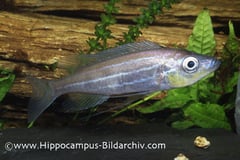
Benthochromis tricoti
Cichlidae · (Poll, 1948)
Benthochromis tricoti is a deep-water cichlid endemic to Lake Tanganyika, where it lives in open water and feeds on zooplankton. The species is seldom seen in the hobby as it is difficult to collect and ship, and the similar B. horii, described in 2008, had been confused with it and traded under its name. It needs a long tank with the upper two thirds left clear for swimming, and calm tankmates.

Buccochromis lepturusSlender Tail Hap
Cichlidae · authority not recorded
The slender tail hap, Buccochromis lepturus, is a large cichlid endemic to Lake Malawi, also known as the green lepturus. Adults live in deeper water throughout the lake, though juveniles can be seen in quite shallow water around the shorelines. Its pelagic nature makes it difficult to catch for export, so it is rarely seen for sale. It grows to 400 mm SL, and small fish will end up on the menu.

Buccochromis nototaeniaStripeback Hap
Cichlidae · authority not recorded
The stripeback hap, Buccochromis nototaenia, is a predatory cichlid endemic to Lake Malawi. It hunts juveniles of other species over sandy substrates just off the shoreline, often driving them into shallower water. It is rarely seen in the trade because it retreats at great speed into deeper water at the first sign of threat, which makes it hard to collect.

Butis butisCrazy Fish
Butidae · (Hamilton, 1822)
The crazy fish, Butis butis, is a flathead gudgeon of coastal and brackish waters across the Indo-Pacific, from eastern Africa to Fiji. The most commonly traded member of the genus, it has many other names, including crocodile fish, duckbill sleeper and upside-down sleeper. A nocturnal ambush predator, it often swims upside-down, and it is territorial and not sociable with conspecifics, so is best kept singly.
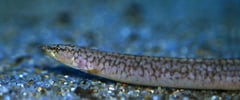
Caecomastacembelus albomaculatus
Mastacembelidae · authority not recorded
Caecomastacembelus albomaculatus is a spiny eel endemic to Lake Tanganyika, where it inhabits rocky areas around the shoreline. Rarely seen in the hobby, it suits a Tanganyikan community of species too large to be considered food, and its hard, alkaline water requirements rule out most other freshwater tanks. The stiffened dorsal rays that give spiny eels their name mean care is needed when handling it.

Callochromis macropsBig-eyed Mouthbrooder
Cichlidae · authority not recorded
The big-eyed mouthbrooder, Callochromis macrops, is a sand-sifting cichlid endemic to Lake Tanganyika, found in the southern part of the lake. It lives over shallow sandy bottoms near rocks, taking in mouthfuls of sand and sifting out invertebrates through the gills. Several geographical colour forms exist and should not be kept together, as they hybridise freely. Males are particularly belligerent towards one another in captivity, so a small tank suits one male with several females.

Chalinochromis sp. 'ndobhoi'
Cichlidae · authority not recorded
Chalinochromis sp. 'ndobhoi' is an undescribed cichlid from a limited stretch of Lake Tanganyika's eastern shore in Tanzania. Also traded as C. sp. 'ndoboi' or 'ndobnoi', it is told apart from C. brichardi and C. popelini by two or three series of irregular dark blotches along the body. It lives among rocky structures, males become highly territorial as they mature, and it should never be mixed with other Chalinochromis because they will hybridise.

Champsochromis caeruleusMalawi Trout
Cichlidae · authority not recorded
The Malawi trout, Champsochromis caeruleus, is a large predatory cichlid endemic to Lake Malawi, where it roams from rocky shores to open water. Also known as the trout cichlid, it is only occasionally offered for sale because its solitary lifestyle makes it difficult to collect. It is told apart from C. spilorhynchus by its more elongate shape, and at up to 32.5 cm this active, pelagic species needs a tank of at least 180 x 60 x 60 cm.

Champsochromis spilorhynchus
Cichlidae · authority not recorded
Champsochromis spilorhynchus is a large predatory cichlid known from Lake Malawi, Lake Malombe and the upper Shire River. It is only occasionally offered for sale because its solitary lifestyle makes it difficult to collect, and it is much sought after by enthusiasts. A deeper body and distinctive black markings on the snout separate it from C. caeruleus. At up to 35 cm, this active, pelagic species needs a very large tank with plenty of swimming space.
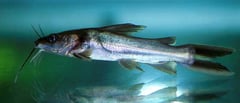
Clarotes laticepsWidehead Catfish
Bagridae · authority not recorded
The widehead catfish, Clarotes laticeps, is a large predatory catfish recorded across much of Africa, from Senegal and Guinea east to Egypt and Kenya. It inhabits large lakes and rivers and grows to 80 cm, though it is unlikely to reach this in captivity. Uncommon in the trade, it is capable of swallowing surprisingly large prey and is unsuitable for all but the biggest aquaria.

Copadichromis borleyi
Cichlidae · authority not recorded
Copadichromis borleyi is an Utaka cichlid endemic to Lake Malawi, where it shoals over rocky areas and isolated boulders at 5-20 metres. One of the species most commonly encountered in the hobby, it is available in several colour morphs, often divided into yellow and red finned forms and sold with the collection locality attached, such as 'Kadango'. It is also sold under invalid names such as Haplochromis 'red Kadango'. Other Copadichromis should be left out, as they can hybridise.

Copadichromis virginalis
Cichlidae · authority not recorded
Copadichromis virginalis is an Utaka cichlid endemic to the northern end of Lake Malawi, shoaling in open water around rocky shores and reefs. Numerous colour forms exist and are usually sold with the collection locality attached, such as 'Gold Nkanda'. It shoals alongside the similar C. ilesi at some locations, but males have a red stripe along the dorsal fin and the females are silver. Peaceful even by Copadichromis standards, it should not be combined with Mbuna.

Cyathopharynx furciferFeatherfin Cichlid
Cichlidae · authority not recorded
The featherfin cichlid, Cyathopharynx furcifer, is a maternal mouthbrooder endemic to Lake Tanganyika, where it lives over scattered rocks and sand. Highly sought after in the hobby but fairly delicate, it needs a lot of space and the highest water quality, and males develop full adult colour only at around 4 inches. Males dig spawning craters up to 60 cm across. The colour forms of the two Cyathopharynx species should not be kept together, as they can hybridise.

Cynotilapia afraDogtooth Cichlid
Cichlidae · authority not recorded
The dogtooth cichlid, Cynotilapia afra, is a Mbuna endemic to Lake Malawi, found around the rocky shoreline. It is easily confused with some Pseudotropheus but has unicuspid teeth, and its black flank bars continue into the dorsal fin. The many colour forms should not be mixed, as they interbreed. Belligerent and very aggressive towards its own species, it is one of the hardier Mbuna and a good choice for the newcomer to these fish.

Cyphotilapia frontosaHumphead Cichlid
Cichlidae · (Boulenger, 1906)
The humphead cichlid, Cyphotilapia frontosa, is a large cichlid endemic to the northern portion of Lake Tanganyika. Known in the hobby as 'frontosa' or 'front', it grows to 255 mm SL and is gregarious, forming a dominance hierarchy in groups of at least five. Populations are usually labelled by locality to preserve pure bloodlines, and forms referred to as 'Blue Zaire' belong to its only congener, C. gibberosa.

Cyphotilapia gibberosa
Cichlidae · Takahashi & Nakaya, 2003
Cyphotilapia gibberosa is a large cichlid endemic to southern Lake Tanganyika, with a hump on the forehead and broad vertical body bands. Until its description in 2003 the genus was considered monotypic, and forms referred to as 'Blue Zaire' are sometimes misidentified as C. frontosa. A gregarious maternal mouthbrooder, it grows to 255 mm SL and forms a dominance hierarchy in groups of at least five.

Cyprichromis leptosomaSardine Cichlid
Cichlidae · (Boulenger, 1898)
The sardine cichlid, Cyprichromis leptosoma, is a peaceful open-water cichlid endemic to Lake Tanganyika. In nature it congregates in shoals of several thousand, feeding on zooplankton, and it occurs in several geographical morphs, each in blue and yellow-tailed forms. Fish sold as C. leptosoma sp. 'Jumbo' grow larger than the 'true' leptosoma and are likely a different species, and none of these forms should be housed together because they can hybridise.
Cyprichromis microlepidotusSmallscale Cyprichromis
Cichlidae · (Poll, 1956)
The smallscale Cyprichromis, Cyprichromis microlepidotus, is an open-water cichlid endemic to Lake Tanganyika, mostly at the northern end of the lake. Quite a rarity in the hobby, it lives in huge mixed groups with other Cyprichromis species and the similar Paracyprichromis. Several geographical variants exist, each with a yellow and a blue-tailed form, and they should never be mixed in the aquarium because they will interbreed.

Dimidiochromis compressicepsMalawi Eye-Biter
Cichlidae · authority not recorded
The Malawi eye-biter, Dimidiochromis compressiceps, is a predatory cichlid endemic to Lake Malawi, where it is widely distributed. An ambush predator, it hides head-down among Vallisneria beds, its laterally compressed body and dark stripe from snout to tail helping to conceal it. Despite its name it mainly hunts small fish, and eye-eating happens infrequently in nature and rarely, if ever, in aquaria with well-fed specimens.

Ectodus descampsiiDescamp's Strange-Tooth Cichlid
Cichlidae · authority not recorded
Descamp's strange-tooth cichlid, Ectodus descampsii, is a shy cichlid endemic to Lake Tanganyika, between Moliro and Utinta Bay. It inhabits open water over sand and is gregarious, so a group of at least eight is recommended. An undescribed fish, Ectodus sp. 'north', is sometimes imported under this name and has a smaller adult size and a black dorsal spot towards the front of the fin (in the middle in E. descampsii).

Eretmodus cyanostictusStriped Goby Cichlid
Cichlidae · Boulenger, 1898
The striped goby cichlid, Eretmodus cyanostictus, is one of the goby cichlids endemic to Lake Tanganyika, living in the surge zone of rocky shores. It scrapes algae from the rocks with specialised teeth and has a swim bladder rendered useless to reduce buoyancy. Delicate in aquaria, it needs the highest water quality, a higher pH than many Tanganyikans and a specialised diet, and is not recommended for beginners.

Fossorochromis rostratus
Cichlidae · authority not recorded
Fossorochromis rostratus is a large, sand-sifting cichlid endemic to Lake Malawi, most common over shallow sandy substrates. When startled it may bury itself, and a sand substrate is essential since gravel may injure it. A very fast, active swimmer, it needs open water and should not be kept with boisterous species such as mbuna. Shoals of Cyrtocara moorii follow feeding groups in the wild to take the morsels they stir up.

Gnathochromis permaxillaris
Cichlidae · authority not recorded
Gnathochromis permaxillaris is a deep-water cichlid endemic to Lake Tanganyika, recorded foraging at depths of up to 200 metres. The upper lip of adults is extended to extraordinary proportions, so the mouth faces downwards when opened, and the fish uses it to sift invertebrates from the sand. It is rare in the trade because it is difficult to collect in numbers, it is sensitive to deteriorating water quality, and the colour morphs should not be mixed as they may hybridise.
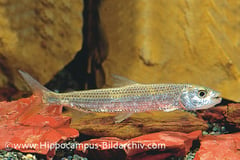
Hydrocynus vittatusAfrican Tiger Fish
Alestidae · authority not recorded
The African tiger fish, Hydrocynus vittatus, is a large predatory alestid found throughout Africa, from Egypt to South Africa. A voracious piscivore with dagger-shaped, interlocking teeth, it hunts in large shoals in the wild and is a popular game fish. Small specimens show up quite frequently in dealers' tanks, but even an aquarium of 300 by 90 cm is too small for an adult.

Julidochromis reganiRegan's Julie
Cichlidae · authority not recorded
Regan's julie, Julidochromis regani, is the largest species of Julie, a cichlid endemic to Lake Tanganyika. It reaches 30 cm but rarely grows beyond 15 cm in aquaria, and is the least aggressive member of the genus. Less of a rock dweller than its congeners, it is more often found over sand with scattered rocks, though it still spawns in rocky caves. It may also be seen for sale as the striped or convict julie.

Labeotropheus fuelleborniFuelleborn's Cichlid
Cichlidae · authority not recorded
Fuelleborn's cichlid, Labeotropheus fuelleborni, is an mbuna endemic to Lake Malawi, found in turbulent shallow water around rocky shorelines. An overhanging snout and chisel-shaped teeth let it graze algae from rocks other species cannot reach. It occurs in many colour forms, including orange and orange blotch females, and forms should not be mixed as they may hybridise. It is aggressive and territorial and should not be kept with peacocks or utaka.

Lestradea perspicax
Cichlidae · authority not recorded
Lestradea perspicax is a cichlid endemic to the northern end of Lake Tanganyika, where it inhabits shallow water over sandy substrates. There is some confusion over the taxonomy of this species and its congener L. stappersi, which was originally regarded as a subspecies of perspicax and is now considered distinct. Very peaceful, and a maternal mouthbrooder in nature, it is not often seen in the hobby.
Lophiobagrus cyclurusAfrican Bullhead
Claroteidae · authority not recorded
The African bullhead, Lophiobagrus cyclurus, is a small claroteid catfish endemic to Lake Tanganyika. It hides among rocks by day and forages after dark, and it lives in most communities of Tanganyikan catfish and cichlids, though very small fish will be eaten. It is rumoured to secrete a poisonous mucus when stressed that can kill other fish in the aquarium, which is one reason to house it in as large a tank as possible.
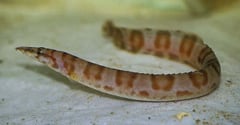
Mastacembelus ellipsiferTanganyikan Spiny Eel
Mastacembelidae · authority not recorded
The Tanganyikan spiny eel, Mastacembelus ellipsifer, is a spiny eel endemic to Lake Tanganyika. It is found around the shores, most often where the rocks give way to sandier substrates, and spends much of its time burrowed in the substrate, so the aquarium needs a layer of sand. Nocturnal and predatory, it is best kept in a Tanganyikan community with species too large to be considered food.
Mylochromis melanonotusHaplochromis Yellow-black Line
Cichlidae · authority not recorded
Known in the trade as 'Haplochromis yellow-black line', Mylochromis melanonotus is a predatory cichlid endemic to Lake Malawi. Rarely imported, it caused confusion because some individuals have a shovel-like lower jaw. Ad Konings found wild populations with and without it, and Platygnathochromis and M. semipalatus are now regarded as synonyms. A sandy substrate is essential, and it will eat small fish.
Neolamprologus brichardi
Cichlidae · (Poll, 1974)
Neolamprologus brichardi is a small cichlid endemic to Lake Tanganyika, found mainly over rocky shores in the northern half of the lake. Known in the hobby as the Princess of Burundi, it lives in large colonies where older young help their parents guard each new brood. It is very like N. pulcher and is told apart by the T-shaped pair of bars on its gill cover. The two hybridise, so they should not be kept together.

Neolamprologus buescheriStriped Lamprologus
Cichlidae · (Staeck, 1983)
The striped lamprologus, Neolamprologus buescheri, is a cichlid endemic to Lake Tanganyika, found around the southern part of the lake. One of the most aggressive small cichlids in the hobby, it is not recommended for the beginner and needs plenty of caves for subdominant fish. Several geographical morphs are available, including 'gombi', 'kachese', 'kamakonde' and 'zaire'.

Neolamprologus callipterus
Cichlidae · authority not recorded
Neolamprologus callipterus is a shell-brooding cichlid endemic to Lake Tanganyika, in which males grow many times larger than females. Males must be large enough to carry snail shells and females small enough to fit inside them, and in nature the nests of large males can measure several metres across. Males are territorial and aggressive, and the species is not very popular in the hobby because of its relatively drab colouration and aggressive nature.
Neolamprologus caudopunctatus
Cichlidae · (Poll, 1978)
Affectionately referred to as 'Puncs', the caudopunctatus is a social and active dwarf cichlid endemic to the rocky and intermediate areas of shallow waters in Lake Tanganyika. A substrate-spawning rock dweller in nature, 'Puncs' are also opportunistic shell dwellers in home aquaria.

Neolamprologus fasciatusBarred Lamprologus
Cichlidae · authority not recorded
The barred lamprologus, Neolamprologus fasciatus, is a predatory cichlid endemic to Lake Tanganyika, living mainly in rocky areas. Its laterally compressed body lets it enter crevices in the rockwork to prey on invertebrates, eggs, fry and small fish. It is sometimes confused with juvenile Altolamprologus but has a blue-green iris and a more elongate body.

Neolamprologus kungweensisOcellated Shell-dweller
Cichlidae · (Poll, 1956)
Neolamprologus kungweensis is a territorial cichlid endemic to Lake Tanganyika, where it lives over open mud flats at 10 to 50 m and digs tunnels in the firm mud. It can be recognised by the gold on top of the eye and a black spot towards the back of the dorsal fin. It uses snail shells only occasionally in the wild. In the aquarium it breeds in them, and it needs a deep soft substrate to dig in and more empty snail shells than there are fish. It is not often seen in the hobby.

Neolamprologus lemairiiLemaire's Lamprologus
Cichlidae · authority not recorded
Lemaire's lamprologus, Neolamprologus lemairii, is a piscivorous cichlid endemic to Lake Tanganyika, growing to around 25 cm. An ambush predator, it lies motionless on the substrate so that its mottled pattern makes it appear dead to the smaller fish that come to investigate. It is unsuited to the general aquarium and should be kept alone, with tankmates too large to be considered food. In nature it spawns in caves.

Neolamprologus pulcherBrichardi
Cichlidae · (Trewavas & Poll, 1952)
Known in the hobby as the brichardi, Neolamprologus pulcher is a cichlid endemic to Lake Tanganyika, where it lives over rocky shoreline. It is sold as the fairy cichlid, lyretail cichlid and princess of Burundi, and is easy to keep and breed. It is aggressively territorial, especially when guarding fry, and in nature occurs in shoals of many thousands. Species in the 'Brichardi complex' hybridise freely and should not be mixed.

Neolamprologus tretocephalusFive-barred Lamprologus
Cichlidae · authority not recorded
The five-barred lamprologus, Neolamprologus tretocephalus, is an aggressive cichlid endemic to Lake Tanganyika. It lives in relatively shallow water over rocky areas and intermediate zones with scattered rocks. Five vertical bars on the flanks, against six in N. sexfasciatus, separate the two species. Its aggression, particularly when breeding, rules it out of the general Tanganyikan community.

Nimbochromis livingstonii
Cichlidae · (Günther, 1894)
Nimbochromis livingstonii is a predatory cichlid endemic to Lake Malawi, where it is fairly widespread. An ambush predator, it lies motionless on the substrate and its mottled pattern makes it appear dead to the smaller fish that come to investigate. This 'playing dead' behaviour gave it the local name 'Kaligono', loosely 'sleeper'. It is not a fish for the general Malawi cichlid community.

Nimbochromis venustusVenustus
Cichlidae · (Boulenger, 1908)
The venustus, Nimbochromis venustus, is a predatory cichlid endemic to Lake Malawi, where it is fairly widespread. Also sold as 'giraffe hap' or 'giraffe cichlid' after its pattern of irregular dark markings, it is an ambush predator that lies motionless on the substrate to take smaller fish. It is not a fish for the general Malawi cichlid community.
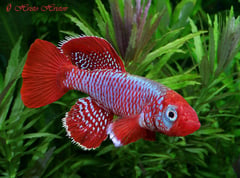
Nothobranchius eggersi
Nothobranchiidae · Seegers, 1982
Nothobranchius eggersi is an annual killifish apparently endemic to the lower Rufiji in eastern Tanzania, including freshwater parts of the delta. It inhabits ephemeral pools and swamps on lowland floodplains that dry out for several months each year, and survives as eggs in the substrate. Many wild populations are in the hobby, labelled with collection codes to limit hybridisation, alongside aquarium strains labelled 'red' or 'blue'.
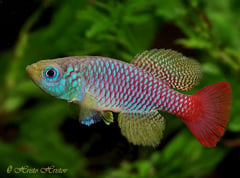
Nothobranchius foerschi
Nothobranchiidae · Wildekamp & Berkenkamp, 1979
Nothobranchius foerschi is an annual killifish from eastern Tanzania that may be restricted to a small area of the Ruvu River catchment. All confirmed records come from the Ruvu and its delta, between Soga and the coast at Bagamoyo. It inhabits ephemeral pools and swamps on lowland floodplains, mostly heavily overgrown with terrestrial vegetation, and an aquarium strain appears more yellowish than the wild form.
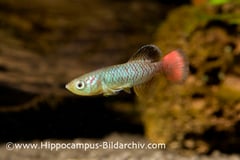
Nothobranchius guentheriGunther's Nothobranch
Nothobranchiidae · (Pfeffer, 1893)
Gunther's nothobranch, Nothobranchius guentheri, is an annual killifish endemic to Unguja, the main island of Zanzibar, Tanzania. It lives in seasonal coastal pools that dry out completely, surviving the dry season as eggs in the mud. One of the easier Nothobranchius to keep and breed, it is often recommended for a first attempt at an annual killifish. The IUCN lists it as Endangered because its pools are being lost to farming.

Ophthalmotilapia boops
Cichlidae · authority not recorded
Ophthalmotilapia boops is a mouthbrooding cichlid endemic to Lake Tanganyika, found only along the southern Tanzanian coastline. It inhabits rocky drop-offs and slopes. A relatively boisterous species needing a lot of space for its size, it becomes withdrawn unless it is the dominant species in the tank, and males are aggressive towards each other. It was the first species placed in the genus Ophthalmotilapia.

Ophthalmotilapia nasuta
Cichlidae · authority not recorded
Ophthalmotilapia nasuta is a mouthbrooding cichlid endemic to Lake Tanganyika, found on its northwestern, southwestern and southern coasts. A fleshy, proboscis-like growth extending beyond the upper lip, more prominent in males, separates it from the rest of the genus. Several geographical morphs exist, including 'Kachese', 'Mpimbwe', 'Cape Tembwe' and 'Chamba', and these should not be mixed as they hybridise freely.

Ophthalmotilapia ventralis
Cichlidae · authority not recorded
Ophthalmotilapia ventralis is a mouthbrooding cichlid endemic to Lake Tanganyika, found around most of the lake's coastline. It exists in well over 20 colour morphs, which hybridise freely and should not be mixed. In nature only the largest dominant males build nests, holding territories that may measure several metres across, while subdominant males and females shoal together.

Oreochromis tanganicaeTanganyikan Tilapia
Cichlidae · authority not recorded
The Tanganyikan tilapia, Oreochromis tanganicae, is a large cichlid endemic to Lake Tanganyika, where it inhabits river mouths and shorelines. It is often seen in shoals in nature and appears to feed primarily on phytoplankton. Reaching 42 cm, it is not seen very often in the hobby.

Paracyprichromis brieni
Cichlidae · authority not recorded
Paracyprichromis brieni is a deep-water cichlid endemic to Lake Tanganyika, where it is quite widespread. Males hold territories under rocky overhangs and are often seen hanging upside down beneath them, while females stay in open water above the rocks. It is easily confused with P. nigripinnis, its only congener, but has smaller eyes and a slimmer, more elongate body, and it quickly loses its best colouration under bright lighting or with boisterous tankmates.

Paracyprichromis nigripinnis
Cichlidae · (Boulenger, 1901)
A deep-water cichlid endemic to Lake Tanganyika, Paracyprichromis nigripinnis is easily confused with P. brieni, its only congener. It has larger eyes and a slightly rounder, stockier body than that species. Males hold territories under rocky overhangs and can often be seen hanging upside down beneath them. Several colour morphs exist that hybridise if mixed, and the fish loses its best colouration under bright lighting or with boisterous tankmates.

Petrochromis famula
Cichlidae · authority not recorded
Petrochromis famula is a cichlid endemic to Lake Tanganyika, found only in the northern part of the lake in shallow water over rocky bottoms. Its highly specialised mouthparts form a rasping 'plate' for scraping algae from rock, so the diet in captivity should be high in fibre and low in protein. Like others in the genus it has a nasty reputation, though aggression is directed primarily towards conspecifics.
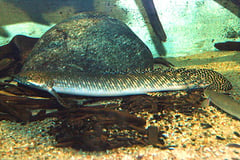
Polypterus ornatapinnisOrnate Bichir
Polypteridae · authority not recorded
The ornate bichir, Polypterus ornatapinnis, is a nocturnal bichir from Cameroon, the Democratic Republic of Congo, Burundi, Angola and Tanzania. It is found in rivers, ponds, marshes and lakes, including Tanganyika. The largest of the 'upper-jawed' polypterids, it reaches 60 cm, though usually less in aquaria, and will eat any tankmate small enough to fit in its mouth.

Protomelas fenestratusFenestratus
Cichlidae · authority not recorded
Known as the fenestratus, Protomelas fenestratus is a cichlid endemic to Lake Malawi, found in the northern and southwestern parts of the lake. It inhabits rocky shorelines and the sandy zones beyond them, feeding by blowing sediment from rocks and taking what it uncovers. A gentle species unsuited to the boisterous mbuna community, it should not be kept with P. taeniolatus or Protomelas sp. 'steveni taiwan reef', as they may hybridise.

Protomelas taeniolatus
Cichlidae · authority not recorded
Protomelas taeniolatus is a cichlid endemic to Lake Malawi, where it is widespread over rocky areas of shallow, clear water. Very similar to P. fenestratus, it is one of the more popular Protomelas, and its colour forms include 'Red Empress', 'Super Red Empress' and 'Blue Fire'. Some of these may be reclassified as distinct species, as they reach different maximum sizes. Tougher than its congeners, it can even be kept with mbuna.

Pseudotropheus demasoni
Cichlidae · authority not recorded
Pseudotropheus demasoni is a dwarf mbuna endemic to Lake Malawi, where it occurs around Pombo Rocks off the Tanzanian coast. It hugs rock surfaces more than most mbuna and is often seen swimming on its side or upside down as it explores caves and crevices. One of the most aggressive and territorial mbuna, it will attack fish several times its own size and is not recommended for the beginner.

Pseudotropheus elongatusElongate Mbuna
Cichlidae · authority not recorded
The elongate mbuna, Pseudotropheus elongatus, is a slender cichlid endemic to Lake Malawi, found in Mbamba Bay and Nkata Bay. Over 30 different forms occur in the lake and they hybridise freely, so they should not be mixed in the aquarium. In nature females defend territories containing 'gardens' of algae. One of the most aggressive and territorial mbuna, it is not recommended for the beginner.

Pundamilia nyererei
Cichlidae · (Witte-Maas & Witte, 1985)
Pundamilia nyererei is a maternally mouthbrooding cichlid endemic to Lake Victoria, recorded only from the southern part of the lake in Tanzania. It is mostly restricted to rocky, littoral habitats around islands. At least 11 populations are known and male colour varies with locality, so fish are labelled with collection details to avoid hybridisation in aquaria. Males are aggressive and can kill other males if the tank lacks cover.

Reganochromis calliurus
Cichlidae · authority not recorded
Reganochromis calliurus is a cichlid endemic to Lake Tanganyika, where it usually swims at 60 metres depth or more over sand or mud. Its deep-water lifestyle makes it difficult to collect, and it is rarely seen in the hobby. A peaceful biparental mouthbrooder, it should be kept in pairs and not with boisterous species such as mbuna.

Sciaenochromis fryeriElectric Blue Hap
Cichlidae · authority not recorded
The electric blue hap, Sciaenochromis fryeri, is a non-mbuna cichlid endemic to Lake Malawi, found along rocky shorelines and the sandy zones beyond. It was previously imported and classified as Sciaenochromis ahli, and is still named as such in much of the literature. Males of every morph are blue and differ only in the fins, and the morphs should not be mixed because they will hybridise. Highly piscivorous in nature, it should not be kept with mbuna.
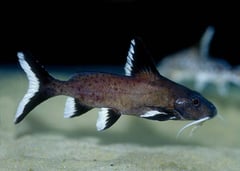
Synodontis granulosa
Mochokidae · authority not recorded
Synodontis granulosa is a large Synodontis catfish endemic to the northern end of Lake Tanganyika, in Burundi and Tanzania. Its deep-water habitat, limited range and solitary lifestyle make collection difficult, so it is rarely seen for sale. It is territorial with its own kind and can be very aggressive in smaller aquaria, though settled fish often become tame enough to feed from the hand. Captive-bred fish from Eastern Europe have been reported to be hybrids.
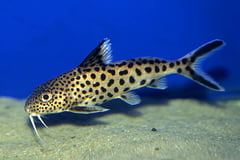
Synodontis multipunctataCuckoo Synodontis
Mochokidae · authority not recorded
The cuckoo Synodontis, Synodontis multipunctata, is a Synodontis catfish endemic to Lake Tanganyika, where it swims in large shoals. One of the only fish known to practise brood parasitism, it lays its eggs among those of a mouthbrooding cichlid, and the young catfish devour the host's eggs. It is bred quite often in aquaria, with cichlids from Lake Malawi or Victoria as hosts, and should be kept in a group of four or more.
Synodontis njassaeLake Malawi Synodontis
Mochokidae · authority not recorded
The Lake Malawi Synodontis, Synodontis njassae, is the only Synodontis catfish in Lake Malawi, to which it is endemic. Both large- and small-spotted morphs are available in the trade. A fairly vigorous species, it suits a community of hard water Lake Malawi cichlids but not shy species, and it will fight with other Synodontis but is not aggressive towards its own kind.
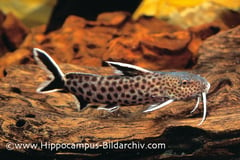
Synodontis petricolaDwarf Lake Synodontis
Mochokidae · Matthes, 1959
The dwarf lake Synodontis, Synodontis petricola, is a small, peaceful Synodontis catfish endemic to Lake Tanganyika. Unlike most of the genus it is bred quite often in aquaria, usually as an open-spawning egg scatterer, though it is also one of the few fish known to practise brood parasitism. It should be kept in a group of four or more, and a dwarf form adapts to a wider range of water chemistry.
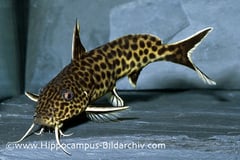
Synodontis polliPoll's Synodontis
Mochokidae · authority not recorded
Poll's Synodontis, Synodontis polli, is a Synodontis catfish endemic to Lake Tanganyika, where it lives in large schools at 30 to 125 metres. It inhabits muddy bottoms and is not comfortable in well-lit conditions without hiding places. Superficially similar to S. petricola, it has larger body spots and a longer head, and it is occasionally mis-identified in the trade as S. angelicus, S. petricola or Synodontis sp.

Tanganicodus irsacae
Cichlidae · Poll, 1950
Tanganicodus irsacae is a goby cichlid endemic to the northern part of Lake Tanganyika, living among pebbles and rocks in water under 1 metre deep. In this surge zone it scrapes algae from the rocks. Quite delicate in aquaria, it needs the highest water quality, a higher pH than many Tanganyikans and a relatively specialised diet, and it is aggressive towards its own kind. A bi-parental mouthbrooder, it is difficult to breed.

Telmatochromis vittatus
Cichlidae · authority not recorded
Telmatochromis vittatus is a lamprologine cichlid endemic to Lake Tanganyika, found in open water near rocky areas at 5 to 20 metres. Similar in lifestyle to Julidochromis species, it suits the smaller Tanganyikan community. It is told from T. brichardi and T. bifrenatus by its larger size, smaller eyes and more rounded nose, and should be kept as a pair because it is aggressive towards conspecifics.
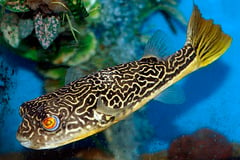
Tetraodon mbuGiant Puffer
Tetraodontidae · authority not recorded
The giant puffer, Tetraodon mbu, is a freshwater pufferfish from rivers and lakes in Central and East Africa, including Lake Tanganyika. Among the most aggressive puffers available, it can reach 75 cm and should be kept alone in a tank of around 240 by 90 by 90 cm. A molluscivore in nature, it needs snails and unshelled shellfish regularly to keep its continuously growing teeth worn down.

Trematocranus placodonSnail-Crusher Hap
Cichlidae · authority not recorded
The snail-crusher hap, Trematocranus placodon, is a large cichlid endemic to Lake Malawi, where it inhabits shallow water. A molluscivore, it feeds mainly on snails, crushing their shells with specially developed pharyngeal teeth. It suits the larger Malawian community but is not often seen for sale. Males are territorial and aggressive towards one another.

Tyrannochromis macrostomaBig-Mouth Hap
Cichlidae · authority not recorded
The big-mouth hap, Tyrannochromis macrostoma, is a large predatory cichlid endemic to Lake Malawi, living in shallow rocky areas. An ambush predator, it often attacks prey while swimming upside-down, and its reverse countershading (a belly darker than its back) is thought to make it harder to spot. Mbuna are its natural diet, and juveniles are easily confused with T. nigriventer.

Xenotilapia flavipinnisYellow Sand Cichlid
Cichlidae · authority not recorded
The yellow sand cichlid, Xenotilapia flavipinnis, is a bi-parental mouthbrooder endemic to Lake Tanganyika, where groups swim over sandy substrates. In nature the pair bond lasts only for the breeding season. In aquaria it can last much longer, with the pair remaining in their territory and defending it even when not spawning. A gentle substrate-sifter, it needs sand, a group of 6-10 and peaceful Tanganyikan tankmates, and it is very sensitive to deteriorating water conditions.
Xenotilapia melanogenysBlack-Chinned Xenotilapia
Cichlidae · authority not recorded
The black-chinned xenotilapia, Xenotilapia melanogenys, is a cichlid endemic to Lake Tanganyika, where it lives in huge shoals over sandy substrates. Much of the literature still places it in the genus Enatiopus. The shoals in nature appear to be fixed, with an individual remaining in the same group for life. A skittish fish, it may react very nervously to rapid movements outside the tank and should not be kept with boisterous fish such as mbuna.

Xenotilapia simaBig-Eyed Xenotilapia
Cichlidae · authority not recorded
The big-eyed xenotilapia, Xenotilapia sima, is a cichlid endemic to Lake Tanganyika, where it is found in large groups over sandy substrates. Rarely seen in the hobby, it feeds like the South American Geophagus species, sifting sand through its gills for invertebrates, so a sand substrate is essential. A peaceful and skittish maternal mouthbrooder, it should be kept in a group of 6-10 with peaceful Tanganyikan species and never with mbuna.

Boulengerochromis microlepisEmperor Cichlid
Cichlidae · (Boulenger, 1899)
The emperor cichlid, Boulengerochromis microlepis, is the only member of its genus and the largest African cichlid, endemic to Lake Tanganyika. A prized food fish around the lake, it grows to 450 to 550 mm and adults are almost entirely piscivorous. Young farm-raised specimens have been readily available in the trade since the mid-2000s, but it is suitable only for public installations or the very largest private aquaria.

Ctenopharyngodon idellaGrass Carp
Cyprinidae · (Valenciennes, 1844)
The grass carp, Ctenopharyngodon idella, is a large cyprinid native to the Amur River system in eastern Russia and northeastern China. Adults typically reach 800 to 1200 mm, making it a wholly unsuitable aquarium subject, though an albino form is traded. Widely introduced for aquaculture and weed control, it has caused serious damage to natural waters, and unwanted fish should never be released.

Julidochromis ornatusGolden Julie
Cichlidae · authority not recorded
The golden julie, Julidochromis ornatus, is a cave-spawning cichlid endemic to Lake Tanganyika, found mainly in the north of the lake. One of the most common Julie species in aquaria, it may also be sold as the yellow or ornate julie. Most specimens available are tank bred and lack the bright colouration of wild fish. Several geographical morphs and an albino aquarium sport exist, and none should be kept with other Julidochromis as they may hybridise.
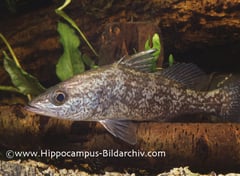
Lates angustifronsTanganyika Lates
Latidae · authority not recorded
The Tanganyika lates, Lates angustifrons, is a giant predatory fish endemic to Lake Tanganyika, growing to 200 cm. Juveniles have turned up in some aquatic stores, but the species is not suited to captive life in any respect, and housing an adult is beyond the reach of most public aquaria. Highly piscivorous, it feeds mainly on cichlids in nature, and adults live throughout the lake, usually around the lake bed.
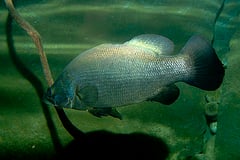
Lates niloticusNile Perch
Latidae · authority not recorded
The Nile perch, Lates niloticus, is a giant predatory fish from Central and Western Africa, reaching 193 cm and up to 200 kg. Introduced into many African countries as a food fish, it is thought to have contributed to the extinction of over 200 endemic species in Lake Victoria, and the IUCN lists it among the world's top 100 invasive species. Juveniles turn up in some aquatic stores, but it is not suited to captive life in any respect.

Neolamprologus boulengeri
Cichlidae · authority not recorded
Neolamprologus boulengeri is a small shell-dwelling cichlid endemic to Lake Tanganyika, found along the Tanzanian shoreline in the north of the lake. It lives among scattered rocks and open sand littered with empty snail shells. It is told apart from N. hecqui and Lamprologus kungweensis by the orange border on its dorsal and anal fins, and it will spawn in small caves if no shells are available.

Neolamprologus brevis
Cichlidae · authority not recorded
Neolamprologus brevis is a shell-dwelling cichlid found widely throughout Lake Tanganyika, and one of the commoner shell dwellers in the hobby. Where few snail shells collect, pairs share the same shell. Its territories are usually no more than 6" across but are defended vigorously. It is told apart from the similar Neolamprologus ocellatus by the vertical barring on its flanks.

Neolamprologus leleupiLemon Cichlid
Cichlidae · (Poll, 1956)
The lemon cichlid, Neolamprologus leleupi, is a cichlid endemic to Lake Tanganyika, found over rocky shorelines in the south of the lake. It is not as easy to maintain as its popularity suggests, being intolerant of conspecifics and sensitive to deteriorating water conditions. The darker N. l. melas lives alongside the yellow form in nature, an example of polychromatism.

Neolamprologus multifasciatus
Cichlidae · authority not recorded
Neolamprologus multifasciatus is a shell-brooding cichlid endemic to Lake Tanganyika, and probably the smallest known cichlid species. It lives in fairly deep water around the shoreline, over soft substrates where the empty shells of snails collect. Each fish defends a territory usually no more than 6" across, and a group kept with more shells than fish will form a colony.

Neolamprologus ocellatusOcellated Shell-dweller
Cichlidae · authority not recorded
The ocellated shell-dweller, Neolamprologus ocellatus, is a small shell-brooding cichlid endemic to Lake Tanganyika. It buries its shell until only the entrance shows and defends it vigorously, sometimes burying neighbouring shells as well to keep other fish out. Males grow much larger than females, and a gold morph has become popular in the hobby. The lack of vertical barring on the flanks separates it from the similar N. brevis.

Neolamprologus savoryiStriped Brichardi
Cichlidae · authority not recorded
The striped brichardi, Neolamprologus savoryi, is a rock-dwelling cichlid endemic to Lake Tanganyika. A member of the so-called 'Brichardi complex', it hybridises freely with the others and should not be mixed with them in aquaria. Its pattern of vertical bars distinguishes it within the complex. An aggressive, territorial species, it is best kept in a species tank.

Neolamprologus sexfasciatusSix-barred Lamprologus
Cichlidae · authority not recorded
The six-barred lamprologus, Neolamprologus sexfasciatus, is a predatory cichlid from the southern part of Lake Tanganyika. It occurs only between Cape Tembwe and Karema, in shallow rocky areas and intermediate zones. Several geographical morphs are available, including 'Sambia' and 'Kipili', varying in base colour from blue to yellow to white. Its aggressive and predatory nature rules it out of the general Tanganyikan community, and only a single pair should be kept.

Oreochromis alcalicusSoda Cichlid
Cichlidae · (Hilgendorf, 1905)
The soda cichlid, Alcolapia alcalica, is endemic to Lake Natron in Tanzania, a shallow soda lake full of hot, alkaline springs. The lake runs at pH 9.5-10.5 and 32-43.5 °C, and though captive fish can be acclimatised to more normal conditions, this must happen slowly, with the pH kept above 8.0 and the temperature at 28 °C or more. Exceptionally rare in the hobby, it excretes urea where most fish excrete ammonia, and periodically gulps air at the surface.

Tropheus brichardi
Cichlidae · authority not recorded
Tropheus brichardi is a cichlid endemic to the northern end of Lake Tanganyika, found in shallow water around rocky shorelines. Not a good species for the beginner, it is very susceptible to 'bloat', so water quality is of the utmost importance. It exists in numerous colour morphs that hybridise freely and should not be mixed, and some may eventually be described as distinct species.

Tropheus duboisiWhite-Spotted Cichlid
Cichlidae · authority not recorded
The white-spotted cichlid, Tropheus duboisi, is endemic to Lake Tanganyika, found in rocky areas in deeper water than its congeners. Young fish have white or light blue spots on a jet black body, which fade to blue-black with a yellow or white vertical bar as they mature. Like others in the genus it is very susceptible to 'bloat' and not a good species for the beginner.

Tropheus moorii
Cichlidae · Boulenger, 1898
Tropheus moorii is a cichlid endemic to Lake Tanganyika, found in shallow water around rocky shores and known in over 50 geographical morphs. Despite its popularity it is not a good species for the beginner. Water quality matters above all because it is very susceptible to 'bloat', vegetable matter should form the basis of its diet, and different morphs hybridise freely and should not be mixed.
Variabilichromis moorii
Cichlidae · authority not recorded
Variabilichromis moorii is a lamprologine cichlid endemic to the southern part of Lake Tanganyika, living in shallow water around rocky shorelines. All adults are dark, but depending on locality the fry may be dark, yellow or orange. The only known lamprologine that eats filamentous algae, it is often sold as Neolamprologus moorii and is relatively peaceful even when spawning.