Genus
Acestrorhynchus
- Species
- 6
- Photographed
- 6 of 6
- Difficulty rated
- 6 of 6
Where the name comes fromEdit
from the Greek akéstra (Gr. ἀκέστρα), meaning 'darning needle' and rhýnchos (Gr. ῥύγχος), meaning 'snout', in reference to the presence of sharp teeth on both jaws.
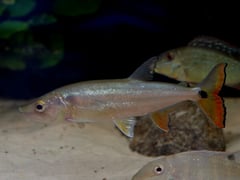
Acestrorhynchus altusRed Barracuda Tetra
Menezes, 1969
The red barracuda tetra, Acestrorhynchus altus, is a predatory acestrorhynchid that may be restricted to the lower Amazon in Brazil. A member of the A. lacustris group, it has a round humeral spot and is virtually impossible to tell from its relatives in the trade unless collection data is known. An obligate piscivore of open water, it is best kept in a group of four or more of comparable size, since acestrorhynchids are cannibalistic.
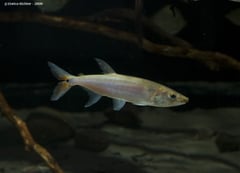
Acestrorhynchus falcatusRed-Tailed Freshwater Barracuda
Bloch, 1794
The red-tailed freshwater barracuda, Acestrorhynchus falcatus, is a predatory acestrorhynchid from the northern Amazon and Orinoco basins. It also occurs in coastal rivers of Guyana, Suriname and French Guiana. Its large humeral spot, shaped like an inverted tear drop, separates it from other Acestrorhynchus. Reaching 250 to 275 mm, it needs plenty of open water, and a group must be of comparable size because acestrorhynchids are cannibalistic.
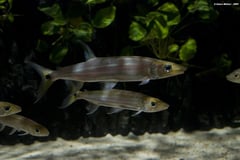
Acestrorhynchus falcirostrisBig-Eyed Cachorro
Cuvier, 1819
The big-eyed cachorro, Acestrorhynchus falcirostris, is a large predatory acestrorhynchid from northern Amazon drainages and the Orinoco. The two dark body stripes of the A. nasutus group appear only in its juveniles, and at 320 to 350 mm SL it grows far larger than the other members. A black fringe to the rear of the operculum gives it a 'collared' look. It needs open water, and a group must be of comparable size because acestrorhynchids are cannibalistic.
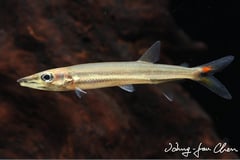
Acestrorhynchus isalineaeStriped Barracuda Tetra
Menezes & Géry, 1983
The striped barracuda tetra, Acestrorhynchus isalineae, is a small predatory acestrorhynchid from the rio Madeira basin in the Brazilian Amazon. Most records come from the type locality, a tributary of the rio dos Marmelos. Like others in the A. nasutus group it keeps two dark longitudinal stripes into adulthood and stays around 100 mm. Acestrorhynchids are cannibalistic given the opportunity, so a group must be of comparable size.
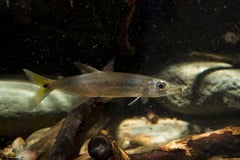
Acestrorhynchus microlepisPike Tetra
Jardine, 1841
The pike tetra, Acestrorhynchus microlepis, is a predatory acestrorhynchid from northern Amazon drainages and the Orinoco. It also occurs in coastal rivers of Guyana, Suriname and French Guiana. A member of the A. microlepis group, it has a small blackish spot behind the gill cover and is separable from the very similar A. grandoculis only by counts. It tends to take smaller prey such as tetras, and acestrorhynchids are cannibalistic, so a group must be of comparable size.
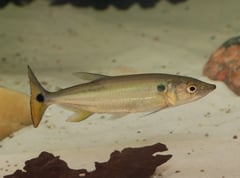
Acestrorhynchus pantaneiroPantanal Barracuda Tetra
Menezes, 1992
The Pantanal barracuda tetra, Acestrorhynchus pantaneiro, is a predatory acestrorhynchid from the Paraná, Uruguay and de la Plata basins. It also occurs in the rio Mamoré in Bolivia. A member of the A. lacustris group with a round humeral spot, it is virtually impossible to tell from its relatives in the trade unless collection data is known. It lives in open water, and a group must be of comparable size because acestrorhynchids are cannibalistic.