Acestrorhynchus pantaneiro
Pantanal Barracuda Tetra
Formerly Salmo denticulosus Larrañaga, 1923 · Salmo vigintisexradiatus Larrañaga, 1923
Last revised 2026Edit this page
On this page13 sections
Quick factsEdit
Difficulty7 of 8 measures
Rated difficult because it needs a tank at least 2 m long.
- Space
- very large tank
- Water
- flexible
- Temp
- flexible
- Diet
- unknown
- Temperament
- eats smaller fish
- Social
- needs to be in a group
- Compatibility
- choose tankmates carefully
Other demands
Each of these can raise the rating on its own, whatever the measures above say.
- Hardiness
- needs a well-established tank
- Needs a tank at least 2 m long
Before you buy
Needs a tight-fitting lid as this species is known to jump
A tightly-fitting cover should be used in all cases since acestrorhynchids tend to be powerful jumpers.
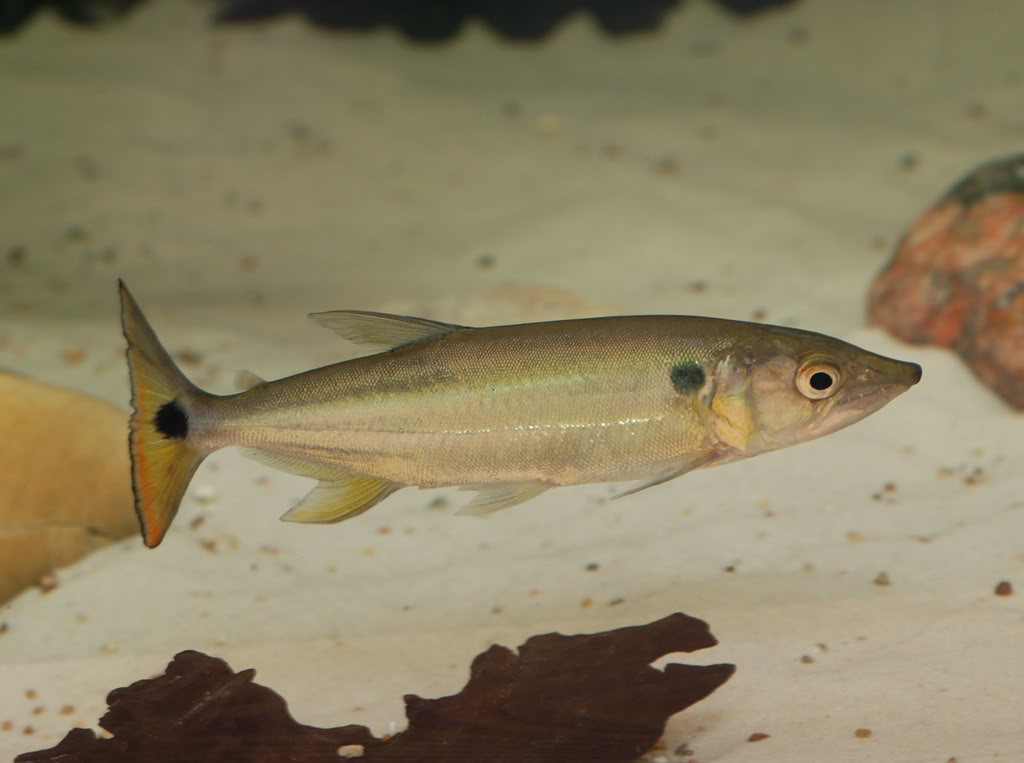
The Pantanal barracuda tetra, Acestrorhynchus pantaneiro, is a predatory acestrorhynchid from the Paraná, Uruguay and de la Plata basins. It also occurs in the rio Mamoré in Bolivia. A member of the A. lacustris group with a round humeral spot, it is virtually impossible to tell from its relatives in the trade unless collection data is known. It lives in open water, and a group must be of comparable size because acestrorhynchids are cannibalistic.
Etymology
EditDistribution
EditType locality is 'Rio Cuiabá, Volta Grande, município de Santo Antônio do Leverger, Mato Grosso' and this species also occurs in the lower Río Paraná, Río Uruguay, Río de la Plata and rio Mamoré Paraguay, Uruguay, Argentina and Bolivia, respectively.
Ongoing confusion regarding the precise identities of this and certain other, closely-related members of the genus mean the full extent of its natural range is unclear at present (see 'Notes').
Habitat
Write a noteEditInhabits major river channels and tributaries, and during the wet season often moves into flooded zones.
Aquarium size
Write a noteEditAcestrorhynchids are typically very active and extremely fast swimmers so minimum base dimensions in the region of 250 ∗ 90 cm98 ∗ 36 in are required for long-term care.
Even juveniles need a significant amount of room since they tend to act skittishly in confined spaces and can easily injure themselves by swimming into the glass.
Maintenance
Write a noteEditThis species is a near-exclusive inhabitant of open water and an excess of cover can actually stress it meaning, substrate aside, the majority of the tank should be décor-free with plenty of open space.
Should you wish to create a natural effect use a sandy substrate, perhaps with a few handfuls of leaf litter and some driftwood branches or roots.
Plants which can grow in sand can also be added as can those which prefer to be attached to solid surfaces such as Microsorum pteropus, Taxiphyllum barbieri or Anubias spp. while lighting can simply be tailored to the plants being used.
If using a deeper tank you could even fill it to 50-70% of capacity and add emergent branches or plants which can look very effective.
A tightly-fitting cover should be used in all cases since acestrorhynchids tend to be powerful jumpers.
Efficient filtration is a must when keeping predatory species due to the amount of waste produced so install one or more external canister filters and/or a sump system, organising the return in such a way that some surface movement is created.
Weekly water changes of 30-50% should be considered mandatory as this species can be sensitive to organic pollutants and swings in water chemistry, and for this reason it must never be introduced to biologically immature set-ups.
Water conditions
EditDiet
Write a noteEditAn obligate piscivore capable of consuming quite large prey in relation to its body size.
Newly-imported specimens may refuse to accept anything but live fishes although most can be weaned onto dead alternatives once they recognise them as edible, and some even learn to accept dried foods.
Like the vast majority of predatory fishes this species should not be fed mammalian or avian meat such as beef heart or chicken.
Some of the lipids contained in these cannot be properly metabolised by the fish and may cause excess fat deposits and even organ degeneration.
Similarly there is no benefit in the use of 'feeder' fish such as livebearers or small goldfish which carry with them the risk of parasite or disease introduction and at any rate tend not have a high nutritional value unless properly conditioned beforehand.
Behaviour and compatibility
Write a noteEditRelatively peaceful with anything too large to swallow and can be maintained in a community provided tankmates are chosen with care.
Aggressively territorial or very competitive species should be avoided with the best choices being placid fishes such as Geophagus spp., Acarichthys heckelii, medium-sized doradid or loricariid catfishes and characids from genera like Ctenolucius, Mylossoma or Myloplus.
This species is not aggressive towards conspecifics with juveniles in particular exhibiting a marked schooling instinct.
Older individuals tend to be more solitary but still group together from time-to-time, and it's best maintained in numbers of four or more.
One important point to note is that acestrorhynchids are cannibalistic given the opportunity so if buying a group or adding to an existing school try to ensure that all individuals are of comparable size.
Sexual dimorphism
Write a noteEditSexually mature females tend to grow a little larger and be deeper-bodied than males.
Reproduction
Write a noteEditObservations of the congener A. falcatus suggest that spawning occurs in midwater with the female remaining stationary while the male swims around her in a 'figure-of-eight' pattern.
The eggs are scattered in large numbers and parental care is non-existent.
Notes
EditThis species is a member of the putative 'A. lacustris group' of closely-related species within the genus alongside A. abbreviatus, A. lacustris and A. pantaneiro.
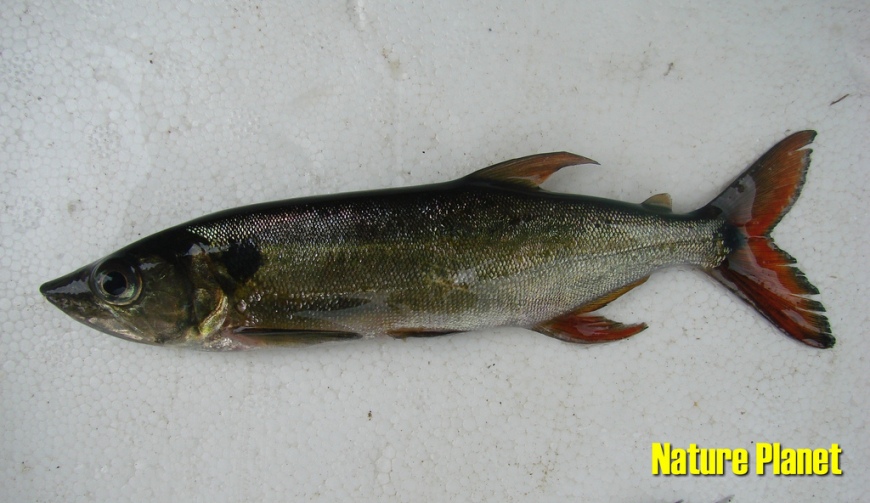
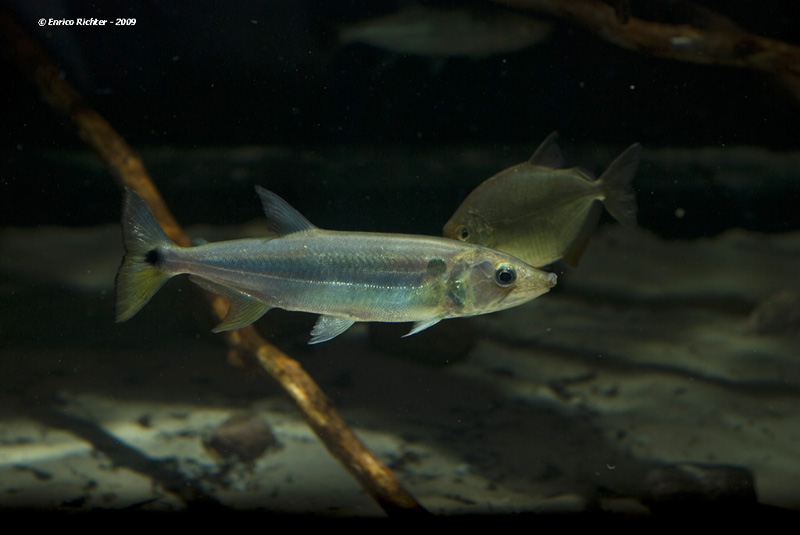
These are all characterised by possession of a blackish, more-or-less circular-shaped, humeral spot, i.e., the dark marking located just behind the gill cover, and therefore can be distinguished from A. falcatus which has a much larger marking shaped somewhat like an inverted teardrop.
Several members of the group are occasionally available in the trade but unless collection data is known are virtually impossible to tell apart.
The specimens in our images above were collected in Paraguay so based on current knowledge are tentatively identified as A. pantaneiro.
Recent morphological (Toledo-Piza, 2007)[6] and molecular (Pretti et al., 2009) phylogenetic studies have been similarly unable to recover the precise relationships existing both within the A. lacustris group plus A. falcatus, which together appear to form a clade with the latter basal and sister to the rest.
Acestrorhynchus spp. cannot always be separated on the basis of morphology and are also very similar genetically leading Pretti et al. (2009) to conclude that a detailed revision of the group containing material collected across their distribution range is necessary in order to better understand the systematics involved.
The remainder of the genus is currently composed as follows:
A. microlepis group: A. britskii, A. grandoculis, A. microlepis, A. minimus
A. nasutus group: A. falcirostris, A. nasutus, A. isalineae, possibly A. maculipinnis
Not assignable to any group: A. heterolepis
The family Acestrorhynchidae appears most closely-related to the Cynodontidae which contains the genera Cynodon, Hydrolycus and Rhaphiodon.
References
- Géry, J. (1977). Characoids of the World. T.F.H. Publications, Inc., 1-672
- López-Fernández, H. and K. O. Winemiller (2003). Morphological variation in Acestrorhynchus microlepis and A. falcatus (Characiformes: Acestrorhynchidae), reassessment of A. apurensis and distribution of Acestrorhynchus in Venezuela. Ichthyological Exploration of Freshwaters 14(3), 193-208
- Menezes, N. A. (1969). Systematics and evolution of the tribe Acestrorhynchini (Pisces, Characidae). Arquivos de Zoologia (São Paulo) 18(1-2), 1-150
- Reis, R. E., S. O. Kullander and C. J. Ferraris, Jr. (eds) (2003). Check list of the freshwater fishes of South and Central America. CLOFFSCA. EDIPUCRS, Porto Alegre, i-xi + 1-729
- Prettia, V. Q., D. Calcagnottoa, M. Toledo-Piza and L. F. de Almeida-Toledo (2009). Phylogeny of the Neotropical genus Acestrorhynchus (Ostariophysi: Characiformes) based on nuclear and mitochondrial gene sequences and morphology: A total evidence approach. Molecular Phylogenetics and Evolution 52(2), 312–320
- Toledo-Piza, M. (2007). Phylogenetic relationships among Acestrorhynchus species (Ostariophysi: Characiformes: Acestrorhynchidae). Zoological Journal of the Linnean Society 151(4), 691–757
Species images · 3
These photographs are used with each photographer's permission.
Send a photographDistribution
Profile completeness23 of 24
Community
Questions about Acestrorhynchus pantaneiro?
Ask on Discord