Genus
Brachygobius
- Species
- 8
- Photographed
- 8 of 8
- Difficulty rated
- 8 of 8

Brachygobius aggregatusSchooling Bumblebee Goby
Herre, 1940
The schooling bumblebee goby, Brachygobius aggregatus, is a small goby described from the Philippines and recorded from the lower Mekong in Vietnam. The name appears on ornamental trade lists quite often but seems to be routinely misapplied to other species, particularly B. doriae-type fishes. It is very similar to B. kabiliensis, and both are best considered nominal taxa for now since several species might be involved. Small live foods are probably essential.
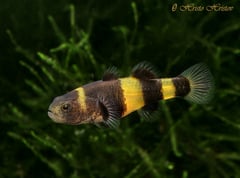
Brachygobius doriaeBumblebee Goby
Günther, 1868
The bumblebee goby, Brachygobius doriae, is a small goby from western Borneo and the Natuna Islands, described from Sarawak. Among the more frequently traded members of the genus, it is often misidentified as B. nunus or B. xanthozonus and is most easily confused with B. sabanus. It lives in fresh and brackish water in lowland coastal habitats such as mangrove swamps, estuaries and tidal streams. It is best kept in a species-specific set-up.
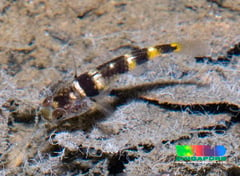
Brachygobius kabiliensisKabili bumblebee goby
Inger, 1958
The Kabili bumblebee goby, Brachygobius kabiliensis, is a tiny goby described from the Kabili River in Sabah, northeastern Borneo. Its reported range is disjunct, with records from Brunei, Singapore and the lower Mekong in Vietnam and Cambodia. The name is often misapplied to B. doriae-type fishes in the trade. It lives in fresh and brackish lowland coastal habitats and prefers harder water than some congeners. It grows to just 15 to 18 mm.

Brachygobius mekongensisMekong Bumblebee Goby
Larson & Vidthayanon, 2000
The Mekong bumblebee goby, Brachygobius mekongensis, is a tiny goby from the central and lower Mekong, including the Tonlé Sap system. It is apparently restricted to slow-moving or standing fresh water such as marshes, seasonal swamps and floodplains with dense aquatic vegetation. Narrow, often broken dark bars on a pale background separate it from the most similar species, B. nunus. It is poorly known in the hobby, and other species are sold under its name.

Brachygobius nunus
Hamilton, 1822
Brachygobius nunus is a bumblebee goby described from the Ganges delta near Kolkata, more likely restricted to India, Bangladesh and Sri Lanka. Reports of its wider range vary, and it may also occur in Myanmar. The name is widely misapplied to B. doriae and B. sabanus, which may give a false impression of its availability, though it looks completely different, with four black bands on the body and a black stripe through the eye. It lives in fresh and brackish lowland coastal habitats.
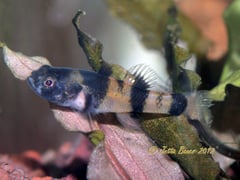
Brachygobius sabanusSabanus Bumblebee Goby
Inger, 1958
The Sabanus bumblebee goby, Brachygobius sabanus, is a small goby described from the Kinabatangan district of Sabah, northeastern Borneo. Among the more frequently traded members of the genus, it is easily confused with B. doriae, but the last one or two rays of its first dorsal-fin are colourless and less than half of the pectoral-fin is black. Its full range is unclear, and populations in Singapore are not thought to be natural. It lives in fresh and brackish lowland coastal habitats.
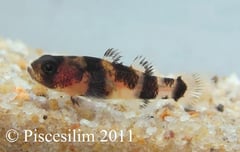
Brachygobius xanthomelas
Herre, 1937
Brachygobius xanthomelas is a small bumblebee goby recorded throughout much of Peninsular Malaysia and southern Thailand. It lives in lowland freshwater swamps, streams and forest peat swamps and, unlike most congeners, does not appear to occur in brackish water. The name is widely misapplied to an unidentified member of the genus, the fish in most online images, which has a dark marking at the front of the first dorsal-fin base where B. xanthomelas is colourless.
Brachygobius xanthozonus
Bleeker, 1849
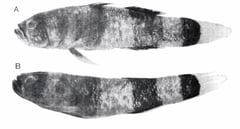
Brachygobius xanthozonus is a bumblebee goby described from Surabaya in eastern Java, Indonesia, and may be endemic to that island. Its name has been widely misapplied in aquarium literature for decades, and fish labelled as such are invariably B. doriae or B. sabanus. With about 50 lateral scales, where congeners have fewer than 30, it is comparatively elongate, and it has four dark bars on the body and an entirely black anal-fin.