Genus
Crossocheilus
- Species
- 8
- Photographed
- 8 of 8
- Difficulty rated
- 8 of 8
Where the name comes fromEdit
from the Ancient Greek κροσσός (krossós), meaning 'fringe, tassel', and χείλος (cheílos), meaning 'lip', in reference to the barbels on the upper lip in members of this genus.

Crossocheilus atrilimesSiamese Algae Eater
Kottelat, 2000
Crossocheilus atrilimes is one of several near-identical cyprinids traded as the Siamese algae eater, native to the Mekong and Chao Phraya drainages. Telling it apart from C. langei and the undescribed C. sp. 'citripinnis' takes a combination of characters, including a black stripe running to the tip of the caudal fin that broadens and pales when the fish spar. A shoaling fish of flowing streams, it needs spotless, well-oxygenated water and a group of six or more.

Crossocheilus burmanicus
Hora, 1936
Crossocheilus burmanicus is a cyprinid from Myanmar plus northeastern India and western Thailand, in rivers draining to the Irrawaddy and Salween. It lives in clear, flowing streams over boulders, pebbles, gravel and sand, browsing the biofilm on submerged surfaces. Its dark lateral stripe does not extend into the caudal fin, which separates it from the fish traded as 'Siamese algae eater' or 'SAE'.

Crossocheilus cobitis
Bleeker, 1854
Crossocheilus cobitis is a cyprinid ranging from the Mekong drainage in Laos, Vietnam and Thailand south to Sumatra, Borneo and Java. Primarily a lowland species, it lives in the turbid lower reaches of rivers over mud, close to submerged logs and similar objects. Given its wide range it has probably reached the trade as the invalid 'Crossocheilus siamensis', and it is likely to represent a group of similar-looking, closely related species.
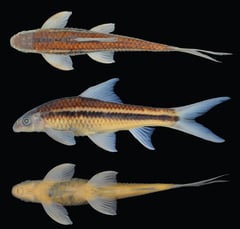
Crossocheilus elegans
Kottelat & Tan, 2011
Crossocheilus elegans is a cyprinid known only from the Segama and Kinabatangan river systems in Sabah, northern Borneo. It is mostly collected in or near the riffles of fast-flowing, rocky headwater hill streams. A pale yellowish brown stripe between the dark brown back and the blackish midlateral stripe separates it from other black-striped Crossocheilus, and before its description it was referred to as Epalzeorhynchos kalliurus and C. cobitis.
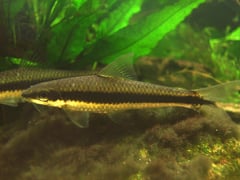
Crossocheilus langeiSiamese Algae Eater
Bleeker, 1860
Crossocheilus langei is a cyprinid from Borneo, Peninsular Malaysia and Thailand, one of several near-identical fish sold as the Siamese algae eater. The trade name 'Crossocheilus siamensis' used for these fish is not valid. C. langei can be told apart by a dark blotch in front of the anal fin and a lateral line running straight through the dark body stripe.

Crossocheilus latius
Hamilton, 1822
Crossocheilus latius is a cyprinid widespread in India, described from the Tista River on the border with Bangladesh. It lives everywhere from boulder-strewn Himalayan hill streams to silt-laden tributaries and pools. Not often available in the trade, it sometimes turns up in shipments of Indian Garra, and its relatively plain pattern makes it unlikely to be confused with congeners. Juveniles are gregarious and active, but adults tend to become sedentary and solitary.
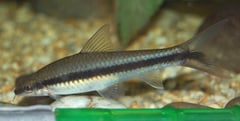
Crossocheilus nigriloba
Popta, 1904
Crossocheilus nigriloba is a cyprinid endemic to Borneo, known from the Kapuas, Belayan and Mahakam rivers in Indonesian Kalimantan. Rarely seen, it is among the near-identical congeners traded as 'Siamese algae-eater' or 'SAE' but is simple to identify: the lower caudal-fin lobe carries dark pigment suffused with red, which gave rise to the trade name 'penguin flying fox'. The lateral stripe breaks into blotches when the fish are sparring, stressed or sleeping.

Crossocheilus reticulatus
Fowler, 1934
Usually offered as the reticulated or fishnet flying fox, Crossocheilus reticulatus is a cyprinid from the Chao Phraya and Mekong basins. A silvery body, dark-edged scales and a dark caudal peduncle blotch set it apart from similar congeners. Patterning varies with collection locality, which led to several names now treated as synonyms. A fish of flowing streams, it is best kept in a group of six or more, since weaker individuals can be bullied in smaller numbers.